
A chef phones in sick two hours before Saturday service. The sous chef is already covering prep, the head chef is stuck on the pass, and the booking sheet is full. By lunchtime, the venue isn't deciding whether to improve its staffing model. It's deciding whether to cut the menu, close sections or risk sending inconsistent food to paying guests.
That's where an agency chef earns their place. They aren't just a spare pair of hands. A capable relief chef arrives in an unfamiliar kitchen, reads the pressure points quickly and helps the existing team protect service, standards and morale. For a pub in Devon, a restaurant in Bristol, a hotel in Berkshire or a seasonal venue in Dorset, that ability can matter more than a polished job description.
The Hidden Reality Behind Agency Chef Roles
A typical crisis starts without warning. A permanent chef is absent because of short-notice sickness, a resignation leaves a rota exposed, or a sudden booking surge stretches a small brigade beyond safe working capacity. The remaining team may know the menu perfectly, but they can't prep, cook, clean down and manage service indefinitely without increasing mistakes and exhaustion.
The UK hospitality sector has dealt with staffing pressure at a scale that makes this more than an occasional inconvenience. UKHospitality reported 132,000 vacancies, with vacancies 48% above pre-pandemic levels, while chef shortages ranged from 10% for head chefs to 21% for production chefs in the same evidence base. The government's hospitality strategy records the wider labour-market pressure affecting kitchens across the country.
Cover is now an operating decision
A temporary chef can keep a kitchen open while a permanent recruitment process continues. That distinction matters. A permanent hire may be the right answer for a stable long-term vacancy, but interviews, notice periods and onboarding won't solve tonight's missing shift.
An agency chef also gives managers room to make a better permanent decision. Instead of rushing an unsuitable appointment because the rota is failing, the venue can maintain service while assessing the actual role, the required skill level and the workload the next employee must handle.
Practical rule: Use relief cover to protect the operation first. Use permanent recruitment to build the team once the immediate pressure has been controlled.
The hidden cost of bad cover isn't limited to an agency invoice. It can include reduced menus, cancelled bookings, overtime, frustrated regular staff and guests who don't return. Managers assessing that risk can also review the hidden cost of bad chef cover before choosing the cheapest apparent option.
Core Responsibilities of an Agency Chef
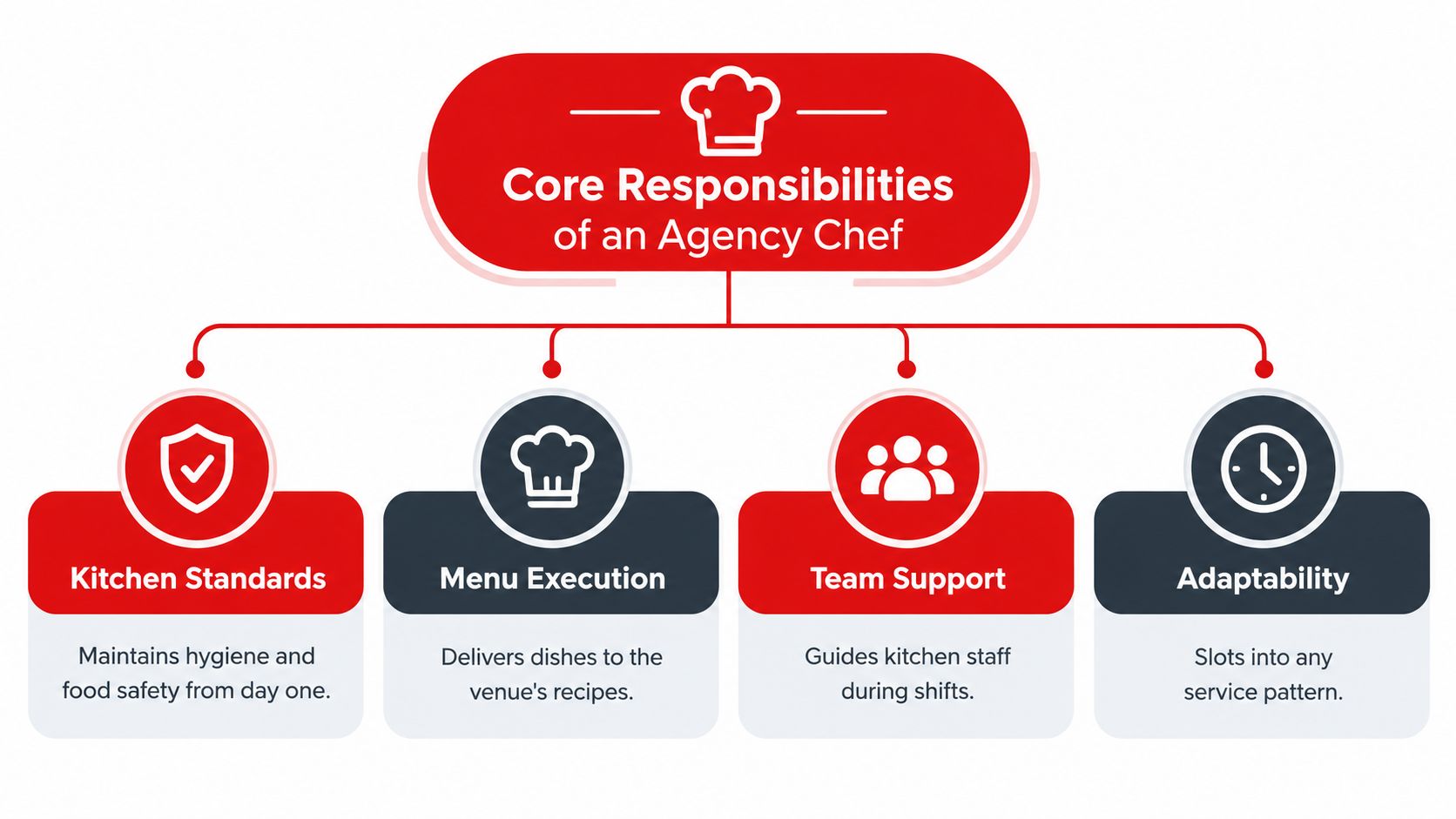
An agency chef's first responsibility is to make the kitchen safe and workable. On arrival, they need to understand the pass, refrigeration, equipment, allergen controls, cleaning routine and current prep position. They should ask focused questions rather than interrupting the whole team with a long personal introduction.
Standards before speed
A relief chef doesn't improve a difficult shift by rushing blindly. They check that food is stored correctly, stations are clean, knives and boards are being used properly, and the team understands the venue's food safety and allergen procedures. If a control is unclear, they raise it with the responsible manager rather than inventing their own process.
The chef then identifies what must happen before service. That might mean finishing sauces, portioning protein, labelling prep, organising the cold section or simplifying a garnish that can't be completed safely in time. Good relief work creates order before the first ticket arrives.
Execution under pressure
The chef must follow the venue's recipes and plating expectations, even if they would personally cook a dish differently. They learn the menu by prioritising the dishes most likely to drive service delays, then confirm portion sizes, cooking times and pass standards with the head chef or manager.
During service, the job is partly technical and partly observational. A strong agency chef notices a blocked section, missing prep or overloaded junior cook before it becomes a queue of late tickets. They communicate in short, useful instructions and keep the pass informed when a dish needs time.
Support that leaves the kitchen stronger
Relief chefs often guide junior staff without taking over every task. They may show a commis how to organise a station, help a chef de partie sequence prep or demonstrate a cleaner handover between shifts. The aim isn't to create dependence. It's to make the current team more capable for the rest of the service.
A concise handover protects that progress. It should record what was prepared, what ran short, what needs ordering and which operational issue still needs attention. A clear handover documentation process helps the next chef start with facts instead of guesswork.
How Agency Chefs Differ From Permanent Staff
Permanent staff and agency chefs solve different problems. Permanent employees build familiarity with suppliers, regular guests, equipment quirks, recipes and internal relationships. They understand why a particular prep list works and which service patterns create problems at the venue.
An agency chef brings a different advantage. They have to become useful quickly, often without the comfort of knowing where every pan is kept or how the team normally communicates. Their experience across kitchens can help them recognise a failing service pattern early, but they must respect the venue's existing standards rather than impose a new system.
| Aspect | Agency Chef | Permanent Staff |
|---|---|---|
| Primary value | Short-notice capacity, specialist cover and operational recovery | Continuity, institutional knowledge and long-term team development |
| Kitchen familiarity | Learns layout, menu and routines quickly | Builds detailed knowledge over time |
| Problem solving | Brings experience from different venues and adapts to immediate conditions | Understands recurring issues and the venue's established solutions |
| Team relationship | Joins with a clear shift objective and must earn trust quickly | Develops deeper working relationships and shared habits |
| Best use | Sickness, vacancies, peak demand, events and transition periods | Stable core staffing and sustained culture |
| Main limitation | Needs a precise briefing and cannot know every local detail immediately | May not provide enough capacity when several pressures arrive together |
The trade-off managers need to understand
A permanent chef may move faster on a familiar section because they know the stock levels and plating rhythm. An agency chef may spot a wasteful process because they aren't attached to the way the kitchen has always done it. Neither advantage replaces the other.
The mistake is treating temporary cover as a substitute for team planning. A relief chef should receive the menu, shift times, expected covers, dress requirements, contact details and any relevant compliance information before arrival. That preparation gives an unfamiliar chef a fair chance to perform well.
Managers should also distinguish poor agency practice from the temporary model itself. An unsuitable or badly briefed chef can disrupt a service, just as an unsuitable permanent hire can. Clear expectations, reliable communication and a sensible approach to working with temporary agencies reduce that risk.
Real-World Scenarios Where Agency Chefs Shine
A Friday lunchtime booking exposes a sickness problem at a small Bristol restaurant. The head chef can cover the pass, but only by abandoning prep for the evening. A relief chef who has worked busy à la carte services can take the vacant section, follow the restaurant's recipes and give the head chef enough space to manage the whole kitchen rather than firefight every plate.
The value isn't just the number of hands on the rota. It's the restoration of a workable division of labour. The permanent team keeps its rhythm, the manager can honour bookings and the chef who called in sick doesn't leave colleagues facing an impossible shift.

Seasonal pressure in tourist areas
A coastal pub in Devon or Dorset may have a kitchen that runs comfortably through quieter weeks but struggles when bookings, walk-ins and holiday demand arrive together. Hiring a permanent brigade large enough for the busiest period may leave the business carrying unnecessary cost later. Using short-term reinforcement gives the manager more control over that uneven demand.
The same principle applies to boutique hotels in Wales or independent venues around Windsor. A relief chef can join for a defined run of shifts, support breakfast or banqueting, and leave the core team with a clearer picture of the capacity they need in future seasons.
The sector's scale explains why these decisions affect more than individual businesses. In 2019, UK hospitality comprised approximately 143,000 businesses, employed around 1.8 million people and generated £40.4 billion for the UK economy, according to the UK hospitality sector evidence summarised by Flipdish.
Departures, events and specialist work
A sudden resignation creates a different problem from sickness. The venue may need cover for several weeks while it recruits, interviews and checks references. An agency chef can stabilise the rota while the manager avoids appointing the first available candidate to fill a gap.
Events and pop-ups also reward specialist matching. A venue may need a pastry chef, a senior sous chef for a wedding, a yacht chef familiar with private service or a villa chef comfortable working in a household environment. The right temporary appointment brings relevant experience without pretending that every kitchen requires the same profile.
Choosing the Right Agency Chef for Your Venue
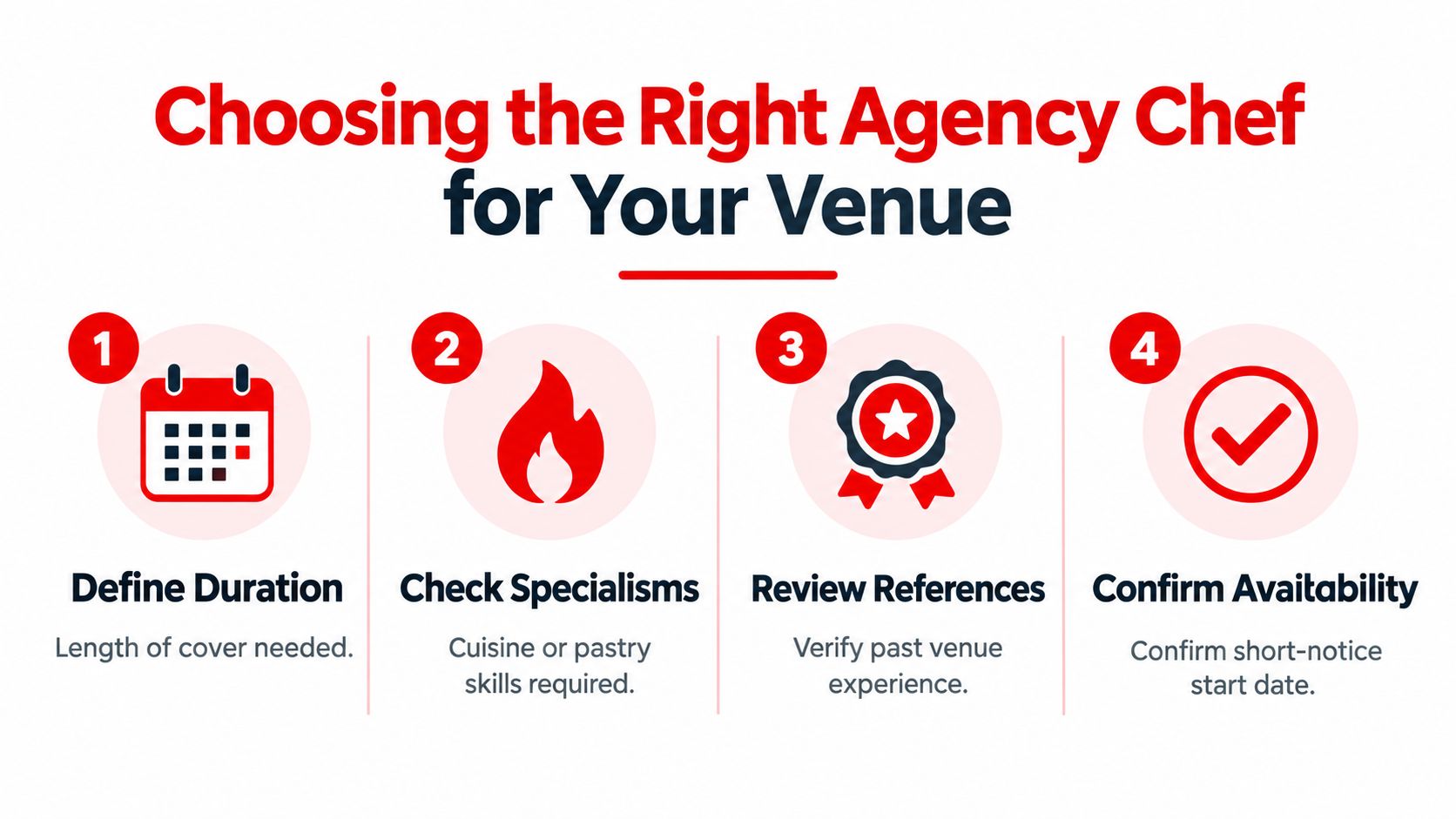
Start with the shift, not the job title. “We need a chef” doesn't tell an agency whether the venue requires a breakfast chef, a confident section chef, a sous chef to run service or a head chef who can manage ordering and staff.
Define the cover clearly
Write down the dates, shift times, expected service, menu style and reason for cover. State whether the chef will work alone, join an established brigade or take responsibility for the pass. A one-off emergency shift needs a different briefing from a recurring vacancy.
Then identify the consequence of getting the match wrong. If the main risk is slow service, prioritise section speed and volume experience. If the risk is poor supervision, request a chef who has led a brigade. If the venue handles allergens or specialist diets, make that requirement explicit before booking.
Check specialisms and working style
Cuisine matters, but it isn't the only matching factor. A chef may understand the food but struggle with the venue's pace, team structure or guest expectations. Ask whether the candidate has worked in a comparable operation, such as a high-volume pub, hotel banqueting kitchen, fine dining restaurant, yacht or private household.
Use the briefing to confirm practical details:
- Menu fit: Explain the dishes, service format and plating expectations.
- Leadership need: Say whether the chef will support a section or direct the shift.
- Team conditions: Describe the brigade's size, experience and current pressure.
- Compliance: Confirm right-to-work checks, insurance and any venue-specific requirements.
- Continuity: Agree how the next chef will receive notes if cover continues.
A reliable agency should also explain how it vets candidates, handles sickness, communicates changes and manages an unsuitable match. Ask for direct contact during service rather than relying on a generic inbox.
Relief Chefs UK is one option for venues seeking nationwide relief chefs, temporary chefs, permanent chef recruitment, yacht chefs, villa chefs and broader hospitality staffing support. Its operating model is built around chef matching rather than treating every vacancy as the same administrative booking.
Why Specialist Agencies Outperform General Recruitment
A general recruiter fills a rota line. A specialist chef agency fills a section with someone who understands how that section affects the whole service. That distinction matters when a kitchen is short-staffed, because a chef who can cook well may still struggle with another team's prep system, equipment, recipes or pace.
The government's Hospitality and Tourism Workforce Landscape report found that 39% of chef vacancies were hard to fill because skills were hard to find, compared with 17% across the sector. The figures point to a practical problem: a large pool of available workers does not guarantee the section competence a venue needs.
Specialist agencies match capability to service pressure
General recruitment often starts with availability, then works towards a role. A chef specialist starts with the work the person must deliver. That means distinguishing between a chef needed to run a busy pass, one needed to take responsibility for a section, and one needed to support prep during a quieter shift.
The trade-off is clear. A lower-cost booking can become expensive if the head chef has to stop managing the kitchen, correct basic errors or take over the section. Equally, booking a senior chef for straightforward support may waste budget and unsettle the team by placing the wrong level of authority in the shift.
Specialist agencies also understand that unfamiliar kitchens create pressure beyond the job title. A relief chef must read the brigade quickly, identify the venue's service rhythm and work within existing standards without trying to redesign the operation. The strongest temporary chefs make sensible adjustments while protecting consistency for guests.
The useful question is not “Can this person cook?” It is “Can this person make this kitchen more stable on the shift we need covered?”
Reliability supports the wider staffing plan
A specialist partner should provide clear booking terms, accurate availability and a defined response when a chef becomes unavailable. Those processes protect the service without turning every absence into a fresh search.
They also give managers better information about longer-term staffing needs. Repeated cover on the same section may show that the venue needs a permanent appointment, a different rota structure or stronger development within the existing brigade.
For independent pubs, restaurants, hotels and hospitality groups across England and Wales, specialist recruitment connects a chef's working level with the service the venue must deliver. General recruitment can provide names. Specialist agencies are more useful when the true requirement is dependable section performance under unfamiliar conditions.
Frequently Asked Questions About Agency Chefs
How quickly can I book emergency cover?
Response times depend on the location, chef level and shift requirements. Give the agency the exact date, start time, menu, venue type and required responsibility. Clear information helps it assess a suitable match instead of sending an unsuitable chef just because they're available.
What should I provide before the chef arrives?
Send the menu, service expectations, dress code, address, parking information, shift times, contact person and any relevant food safety or allergen procedures. Tell the chef which section needs attention and what the team has already prepared.
Can temporary cover become permanent recruitment?
Yes. A relief booking can protect service while you assess the long-term vacancy. If the fit works, discuss a permanent chef recruitment route separately and agree the terms before making any appointment.
How do I maintain continuity with several chefs?
Use one written handover covering prep, stock shortages, outstanding orders, service issues and follow-up actions. Keep one manager responsible for briefing each incoming chef, even when the kitchen is operating across several temporary shifts.
What roles can agencies cover?
Depending on the provider, cover may include chef de partie, sous chef, head chef, pastry chef, yacht chef, villa chef and other hospitality staffing requirements. Match the role to the actual responsibility, not just the title on the rota.
Relief Chefs UK is a nationwide chef recruitment agency established in 2013, providing relief chefs, temporary and permanent chef recruitment, yacht chefs, villa chefs and hospitality staffing support for venues that need dependable cover. If short-notice sickness, seasonal demand or an open vacancy is putting your kitchen under pressure, visit Relief Chefs UK to discuss the right chef for your next service.