
HR Temp Staffing for Hospitality: A Practical UK Guide
11 August 2026
Saturday service is half set, the booking board is full, and then the call comes in. Your sous chef is off sick, two starters are already on the till, and the phones haven't stopped. In that moment, hr temp staffing stops being an HR topic and becomes kitchen survival.
The businesses that cope best don't scramble for the cheapest name on a list. They keep a trusted temp pipeline ready for short-notice sickness, seasonal spikes, rota gaps, and last-minute demand. In hospitality, that difference protects service, protects morale, and protects the bottom line.
When Your Kitchen Needs Cover Yesterday
A good kitchen rarely falls apart because of one problem. It falls apart because one problem lands on top of a fragile rota, an underfilled section, and a team that's already stretched. That's why panic booking usually makes things worse, not better.
The practical issue is simple. If a head chef rings in sick before a fully booked Saturday, the venue doesn't need a theory on workforce planning. It needs a vetted relief chef, a clear brief, and someone who can walk in, read the pass, and keep the service moving.
Practical rule: if you wait until the rota is already breaking, you've left no time to check compliance, skill fit, or availability.
That's where a professional temp partner changes the outcome. Relief Chefs UK, a nationwide chef recruitment agency established in 2013, works as the kind of support many operators wish they'd lined up earlier. The point isn't just speed, it's having a process that gets you from call to cover without dragging the whole team through a crisis.
For hotels, pubs, restaurants, and multi-site operators, the better model is predictable. You know who to call, what checks have already been done, and what standard of chef is arriving. That's how temporary cover becomes a control system rather than an emergency patch.
A lot of operators still treat temp staffing as a last resort. In practice, it's often the only thing standing between a manageable gap and a damaged weekend service. The kitchens that stay stable are usually the ones that plan for absence before absence turns up.
Why UK Hospitality Relies on Temporary Staffing
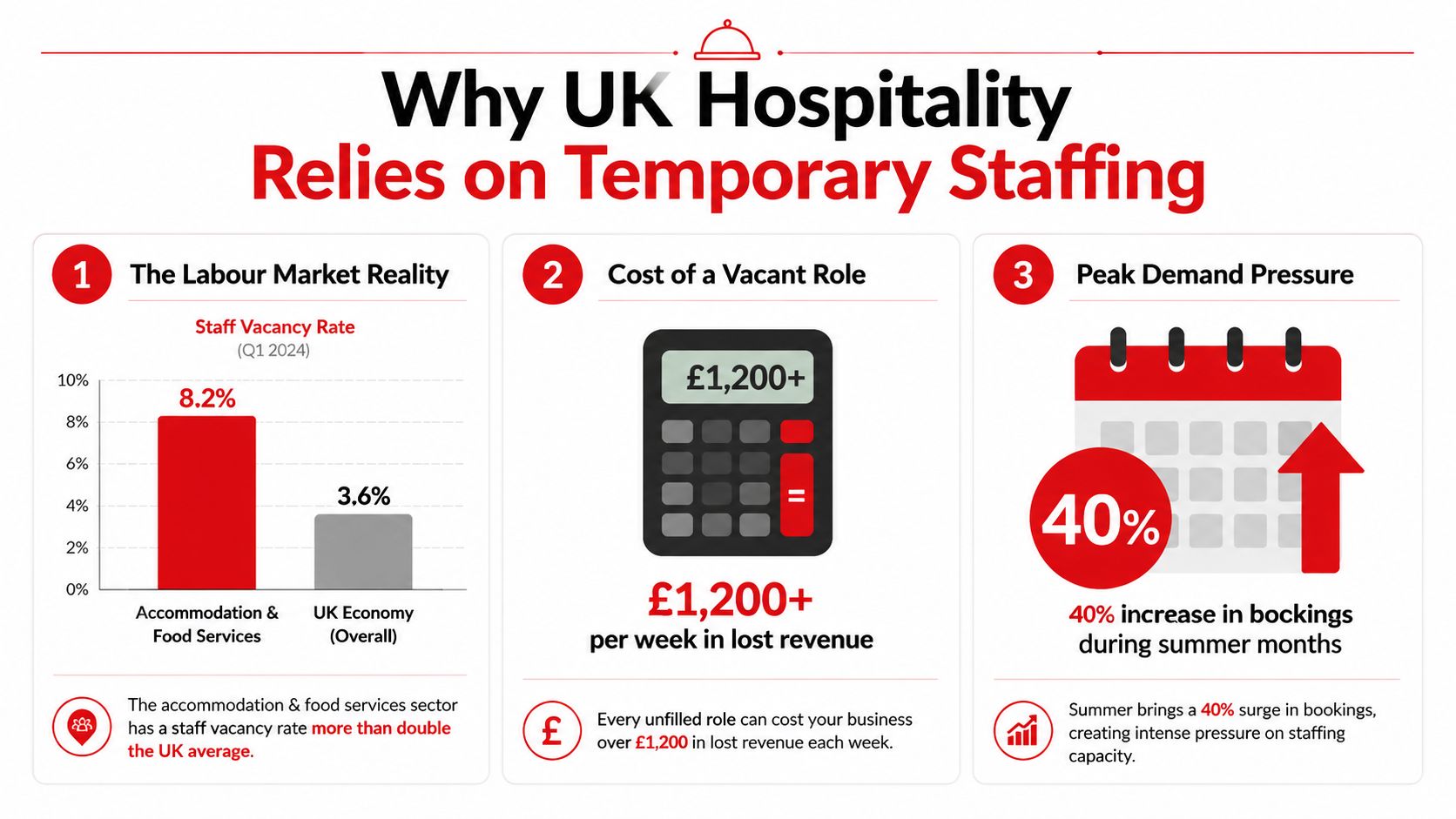
The UK doesn't use temporary labour as a side note. The Office for National Statistics reported 1.12 million people in temporary employment in January to March 2024, equal to 3.6% of everyone in work, and it breaks temporary work into fixed-term, agency temping, casual, seasonal, and other temporary arrangements. That tells you something important, temporary labour is built into the way UK employers absorb vacancies, demand swings, and project work. The labour market already treats temporary work as normal operating practice, not an exception, as shown in the ONS-based market context reported by the American Staffing Association.
Vacancy pressure changes the calculation
Hospitality feels those pressures more sharply than most sectors. The sector has long been exposed to seasonality, holiday peaks, event trade, and unpredictable absenteeism, and UK labour market commentary has repeatedly placed accommodation and food service activities among the industries with higher vacancy pressure after the pandemic. Industry reporting on the UK labour market also noted that the overall vacancy level reached 1.3 million in April to June 2022 before easing, which helps explain why many kitchens still rely on fast-response cover when recruitment drags on. That backdrop is reflected in the wider staffing industry analysis from Staffing Industry.
Seasonality isn't a buzzword, it's the rota problem
In hospitality hotspots, the pressure stacks up quickly. Devon, Dorset, Bristol, Berkshire, Windsor, Reading, Slough, and Wales all feel the same pattern in different ways, weekend surges, event-led bookings, tourism spikes, and the kind of short-notice changes that leave kitchens exposed. VisitBritain reported 38.0 million inbound visits to the UK in 2023, and that demand ripples through hotels, pubs, restaurants, and contract caterers in peak regions and peak months, as reflected in World Metrics' hospitality staffing context.
For operators, this means temp staffing is not a sign that the business is failing. It's a standard mechanism for keeping service stable when the labour market isn't giving you enough permanent hands at the right moment. If one chef goes down or a recruiter hasn't filled the role in time, temporary cover keeps the kitchen open while the permanent plan catches up.
Legal and Compliance Checks You Cannot Skip
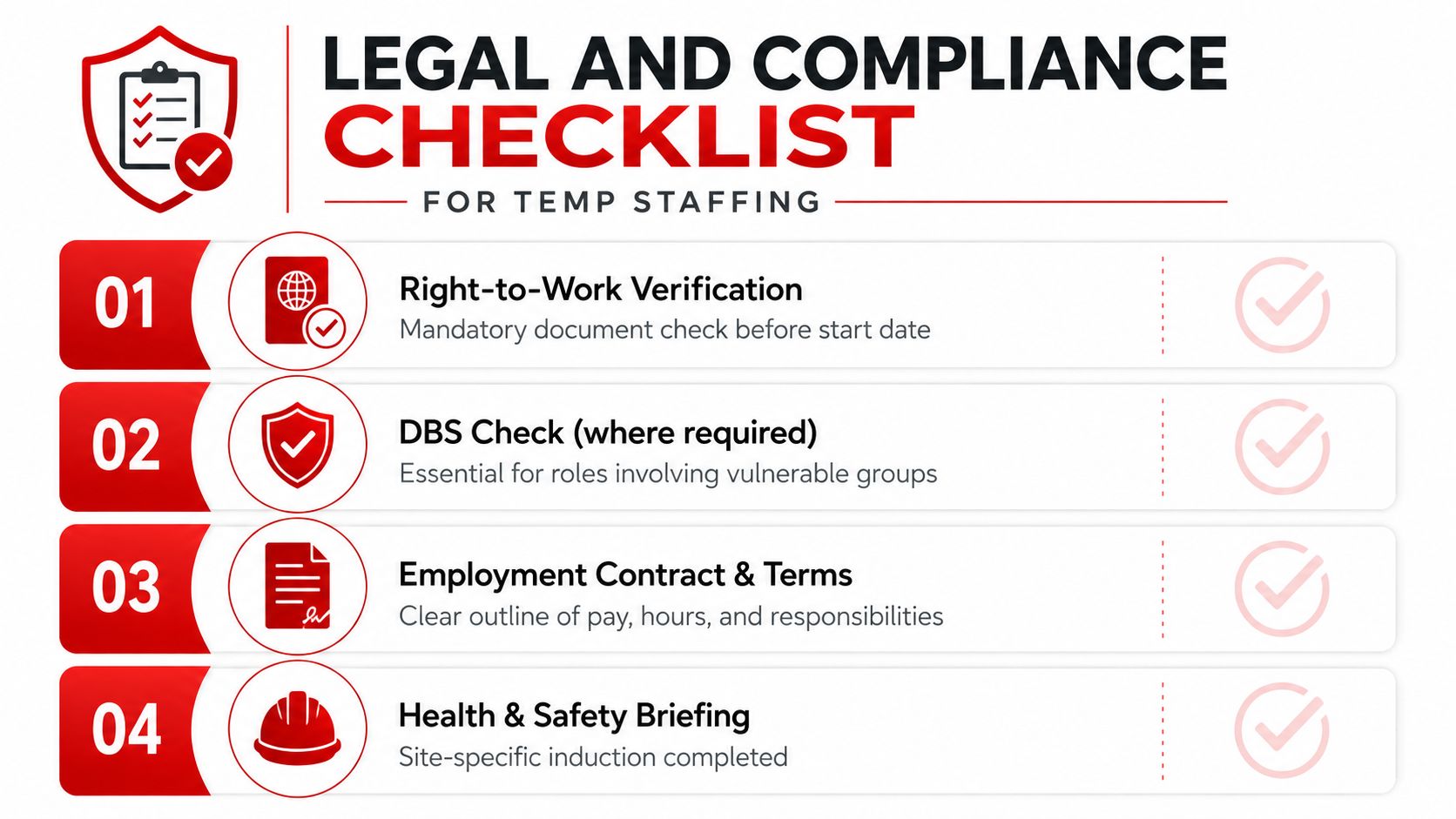
A temp chef can be brilliant and still create risk if the paperwork is thin. Right-to-work checks, contract clarity, site induction, and role-specific vetting are not admin extras, they're the line between a controlled deployment and an avoidable problem. One sloppy booking can create issues for the business, the agency, and the worker.
What has to be checked before anyone starts
Use a hard pre-start checklist, not a verbal promise.
- Right-to-work verification: See the original documents or a compliant digital check before the start date.
- DBS check where relevant: Required for roles involving vulnerable groups or specific client settings.
- Employment contract and terms: Pay, hours, responsibilities, and cancellation terms need to be clear.
- Health and safety briefing: Site-specific induction matters, especially in unfamiliar kitchens, hotels, and event spaces.
If any of those are missing, stop the placement until they're resolved. A reputable agency should be able to show you what was checked, when it was checked, and who confirmed it.
Spot the warning signs early
The bad signs are usually obvious once you look. A supplier who can't explain their vetting process, won't document checks, or pressures you to start someone before you've seen the paperwork is cutting corners somewhere else too. If a chef arrives with no understanding of your service style, allergens, or brigade structure, the problem started before they walked through the door.
For a deeper look at the employer side of this, see employment law for temporary staff. Keep that kind of guidance next to your own site checklist, not buried in a folder nobody opens during service.
Right-to-work and contract checks are boring until the day you need them. Then they're the difference between a smooth shift and a very expensive conversation.
Understanding Temp Staffing Costs and Pricing Models
Temp staffing looks expensive when you compare only the hourly rate. That comparison is too shallow for hospitality, because the alternatives are overtime, closed covers, service failure, and the cost of running a kitchen short. A useful budget view compares the price of cover against the operational damage of not having it.
The pricing model matters too. Some venues prefer hourly rates because they only need sporadic cover. Others want daily rates for predictability during holiday blocks or events. Retainers make sense when a group needs regular access to relief chefs without starting from zero every week.
The commercial pressure gets sharper when wage floors move. For UK hospitality, National Minimum Wage and National Living Wage changes can squeeze agency spread and gross margin if bill rates don't move with them. That's why the right pricing conversation is not “can you do it cheaper?” but “can you do it transparently, consistently, and at a rate that still allows quality cover?” The operational logic behind spread, billable hours, and acceptance rate is set out in the KPI framing at strategyforindustry.com.
Temp Staffing Cost Comparison
| Approach | Cost Structure | Best For | Risk Level |
|---|---|---|---|
| Hourly temp cover | Pay only for hours used | Ad hoc sickness, one-off gaps | Medium |
| Daily temp cover | Fixed daily charge | Busy services, known rota gaps | Medium |
| Monthly retainer | Predictable ongoing support cost | Multi-site groups, seasonal planning | Lower if volume is steady |
| Overtime for existing staff | Higher internal labour cost and fatigue risk | Very short emergencies | Higher |
| Leaving the shift uncovered | Lost covers and service disruption | Almost never the right choice | Highest |
What to ask before you accept a quote
A clean quote should tell you what's included and what isn't. That means clarity on start-up time, cancellation terms, replacement arrangements, and whether any hidden admin charges sit outside the headline rate. Relief Chefs UK publishes its transparent pricing model, which is the kind of clarity operators should demand from any supplier.
The other numbers that matter live inside the agency's performance. Fill rate, time to fill, and redeployment rate are the measures that show whether a supplier can keep pace when demand spikes. If they can't speak to those metrics, they probably can't manage pressure well either.
How to Vet and Select a Reliable Temp Agency
The right agency saves time because it already knows what good looks like in a kitchen. The wrong one gives you an inbox full of names and still leaves you to discover the fit problem during service. The difference usually shows up in how they recruit, how they vet, and how fast they react when the first placement doesn't work.
Start with specialisation
Ask who understands hospitality operations. An agency built around generic office recruitment won't always appreciate brigade structure, menu tempo, or the realities of a split service. A recruiter who's spent time in kitchens is more likely to ask the questions that matter, from section strength to allergy handling.
Test the vetting process
Ask how the agency checks cooking skills, references, right-to-work status, and reliability. If they can't describe the steps clearly, they probably don't have a solid process. A serious partner should be able to explain how it separates a competent commis from someone who only looks good on paper.
Insist on replacement clarity
You need to know what happens if a chef doesn't fit the site. Will they replace quickly, how is feedback handled, and who owns the follow-up call? The answer tells you whether the agency is managing risk or just pushing names out the door.
Practical rule: the first booking is a test of process, not just of the chef.
Compare agencies with a simple scorecard
- Specialisation and track record: Hospitality focus, not generalist volume.
- Compliance discipline: Right-to-work, contracts, and site induction.
- Communication speed: Fast replies matter when service is already under pressure.
- Value clarity: No vague fee structure, no surprise add-ons.
- Regional fit: Local knowledge in places like Bristol, Berkshire, Dorset, and Wales matters when lead times are short.
If you want to compare how supplier relationships should work in practice, the guidance on working with temp agencies is worth reading alongside your own vetting sheet. The main point is simple, don't buy promises, buy process.
Converting Temp Cover into Long-Term Recruitment
The best temp bookings do more than keep service alive. They show you who turns up prepared, who fits the brigade, and who can handle pressure without dragging the rest of the team down. Used properly, temp staffing becomes a low-risk way to identify permanent hires before you make a long-term commitment.
That approach works because kitchen performance is visible very quickly. Reliability shows up in punctuality, prep standards, attitude during a rush, and whether the chef can take direction without friction. If you define those standards up front, the temp role becomes a structured trial rather than an informal audition.
Build the conversion pathway before the first shift
Don't wait until someone has already become popular with the team. Set the criteria early, tell the agency what a successful assignment looks like, and ask for feedback from the head chef, sous chef, and whoever is working the section. That keeps the decision grounded in service realities instead of post-shift sentiment.
The most effective operators also keep the transition clean. If a temp is being considered for a permanent role, say so carefully and without overpromising. The message should be simple, good work may lead to a longer conversation, but nothing is guaranteed until the review is complete.
Use temps to reduce bad hires
A lot of costly recruitment mistakes come from making permanent offers before anyone has worked under pressure together. Temporary placements let you test consistency, culture fit, and technical competence in the actual environment, which is where the truth usually appears. That's one reason temporary staffing can work as a pipeline tool rather than a pure emergency fix, as highlighted in Allen Associates' guidance on getting more from temporary staff.
Relief Chefs UK also supports permanent chef recruitment, so a temp-to-perm path can sit inside the same staffing strategy instead of living as a separate process. Used well, that keeps the kitchen stable while you build the next layer of talent underneath it.
Balancing Temp Cover with Team Wellbeing and Retention
A kitchen can survive a lot. It can't survive permanent overload forever. If the core team is always covering gaps, training new faces, and absorbing late rota changes, temp staffing starts hiding a deeper retention problem rather than solving it.
The pressure is usually easiest to spot in behaviour. The best people go quiet, calls in sick rise, standards slip, and the rota starts relying on the same exhausted names every week. At that point, adding more temporary labour without changing the workload design just delays the next problem.
Keep temp cover as a stabiliser, not a crutch
Temporary staff should absorb peaks, planned absence, and unexpected gaps. They shouldn't be used to normalise a permanently broken rota. If overtime has become the default answer, the business should ask whether it's solving demand or merely postponing the staffing change the team already knows is coming.
Cross-training helps, but only if it's focused. Train people to cover the essential tasks that keep service moving, not every role in the kitchen at once. That protects flexibility without turning your permanent team into a permanent catch-all.
Watch for the signs of strain
- Constant handover fatigue: Your strongest staff spend too much time briefing newcomers.
- Burnout signals: Overtime becomes expected rather than exceptional.
- Quality drift: Standards hold on good days but wobble under pressure.
- Retention risk: Good people leave because the pattern feels unsustainable.
UK-facing guidance on short-staffed teams also warns that overtime needs to be balanced carefully against burnout, and that cross-training plus prioritising essentials works better than pretending temp cover fixes everything. That's the practical lesson in the operational advice from Indeed Flex.
The right question isn't how many temps you can book. It's whether your temp strategy supports a team that can keep doing the job six months from now. That's where workforce planning, service quality, and retention all meet.
If your kitchen is dealing with short-notice sickness, seasonal pressure, or an unreliable agency chain, speak to Relief Chefs UK about relief chefs, temporary chefs, yacht chefs, villa chefs, and permanent chef recruitment. Visit Relief Chefs UK to request cover, build a steadier staffing pipeline, and keep your kitchen stable when it matters most.
Call the team.
Office 01392 715474 · info@reliefchefs.co.uk