
Temporary Chefs Wales: Expert Relief Staff 2026
26 April 2026
Friday dinner service is fully booked. The pass is set. Prep is half-done. Then the call comes in. Your head chef is off sick, your sous is already stretched, and you need someone who can walk into the kitchen and cook to standard tonight, not next week.
That’s reality behind most searches for Temporary chefs Wales. It usually starts with pressure, not planning. A pub in Pembrokeshire needs cover before a bank holiday push. A boutique hotel in Snowdonia loses a chef mid-rota. A Cardiff restaurant has to protect service with almost no notice.
The mistake is treating temporary chef cover like an emergency-only fix. In practice, the strongest operators use it as part of their staffing model. They know chef shortages, sickness, seasonal spikes, transport problems and rural hiring delays are all part of trading in Wales. The question isn’t whether disruption will happen. It’s whether your process is strong enough when it does.
Why You Need a Modern Strategy for Temporary Chefs in Wales
A rural hotel in Pembrokeshire can go from a manageable week to a full bank holiday trading pattern in hours. A restaurant in Eryri can have the bookings, the food orders and the front of house team ready, then lose service control because one chef drops out and the replacement cannot get to site, cannot run the section, or has not been checked properly.
That is why temporary chef cover in Wales needs a proper system. The old method of ringing round, posting a last-minute ad, or relying on whoever is free that day creates avoidable risk. In city sites, that usually means wasted management time. In rural Wales, it can mean reduced menus, slower service, staff burnout, guest complaints, or cancelled covers because the kitchen cannot hold standard.

The pressure is not theoretical. Operators across Wales are still dealing with a tight labour market, higher absence risk, and harder recruitment outside major urban areas. The article from The Caterer on hospitality job losses in Wales underlines the scale of staffing pressure, but the bigger operational point is simpler. Good chefs are harder to secure at short notice, and the sites furthest from large labour pools usually feel it first.
Why informal hiring breaks down
The failure points are usually predictable.
- Availability gets mistaken for suitability: A chef may be free, but that does not mean they can handle your menu, pace, equipment or service style.
- Travel gets ignored until too late: Cover for Cardiff is one thing. Cover for a coastal hotel, country house or seasonal venue with weak public transport is another.
- Compliance slips under pressure: Right-to-work, food hygiene records, references and agency checks can be rushed or missed.
- Briefing is too thin: If a chef arrives with no prep list, no spec, no section handover and no realistic picture of covers, service will suffer even if they are competent.
I have seen operators lose more money from one poor relief shift than from leaving a vacancy unfilled for a day. A weak temp can waste stock, unsettle the brigade, slow the pass and force the senior team back onto damage control.
What a proper strategy looks like
A modern staffing approach treats temporary chefs as part of operational planning, especially in Wales where geography changes the hiring equation. The issue is not just finding a chef. It is finding a chef who is checked, reachable, willing to travel, and capable of stepping into that specific kitchen with minimal disruption.
Reliable operators usually work to three rules:
- Map the pressure points early. School holidays, event weekends, summer coastal trade, weddings, rugby fixtures and known sick-leave pinch points should already be on your staffing risk list.
- Use specialist chef supply. Generic temp labour rarely solves kitchen problems at the level required.
- Judge cover by outcome, not by fill rate. A booked shift only has value if the chef turns up, fits the brigade and protects service.
For businesses dealing with both city demand and remote-site logistics, using a specialist temporary chef agency in Wales is a practical control measure. It helps keep standards consistent whether you need breakfast cover in Cardiff, banqueting support in Swansea, or a relief chef who can get to a rural kitchen in West Wales and deliver a clean service.
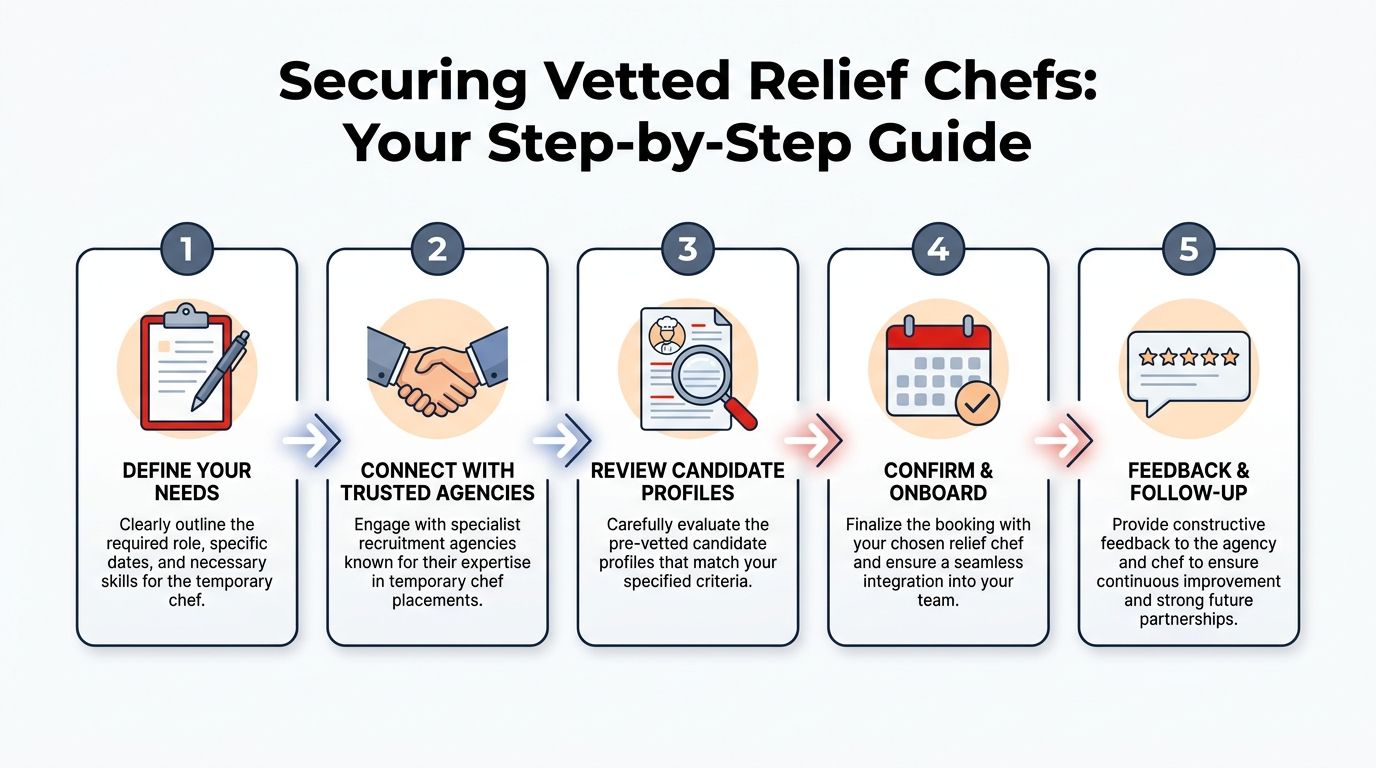
The Step-by-Step Process for Securing Vetted Relief Chefs
Friday lunch is 90 minutes away. Your sous chef is off sick, the prep list is half done, and the booking sheet is full. In Cardiff, that is a pressure test. In Pembrokeshire or mid Wales, it can become a transport and compliance problem as well, because the right chef still has to reach site, arrive on time, and step into service without dragging the rest of the kitchen off pace.
Good temporary cover comes from process, not luck. A staffing agency guide to temporary chef recruitment reports 98% placement fulfilment within 48 hours, and notes that unverified Food Hygiene certificates were involved in 25% of failed placements reviewed during 2023 to 2024, according to this temporary chef recruitment process breakdown. The same source notes that poor matching can drive first-shift drop-off, which is exactly why Welsh operators need to judge fit before they confirm anyone.
1. Build the brief properly
The brief decides the quality of the shortlist. If the request is vague, the result is vague.
State the level of chef, section, dates, shift pattern, covers, menu style, and what the person must handle alone. In Wales, add the practical details early. A chef who can run a strong service in Swansea may still be the wrong booking for a remote site near St Davids if there is no live-in room, weak public transport, and a 7am breakfast start.
Include the points that affect whether the shift works in real life:
- Role level: CDP, Sous Chef, Head Chef cover, breakfast chef, pastry, banqueting support
- Kitchen type: gastro pub, branded site, hotel, events venue, private estate, care setting
- Service pressure: expected covers, menu complexity, prep load, allergens, ordering, stock control
- Site logistics: parking, staff accommodation, split shifts, late finish transport, rural access
- Team context: size of brigade, who leads service, whether the chef will work a section or run the pass
A short, accurate brief saves hours later.
2. Match for the kitchen, not just the vacancy
Relief chef hiring fails when availability is treated as the main criterion. Availability matters. Capability matters more.
A good matcher looks at what the kitchen needs during that shift. Can the chef hold grill at volume? Can they run a breakfast service alone? Can they slot into a produce-led menu with minimal hand-holding? Those are different assignments, and Welsh sites magnify the risk of getting it wrong because the replacement options are thinner once service is close.
Use a specialist chef agency in Wales for relief chef cover if you need people who are already screened for section strength, reliability, and travel realism. That matters far more for an inn in Ceredigion or a coastal hotel in Tenby than it does for a central site with a deeper local labour pool.
A relief chef should reduce pressure from the first service.
3. Clear compliance before confirmation
Weak bookings usually break at this point. If checks happen after the chef is pencilled in, the venue takes the risk.
Confirm the paperwork before sign-off:
- Right to work
- Food Safety certification
- Recent references from relevant kitchens
- Identity verification
- DBS status where the setting requires it
- Practical assessment or recorded work history for senior cover
I also want one more answer before a rural booking is confirmed. How is the chef getting to site, and what happens if the shift finishes after local transport stops? In West Wales and parts of north Wales, that question is operational, not administrative.
4. Review the shortlist against service reality
A fast shortlist is useful only if someone with kitchen judgment reviews it. That means checking the candidate against the actual service ahead, not the job title alone.
For example, a chef with strong hotel background may be ideal for banqueting in Newport and still be a poor fit for a tight, high-spec pub kitchen in Conwy where the menu changes constantly and the section runs lean. The reverse is also true. A strong solo operator may cover a rural breakfast and lunch service well, then struggle in a larger brigade with strict hotel systems.
Ask direct questions:
- What section have they worked most recently?
- What volume have they handled in the last six months?
- Have they worked in a remote or live-in setting before?
- Are they comfortable with your menu style and pace?
- Can they get to site for the actual start time, not the theoretical one?
A ten-minute call settles this faster than six back-and-forth emails.
5. Set the chef up to succeed before arrival
Once the booking is confirmed, handover quality decides whether the shift starts cleanly or badly. Many operators leave this part too late and then blame the chef for a poor first service.
Send the start time, postcode, parking details, kit list, site contact, menu notes, allergens process, and section expectations in writing. If accommodation is included, confirm check-in arrangements and who holds the key. If the venue is rural, send realistic directions and mobile signal notes where relevant. Small details matter when someone is driving into an unfamiliar part of Wales before dawn.
The best handovers are simple:
- written start details
- named contact on site
- confirmed rota and finish time
- section brief before arrival
- uniform and knife requirements
- access, parking, or accommodation instructions
The worst handovers create preventable friction:
- vague arrival times
- no menu or prep information
- nobody answering the phone on arrival
- assumptions about transport
- no plan for who inducts the chef onto section
A vetted chef still needs a workable start. Get the process right, and temporary cover protects service instead of adding another problem.
Mastering Peak Season and Rural Staffing in Wales
A Friday in August in Pembrokeshire tells you very quickly whether your staffing plan was real or wishful thinking. Lunch runs long, check-ins start early, the terrace fills, and the chef who said they could cover cannot get to site for a 7am breakfast start the next day. That is how rural Welsh bookings fail. Not because there are no chefs in Wales, but because distance, housing, roads, and shift pattern all have to work at the same time.
Pembrokeshire, Anglesey, the Gower, Carmarthenshire and inland tourism areas all face the same operating problem. Demand spikes hard at bank holidays, school breaks, event weekends and good-weather periods. Supply is tighter outside Cardiff, Swansea and the main transport routes. A chef may be strong on paper and still be the wrong booking if they are based too far away, rely on poor public transport, or cannot stay over for consecutive shifts.

Rural cover needs to be planned as an operations job, not a last-minute rota fix.
Why rural bookings fail
In practice, the weak point is usually logistics. Skill matters, but travel and site reality decide whether the booking holds.
The common failure points are:
- Travel that only works in theory: The chef is available, but the drive time, fuel cost, or route makes early starts and split shifts unrealistic.
- No workable accommodation: Multi-day cover is needed, but there is no live-in room, no nearby short-stay option, or no clear check-in process.
- Late booking pressure: Venues wait until the brigade is already stretched, then try to fill peak dates when the stronger relief chefs are already committed.
- Job creep: The brief says section support, but the venue really needs someone to lead service, order stock, or steady a weak team.
I see this most often in destination pubs, coastal hotels and wedding venues where trade arrives in blocks, not in a steady city pattern. One big Saturday can put more pressure on a small rural kitchen than three normal midweek services. If cover is booked too late, managers end up choosing from whoever can get there rather than who fits the shift.
What works in Pembrokeshire, Snowdonia and other remote areas
The operators who handle summer properly do not buy cover one emergency at a time. They map demand first, then book around the pressure points. That usually means school holidays, festival weekends, wedding clusters, known annual leave, and breakfast-heavy periods where burnout hits early.
A practical approach looks like this:
| Pressure point | Better response |
|---|---|
| School holidays | Book blocks of cover before the peak begins |
| Weddings and events | Reserve named chefs against event dates, not after bookings are confirmed |
| Known chef leave | Protect the core brigade with planned relief cover |
| Repeated breakfast gaps | Rebook the same breakfast chef where possible |
| Hard-to-reach sites | Confirm live-in or transport arrangements before the booking is signed off |
For remote sites, repeat bookings matter more than many managers realise. A chef who already knows your delivery entrance, your dry store layout, your pace on a 120-cover Saturday, and the fact that mobile signal drops outside the village is worth more than a new name with a strong CV. Familiarity saves time and reduces mistakes.
Live-in options also change the quality of candidate you can secure. A clean room, clear check-in, reliable Wi-Fi, and an honest description of the site make a real difference for multi-day placements in west and north Wales. If the venue is 25 minutes from the nearest decent transport link, say that at the booking stage. If a car is required, state it plainly.
Planning habits that protect service
Rural venues usually get better results when they build staffing around how the site trades.
- Book early for dates you already know will be difficult
- Use returning chefs for repeat peak periods
- Group shifts into blocks that justify travel time
- Sort accommodation to the same standard as the booking itself
- Describe the kitchen accurately, including volume, equipment limits and team strength
That last point saves more services than people admit. A temporary chef can handle a cramped pass, old equipment, heavy covers and a thin KP team if they know before they arrive. Problems start when the brief hides the reality. In rural Wales, where replacing a failed booking on the same day is often impossible, accuracy is what protects service.
Your Essential Onboarding Checklist for Temporary Chefs
A good booking can still fail in the first hour if the chef arrives to confusion. Temporary chefs don’t need hand-holding, but they do need a clean handover. If they spend the first part of the shift hunting for dry stores, chasing allergen information or trying to work out who’s in charge, you’ve already lost valuable service time.
The simplest fix is a standard arrival checklist used every time. Not a vague welcome. A proper operational handover.
What the first 20 minutes should achieve
By the time a temporary chef starts prep, they should know five things clearly:
- who they report to
- what section or responsibility they own
- where key stock and equipment are kept
- what the menu priorities are for that shift
- how the kitchen communicates during service
On arrival: Give the chef the information your regular team carries in their head.
Below is a practical checklist you can lift into your own SOP.
Temporary Chef Onboarding Checklist
| Category | Checklist Item | Details / Notes |
|---|---|---|
| Key contacts | Site lead identified | Name the head chef, GM or duty manager responsible for the shift |
| Key contacts | Emergency contact number | Give a direct mobile number, not just the venue landline |
| Arrival basics | Start time confirmed | Confirm actual kitchen start time, not just shift date |
| Arrival basics | Parking or access | Share staff entrance, gate code, parking rules or delivery access |
| Arrival basics | Uniform expectations | State jacket, trousers, apron, safety shoes and knife policy |
| Kitchen layout | Section tour | Show pass, hot line, cold section, dessert area, wash-up flow |
| Kitchen layout | Storage locations | Walk through fridges, freezers, dry store, cleaning materials |
| Safety | Haccp and cleaning routine | Explain opening, closing and critical cleaning tasks |
| Safety | Fire and first aid points | Show exits, extinguishers, burns kit and accident book |
| Menu | Core menu review | Highlight best sellers, specials and any item under pressure |
| Menu | Allergen controls | Identify allergen matrix, storage separation and escalation process |
| Menu | Plating guidance | Show photos, specs or examples where presentation matters |
| Prep | Priority prep list | State what must be done first and what can wait |
| Service | Ticket time expectation | Explain pace of service and any problem service periods |
| Service | Communication style | Clarify who calls tickets and how sections communicate |
| Stock | Ingredient substitutions | Flag any shortages, 86’d items or approved swaps |
| Team fit | Brigade introductions | Introduce key FOH and BOH people by name |
| End of shift | Handover notes | Ask for stock gaps, prep issues and service notes before finish |
| End of shift | Timesheet or sign-off | Confirm how hours are approved and who signs them |
Where managers often go wrong
The biggest mistakes are usually basic:
- leaving the chef to “settle in”
- failing to brief on allergens and specials
- assuming every kitchen works the same way
- giving no end-of-shift sign-off process
A temporary chef doesn’t need a long meeting. They need sharp, operational information. Kitchens that do this well usually get faster output, better team morale and fewer avoidable errors during service.
Understanding Costs and Choosing the Right Staffing Partner
Cost control matters. In Wales, so does whether the chef can get to site, work the standard you need, and hold service without creating extra pressure for the rest of the brigade.
A pub in rural Ceredigion, a hotel near Tenby, and a busy coastal site in Pembrokeshire do not carry the same staffing risk. Travel time, live-in requirements, split shifts, patchy transport links, and weekend peaks all affect the actual cost of relief cover. A lower hourly rate means very little if the chef cancels because the journey is unrealistic, arrives without the checks you need, or cannot cope with your menu and pace.
Assess staffing partners on operational reliability first, then price. Ask:
- How do you vet chefs before they reach my kitchen
- Are right-to-work checks completed and recorded
- Can you fill short-notice shifts in rural or hard-to-reach parts of Wales
- Do you understand service pressure, section ability, and kitchen hierarchy
- Can you provide chefs for specialist settings or longer blocks, including live-in placements
- What is your replacement process if the first booking is not good enough
Compliance should be handled as a working requirement, not a sales line. For schools, care settings, some live-in roles, and higher-trust placements, ask exactly what has been checked and what evidence is held. If a supplier is vague on DBS status, right-to-work, references, or food safety records, treat that as a warning sign.
Price still matters, but headline rate is only one part of the buying decision.
A serious staffing partner will explain what sits behind the fee. That usually includes sourcing, vetting, availability checks, booking support, timesheet handling, and action if the chef drops out. In Welsh hospitality, where remote access and peak-season pressure can turn one missed shift into a failed weekend, that support has a direct commercial value.
For a clearer breakdown of what sits behind temporary and permanent staffing spend, review this guide to the cost of employing hospitality staff.
Frequently Asked Questions About Temporary Chef Hire
How quickly can I get a chef to a remote part of Wales
For remote areas such as Tenby, Aberystwyth or inland country hotels, the viable answer depends on the brief, location and whether travel or live-in is required. Remote placements usually move faster when you provide full role details early, confirm access clearly and stay flexible on shift blocks rather than asking for one isolated service.
What if the chef isn’t a good fit for my kitchen
This should be addressed before booking through accurate briefing and proper matching. If there is still a problem, a professional staffing partner should respond quickly, review the issue properly and arrange replacement support where that forms part of the agreement. The key is to raise concerns immediately after the first shift, not after several difficult services.
Can I hire a temporary chef for one shift only
Yes, single-shift cover is often necessary. That’s common when a chef goes off sick before service, when a pub has a major event, or when a hotel needs to protect an essential breakfast or dinner period. Longer bookings usually give more continuity, but one-off cover can still be the right commercial decision.
Do agencies supply specialist chefs as well as general relief cover
A good hospitality staffing partner should be able to help across more than one need. That includes relief chefs for short-term gaps, temporary chefs for longer blocks, permanent chef recruitment when you need to hire properly, and specialist support such as yacht chefs, villa chefs or chefs with fine dining, pastry or private household experience.
What should I prepare before making the booking call
Have the basics ready. Role level, dates, shift pattern, menu style, team size, live-in details if relevant, and any specific requirements such as breakfast strength, banqueting experience or allergen confidence. The clearer the brief, the stronger the booking outcome.
If your kitchen needs dependable cover, Relief Chefs UK gives hospitality businesses a practical way to secure relief chefs, temporary chefs, permanent chef recruitment support, and specialist placements including yacht chefs and villa chefs. Established in 2013 and run by chefs, not recruiters, they support pubs, restaurants, boutique hotels and hospitality operators across Wales and the wider UK with vetted chef staffing, 24/7 support and fast response when service can’t wait.
Call the team.
Office 01392 715474 · info@reliefchefs.co.uk