
Training for Chefs: A Practical UK Guide for 2026
9 August 2026
The phone rings at 4.45pm. A commis has called in sick, the second chef is still on the motorway, and service starts in thirty minutes. You've got a half-trained starter on starters, a pastry section that's already behind, and a dining room full of bookings that won't care how good the induction folder looked on day one.
That's the test of training for chefs. Not whether someone can repeat food safety rules in a classroom, but whether they can hold a section together when the pass is hot, the tickets are stacking, and the kitchen needs a calm pair of hands.
In UK hospitality, weak training doesn't just create mistakes, it creates churn. The sector has lived with heavy vacancy pressure for years, including 132,000 vacancies in accommodation and food services in the three months to May 2022, one of the highest vacancy totals of any UK industry at that time (ONS vacancy figure referenced in this source). In practice, that means every bad starter who quits in week nine costs more than onboarding time, it drains the brigade's patience and puts the whole rota under strain.
Why Most Chef Training Fails Before Service Begins
A lot of kitchens still train like they're handing out a uniform, not building a working brigade. Someone gets a quick tour, shadows for a few shifts, learns where the fridge is, then gets pushed onto a section because the rota's thin. It feels efficient until the first busy Friday exposes everything they can't yet do without help.
A failure is treating training as a welcome process instead of an operational control. A new chef might look fine when the pace is slow, but live service shows whether they can move stock, read the pass, communicate with FOH, and keep standards steady when the tickets hit. If they can't, the issue isn't motivation. It's that the kitchen cleared them too early.
Practical rule: if a chef can only perform with someone standing over them, they aren't trained, they're still being babysat.
UK kitchens face a harder version of this because the talent pipeline is mixed. FE News reported that in 2015/16 there were 509,400 apprenticeship starts in England, and 32,000 of those were in hospitality and catering, making it the fourth most popular apprenticeship framework that year (FE News). That matters because some chefs arrive with formal training, while others come through work-based routes and learn inside the pressure of live service. If you don't build a proper in-house system, you end up assuming everyone learns the same way. They don't.
Seasonal pressure makes weak training even more expensive. In Devon, Bristol, Dorset, Wales, and coastal hotel markets, a short-notice sickness can wreck service faster than a bad rota review ever will. The kitchens that cope best don't rely on hope. They train for repetition, sign-off, and replacement capacity.
A kitchen that trains by accident will staff by accident too.
Setting Goals and a Competency Framework Your Brigade Will Use
A useful training framework starts with the plate, not the policy. Write down what the chef must be able to deliver in the specific kitchen they're joining, then break that into what success looks like at 30, 60, and 90 days. A pub grill section needs different habits from a boutique hotel breakfast team, and a private house has different rhythm again.
The best frameworks live on one page and sit where the team can see them. If a CDP can't explain the target in their own words, the target isn't clear enough. I want the language to be plain enough for a commis, a kitchen porter stepping up, or a career-switcher coming back after time away.
Build it around the station, not a generic job description
Start with the actual station you need covered. If it's larder, grill, sauce, pastry, or breakfast, list the outputs that matter most. That usually means speed, consistency, hygiene, allergen discipline, stock rotation, and how well they speak to the pass.
For a typical independent restaurant or boutique hotel, a practical competency sheet might include:
- Speed of service, can they get dishes out without bottlenecking the section
- Dish consistency, does the same plate look and taste the same every time
- Allergen awareness, do they check, communicate, and separate properly
- Stock rotation, are they using FIFO correctly and flagging low stock early
- Pass communication, do they call delays, repeats, and missing items clearly
Tie each point to your menu. If the restaurant runs a heavy brunch trade, build competencies around eggs, holding, and timing. If the kitchen does tasting menus, the framework needs precision, coordination, and plating discipline. Generic goals produce generic chefs. Menu-led goals produce usable ones.
If you want a practical starting point for spotting where a new starter will struggle, the framework in how to identify skill gaps is worth using before the first rota goes live.
The 30/60/90 Training Plan That Actually Works on the Line
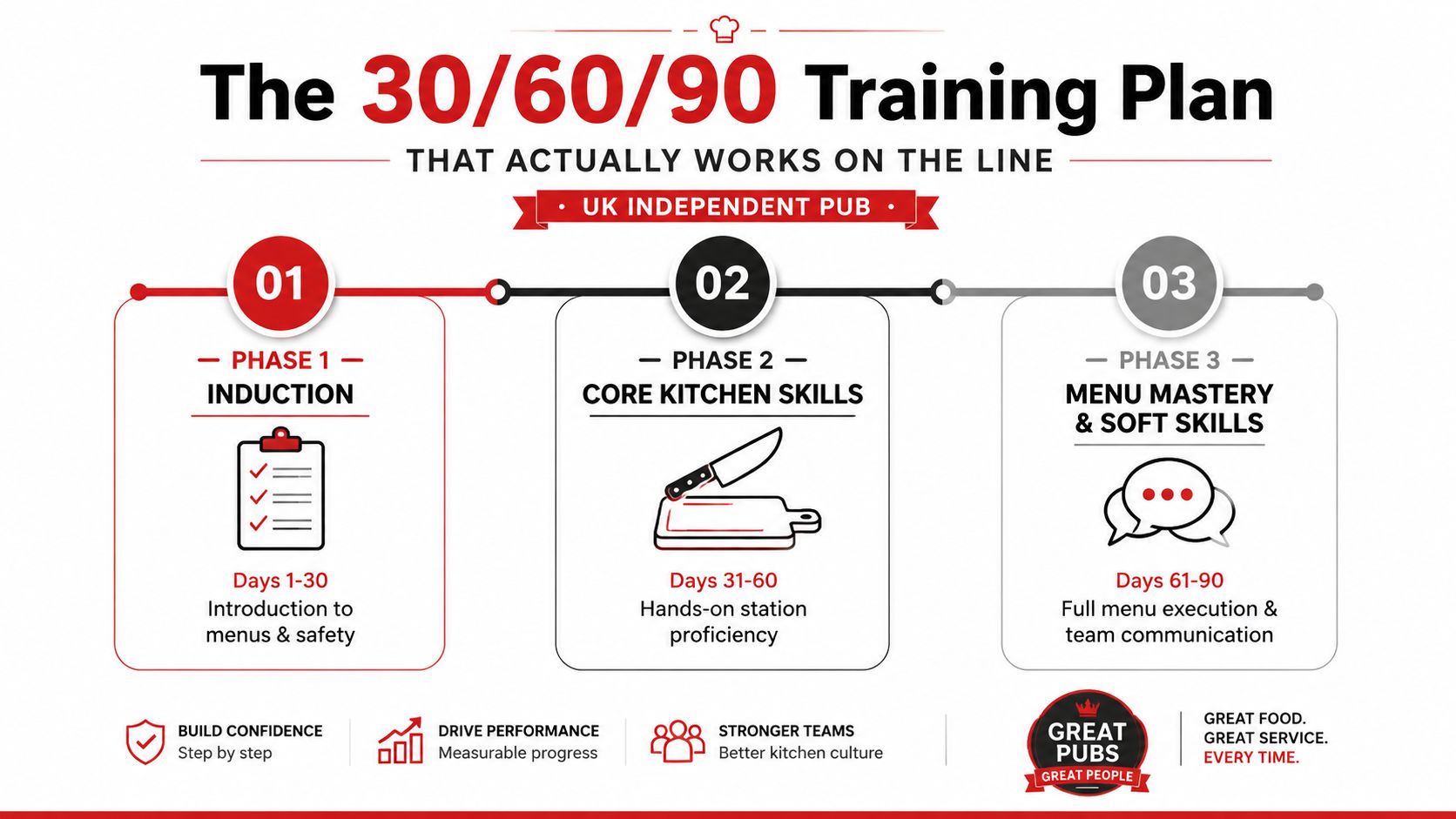
A strong 30/60/90-day plan stops training drifting into vague shadowing. It gives the kitchen a rhythm, the new starter a target, and the manager a way to see whether progress is real. It also protects you from the mistake that causes the week-nine quit, clearing someone as “fine” before they've proved they can survive a bad service.
Days 1 to 3 set the floor
Orientation should be short, direct, and practical. Cover food safety basics, the kitchen layout, FIFO, allergen routines, waste points, and who talks to whom during service. Give one named trainer, not “the team”, because everyone means nobody when the heat goes up.
The first sign-off should be simple. Can they move safely, find everything, follow the brigade's communication rules, and understand the pace of the section without freezing? If not, they're not ready for more.
Days 4 to 30 build one station properly
Most kitchens rush. Don't. Pick one station and keep the focus there until the chef can repeat core recipes, manage mise en place, and hit the speed standard without correction every five minutes. Repetition beats novelty at this stage.
Practical rule: one station, one trainer, one standard. If the new starter is bounced around every shift, they'll learn the room but not the job.
Days 31 to 90 turn supervision down
Once the core station is stable, add adjacent stations and reduce intervention under rush conditions. The chef learns how to work when the tickets are ugly, the printer won't stop, and FOH needs answers quickly. That's also where soft skills matter, because calm communication, ticket flow, and clear handovers are part of competence, not an extra.
For the live kitchen, soft skills are trained best in context. Ask the chef to call tickets back, flag delays early, and tell the pass what's missing before it becomes a complaint. That's the sort of habit that keeps service clean when the room is full.
Assessment, Sign-Off Templates and What to Measure
A lot of kitchens still assess chefs by instinct. That's how someone ends up solo on a Saturday without ever being properly checked on knife work, allergen handling, or service sequencing. In a labour-tight market, that's a bad gamble, especially when the right route may be a relief chef, a temporary chef, or a more structured internal pathway.
The benchmark should be direct observation on a live service, not a fake trial in an empty kitchen. Shadowing alone doesn't prove anything about speed, decision-making, or behaviour under pressure. The kitchen needs evidence that the chef can perform to spec when the room is full and the team is moving fast.
Use a simple station checklist
A workable checklist can cover:
- Mise en place, prepared, labelled, and arranged in service order
- Knife work, controlled, safe, and efficient
- Service sequencing, correct order, correct timing, correct handover
- Hygiene, clean hands, clean surfaces, clean habits
- Allergen control, ingredient verification, separation, communication
For formal handover records, the template at handover documentation helps keep sign-off consistent across shifts and managers.
The highest-risk points under the Food Standards Agency system are hygiene, allergen control, and temperature control, so those need explicit sign-off before anyone is cleared for solo service. A pass is a pass only when the chef can run the station without corrective intervention. If they still need rescue on each rush, mark them borderline, not “nearly there”.
Borderline results should trigger a focused re-test within seven days, not a vague promise to revisit it later. Record date, dish, ticket time, wastage, and any correction made. That gives you a proper paper trail and tells the next manager what the last one saw.
Training for Retention, Not Just for Entry
The industry has spent years asking how to get chefs into kitchens. The sharper question is how to keep them there when the honeymoon ends, the rota gets messy, and the pressure becomes normal. The cost of training is wasted if the chef leaves before they become useful in the way you need them.
Vacancy pressure is still part of the background noise. The ONS figure above shows how tight the sector has been, and UKHospitality has repeatedly pointed to structural labour weakness after Brexit and the pandemic. That's why retention matters more than another certificate on the wall. A chef who is supported, scheduled properly, and given a path forward is far more likely to stay than one who's trained harder.
What actually keeps chefs in post
The simplest retention levers often cost nothing.
- Give rotas earlier, so people can plan their lives and child care
- Name a 90-day progression conversation, so the chef knows there's a next step
- Map the route from commis to sous, so training feels like progress, not repetition
- Protect training time, so the chef isn't dragged back to the pass every night at 6pm
Line-management quality matters more than most owners admit. If a head chef is reactive, inconsistent, or always too busy to coach, new staff feel it fast. That's when week nine becomes the breaking point, because the chef sees the job as chaos rather than a route to competence.
Relief cover and temporary chef support can protect the training plan during peak weeks. If you're running a busy hotel in Berkshire, a coastal pub in Dorset, or a private house with guest turnover, plugging gaps with a proper cover partner keeps your permanent team in training mode instead of survival mode. Relief Chefs UK is one option venues use for that kind of support, alongside in-house mentoring and structured progression.
Later service depends on early trust. If a chef believes the rota will change every day and no one will back their development, they'll leave long before they become part of the core brigade.
Relief Cover, Blended Learning and Measuring Effectiveness
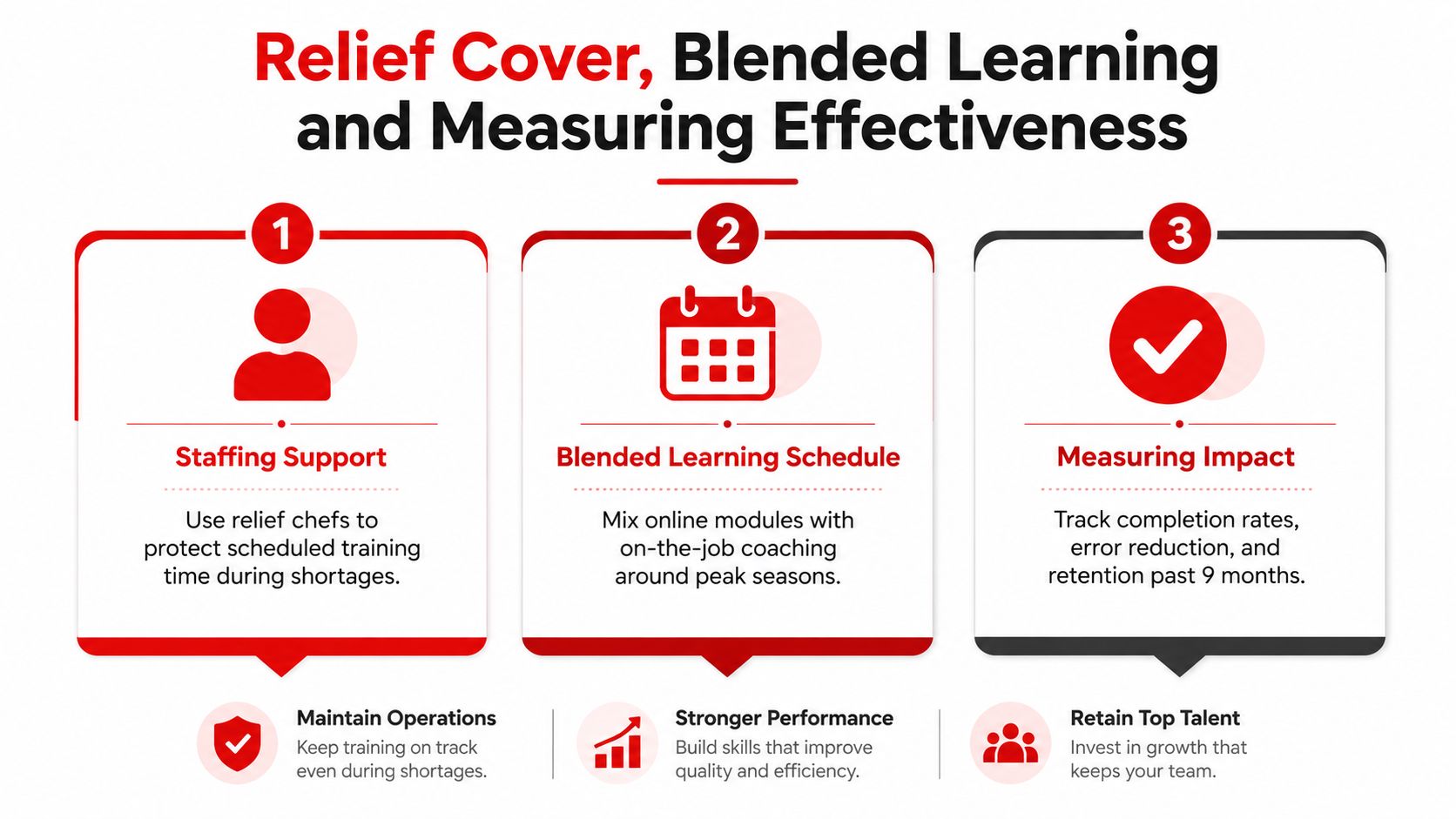
Training falls apart quickest when the kitchen is short-staffed. The obvious fix is to cancel training, but that just pushes the problem into the next quarter and leaves the same weak habits in place. A better fix is to separate cover from development time, then use relief support so the chef you're training gets to train.
Use cover to protect the timetable
If a season is about to spike in the Cotswolds, Cornwall, Berkshire, or the Home Counties, plan relief cover before the diary fills up. That keeps the senior team on service while the new starter gets coached properly on prep, pacing, and station discipline. If you're hiring from outside, use temporary chef support to keep the rota steady while the permanent team learns.
Blended learning helps too, but only if it supports the floor rather than replacing it. Food safety, allergens, and basic costing can be covered in short remote modules, then checked on the line during real service. The point is to reduce time wasted on classroom-style explanation, not to move the whole job into a laptop.
Measure what predicts stability
Use a handful of measures that a GM can explain to an owner.
- Time to competence per station, because it shows how long the kitchen takes to make someone useful
- Retention at six and twelve months, because training is pointless if people disappear early
- Internal progression rate, because strong kitchens grow their own cover
- Service error trends, because repeated mistakes tell you where the training is still weak
Ignore dashboards that look impressive but don't tell you whether the kitchen is more stable. Completion counts and course attendance matter less than whether the chef can run service, stay in post, and move up. If you want one score, make it a stability score built from competence, retention, and service performance, not a vanity total of courses completed.
Your 90-Day Chef Training Plan and Next Steps
Start Monday with seven actions. Agree the competency framework, name the trainer, print the sign-off template, block training slots into the rota, brief the brigade, set the 30-day check-in, and line up cover for peak weeks before the pressure lands. If you do those seven things properly, the training plan stops being theory and starts becoming control.
The true test is still week nine. If the chef is calmer, faster, and less dependent on rescue by then, the plan is working. If not, the kitchen doesn't need more hope, it needs a tighter structure, better cover, and clearer standards.
For pubs, hotels, private households, yachts, and villa operators, Relief Chefs UK provides relief chefs, temporary chefs, permanent chef recruitment, yacht chefs, villa chefs, and wider hospitality staffing support. The business has been established since 2013, is run by chefs rather than recruiters, and works with venues that need fast, dependable cover and a stronger pipeline.
If you need chef cover that protects training time and keeps service stable, speak to Relief Chefs UK about temporary chefs, relief chefs, permanent recruitment, or hospitality staffing support. Visit Relief Chefs UK to arrange cover quickly and keep your brigade moving.
Call the team.
Office 01392 715474 · info@reliefchefs.co.uk