
10 Types of Chef Every UK Kitchen Should Know
21 October 2026

Your head chef has called in sick, the delivery is waiting outside and the restaurant team needs to know whether the full menu is still available. You need cover, but asking for a chef won't tell an agency who can take charge, run the grill or finish the prep before guests arrive.
When one chef is missing, the whole kitchen feels it. Choose someone without the right section experience or decision-making authority and you can leave the same operational gap in place, even with another person on the rota.
The different types of chef describe a mixture of seniority, specialism and working environment. A sous chef and an executive chef hold different responsibilities; a pastry chef and a yacht chef need different practical capabilities. Neither distinction tells you, by itself, who's right for tonight's service.
Start with the missing responsibility, not the missing job title. Identify what must happen before service, who must lead it and which skills the remaining team already has.
For a Devon pub, that might mean someone who can manage Sunday roast production without supervision. For a Bristol restaurant, Windsor hotel or private household in Berkshire, it could mean section expertise, banqueting preparation or continuity around dietary requirements.
The roles below explain what each chef owns and how to arrange cover without unsettling the team. The same principles apply across Wales, Reading, Slough, Dorset and other UK hospitality locations: match the chef to the work, then make the handover clear.
1. Head Chef
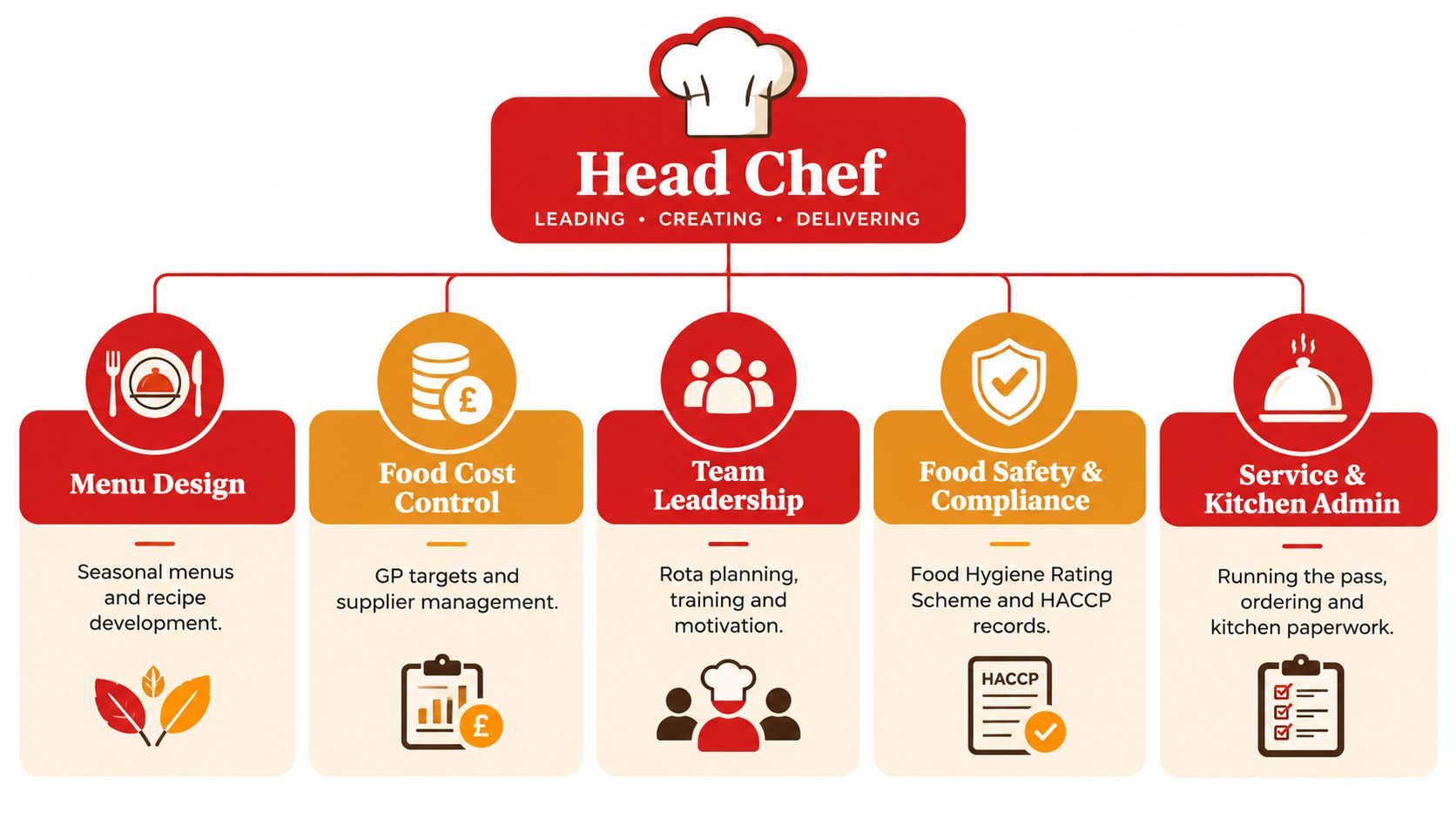
The head chef owns the kitchen's day-to-day performance. That means menu execution, ordering, rotas, portion controls, food safety and the standards guests experience on the plate.
In an independent pub or restaurant, this person may also cook throughout service. The distinction between hands-on pub leadership and broader hotel management matters when recruiting, as discussed in Cookaburra's analysis of UK kitchen skills gaps.
Cover authority as well as cooking
Consider a Devon gastropub whose head chef takes unexpected leave. A replacement who can cook the menu still needs access to suppliers, purchasing limits and someone authorised to approve rota changes.
Make the temporary appointment operationally complete:
- Agree decision limits. State who can change the menu, authorise purchases and adjust staffing.
- Prepare the handover. Include supplier contacts, par levels, prep lists and secure access to essential systems.
- Name the deputy. Make it clear who leads when the cover chef isn't working.
Don't judge candidates by years served alone. Ask how they would organise your actual service, control waste and supervise the available team.
Use temporary head-chef cover for sickness, holidays or a recruitment gap. Choose permanent recruitment when you need lasting ownership of menu direction, team development and commercial performance, rather than someone to keep the pass moving.
2. Executive Chef
An executive chef oversees the wider culinary operation, rather than concentrating solely on a single kitchen's service. In a hotel group, restaurant business or large estate, the role can include menu direction, budgets, recruitment and support for head chefs.
The distinction comes from the brigade structure associated with Auguste Escoffier, which separated executive oversight, kitchen leadership and specialist stations. Epos Now's explanation of the kitchen brigade system outlines how those responsibilities fit together.
Define the business-wide brief
For a Dorset hotel group planning a shared breakfast menu, the requirement isn't just recipe development. The executive chef should establish specifications, supplier arrangements, training expectations and a workable process for local head chefs.
A Wales pub operator introducing a seasonal menu needs the same clarity. Site teams must know which elements are fixed and where they can adapt to equipment, demand or ingredient availability.
Don't book executive-level cover to solve an ordinary station shortage. Use interim executive support when the gap concerns group standards, senior leadership or a significant menu transition.
Before appointment, agree budget authority, reporting lines and the decisions that remain with owners or operations managers. Relief Chefs UK's guide to what an executive chef does provides a useful starting point for defining that scope.
For permanent recruitment, assess how candidates develop head chefs. A business shouldn't depend on its executive chef personally resolving every difficult service.
3. Sous Chef
A full dining room and an unfinished prep list make the sous chef's operational value obvious. This is the head chef's second-in-command, responsible for coordinating production, supporting section chefs and taking charge when the head chef is absent.
In practical terms, the sous chef connects the plan to the people delivering it. They need to spot missing preparation, redistribute work and keep communication between the pass and sections clear.
The National Careers Service chef profile identifies leadership, organisation, attention to detail and working under pressure among the capabilities the profession requires. Those qualities deserve close scrutiny when appointing a deputy.
A sous-chef absence can be harder to absorb than the rota suggests. If the head chef must leave menu planning and ordering to supervise every section, you've moved the gap rather than covered it.
Give the replacement usable authority
For a Berkshire restaurant facing short-notice sickness before Sunday lunch, identify who will run the pass before looking for another pair of hands. If the head chef can lead service, a strong section chef may be enough; if not, recruit someone who can direct the brigade.
- Set ordering limits. Explain what the replacement can purchase without approval.
- Share staffing constraints. Identify inexperienced team members and stations needing support.
- Agree escalation. Name the manager responsible for guest complaints, equipment failures and staffing decisions.
Use the duties of a sous chef to build a role-specific brief. Arrange cross-training within the permanent team so the deputy's absence doesn't leave nobody ready to coordinate service.
4. Chef de Partie
The chef de partie runs a section, such as grill, fish, sauce, larder or pastry. Their immediate responsibility is to have that station prepared, organised and ready to deliver the menu to the kitchen's specification.
This is a production role with clear ownership. A replacement needs to understand the station's workload, equipment and relationship with the rest of the brigade, not merely recognise the dishes.

Recruit for the station you actually need
Suppose a Reading restaurant introduces a fish section while its existing team remains stretched across meat and garnish. Ask candidates about fish preparation, cooking methods, holding arrangements and coordination with the pass.
A chef with a senior title but little relevant station experience isn't automatically the stronger appointment. For temporary cover, direct section competence takes priority over hierarchy.
Send the replacement practical information before arrival:
- Recipe specifications. Include portions, garnishes, plating references and permitted substitutions.
- Allergen information. Explain the venue's communication and cross-contact procedures.
- Service arrangements. Describe tickets, calls from the pass and how the section replenishes stock.
The duties and responsibilities of a chef de partie help managers distinguish independent section ownership from general preparation support.
Temporary cover suits annual leave, events and seasonal reinforcement. If the same section repeatedly needs external support, review the permanent rota and workload rather than treating each booking as an isolated emergency.
5. Commis Chef
A commis chef supports the brigade while developing practical kitchen skills. Preparation, assisting senior colleagues and learning how sections operate belong at the centre of the role, not unsupervised responsibility for an unfamiliar service.
The UK apprenticeship system distinguishes Level 2 commis chef and production chef routes. Commis training supports development within a kitchen team, while production chefs focus on larger-quantity preparation using established recipes and procedures, according to the government's chef apprenticeship guidance.
Add capacity without removing supervision
For a Windsor boutique hotel preparing for weddings, a commis chef could support vegetable preparation, garnishes and organised mise en place under an experienced supervisor. Don't assume that extra preparation capacity also provides someone ready to lead banqueting service.
A café in Wales can use the same principle during a busy breakfast period. Keep the commis chef's tasks specific, with clear standards and a named person checking the work.
- Assign a supervisor. Make responsibility clear for every shift.
- Track practical skills. Record which tasks the chef can perform independently and which still need checking.
- Protect development time. Explain techniques and standards rather than relying on hurried corrections during service.
Don't cover a missing head chef with a commis chef and expect the team to absorb the difference. Junior support works when leadership already exists.
For temporary bookings, describe the preparation tasks accurately. For permanent appointments, assess the kitchen's capacity to train before promising progression, and confirm apprenticeship arrangements with the relevant provider before employment begins.
6. Pastry Chef (Pâtissier)
Pastry cover needs a production brief, not just a dessert menu. The pastry chef's remit can include plated desserts, bread, viennoiserie, petits fours and chocolate work, depending on the venue.
Precision matters in the handover. Give a replacement the recipes, methods, equipment details and service expectations they need to reproduce your offer rather than asking them to interpret photographs alone.
The following video offers a visual reference for pastry work.
Check the specialism within pastry
A Cornwall boutique hotel preparing for wedding service should distinguish between dessert production, bread baking and celebration work. Don't assume every pastry candidate has equal experience across the full requirement.
Likewise, a Bristol bakery-restaurant planning house-made viennoiserie should recruit for that production process specifically. Ask candidates to explain their workflow against your equipment and available preparation windows.
- Document production methods. Include weights, temperatures, timings and expected yields.
- Explain storage. Identify available refrigeration, freezing capacity and labelling procedures.
- Separate preparation from service. State whether the chef must also plate desserts during the evening.
Cross-train a suitable colleague in the essential dessert service so the business has a workable fallback. Keep that fallback narrower than the full specialist offer rather than expecting another chef to reproduce everything without preparation.
Use temporary pastry cover for a defined absence or event programme. Recruit permanently when the menu and trading model depend on regular specialist production, and assess candidates against the work the kitchen sells.
7. Private Household Chef
A private household chef works around the client's household, rather than a restaurant's fixed service pattern. Build the role around menus, dietary requirements, shopping, storage, budgets and the arrangements for family meals and entertaining.
For a Berkshire estate or London household, technical cooking ability is only part of a useful recruitment brief. Include discretion, communication preferences and expectations around access to the home.
Make preferences transferable
Consider holiday cover for a household with established dietary plans. The replacement needs a record of approved meals, ingredient restrictions and purchasing preferences, not a verbal summary passed on at the door.
Keep household preferences distinct from allergies and other essential dietary controls. A guest disliking an ingredient and a household member requiring an allergen exclusion must not be recorded as interchangeable requests.
Private-service rule: Agree how menu changes, shopping substitutions and additional guests will be approved before the chef starts.
For temporary cover, provide a shared menu log and clear instructions for household access, deliveries and contact with other staff. Confirm working hours and entertaining requirements before the booking is accepted.
For permanent recruitment, assess whether the candidate's working style suits the household's routine. A chef who enjoys a tightly scheduled restaurant environment may need a different brief to succeed in a home with changing plans.
Ask the staffing partner to explain vetting, right-to-work checks and insurance arrangements. Where the booking involves a holiday property, specify whether you need a villa chef with responsibility for arrival shopping, daily menus and departure handover.
8. Yacht Chef
A yacht chef booking starts with the vessel and itinerary, not just the preferred cuisine. Specify who the chef will cook for, the galley facilities, storage constraints, provisioning arrangements and the dietary requirements of guests and crew.
Treat yacht experience as a practical recruitment question. A candidate should be able to discuss how they would organise production and stock within the vessel's actual working conditions.
Resolve joining requirements before departure
For a Southampton yacht manager arranging cover before a charter, the first task is to confirm availability and suitability together. A chef who can travel immediately still needs the required documentation, relevant experience and a workable provisioning plan.
Don't leave those checks until the chef reaches the vessel:
- Confirm documentation. Ask the vessel manager to specify maritime, medical and training requirements.
- Share galley details. Include equipment, storage, operating restrictions and available assistance.
- Approve provisioning. Identify suppliers, delivery arrangements and purchasing authority.
- Record preferences. Distinguish guest choices from essential allergen and dietary controls.
A guest group requesting plant-based and gluten-free meals needs a menu plan that fits the galley and ingredient supply. Ask the replacement to explain that plan before joining rather than assuming a broad culinary background covers every requirement.
Use temporary yacht chefs for leave, rotations and defined charter periods. Choose permanent recruitment when you need continuity across the vessel's programme, and maintain a clear handover between outgoing and incoming chefs.
Don't promise an unchanged menu until the replacement has reviewed the stock and equipment.
9. Gastropub Chef
Sunday roast service tests more than cooking technique. A gastropub chef needs to coordinate preparation, replenishment and service while keeping portions and purchasing under control.
Treat this as a venue-specific brief, not a separate rung in the brigade. The person may also be your head chef, sous chef or sole chef, depending on how you organise the business.
Staffing evidence reinforces the need to distinguish leadership from production capacity: UKHospitality figures reported by The Caterer identified a 10% shortage of head chefs compared with a 21% shortage of production chefs.
Match cover to the busiest service
For a Devon pub facing sudden sickness, specify whether the replacement must take charge alone or work alongside the existing team. Describe roast preparation, grill work, dietary requests and how food orders reach the kitchen.
A Dorset venue preparing for beer-garden demand needs a different emphasis from a quiet midweek dining service. Ask for relevant volume-cooking experience and explain the equipment available.
- Send the core menu. Include portions, prep sheets and dish specifications.
- Agree a fallback offer. Decide which dishes to suspend if staffing remains below plan.
- Plan known peaks. Arrange cover around bank holidays, Sunday lunches and seasonal bookings.
Don't protect menu breadth at the expense of manageable service. A controlled temporary reduction is better than asking an unfamiliar chef to deliver work the kitchen can't support.
The right candidate may be a capable production-focused chef rather than the most senior applicant.

10. Relief Chef (Temporary Cover)
Relief chef describes the arrangement, not the rank. You can need a relief head chef, temporary sous chef, pastry specialist or chef de partie, each filling a different gap.
Book against responsibilities and expected output. Someone taking over ordering and kitchen leadership needs a different handover from someone supporting preparation during a busy period.
The official senior production chef apprenticeship standard describes work across settings including pubs, casual dining, hospitals and care homes. That range is a useful reminder to check operational fit rather than treating previous kitchen employment as sufficient evidence.
Make agency reliability specific
For a Slough hotel maintaining its food offer during refurbishment, temporary staffing should fit the reduced facilities and changing service requirements. Explain those constraints when booking, not after the chef arrives.
Ask the agency direct questions:
- Matching process. How will it confirm experience relevant to your menu and service?
- Communication. Who updates you if availability changes?
- Replacement arrangements. What happens if the agreed chef cannot attend?
- Support. Who can resolve a problem outside office hours?
The best temporary chef for your kitchen is the one who can fulfil the missing responsibilities with the handover and support you can provide.
Give feedback after the placement, including section performance, communication and readiness for service. For recurring seasonal demand, agree support in advance; for an ongoing vacancy, combine temporary cover with permanent recruitment rather than leaving the long-term decision unresolved.
Comparison of 10 Types of Chefs
Treat this table as a staffing tool. The scope column shows how much of the kitchen stops when one person is off; the right-hand column shows what that absence costs you.
| Chef Role | Scope & Complexity | Resource Requirements | Expected Outcomes | Ideal Use Cases | Key Advantage |
|---|---|---|---|---|---|
| Head Chef | High: leads one kitchen and owns daily operations | Experienced chef; usually 5–10 years' experience; team, stock and budget oversight | Consistent food quality, cost control and team performance | Independent pubs and restaurants needing strong site leadership | Direct control over standards, margins and kitchen culture |
| Executive Chef | Very high: sets strategy across multiple kitchens | Senior culinary and leadership experience; group-level budget and supplier authority | Consistent menus, purchasing efficiencies and developed head chefs | Hotel groups, restaurant brands and large estates | Scales standards and purchasing power across sites |
| Sous Chef | High: supports the head chef and leads in their absence | Senior kitchen experience; operational, ordering and food-safety skills | Maintains service continuity and supports team development | Busy kitchens needing a second-in-command or succession pathway | The widest gap to fill at short notice, since ordering, the pass and daily discipline sit in one role |
| Chef de Partie | Moderate: runs a specific kitchen section | Station expertise; recipe, stock, hygiene and allergen knowledge | Consistent output and service quality at section level | Professional kitchens needing reliable station coverage | Reduces the risk of a section falling behind during a single-service absence |
| Commis Chef | Low–moderate: performs tasks under supervision | Junior cooking skills; structured training and senior supervision | Adds capacity and develops future skilled chefs | Kitchens with time and staff to train junior cooks | Cost-effective way to build a talent pipeline |
| Pastry Chef (Pâtissier) | High: specialist, precision-led production | Pastry expertise, specialist equipment and careful scheduling | Distinctive desserts and baked goods; potential in-house supply savings | Hotels, bakeries and restaurants with substantial pastry needs | Specialist skills can differentiate the food offer |
| Private Household Chef | Moderate–high: adapts to one client's routine and preferences | Menu planning, dietary and allergy knowledge, discretion and organisation | Personalised meals and continuity of household food service | Families or individuals seeking regular in-home cooking | Service built around one household's routine and preferences |
| Yacht Chef | Very high: cooks in a confined galley with changing conditions | Provisioning skills, food-safety knowledge and relevant maritime credentials | Flexible dining for guests and crew across itineraries | Private or charter yachts, crew rotations and refits | Combines varied cooking with international travel |
| Gastropub Chef | Moderate–high: balances a broad menu with busy services | Volume cooking, seasonal sourcing and tight cost control | Quality pub food with efficient service and commercial control | Pubs with seasonal menus, weekend peaks or lean teams | Combines familiar pub dishes with more ambitious seasonal cooking |
| Relief Chef (Temporary Cover) | Moderate: must adapt quickly to an existing kitchen | Relevant kitchen experience; vetting, insurance and clear venue briefing | Helps maintain service during absences and demand peaks | Sickness, holidays, vacancies, events and seasonal cover | Flexible short-term staffing without a permanent hire |
Senior absences hurt most. Losing a head chef or sous chef removes ordering, the pass and supplier contact in one move, so those are the gaps to arrange cover for first. A commis absence redistributes across the team. A pastry absence stalls one part of the menu while the rest of service continues.
Build Cover Before the Kitchen Is in Crisis
A head chef hands in notice on a Tuesday, and by Friday the pub is running Sunday lunch on a temp who has never seen the menu. That scenario is avoidable, and it costs more to fix than to prevent.
The right chef depends on the gap, the venue and the work that must happen on the day. A senior appointment will not automatically resolve a production shortage, and another pair of hands will not replace missing leadership.
Start by mapping responsibility across the kitchen. Identify who runs service, who orders, who controls specialist production and who can supervise junior staff when the usual person is absent.
Then test those arrangements against a realistic absence. If the sous chef is unavailable, can the head chef still complete ordering and lead the pass, or does the whole plan depend on someone working beyond their agreed shift?
Prepare a handover someone can use
Maintain a current cover pack containing menus, recipe specifications, par levels, allergen information, opening and closing procedures, supplier details and key contacts. Keep access to passwords and personal information controlled rather than circulating everything in an unrestricted document.
The handover should also describe the people and facilities. Identify inexperienced team members, equipment faults, delivery restrictions and any menu changes already communicated to guests.
Arrange temporary cover when the need is defined, such as sickness, holiday, seasonal reinforcement or a recruitment gap. Pursue permanent recruitment when the business needs ongoing leadership, specialist ownership or a more stable staffing structure.
Do not wait for repeated emergencies before making that distinction. Review why each booking was needed and whether a change to the permanent team would reduce the same pressure returning.
Brief a staffing partner before you need one
Relief Chefs UK is a nationwide chef recruitment agency run by chefs with more than 60 years of combined hospitality experience, supporting independent pubs, restaurants, hotels, private households and yacht operations.
For venues in Devon, Bristol, Wales, Berkshire, Windsor, Reading, Slough, Dorset and beyond, the useful starting point is a specific conversation about operational requirements. Explain the role, location, service style, equipment, supervision available and the responsibilities the chef must take on.
That preparation gives the staffing partner a clearer basis for matching candidates. It also lets your managers make sensible decisions about the menu and rota while cover is being arranged, rather than assuming an incoming chef can absorb every unresolved task.
Contact Relief Chefs UK before the next absence becomes a service decision. Share your current vacancy or upcoming pressure period, establish the right level of support and prepare the handover while your permanent team is available to explain it.
Relief Chefs UK covers temporary and permanent roles across kitchen leadership, sections, private households, yachts and villas. Visit Relief Chefs UK with your location, required dates and the responsibilities you need covered, and discuss the right chef for your next service or longer-term vacancy.
Call the team.
Office 01392 715474 · info@reliefchefs.co.uk