
A chef calls in sick at 6am. Saturday service starts in a few hours, the kitchen is already short-staffed, and your usual agency contact is sending over a relief chef who can arrive quickly. The urgent question isn't whether the chef can cook. It's whether you've completed a compliant right to work check before that person starts work.
For hospitality operators, right to work checks in the UK belong in the pre-shift control process, alongside allergen records, temperature checks, and opening duties. The Home Office requires employers to complete the prescribed check before employment starts if they want a statutory excuse against civil penalty liability. That applies whether you're running a pub in Bristol, a hotel in Windsor, a restaurant in Devon, or a seasonal kitchen in Wales. The legal history is long-standing, with employer responsibilities in place since 1997 and prescribed checks required before hiring since 2008. The Home Office's overview of illegal working and employer responsibilities also records the temporary adjusted checking arrangements introduced during COVID-19 and ended on 30 September 2022.
The practical rule is straightforward. No check, no shift. A last-minute staffing gap doesn't remove the obligation, and a busy service doesn't turn an incomplete check into a compliant one. This guide sets out a workable process for pubs, restaurants, hotels, catering businesses, and chef staffing teams that need to make decisions before the pass opens.
When Service Starts in Hours and the Check Has Not Been Done
At 8am on a Saturday, a Bristol pub has a chef no-show, a full booking list, and a head chef who cannot stretch the brigade further. An agency confirms that a relief chef can arrive before lunch. The kitchen has a solution, but the shift is not ready to start.
The operational question is simple: has the right to work check been completed before the chef starts? If the answer is no, the chef stays off the rota, even when service begins in hours. Experience, availability, and an agency's assurance do not replace the employer's responsibility.
The official employer checklist for right to work checks requires the check to take place before work begins if the employer is to establish a statutory excuse against a civil penalty. Treat that requirement as a pre-shift control, alongside food safety records, temperature checks, and opening duties.
Pre-shift rule: Complete right to work verification before the chef handles food or begins any paid shift.
October 2026 makes this control harder to ignore. The rule expansion to non-standard labour models means operators must build the check into how they engage relief chefs and other flexible workers, rather than leaving it as an HR back-office task. A staffing model that changes at short notice still needs a clear start condition.
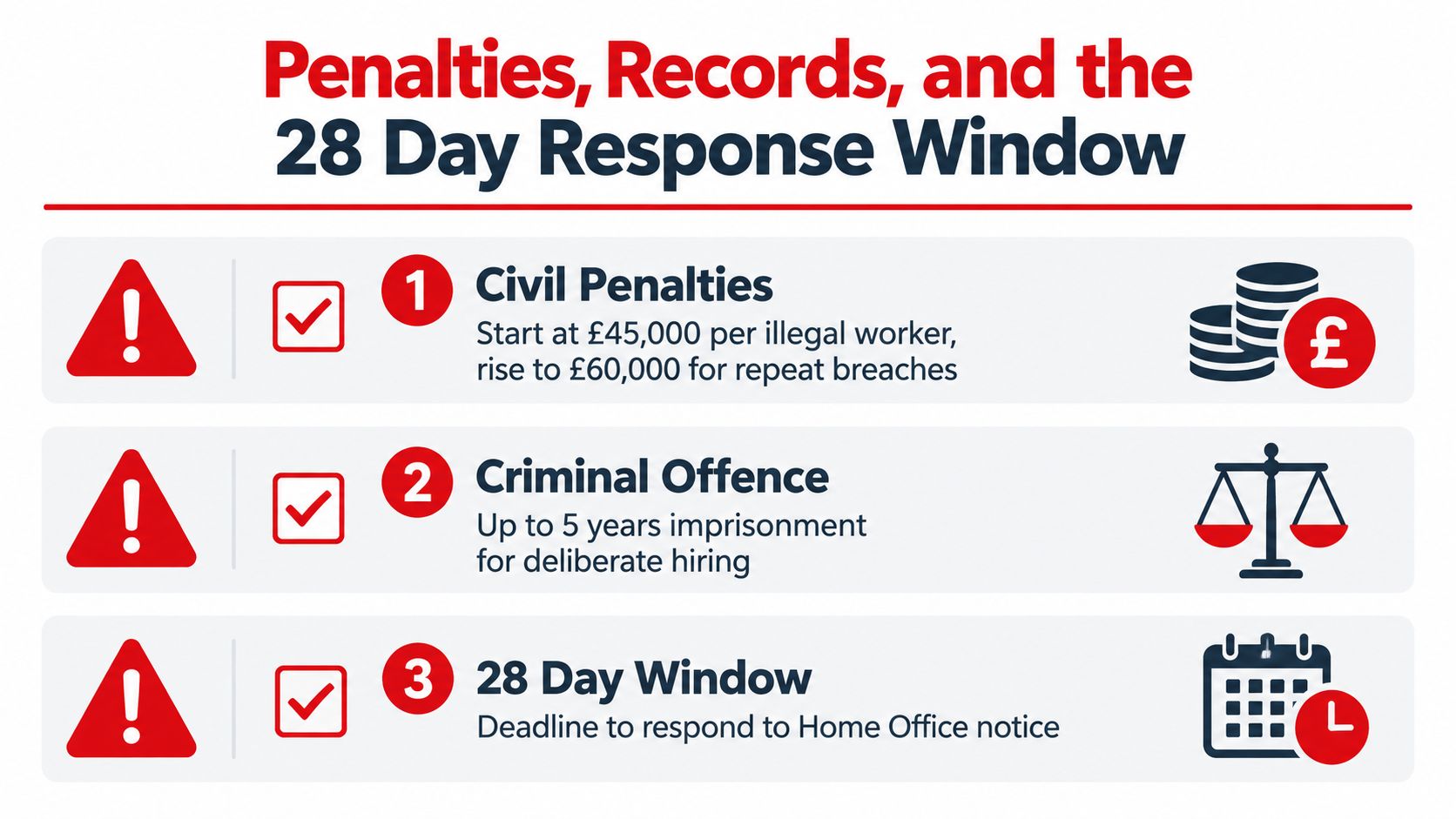
A manager who lets a chef work first and promises to complete the paperwork on Monday creates an audit gap. The business may face a civil penalty of up to £60,000 per illegal worker. Knowingly permitting illegal working can also result in up to five years' imprisonment and/or an unlimited fine, as set out in the Home Office right to work Code of Practice.
Set up the emergency workflow before the next absence:
- Nominate an authorised checker: Give a duty manager, head chef, or operations contact responsibility for completing checks.
- Set a hard start condition: Keep the relief chef off the rota until the record is complete.
- Use a central record: Store the worker's name, check date, route used, and any follow-up date together.
- Cover closed head offices: Saturday's manager must be able to complete the process without waiting for HR.
Good handover records show what happened, when it happened, and who approved the shift. Keep the right to work record with your handover documentation for hospitality teams, not in a personal inbox or WhatsApp thread.
What a Right to Work Check Actually Requires
A compliant check isn't a quick glance at a passport or a message from an agency saying, “All sorted.” The employer must use one of the recognised Home Office routes and keep evidence that the prescribed process was followed.
There are three compliant methods:
Manual document checks
The employer examines original documents in the holder's presence, confirms that the documents are consistent, and makes a clear copy for the records. This may suit a Portuguese line cook who arrives at a hotel with an eligible passport and can present it in person before starting.
The manager must check that the document belongs to the person standing in front of them. Names, dates of birth, photographs, and any relevant permission must make sense together. A photocopy sent by a friend or an image forwarded by an agency isn't the same as a compliant in-person check.
Online Home Office checks
Where the worker has digital status, the employer uses the Home Office online service with the worker's share code and date of birth. The result must be checked against the person who will work in the kitchen, and the employer should retain evidence of the online result and the date of the check.
For example, a Brazilian sous chef with time-limited permission may provide a share code. The venue shouldn't rely on the code alone. It must access the live result, confirm the permission covers the proposed work, and save the evidence.
Digital identity verification
For eligible workers, an employer can use a Right to Work Digital Verification Service provider. This is useful when a relief chef is being arranged remotely and there isn't time to wait for an in-person document appointment, but the employer still needs to use the prescribed process and retain the resulting evidence.
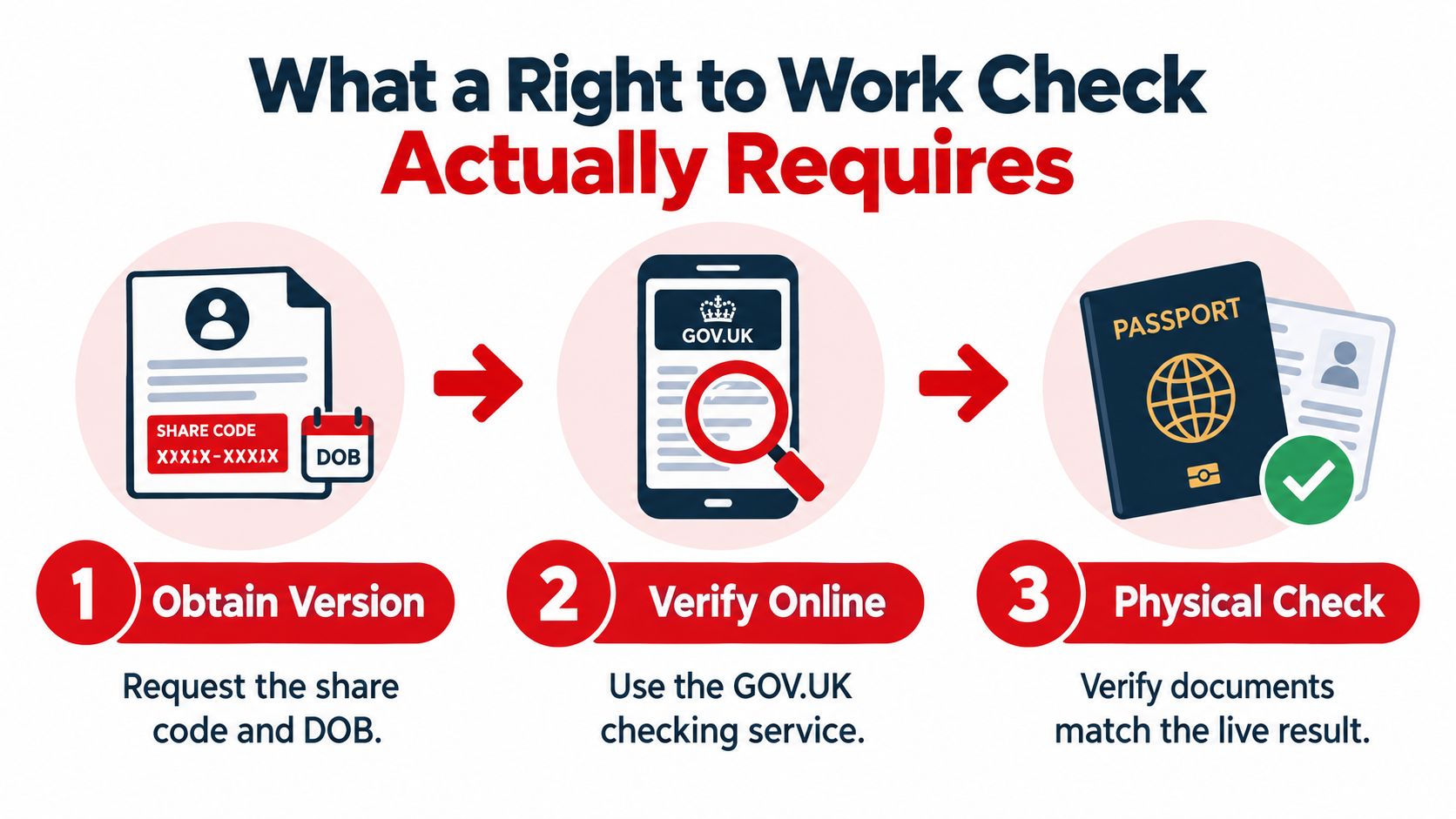
The check isn't complete until the identity and permission result match the individual who will do the work. That matters when an agency sends a replacement chef, when a platform changes the person allocated to a shift, or when a contractor arrives instead of the person named in the booking.
Do not transfer trust blindly: An agency's confirmation is useful evidence, but your business should know who completed the check, which route was used, and where the record is held.
For operators using self-employed relief chefs or other non-standard labour, the responsibility needs to be agreed before the booking. Set out the process in the supply arrangement and read the practical guidance on right to work checks for self-employed contractors.
Manual, Online, and Digital IDSP Checks Compared
The best checking route depends on the worker's status, the documents available, and the time before the first shift. There isn't one method that works for every kitchen.
Manual checking remains useful when the chef is already in front of you and has the original documents. It doesn't work well when a venue in Reading needs cover from a chef based elsewhere, or when a relief booking changes during the night. The employer has to see the documents in the holder's presence and keep a legible copy.
Online checks are usually the cleanest option where the worker has a valid share code and digital status. The manager can access the Home Office result, confirm the individual's identity, check the relevant permission, and retain the result. It works particularly well for planned recruitment and for candidates who already understand the online process.
Digital IDSP checks can support eligible workers who need remote identity verification. They can be practical for agency-led bookings, but the business shouldn't assume that any identity app or video call is enough. The provider and process must meet the relevant Home Office requirements.
| Method | Cost | Speed | Best for | Limits |
|---|---|---|---|---|
| Manual document check | No separate Home Office checking fee | Depends on seeing the original documents | Local hires, planned starts, and workers who can attend in person | Original documents must be checked in the holder's presence and copied |
| Online Home Office check | The online route is available through the Home Office service | Suitable for a remote check where a valid share code is available | Workers with digital status and planned or urgent cover | It won't work if the worker can't provide the required share code or the permission result doesn't support the work |
| Digital IDSP check | Provider charges and commercial terms vary | Designed for remote verification | Eligible relief chefs and remote agency bookings | The employer must use an appropriate provider and retain the verification evidence |
A decision rule for busy kitchens
Use the route that matches the evidence, not the route that feels quickest.
- A worker with eligible original documents: Complete a manual check in person.
- A worker with a valid Home Office share code: Use the online checking service and save the result.
- A worker who needs remote identity verification: Use an appropriate Digital Verification Service provider and make sure the result relates to the individual attending the shift.
A passport photograph sent over email isn't a fourth route. Neither is a verbal assurance from a recruiter. If the worker's status is unclear, stop the booking and resolve it before the chef starts.
The same rule applies across hospitality locations. A hotel in Berkshire, a restaurant in Slough, and a yacht operation based on the Dorset coast may use different labour models, but the employer still needs a defensible checking record before work begins.
Accepted Documents Split Between List A and List B
The List A and List B distinction matters because it determines whether the employer has a continuing excuse or needs to schedule another check.
List A documents support a continuous right to work for the duration of employment. A British passport holder who presents an eligible List A document can usually complete the evidence stage in one pass, provided the document is genuine, belongs to the person presenting it, and the prescribed check is recorded correctly.
List B documents relate to time-limited permission. A Colombian sous chef working under time-limited permission may produce a share code that confirms the right to work for a defined period. The venue must record the check and diarise a follow-up before that permission expires.
The operational difference is significant. A manager can file the List A evidence and maintain the record during employment. A List B result creates a task that belongs on the rota or compliance calendar, not in someone's memory.
The Home Office's acceptable right to work documents guidance explains the distinction and the follow-up obligation for time-limited permission.
| Feature | List A | List B |
|---|---|---|
| Permission | Permanent or continuing permission under the relevant document route | Time-limited permission |
| Follow-up | No repeat check solely because the employment continues | Follow-up check required before permission expires |
| Typical operational issue | Managers fail to copy or record the document properly | Managers forget to diarise the expiry-related check |
| Kitchen control | File the completed evidence and keep it accessible | Add the follow-up date to a shared compliance calendar |
Train the person on the pass
Supervisors don't need to become immigration lawyers, but they do need to recognise when a document or result needs escalation. They should know that:
- The individual must be the live holder: The photograph and identity details must match the person standing in the kitchen.
- The evidence must be current and relevant: An expired document or an unsuitable combination shouldn't be accepted because the shift is urgent.
- The result must match the role: Check that the permission supports the proposed work and any relevant restrictions.
- The follow-up must be visible: A time-limited result needs a named owner and a calendar date.
Keep an up-to-date List A and List B reference where managers can access it during recruitment and last-minute cover. Don't leave the only copy with a head office team that isn't available when the chef is due to arrive.
The October 2026 Expansion Beyond Direct Employees
Many hospitality operators still think of right to work checks as a payroll task. That assumption is now unsafe.
From 1 October 2026, the updated government position extends the scheme to additional working arrangements, including contracts for services, individual subcontractors, and online matching or platform arrangements. The government response on extending the right to work scheme sets out the expansion and the role of digital verification service providers in the updated framework.
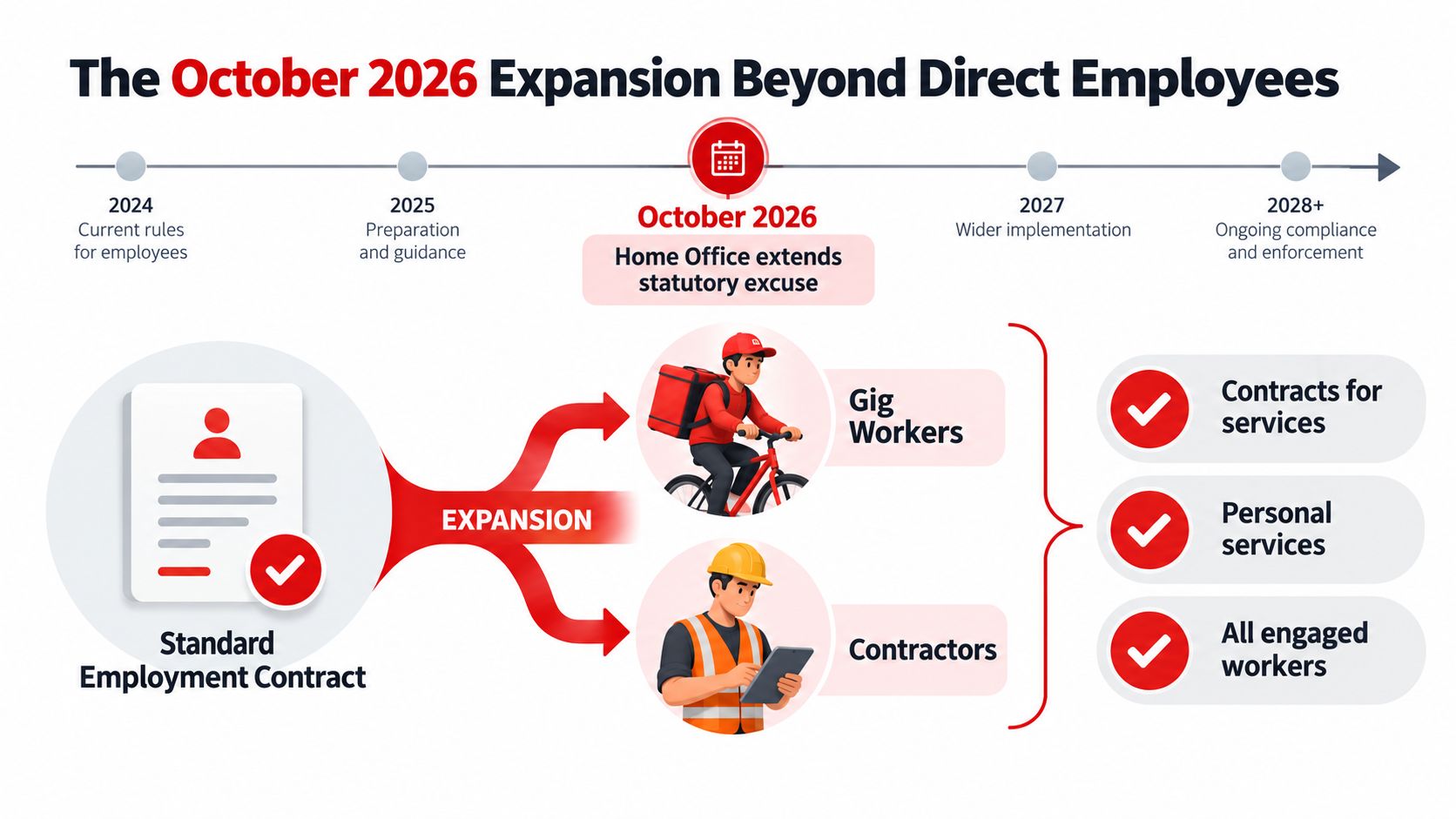
Consider a Bristol pub that takes a freelance chef through an agency for a weekend, or a hotel in Windsor that accepts last-minute cover through an online platform. The fact that the chef isn't on the venue's payroll doesn't settle who needs to check, who keeps the record, or how the venue demonstrates that its supply chain is compliant.
The legal responsibility can depend on the arrangement. That doesn't mean a client should sit back and assume the supplier has everything covered. Contracts should identify the party responsible for the check, the evidence the venue will receive, and what happens if the worker is replaced.
Map every route into the kitchen
An effective review should include more than permanent employees:
- Agency chefs: Confirm whether the agency completes the check and how it provides evidence before arrival.
- Individual subcontractors: Agree who verifies the person and who handles a follow-up for time-limited permission.
- Platform-arranged cover: Check how the platform identifies the actual worker allocated to the shift.
- Trial shifts and work experience: Ask for advice on the correct treatment before the person begins any activity that may constitute work.
- Last-minute replacements: Require a fresh confirmation when the named worker changes.
The right question isn't, “Are they employed by us?” It's, “Who is doing the work, under what arrangement, and where is the compliant evidence?”
Build that answer into procurement, onboarding, rota approval, and agency terms now. A venue that relies on WhatsApp recommendations or informal cash arrangements won't have a reliable audit trail when the rules apply to the wider labour model.
Penalties, Records, and the 28 Day Response Window
A right to work check is a pre-shift control. If a chef is due through the door in two hours, the manager should already be able to show who was checked, which route was used, when it happened, and whether permission needs reviewing. A rota entry or agency confirmation alone does not provide that control.
The current civil penalty framework allows substantial fines for each illegal worker, with higher maximums for repeat breaches. Knowingly permitting illegal working can also create criminal exposure, including imprisonment and an unlimited fine. The figures and enforcement approach should be checked against the current Home Office position rather than an old internal template.
The Home Office reports increased enforcement activity. Between 1 January and 30 June 2026, Immigration Enforcement carried out 7,270 illegal working visits and made 4,756 arrests, representing increases of 31% in visits and 20% in arrests compared with the same period in 2025. The Home Office enforcement update provides the figures.
Build records that survive an audit
Keep a clear copy of the document or online result, the check date, and the identity of the checker alongside your employment law compliance records. For time-limited permission, record the follow-up date and assign ownership. That responsibility must remain visible when a manager leaves, changes role, or hands the rota to someone else.
From October 2026, the wider use of non-standard labour models makes this discipline more important. Apply the same evidence standard to every person who works a shift, including agency and contractor arrangements. The record should identify the actual worker, not just the supplier or booking.
Respond before the deadline
A civil penalty notice gives the employer 28 days to respond, according to Home Office guidance on employer awareness and self-reported compliance. Treat that period as a formal legal deadline, not an administrative reminder.
- Locate the evidence immediately: Gather the original check record, document copy, online result, correspondence, and relevant rota history.
- Check the timeline: Confirm that the check occurred before work started and that any repeat check was completed on time.
- Get specialist advice: If evidence is incomplete or the arrangement is unclear, obtain advice instead of guessing.
- Submit a clear response: Set out the facts, attach the evidence, and address any mitigating circumstances before the deadline.
Pre-shift records prevent an urgent service problem from becoming an enforcement problem.
Keeping Kitchens Compliant With Relief Chefs UK
A relief chef agency should function as part of the compliance chain, not just as a phone number for emergency cover. When a venue needs a chef at short notice, it needs confidence that the person arriving is the person who was checked and that the relevant evidence can be found.
Relief Chefs UK is a nationwide chef recruitment agency established in 2013. Its staffing support covers relief chefs, temporary chefs, permanent chef recruitment, yacht chefs, villa chefs, and hospitality staffing for pubs, restaurants, hotels, private households, and other UK operations.
For an operator in Devon dealing with sickness cover, or a hotel in Berkshire preparing for seasonal demand, the practical benefit is having a defined supplier process instead of starting from a blank WhatsApp conversation. Ask the agency:
- Who completes the check: Establish whether the agency or venue owns the verification step for the specific arrangement.
- What evidence arrives before the shift: Request confirmation that the named chef has been checked and that the record is available.
- How replacements are handled: A different chef must not inherit the first chef's verification.
- How time-limited permission is monitored: Agree who owns the follow-up and how the venue is notified.
- Who answers during service pressure: Keep a live contact for Saturday no-shows, holiday peaks, and late sickness calls.
That approach is stronger than paying cash to a friend of a friend or accepting a freelancer from an unverified group chat. It also gives general managers and head chefs one defined process to follow when the usual recruitment route fails.
Right to work compliance shouldn't make you choose between opening the kitchen and protecting the business. It should be built into the staffing workflow before the booking is confirmed.
Common questions from hospitality operators
Can a relief chef start while the check is still pending
No. The prescribed check should be completed before the chef starts work if the business wants the statutory excuse against a civil penalty. Urgency changes the staffing plan, not the legal sequence.
Does an agency booking remove the venue's responsibility
Not automatically. The arrangement should state who completes the check and how the venue receives evidence. From October 2026, operators must pay particular attention to contractors, contracts for services, and platform-arranged work.
What happens when a chef has time-limited permission
Record the original check and diarise a follow-up before the permission expires. Don't assume that a previous check remains sufficient after the recorded permission period ends.
What should a manager do when a document looks wrong
Don't allow the chef to start while hoping the issue will resolve itself. Escalate to the person responsible for compliance, use the correct Home Office route, and keep a record of the decision.
Relief Chefs UK can provide relief and temporary chefs, permanent chef recruitment, yacht and villa chefs, and wider hospitality staffing support with right to work checks built into the booking process. Visit Relief Chefs UK to request cover and discuss a reliable staffing plan for your next sickness call, seasonal peak, or urgent kitchen gap.