
Chef Hiring Agency: How UK Venues Get Vetted Cover
18 October 2026
Friday service is already booked out when the head chef at a busy Bristol pub calls in sick. The sous chef is off, the kitchen team is short, and the owner has a full list of bookings to honour. A permanent rota can't absorb every sudden absence, and asking the remaining team to stretch further can turn one sick call into a service failure.
That's where a chef hiring agency can act as an operational safety net, not just a place to request CVs. The right partner helps a venue source suitable cover, check that the chef can do the job, and keep the kitchen stable while permanent recruitment continues. But an agency shift only makes sense if the chef fits the kitchen and the venue understands the full cost of the alternatives.
When a Chef Goes Sick and the Rota Cannot Cope
A sickness call before service leaves little time for a conventional recruitment process. The manager still needs to check the menu, confirm the booking list, decide whether the team can safely cope, and tell front of house what the kitchen can deliver. If the remaining chefs are already covering extra stations, pushing ahead without support can mean a reduced menu, slower service or cancelled bookings.
A trusted agency relationship changes the first move. Instead of starting a search from scratch, the manager can send a clear brief: shift times, kitchen style, expected volume, station requirements and any essential food-safety knowledge. The agency can then look for a chef whose experience matches the work, rather than sending whoever is available.
Short-notice cover isn't only for sickness. A resignation can leave a rota exposed while a permanent search is under way; a wedding weekend can stretch a hotel kitchen beyond its normal capacity; and a seasonal pub can need extra hands before its regular team is fully recruited. These problems are particularly familiar to venues in Bristol and other busy hospitality centres, as well as rural and coastal businesses where local availability can be limited.
Practical rule: Agree how you'll request cover before an emergency. A usable brief and a known contact save time when the kitchen is already under pressure.
Treat agency cover as part of staff absence planning, not a substitute for managing the rota. A structured approach to staff absence management can help managers define when to redistribute work, when to adapt service and when to bring in temporary support.
The cost of having no contingency plan is not limited to an awkward phone call. It can include lost covers, team fatigue, inconsistent food and damage to guest confidence. A dependable agency can't remove staffing pressure, but it can give managers another practical option while they protect service and keep longer-term hiring on track.
What a Chef Hiring Agency Actually Does
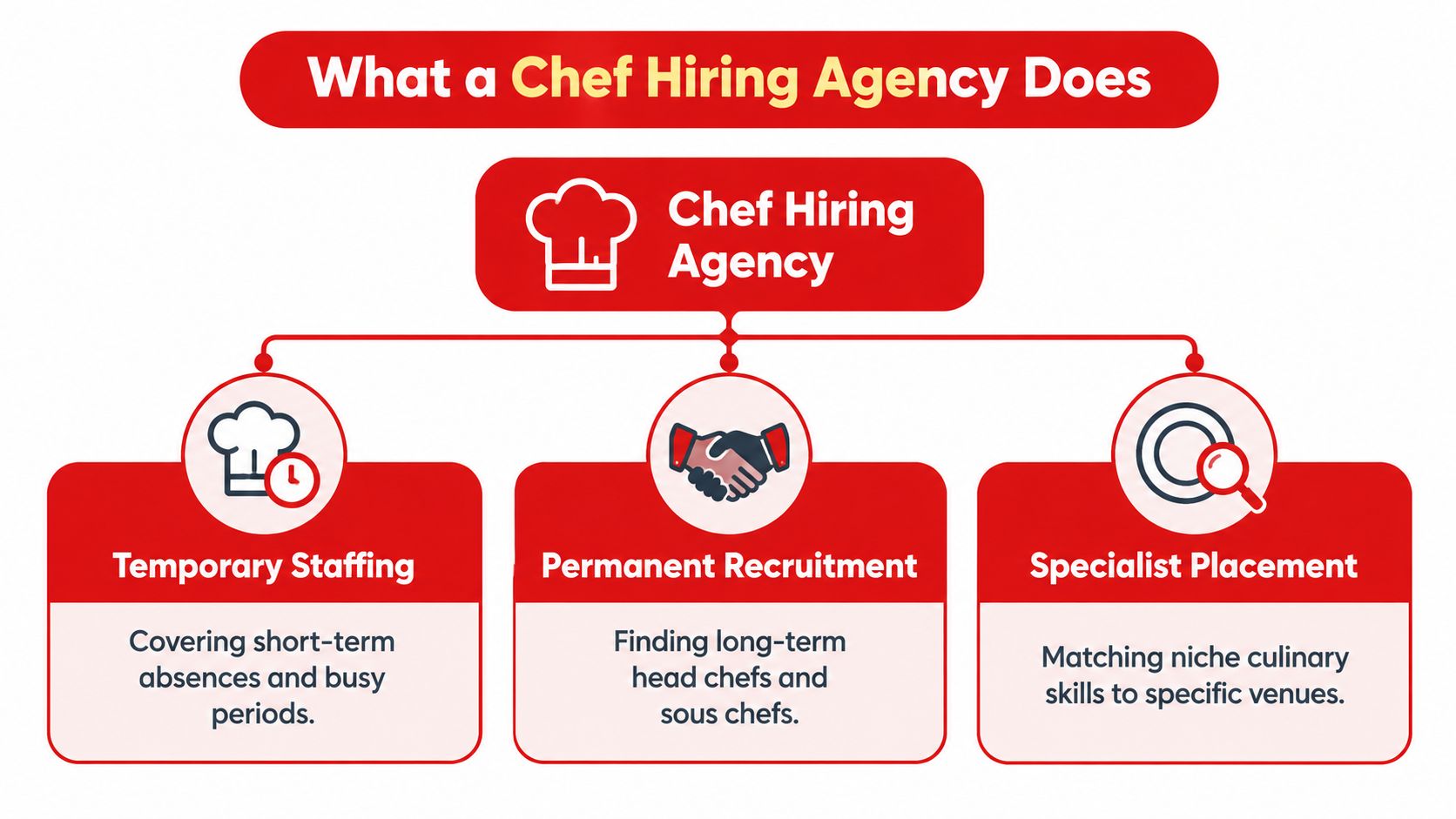
A chef hiring agency connects hospitality businesses with chefs for different types of work. Before requesting a candidate, decide which service you need. “We need a chef” is not enough information for a good match.
Relief cover for immediate gaps
Temporary or relief chefs cover short-term absences, busy periods and unexpected gaps. A pub might need a chef for a weekend while a team member recovers; a hotel might need seasonal reinforcement for a run of events. The venue usually pays for the agreed hours or shift arrangement. Ask what the rate includes, who handles payroll and what happens if the chef can't attend.
Permanent recruitment for a lasting vacancy
Permanent chef recruitment is a search for a longer-term appointment, such as a sous chef or head chef. The agency needs a fuller brief covering the kitchen's style, role responsibilities, leadership expectations and working arrangements. The fee model differs from shift cover, so clarify whether payment is tied to a successful placement and what guarantee or replacement terms apply.
Specialist placement is a separate need. Yacht chefs, villa chefs and private-household chefs work in environments with distinct demands, including privacy, flexibility and the ability to cook for a particular client or setting. A general hospitality recruiter may not assess those requirements in the same depth as an agency familiar with specialist placements.
A chef-focused recruiter should understand the difference between a high-volume pub kitchen and a boutique hotel, yacht galley or private household. That matters when the venue needs more than availability. The agency must match the chef's experience to the service, team and kitchen conditions.
When you call, say whether you need relief cover, permanent recruitment or a specialist placement. Then share the shift or role details, the kitchen's requirements and the time by which you need a response. A precise brief gives the agency a better chance of finding someone who can contribute from the start.
Why UK Kitchens Cannot Hire Their Way Out
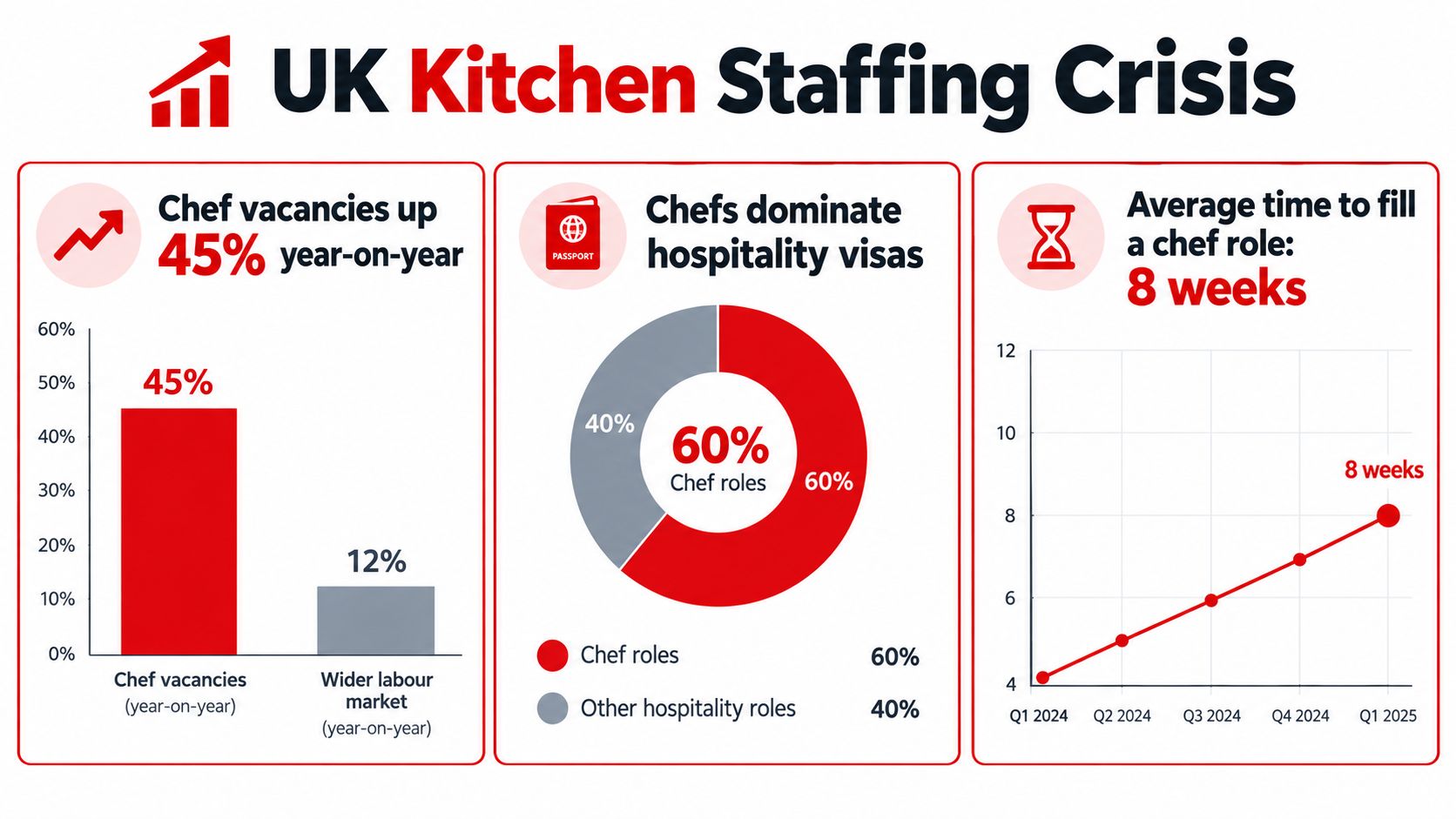
A venue can recruit continuously and still face urgent chef gaps. Hospitality's staffing pressure has been documented across different periods, and chef recruitment has been a particular challenge. A UK Government shortage review found that hospitality vacancies in November 2022 to January 2023 were 72% higher than in January to March 2020, compared with a 42% rise across the UK economy overall. The same review recorded 3,581 chef visa applications, representing 60% of applications across five selected hospitality occupations, even though chefs made up about half of the workers in those occupations. The review identified clearer evidence of shortage for chefs than for several other hospitality roles (UK Government hospitality shortage review).
That evidence helps explain why normal hiring isn't a reliable answer to an immediate rota problem. A permanent search takes time, while a kitchen needs a chef who can cover a particular station, service and shift. The venue's practical question isn't only whether enough people are applying. It's whether the right person is available in the right place at the time the kitchen needs them.
Fewer vacancies don't guarantee easier chef cover
Overall accommodation and food-service vacancies fell from 82,000 in the three months to April 2025 to 79,000 in the three months to May 2025, while payrolled employment dropped from 2,201,193 in May 2024 to 2,100,827 in May 2025. A lower vacancy count doesn't show that a specific pub, hotel or restaurant can quickly find an experienced chef for a hard-to-fill shift (RSM's report on hospitality employment).
Seasonality adds another complication. Recruitment and Employment Confederation data reported that hospitality summer job postings were down 25% year on year, with 22,369 fewer advertisements than in summer 2024. Operators in Devon, Dorset and Wales may need extra kitchen capacity as tourism, events or weddings increase demand, even as the pool of seasonal applicants tightens (The Caterer's report on hospitality job postings).
A temporary chef partner won't solve the wider labour supply problem. It can, however, help a venue manage the gap between needing a chef now and finding the right person for a permanent role. The important test is whether the agency can respond with a chef suited to the actual kitchen, not merely whether it can produce a name.
Vetting, Compliance and What Good Screening Looks Like
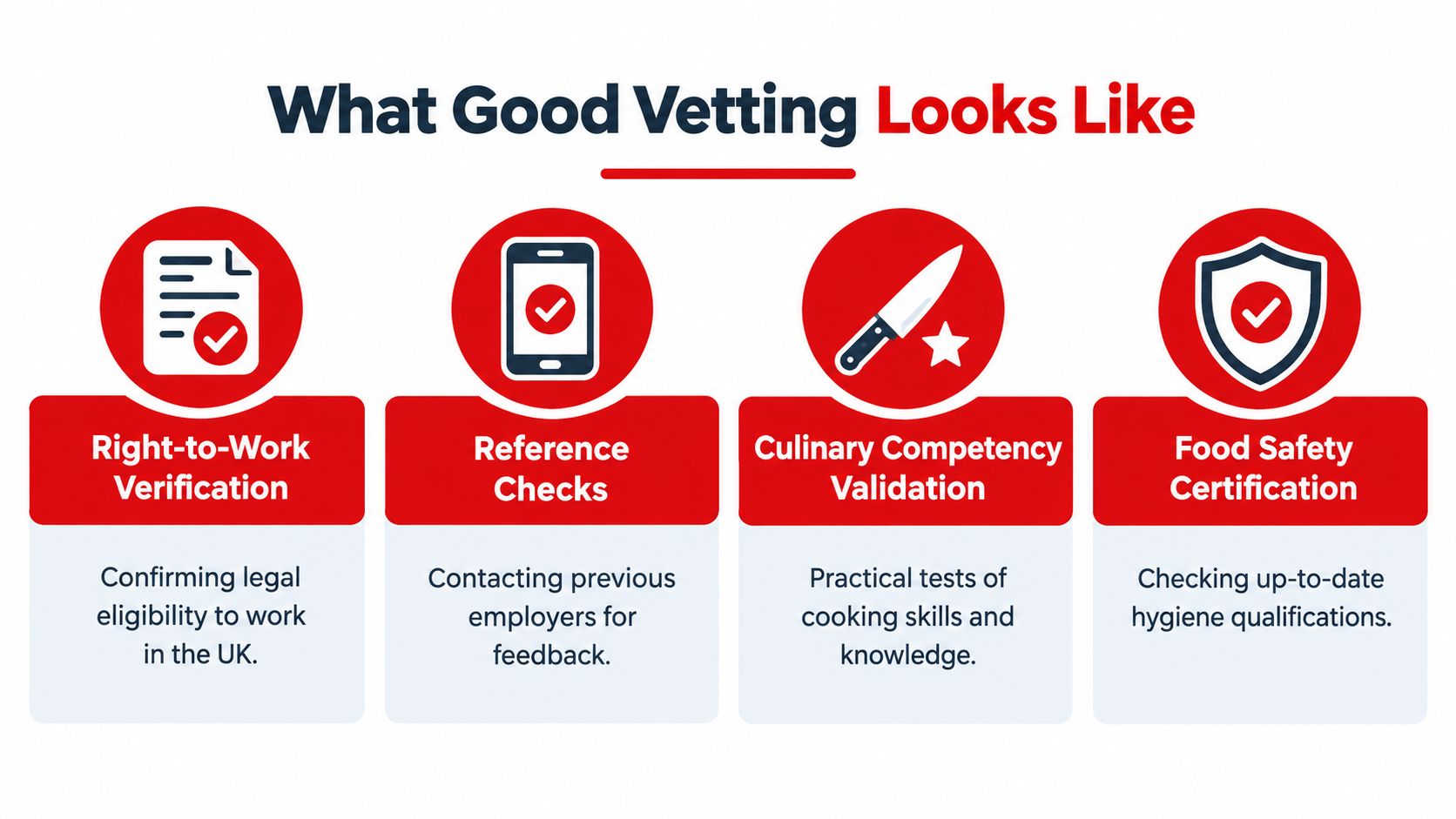
A chef's availability doesn't prove they're right for your service. Good screening checks both their eligibility to work and their ability to handle the kitchen duties for the role. Ask an agency to explain what it verifies, what evidence it holds and how it decides whether a chef suits a particular role.
Start with eligibility and references
Confirm that the agency carries out right-to-work checks and can explain how it records them. Ask whether it contacts previous employers for references and how it resolves gaps or conflicting information. If a role involves relevant responsibilities, ask whether a DBS check is appropriate and whether one has been completed.
The venue should also establish who is responsible for payroll, insurance and any employment-related obligations under the arrangement. Don't assume these details are handled just because a chef arrives through an agency. Get the responsibilities and cover arrangements clear before the shift.
Match skills to the kitchen
A useful competency check is specific to the work. Ask about the chef's experience on the required section, the scale and pace of previous services, and their familiarity with HACCP and allergen controls. If the role includes ordering or supervising others, establish whether the chef has done that work too.
For example, a chef who knows high-volume pub service may be a good fit for a busy local kitchen but not necessarily for a yacht galley or a private villa. A small mismatch can mean longer induction, extra supervision and uneven execution. The agency should be able to explain why it recommended that person for your venue.
Useful questions include:
- Eligibility: How do you verify the chef's right to work, and what records can you confirm?
- Experience: Which stations, cuisines and service volumes has the chef worked in?
- Food safety: What do you check about hygiene, allergen awareness and safe working practices?
- Contingency: What happens if the chef cancels or the match isn't suitable?
Ask about right-to-work verification for chefs as part of the conversation, and don't accept a vague assurance in place of a clear process. An agency should be able to describe its checks and the basis for matching a chef to your brief.
Pricing and Total Cost of Cover Explained
The headline agency rate is only one part of the decision. Agencies may charge through an hourly uplift, a percentage margin or a fixed monthly retainer, but these models aren't directly comparable unless you know what each includes. Check for additional charges, minimum shift terms, cancellation rules, payroll responsibility, insurance and any replacement arrangements. Relief Chefs UK publishes details of its transparent pricing model.
Compare the cost of cover with realistic alternatives. For a two-day absence, overtime may appear cheaper, but it can leave the rest of the team fatigued and less able to manage service. For a peak-season weekend, working short can mean fewer covers or a reduced menu. In a short-notice emergency at a Windsor hotel or Reading restaurant, closing a service may affect guests, bookings and future confidence in the venue.
| Option | Direct cost | Hidden cost | Risk |
|---|---|---|---|
| Agency cover | Agreed shift charge | Briefing and site induction | Match may be unsuitable if the brief is weak |
| Internal overtime | Additional hours or overtime pay | Fatigue, mistakes and disruption to other shifts | Team strain and reduced consistency |
| Reduced service or closure | Avoided labour for the shift | Lost covers, waste and guest dissatisfaction | Immediate loss of service capacity |
| Rushed permanent hire | Recruitment and onboarding costs | Mis-hire, longer training and disruption | Long-term fit may be poor |
A useful comparison includes the chef's capability, the time needed to get them productive and the service you can deliver without them. A cheap hourly quote can cost more if the chef lacks the skills for the station or needs extensive supervision. Equally, agency cover isn't automatically the right answer if the venue can safely redistribute work without damaging service.
Compare like with like: Ask each provider what the quoted rate includes, then compare it with the actual operational consequences of overtime, reduced covers or closure.
How to Choose the Right Chef Hiring Agency

Choose an agency by testing how it works under the conditions your venue faces. Ask how quickly it acknowledges a request, what its stated response time means in practice, and when it can confirm whether a suitable chef is available. A prompt reply isn't the same as a confirmed booking, so distinguish between response time and time to fill.
Regional coverage matters. A provider should understand the areas it serves and be able to discuss practical availability across places such as Bristol, the Thames Valley and coastal Wales. A national claim doesn't tell you whether an agency can cover your location, shift time and kitchen type.
Before agreeing terms, check:
- Replacement terms: What happens if the chef cancels or the match fails?
- Pricing: Are fees and any extra charges clear before you book?
- Support: Is there out-of-hours help, and who handles an urgent change?
- Insurance and payroll: Which party is responsible for each part?
- Account support: Will a named contact learn your requirements if you operate multiple sites?
Ask how the recruiter assesses kitchen fit. A specialist who understands stations, service pressure and the difference between a pub and a boutique hotel can ask better questions than a general recruiter working from a job title alone. You can also test the working relationship with a smaller cover request before discussing an ongoing plan.
chef-led knowledge can help, but judge the agency on evidence: clear communication, relevant candidate recommendations and the way it handles problems. Relief Chefs UK is a nationwide chef staffing partner established in 2013, offering relief cover and permanent recruitment; ask any prospective provider to explain the service, support and terms it can deliver for your venue.
The video below offers another perspective on recruitment and matching, but use it alongside a direct discussion about your kitchen's needs and the agency's actual process.
Placing Agencies Inside a Year-Round Staffing Plan
A good agency relationship should improve planning, not just provide a number to call when the rota breaks. Start by marking the periods when your kitchen is most exposed: seasonal trading, weddings, festivals, local events and planned staff leave. A coastal hotel in Devon or Dorset can discuss peak cover before bookings build; a venue in Wales can flag event dates early; and a Berkshire group can plan for busy periods across its sites rather than handling each vacancy in isolation.
Plan seasonal cover before the rush
Share dates, expected service patterns and the skills you'll need. A boutique hotel with a wedding programme can ask for relief chefs who understand event volume and menu execution. A pub can identify the services where its permanent rota has little room for absence or extra demand.
Early planning doesn't mean booking cover you may not need. It means agreeing what triggers a request, how much notice the agency needs and who can authorise a shift. That keeps the plan useful without locking the business into unnecessary staffing.
Keep permanent and temporary recruitment working together
Temporary cover and permanent recruitment solve different problems. A relief chef can help maintain service while a venue searches for a head chef; the permanent process can then focus on role fit, leadership and long-term stability rather than rushing to fill an empty rota.
For multi-site groups, a retainer or monthly plan may suit recurring support needs, but the terms should match actual demand. Clarify what priority access, account management or replacement support means in practice, and review usage with the provider rather than paying for a plan that doesn't fit.
Give the agency feedback after each shift. Note the station covered, service conditions, strengths and any training needed. Over time, these records help the agency understand which chefs suit which kitchens and help managers avoid repeating the same briefing from scratch. The relationship becomes more useful when the venue shares precise requirements and honest feedback, not just a last-minute request for “any chef”.
Common Questions About Using a Chef Hiring Agency
How quickly can a chef start? Timing depends on location, shift requirements and availability. Relief Chefs UK's recruitment team is available 24/7 to help you find the right cover, subject to availability, so confirm what's possible for your date and whether the agency has a suitable match.
How is compliance handled? Ask who verifies right to work, references, insurance and payroll arrangements, and what evidence is available. Agree responsibilities before the first shift.
What if a chef cancels? Check the provider's replacement process and whether out-of-hours support can help find cover.
Can agencies provide yacht and private-household chefs? Specialist placements can cover yacht chefs, villa chefs and private households. Make those requirements clear at the outset.
What should I include in my first brief? Give the date, hours, venue location, kitchen style, service volume, required station and any relevant food-safety or leadership expectations. If your need is recurring, ask how the agency handles availability, priority support and account management.
Contact Relief Chefs UK to discuss relief chefs, temporary cover, permanent chef recruitment, yacht chefs, villa chefs and wider hospitality staffing support. Share your venue, location and staffing gap with Relief Chefs UK and ask what cover is available for your next shift.
Call the team.
Office 01392 715474 · info@reliefchefs.co.uk