

A chef calls in sick at 3pm. The bookings are full, prep is only half done, and the head chef is already deciding which section can be stripped back without guests noticing. By 5pm, the choice is usually uncomfortable: pay for reliable cover, ask an exhausted brigade to absorb another station, or risk slower service, inconsistent plates and an avoidable loss of revenue.
That is the operator's reality behind chef restaurants London searches. London's dining scene keeps producing ambitious menus, new openings and demanding service standards, but the kitchens delivering that food still depend on people being present, competent and properly briefed. A dependable cover plan protects more than a rota. It protects the pass, the team and the guest experience.
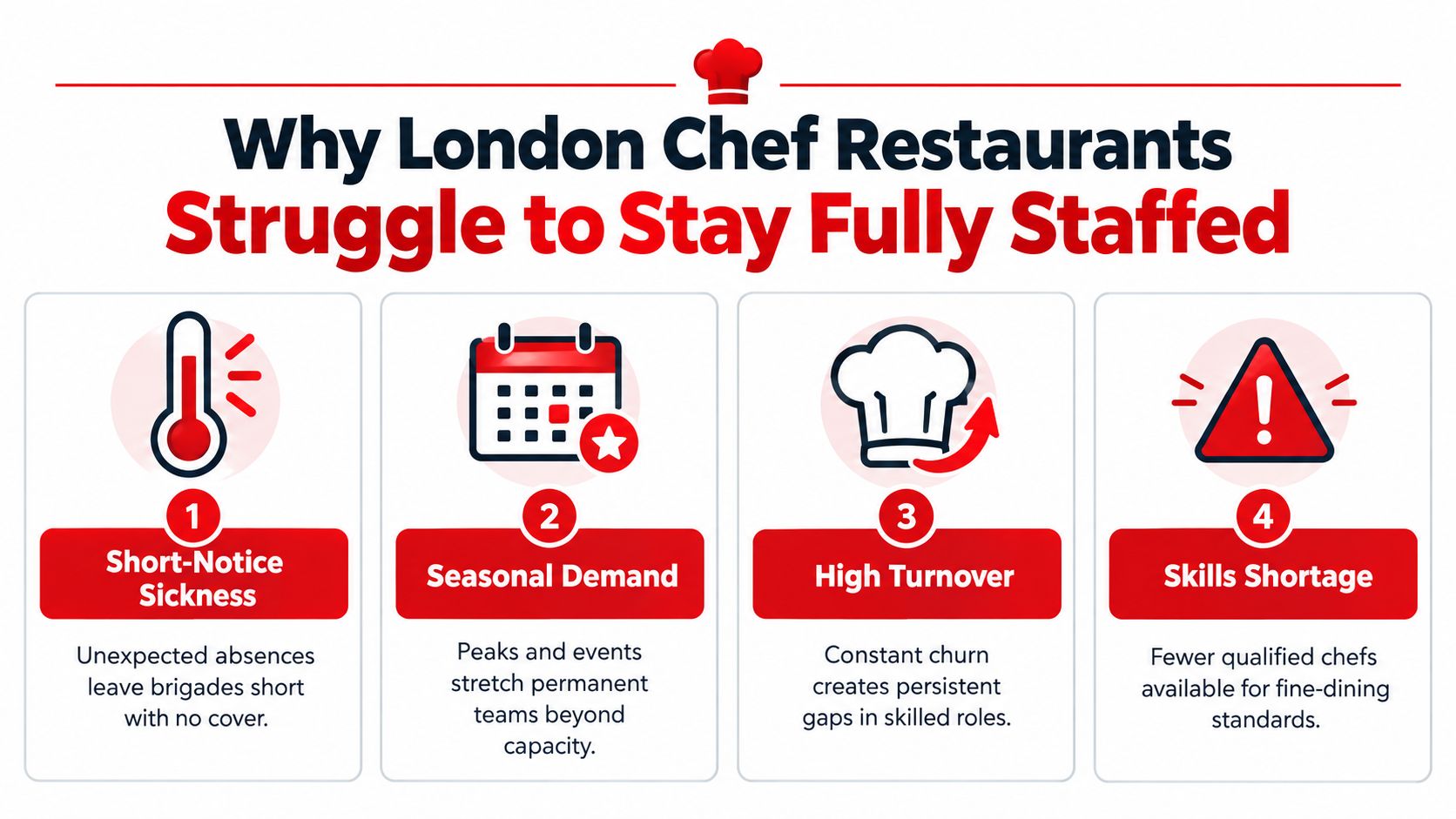
Why London Chef Restaurants Struggle to Stay Fully Staffed
A busy London Saturday can reveal a rota problem that stayed hidden all week. A commis calls in sick, the pastry chef is covering breakfast elsewhere, and a private dining booking adds another service to an already tight plan. The remaining chefs may stretch for one shift, but that approach cannot safely carry a kitchen through repeated pressure.
London is particularly exposed because a large share of the UK's chef workforce and restaurant activity sits in the capital. Research from the Centre for London on the capital's food scene reported that the number of chefs working in London had tripled over 10 years. It recorded about 55,000 chefs and cooks employed in the capital in 2016, alongside roughly 45,000 waiting staff and 50,000 kitchen and catering assistants. The research also stated that 21% of the UK's chefs worked in London, while around 20,000 chefs leave the profession each year across the UK.
Demand keeps moving faster than the rota
London's restaurant market continues to change. The Office for National Statistics records for restaurants in London track businesses by count, employment and turnover across VAT and PAYE businesses. Industry reporting estimated more than 11,400 restaurants in 2025, while Harden's reported 146 new openings in the previous 12 months and net growth of 81 in its 2026 London guide.
That density gives chefs plenty of employment options and forces restaurants to compete for experienced people. A kitchen in Soho, Shoreditch, Mayfair or Canary Wharf may be recruiting against a hotel, private club, event caterer or newly opened neighbourhood restaurant. A capable permanent employee can also become unavailable quickly during weddings, festivals, sporting fixtures, Christmas trading and private dining periods.
Churn makes a vacancy a continuing operational risk
A resignation is rarely a single vacancy. The kitchen must keep service running while the employer advertises, interviews, checks documents, waits for notice and trains a replacement. The pressure is sharper in a small brigade where only one chef can run a specialist or high-volume section.
The UK hospitality turnover benchmarks estimate sector turnover at 52% across accommodation and food services. More detailed employer-reported figures put turnover at 38.7% in hospitality and catering, 39.1% in restaurants and cafés, and 43.2% in quick-service restaurants. For operators, that means planning for roughly 4 in 10 kitchen hires to churn within a year unless retention controls are in place, while service still needs cover during replacement.
Practical rule: If one absence forces the head chef to abandon planning, ordering or quality control, the rota is already too fragile.
Short-notice sickness is only one pressure. Seasonal demand, agency unreliability, chef shortages and fatigue can all destabilise a kitchen. Relief cover works best when planned alongside permanent recruitment and training, rather than bought after service has already started to fail.
When to Book Relief Chefs Instead of Stretching Your Brigade
The right question isn't whether the kitchen can physically open. It's whether the brigade can deliver the planned menu safely, consistently and without damaging the team's ability to trade the following day.
A head chef can often rearrange prep, simplify a garnish or move a capable commis onto a quieter section. That flexibility is useful. It becomes dangerous when managers use it to disguise a repeated staffing gap.
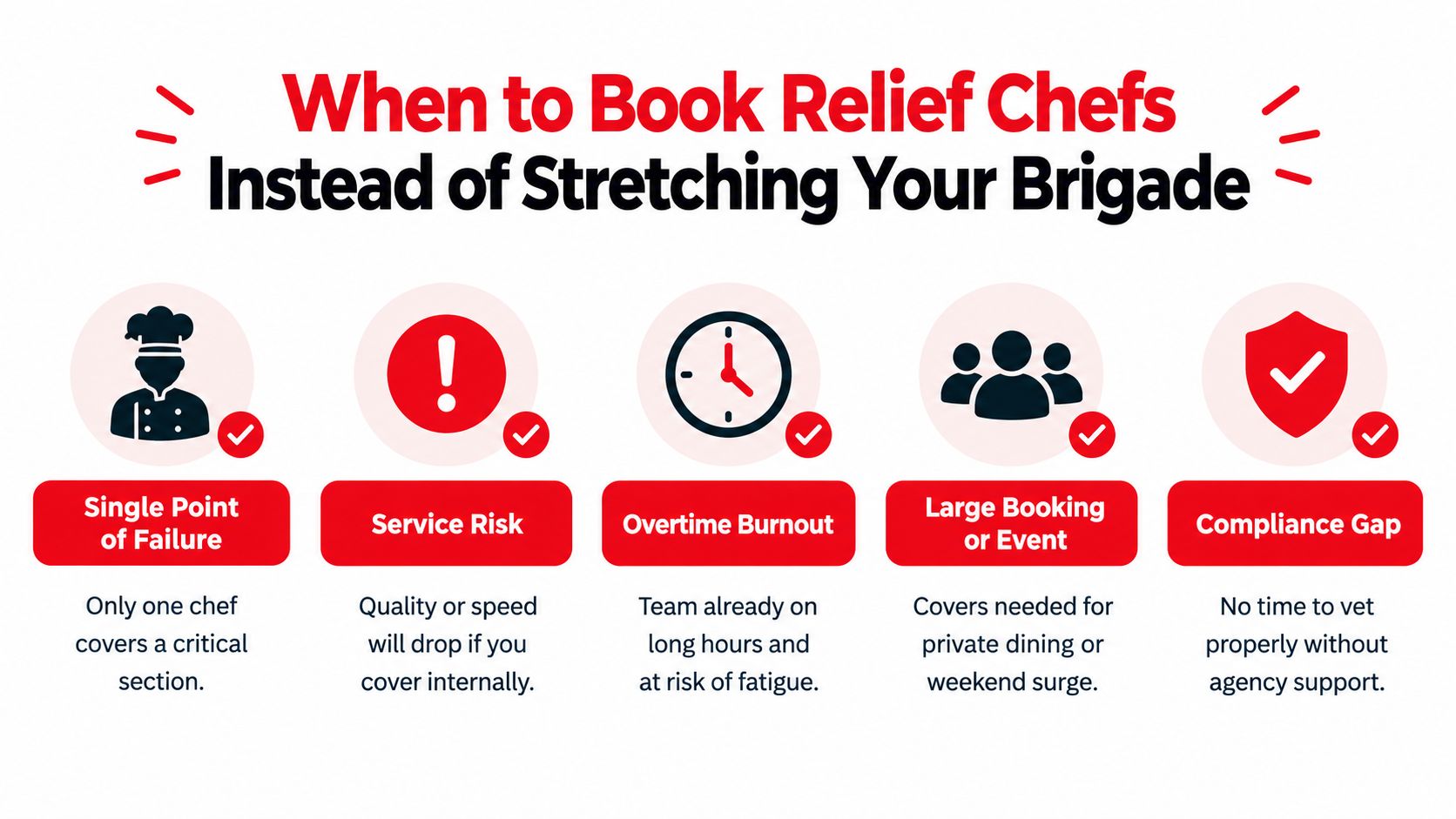
Use five practical triggers
A single chef covers a critical section. If only one person can run sauce, pastry, grill or a specialist dietary station, book cover before that person becomes unavailable. Cross-training helps, but it doesn't create experience overnight.
Service quality will fall if you cover internally. Look at the actual menu and expected covers. If moving a chef creates slower firing, weaker plating or unfinished prep, the apparent saving is likely to appear later as complaints, refunds or lost repeat business.
The team is already carrying fatigue. One additional long shift may seem manageable at breakfast. It can become a food-safety and retention problem by the end of a busy week. A relief chef can give the permanent brigade room to recover while maintaining the booking.
A large booking is already confirmed. Private dining, weekend surges and seasonal events should trigger a staffing review before the final week. Waiting until the rota breaks leaves the manager choosing from whoever is still available, not whoever suits the operation.
There isn't enough time for proper checks. If a same-day request leaves no realistic time to verify right to work, references, hygiene knowledge and insurance, use a specialist staffing route with those controls already built into the process.
The financial decision should include the cost of running short. A stretched brigade may produce a service that technically opens but misses preparation deadlines, sends the head chef onto the pass instead of managing quality, and leaves the next shift underprepared. It can also force permanent chefs to work extra hours, increasing the likelihood of another absence.
Protect the following service
Relief cover works best when managers book against a known risk rather than a vague feeling that the rota looks uncomfortable. Review the next fortnight for leave clashes, events, menu launches, school holidays, hotel occupancy peaks and chefs with no trained backup.
The UKHospitality workforce campaign describes 132,000 vacancies across the sector, which it said was 48% above pre-pandemic levels. That wider pressure matters to London operators because a last-minute phone round may reach several businesses facing the same shortage.
A sensible trigger is simple: if losing one person would make the service unsafe, materially reduce the menu or push the team beyond sustainable hours, book relief cover. Keep stretching for the occasional minor disruption. Don't build your business model around permanent staff rescuing every gap.
Where to Source Vetted Chefs Quickly in London
Not every sourcing channel solves the same problem. A WhatsApp message may find a familiar chef, but it rarely gives an operations manager a dependable process for availability, documentation, references or replacement. A general temp agency may move quickly, yet its checks may be designed for broad hospitality roles rather than a chef-led kitchen with allergens, section skills and pass standards to protect.
Chef-specific pressure remains acute. A 2026 industry update from the Craft Guild of Chefs reported chef vacancies rising 83.4% year on year to 40,395 postings in Q2 2026. The same update highlights the risk of relying on standard recruitment lead times when demand rises quickly. Restaurants should build a cover pipeline in advance and treat same-week sourcing as a contingency, not a normal staffing method.
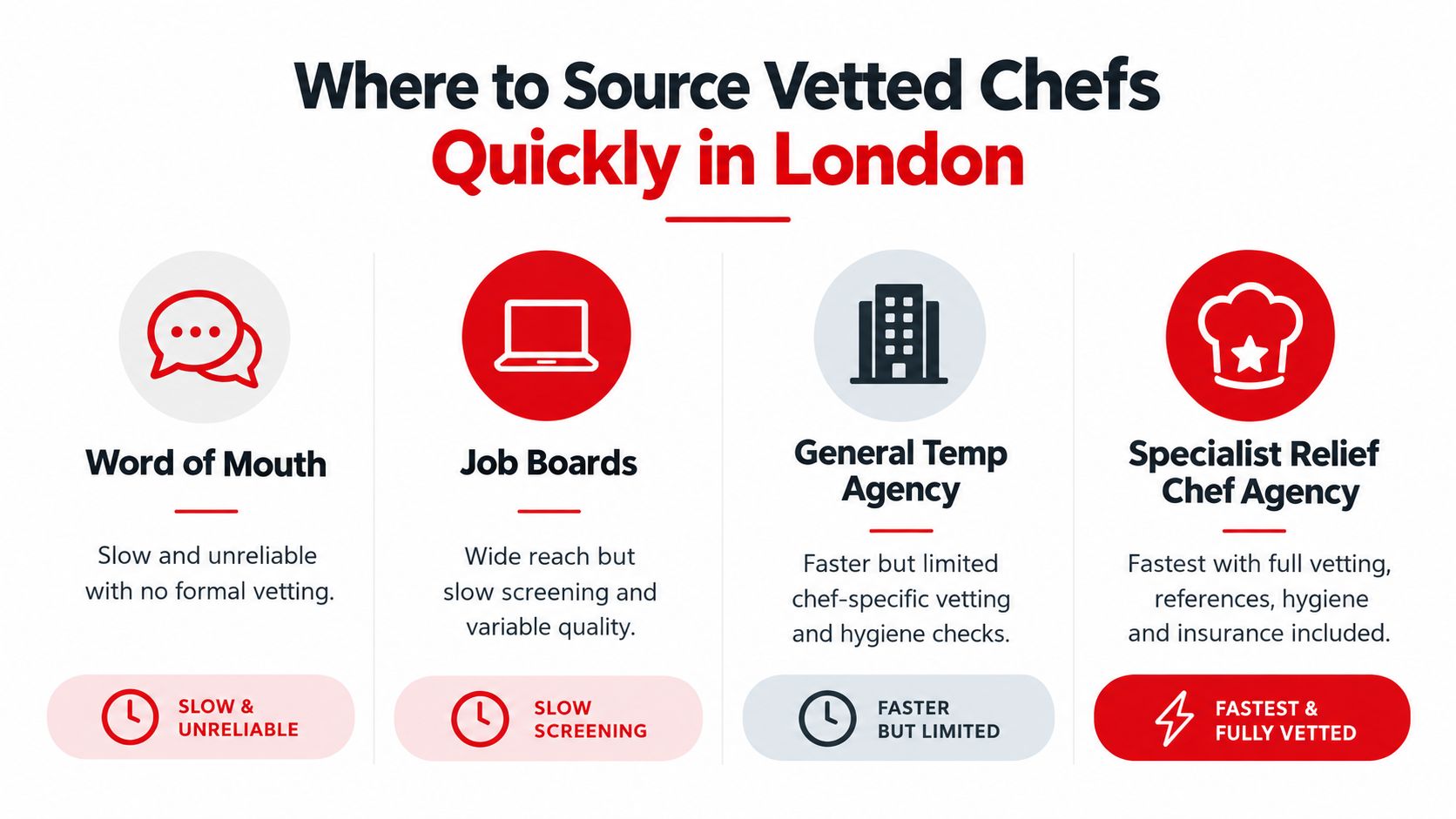
Compare the main routes
| Sourcing route | Where it helps | What can fail |
|---|---|---|
| Word of mouth | A chef may already understand your style and standards | Availability is uncertain, records may be incomplete and the contact may recommend someone they barely know |
| Job boards | They provide broad reach for permanent chef recruitment | Screening takes time, and applicants may not be available for the required shift |
| General temp agencies | They can supply hospitality workers across several roles | Chef-specific skills, hygiene checks and section experience may vary |
| Specialist relief chef agencies | They focus on chef availability, suitability and short-notice cover | You still need to brief the agency accurately and agree the commercial terms |
A specialist temp chef agency in London should be able to discuss the actual operation, not just send a name. Explain the cuisine, service style, section required, equipment, shift pattern, dress expectations, travel constraints and whether the chef needs to work independently.
Build a pipeline before the pressure arrives
The best time to speak to a staffing partner is before the Friday-night absence. Share a rolling calendar of annual leave, known events, menu changes and likely busy periods. That gives the agency a useful picture of the operation and makes it easier to match a temporary chef to the right environment.
A London restaurant may need a strong chef de partie for a Mayfair service, a senior temporary chef for a small independent kitchen in Hackney, or a broader hospitality staffing solution for a hotel group operating across the capital. Those are different requirements. A generic request for “a chef tomorrow” produces less reliable results than a precise brief.
Use word of mouth and job boards to strengthen your long-term talent pool. Use a chef-focused agency when the business needs verified availability, rapid matching and a credible fallback if the first chef becomes unavailable.
The strongest arrangement combines channels. Permanent recruitment builds the core brigade, direct relationships create resilience, and relief chefs cover sickness, seasonal demand and unexpected bookings. That combination is more dependable than expecting one source to solve every staffing problem.
How to Vet and Comply at Speed Without Cutting Corners
A chef calls in sick two hours before service. The replacement may be available, but the booking still needs an evidence trail. Rushed onboarding can leave gaps that become difficult to defend after an incident, inspection or dispute. A fixed process protects the restaurant without slowing a sensible booking.
London's labour supply also has practical limits. A major London-focused hospitality report said 85% of London chefs were born abroad, and recent reporting stated that chefs were excluded from the Skilled Worker visa route from 22 July 2025, as covered in the UK Government right-to-work guidance. The Hospitality Professionals Association update on chef recruitment explains why visa constraints can make recruitment and retention more fragile. Previous work at another venue does not prove that a chef remains eligible to work.
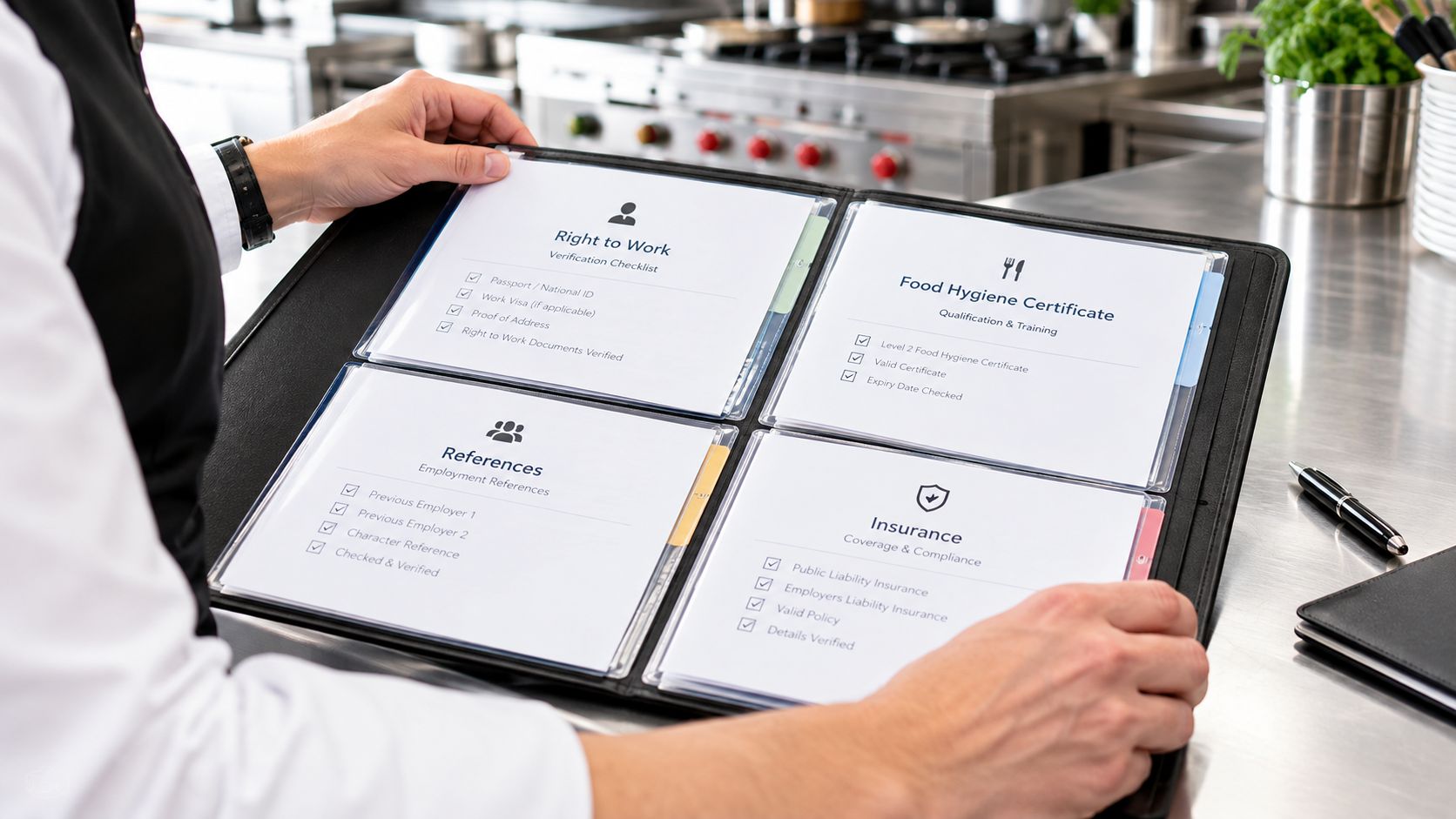
Run the checks in a fixed order
Confirm the role and identity. Record the chef's full name, contact details, role, proposed dates and reporting manager. A clear booking record prevents confusion when temporary chefs cover different sites.
Complete the right-to-work check. Use the employment verification checklist to record documents, share codes and expiry dates consistently. The UK guidance requires employers to ask every prospective worker to prove their right to work. Inspect original acceptable documents or use the online share-code route, then check the photograph, date of birth, expiry date and work restrictions.
Verify relevant experience. Ask which section the chef can run without supervision. Strong grill skills do not automatically qualify someone for pastry, garde manger or high-volume breakfast service. Confirm the scale and style of the kitchen, not only the job title.
Check references and reliability. References should cover attendance, conduct, technical ability and performance under pressure. Ask whether the chef followed recipes, allergen controls and cleaning procedures, and whether they arrived on time.
Confirm food-safety expectations. Check training records and explain the venue's allergen process before the shift. A chef working for one service still needs to understand separation, labelling, front-of-house communication and escalation when information is uncertain.
Review insurance and agency records. Confirm who employs or contracts the chef, what insurance applies and who arranges a replacement if the chef cannot attend. “Fully vetted” is not enough unless the checks behind that description are clear.
Watch for avoidable warning signs
A chef who cannot explain available dates, gives contradictory work history or avoids basic compliance questions should not be rushed into a busy service. Pause the booking if nobody can confirm the exact address, start time, parking arrangements or public transport options.
A short trial shift can show more than a long phone call, provided its purpose is defined. Give the chef a realistic section, state the required standard and watch communication, organisation, knife control, cleaning and response to correction. The trial tests operational fit. It does not replace legal checks.
Pricing Contracts and First Day Onboarding That Protects Service
In a market with thousands of competing restaurants and steady new openings, a temporary chef booking should be treated as an operational contract, not an informal favour. As noted earlier, London's restaurant market remains crowded and active, so unclear commercial terms can become expensive when service is already under pressure.
Ask for a written rate before confirming the shift. It should state what the charge includes, whether holiday pay or other employment costs are included, how invoices are issued, when payment is due and whether agency or administration fees apply. Clear pricing lets a general manager compare cover with the cost of closing a section, delaying service or overworking the permanent brigade.
Put the important terms in writing
A short-term agreement should identify:
- Shift details: Date, start and finish time, location, role, section and expected duties.
- Service expectations: Cuisine, cover pattern, menu complexity, prep requirements and pass responsibilities.
- Cancellation terms: What happens if the venue cancels, the chef becomes unavailable or the booking changes.
- Replacement arrangements: Who contacts the venue, how quickly a replacement is sought and whether an extra charge applies.
- Accountability: Who supervises the chef, approves hours and handles performance concerns.
- Insurance and compliance: Which party holds the relevant cover and records right-to-work and employment checks.
For recurring cover, the service-level agreement options from Relief Chefs UK provide a way to formalise these expectations. The wording should remain clear enough for the head chef, duty manager and accounts team to use without interpretation during a busy week.
Make the first hour useful
A relief chef should arrive knowing where to report and what section needs attention. Send a short joining brief before arrival, then deliver a focused induction on site.
Before the shift, provide the address, contact number, uniform requirements, parking or travel information, menu, expected service and known allergens. Include the name of the person in charge and the section the chef will cover. Confirm whether the chef is expected to prep, run service, close down or take responsibility for a particular station.
On arrival, show the hand-wash point, staff areas, fridges, freezers, chemical storage, fire exits, first-aid arrangements and waste process. Then explain the day's prep, par levels, ticket system, plating photographs and escalation route. Keep the briefing practical. A chef cannot work safely if key information is scattered across verbal instructions and handwritten notes.
Before service, taste key sauces, check the prep list and confirm how allergies move from front of house to the pass. Clarify who can change a dish, stop a plate or call the head chef. A senior temporary chef can work independently, but independence still requires a defined brief and a named decision-maker.
The operating plan will vary by venue. A small London restaurant might use a relief chef to run larder while the head chef stays on the pass. A boutique hotel in Windsor may need a breakfast chef who can manage volume and dietary requests. A private event in Berkshire may require a senior chef who can adapt to a changing menu. In each case, define the standard, authority, handover point and priorities before the first ticket lands.
Keep Your London Kitchen Covered With Relief Chefs UK
London operators need more than a list of available names. They need a staffing partner who understands what happens when a chef arrives late, a section is unfamiliar, an allergen question reaches the pass or a temporary booking turns into a permanent requirement.
Relief Chefs UK is a nationwide chef recruitment agency established in 2013, run by chefs rather than recruiters. Its team brings 60+ years of combined kitchen experience and supports 400+ venues with relief chefs, temporary chefs and permanent chef recruitment. The service also covers yacht chefs, villa chefs and wider hospitality staffing support for independent venues, private households, boutique hotels and multi-site groups.
The operating model is designed for pressure. Clients can request cover through a short form or by phone, receive a response within two hours, and meet fully vetted, right-to-work-checked chefs who can start within 48 hours. 24/7 support, transparent pricing with no hidden agency fees, full insurance and flexible Starter, Growth and Premium plans give operators different levels of cover, from a single independent pub to a hotel group with recurring requirements.
Match the staffing plan to the operation
A restaurant in central London may need relief cover for sickness and weekend demand. A hotel in Berkshire or Windsor may require a repeatable breakfast and banqueting pipeline. A pub group across Devon, Bristol, Wales or Dorset may need temporary chefs during seasonal peaks while it recruits permanent staff.
The practical choice is not relief or permanent staffing. Strong operations use both. Permanent recruitment builds continuity, relief chefs protect the rota when people are absent, and a structured staffing relationship reduces the scramble around every busy period.
A good briefing should include the role, station, dates, service style, menu, location and any compliance requirements. That gives the staffing partner a realistic basis for matching, rather than forcing the venue to accept whoever happens to answer first.
Don't wait until the line is already short. Put a cover plan in place before annual leave, private dining, seasonal demand or a resignation turns a manageable rota into a service emergency.
Relief Chefs UK provides vetted relief and temporary chefs for London restaurants, alongside permanent chef recruitment, yacht chefs, villa chefs and wider hospitality staffing support across the UK. Visit Relief Chefs UK to request reliable cover, discuss your staffing plan and give your kitchen a dependable response when short-notice pressure hits.