
Saturday lunch is already moving when the head chef phones in sick. The general manager of a busy gastropub has two agency chefs on the line, a full dining room and no time to rebuild the prep plan. Then an environmental health officer arrives unannounced. Within the first part of the visit, the officer wants to see the walk-in fridge, probe calibration, the HACCP folder, allergen information and cleaning records.
The kitchen may look busy and productive, but missing records, unclear handovers and inconsistent controls quickly expose whether food safety standards are part of daily work or just paperwork prepared for an inspection. This guide focuses on the details that decide that outcome, from legal duties and temperature control to allergen management, traceability, audit routines and the safe use of temporary chefs.
The Inspection That Changed How This Kitchen Runs
The general manager had inherited a kitchen that appeared organised from the dining room. Fridges were full, the pass was clean and service was selling well. Behind the scenes, however, the temperature folder contained gaps, the cleaning schedule had been signed in advance and the allergen matrix still showed dishes removed from the menu.
The two agency chefs weren't the cause of every weakness. They revealed how much knowledge had been held by the absent head chef rather than built into the operation. One chef didn't know which refrigerator was assigned to raw fish. The other had never been shown where the probe thermometer was kept, or who could answer an allergen question from front of house.
Practical rule: If a process only works when one chef is present, it isn't a reliable food safety system.
A good inspection isn't about catching a team out with obscure theory. An officer wants evidence that the business understands its hazards, controls them and acts when something goes wrong. That means a working HACCP system, accurate temperature records, cleaning verification, allergen controls, staff training and traceability documents that match the food being served.
What the operator needs ready
For an independent pub, restaurant or boutique hotel, the essentials should be available without a prolonged search:
- The food safety management system: A current HACCP-based pack, such as Safer Food, Better Business or an equivalent system.
- Temperature evidence: Fridge, freezer, cooking, cooling and hot-holding checks, with corrective action where results fall outside limits.
- Allergen controls: A menu-linked matrix, ingredient specifications and a clear process for customer questions.
- Cleaning and pest records: Signed schedules, chemical information, contractor visits and follow-up actions.
- Training and handovers: Certificates, induction records and shift notes that temporary chefs can understand.
The practical aim isn't to create a decorative compliance folder. It's to make the right action obvious during a Saturday service in Devon, Bristol, Wales, Berkshire or any other hospitality hotspot where sickness and seasonal demand can change the kitchen team overnight.
What the UK Food Safety Framework Actually Requires
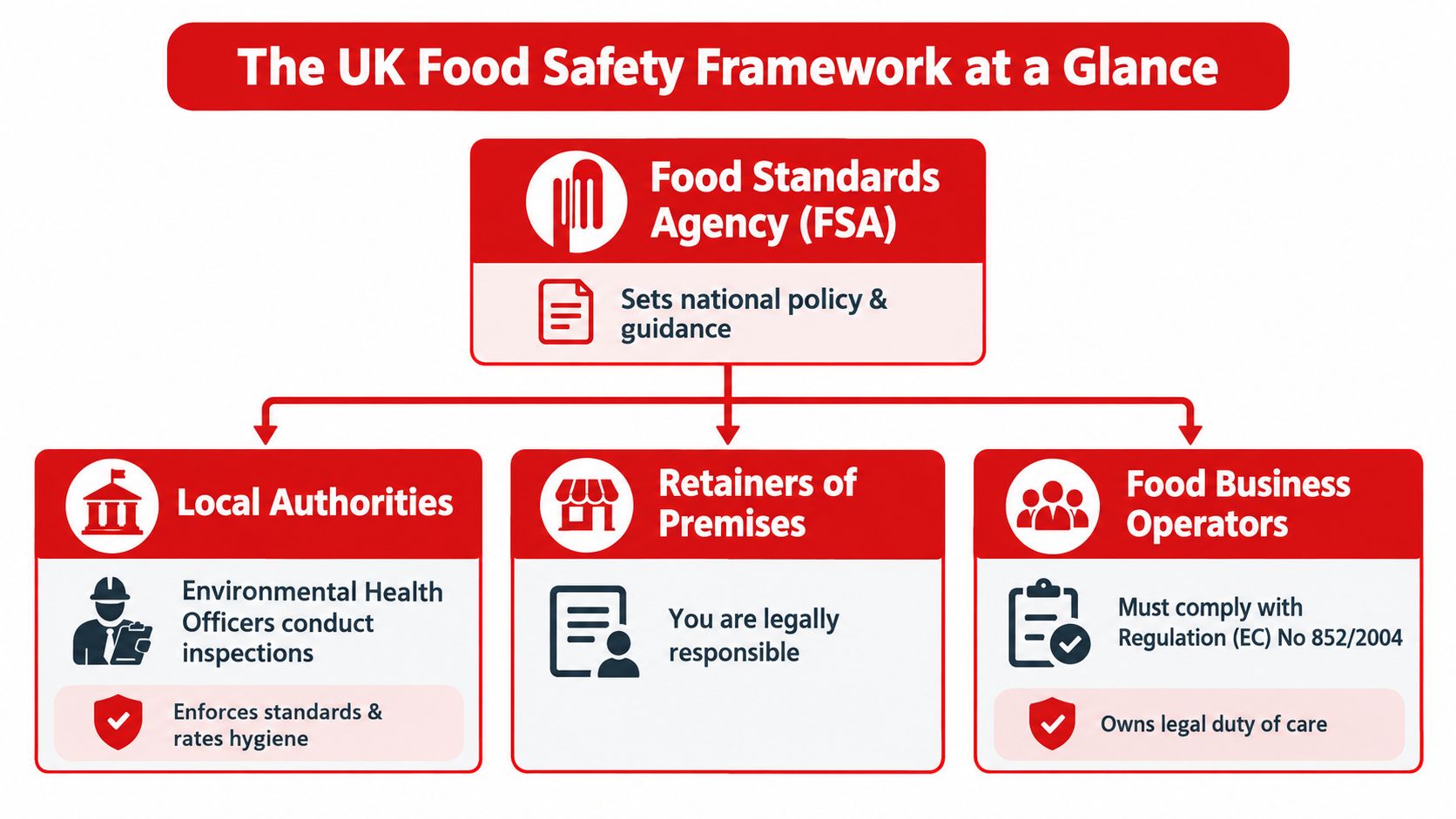
The UK food safety system has several layers, and venue owners need to know which responsibility sits where. The Food Standards Agency, created in April 2000 after major food incidents in the 1980s and 1990s, was designed as an independent government department covering England, Wales, Northern Ireland and Scotland. Its creation moved oversight towards a single public-interest body focused on public health and consumer interests. The FSA's institutional history explains that development.
Local authority environmental health officers carry out inspections and enforce food law at venue level. The Food Hygiene Rating Scheme gives participating businesses a public score from 0 to 5, where 0 means urgent improvement is necessary and 5 means very good. The assessment covers food hygiene and safety procedures, structural requirements and confidence in management, as outlined by Oxford City Council's FHRS guidance.
The operator's legal duty
The food business operator remains responsible for making sure the premises, people and procedures protect consumers. Regulation (EC) No 852/2004, retained in UK law, requires permanent procedures based on Hazard Analysis and Critical Control Point principles. HACCP isn't an optional quality project for large hotels. It should identify hazards, define controls, assign responsibility and record what the team does when a control fails.
The head chef turns that system into a workable kitchen routine. They set recipes, storage rules, cooking controls, cleaning tasks, allergen information and training expectations. Each shift worker must follow those controls, report problems and avoid serving food when they don't have the information needed to do so safely. This UK HACCP overview summarises the legal requirement under Article 5.
Natasha's Law applies to prepacked for direct sale food, including sandwiches, salads and grab-and-go items. Since 1 October 2021, PPDS food must show the food name and a full ingredients list, with any of the 14 major allergens emphasised. Shropshire Council's explanation of Natasha's Law sets out the labelling obligation.
A due diligence defence depends on evidence that the business took reasonable precautions and exercised proper checks. That could include supplier records, training certificates, signed monitoring sheets and corrective-action notes. Managers who need a practical starting point can use Level 2 food hygiene training for kitchen teams alongside a venue-specific HACCP pack.
Inspection frequency and re-rating arrangements can vary between local authorities. A 5 rating is useful evidence of the last inspection, but it doesn't replace today's checks, today's staff briefing or today's control of a changing menu.
The Five Pillars of Day-to-Day Compliance
A kitchen's food safety standards are only as strong as its routine controls. Inspectors usually notice the same five areas first: temperature, cleaning, allergens, personal hygiene and traceability. Each one needs an owner, a record and a response when the result isn't acceptable.
Temperature control
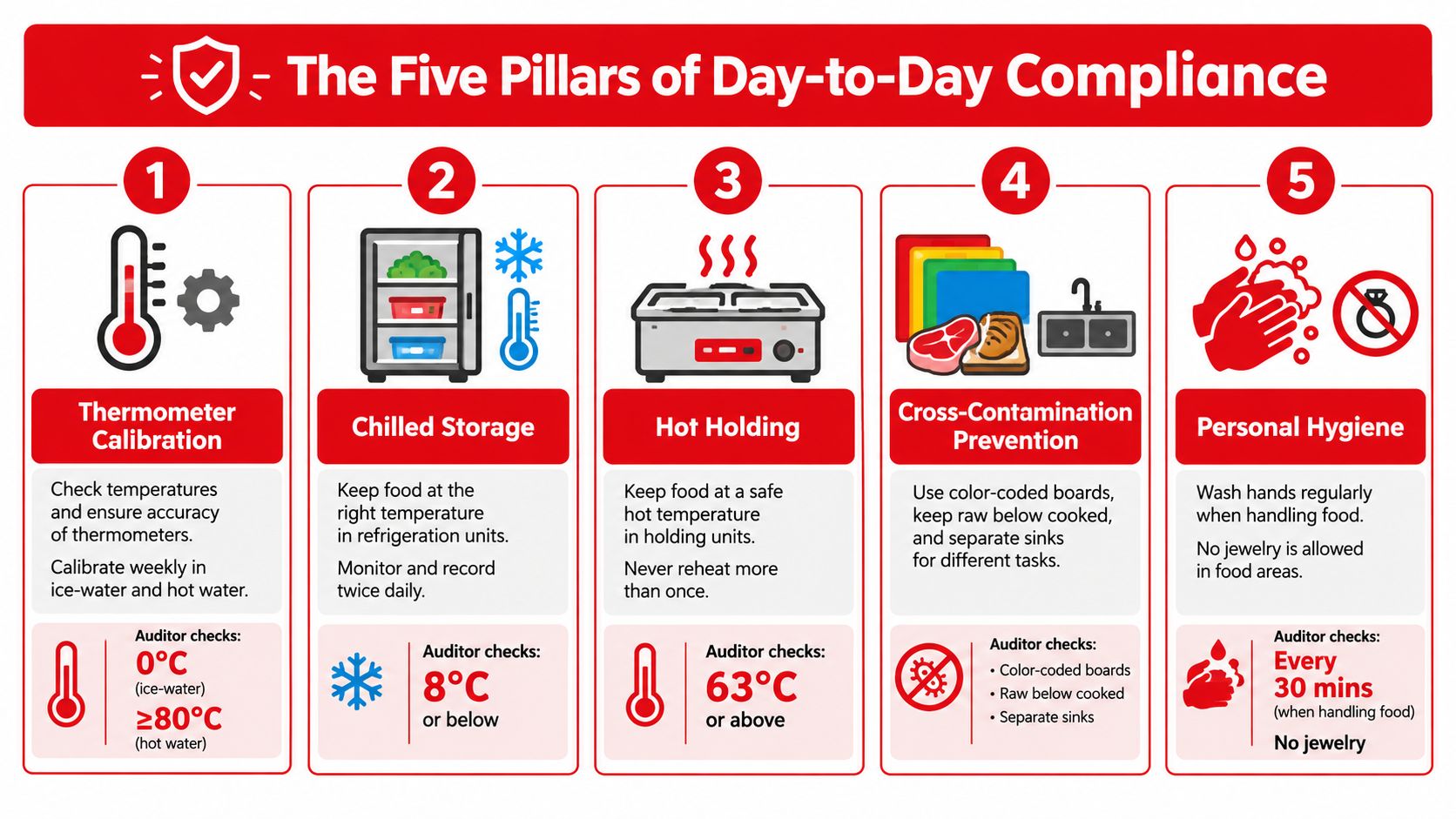
For immediate service, cooked food should reach 70°C for 2 minutes. Equivalent combinations are 75°C for 30 seconds or 80°C for 6 seconds, according to UK government cooking guidance. Food held hot for later service should remain at or above 63°C.
For chilled high-risk foods, the legal ceiling is 8°C. In practice, operating refrigerators between 1°C and 5°C gives a useful margin for door opening and thermostat variation, as described in commercial food business temperature guidance. Don't just write down a number. Check with a clean, sanitised probe and record what happens when food is outside the limit.
Cleaning and separation
A cleaning schedule should name the surface, chemical, dilution, frequency, responsible person and verification method. A cloth that moves from a raw preparation bench to a salad station defeats an otherwise sound schedule.
Keep raw preparation physically or procedurally separate from ready-to-eat food. Store raw products below cooked or ready-to-eat items, use clearly assigned equipment and sanitise probes between checks. The cross-contamination prevention guidance is useful for turning those principles into shift-level habits.
Allergens
The allergen matrix must match the current menu, recipe versions and supplier specifications. When a chef changes a sauce, garnish or bought-in dessert, someone must update the matrix before service and brief front of house.
Shared fryers, tongs, chopping boards and storage containers create risks that a printed label can't solve. A server who can't confirm an ingredient should pause the order and ask the designated manager or chef, rather than guess.
Personal hygiene
Handwashing needs accessible sinks, hot and cold running water, soap and disposable drying facilities. Staff must report relevant illness, wear suitable protective clothing and keep jewellery and personal items away from food handling. A clean jacket doesn't compensate for poor handwashing after handling raw poultry or touching a phone.
Traceability
Keep evidence that identifies suppliers and deliveries, including invoices, product specifications and relevant batch information. The useful test is simple: can the manager identify where an ingredient came from and which customers or dishes may be affected if a problem is discovered?
What Good and Bad Compliance Looks Like in UK Venues
A well-run neighbourhood pub doesn't look clinical. It looks deliberate. The probe sits in a labelled container, staff know how to sanitise it, the fridge sheet is signed at the right time and a new chef can find the cleaning chemicals without asking three people.
In a 60-cover bistro, the raw chicken board is separate from the salad board, the allergen matrix reflects the current menu and the sous chef checks that a changed garnish hasn't introduced a new ingredient. At a boutique hotel, the breakfast team records controls consistently across early starts, rather than assuming a quiet buffet is a low-risk service.
The failing kitchen often looks busy rather than dirty. A wiping cloth is dragged across an apron, a handwash basin is blocked by equipment and a catering-size mayonnaise container sits on the hot pass through an extended service. A chef smokes near the back door, returns to the kitchen and handles garnishes without washing their hands. Those are observable failures, not theoretical ones.
| Area | Pass-Worthy Venue | Failing Kitchen |
|---|---|---|
| Temperature checks | Staff use a sanitised probe and record results with corrective action | Logs are completed from memory or copied from the previous shift |
| Storage | Raw products are separated from ready-to-eat food | Raw ingredients share shelves or equipment with finished dishes |
| Allergens | The matrix changes when recipes change and front of house knows who to ask | Servers rely on memory and chefs guess about bought-in ingredients |
| Cleaning | Tasks have owners, timings and verification | Staff wipe surfaces informally and sign schedules in advance |
| Management confidence | A manager can produce records and explain the system | Nobody knows where the HACCP pack or supplier records are |
A venue doesn't need elaborate technology to improve. A laminated station map, a labelled probe location and a signed close-down checklist can fix more risk than a complicated digital platform nobody opens.
Why Temporary and Relief Chefs Make or Break Your Standards
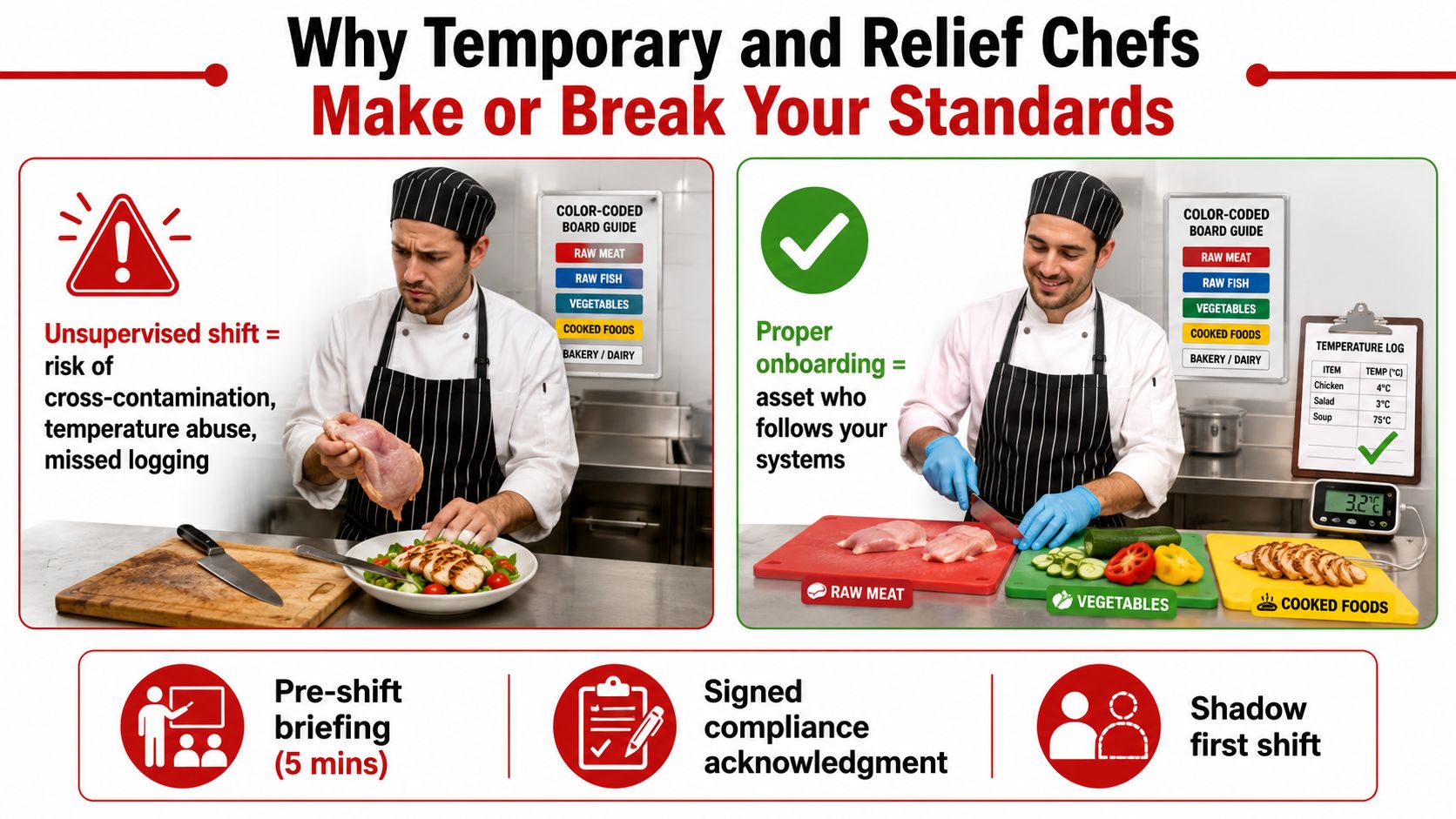
A relief chef can protect a service, or compromise the controls that took months to establish. The difference is rarely culinary ability. It comes down to whether the chef receives enough information to work safely in an unfamiliar kitchen.
An experienced cook may still put raw fish in the wrong fridge if the storage plan isn't explained. They may use the same tongs for a dish containing an allergen and one intended to be allergen-free. They may not know where the probe is kept, which records must be signed or who has authority to stop service when a control fails.
A short induction that prevents long problems
Use a site-specific induction before the chef starts prep:
- Walk the kitchen: Show raw and ready-to-eat storage, handwash points, probe location, chemical storage and waste routes.
- Explain the menu: Identify major allergens, high-risk dishes, bought-in products and any approved substitutions.
- Demonstrate the records: Show how to complete temperature, cleaning, cooling and corrective-action logs.
- Name the decision-makers: Give the relief chef the duty manager's name, the head chef's contact and the person responsible for allergen questions.
- Confirm the handover: Record open actions, stock concerns, equipment faults and the next required checks.
An unfamiliar chef shouldn't have to reverse-engineer your HACCP system during a live service.
The handover should be concise enough to use at speed, but detailed enough to remove guesswork. A practical handover documentation process can match temperatures, allergens, cleaning tasks, par levels and shift patterns to the venue's existing controls.
This matters during short-notice sickness, holidays, seasonal demand and persistent chef shortages across Bristol, Dorset, Reading, Windsor, Slough and Wales. Temporary staffing isn't a reason to lower standards. It is a reason to make the venue's standards easier for every competent chef to follow.
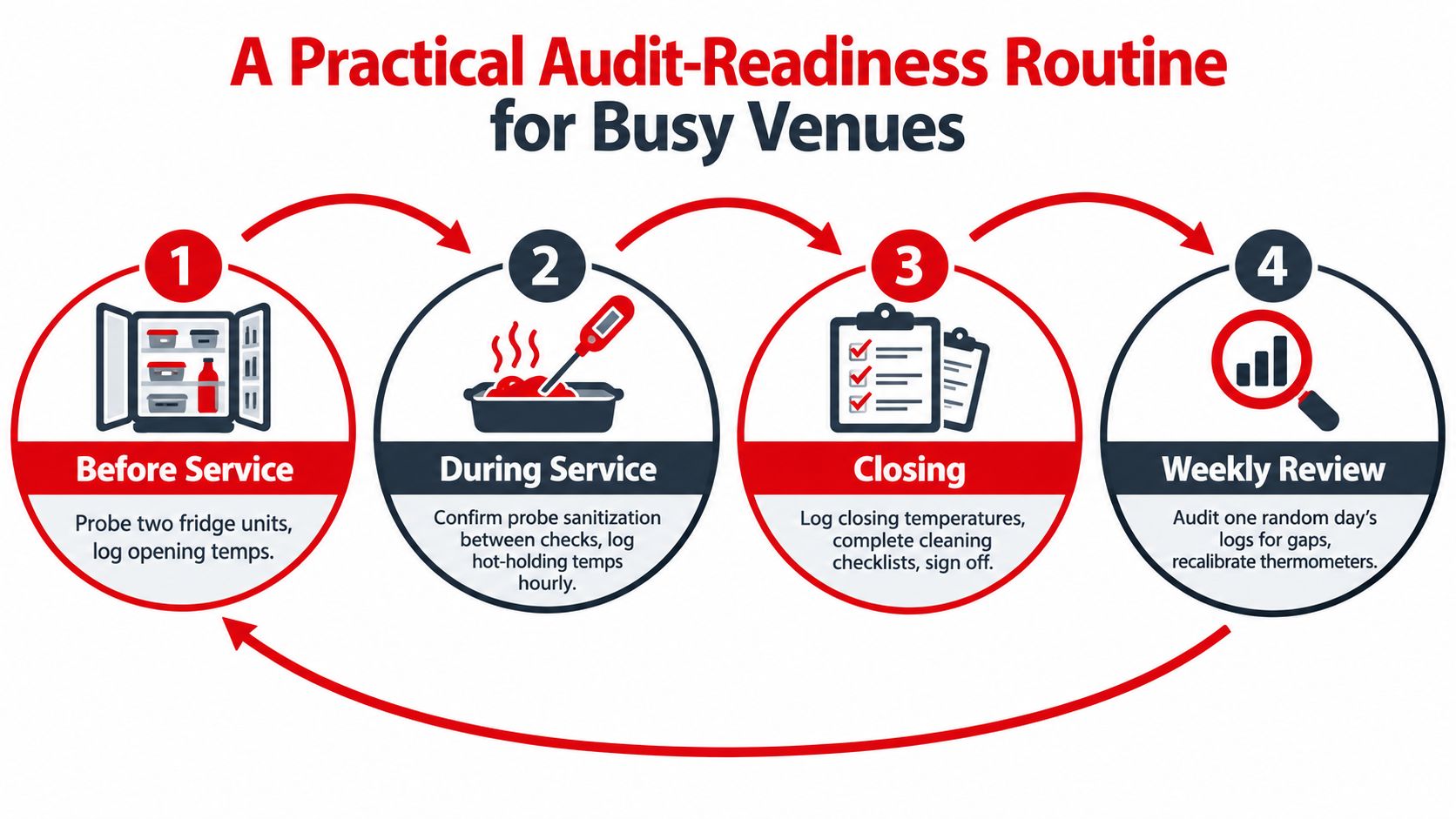
A Practical Audit-Readiness Routine for Busy Venues
Small venues don't need a full-time compliance officer to stay ready. They need a routine that fits around prep, service and close-down, with named responsibility rather than vague expectations.
Before service
The opening manager or senior chef should check two fridge units, record temperatures and inspect the handwash facilities. Date-label prepared food, confirm that paper towels and soap are available, and check that the probe is clean and ready for use.
During service, record the controls that matter for the food being served. Check hot holding, use the probe between different food types and sanitise it between checks. If a result falls outside the limit, record the action taken, not just a replacement number.
At close
Closing records should be completed while the shift is still fresh. The responsible chef signs the cleaning schedule, checks that food is stored correctly, confirms date labels and notes equipment faults for the next team.
A useful weekly review takes one completed day's paperwork and tests it against reality. Check whether the menu matches the allergen matrix, compare one supplier invoice with the delivered product and inspect whether the cleaning schedule shows meaningful verification rather than identical signatures.
Before a known visit
Use the previous 48 hours to remove avoidable friction, not to stage a temporary clean. File the temperature sheets, refresh the Safer Food, Better Business diary, complete outstanding cleaning actions and brief every shift on where records are kept.
Keep these documents immediately accessible:
- SFBB or HACCP diary: Current and signed by the responsible team.
- Training records: Food hygiene, allergen and site induction evidence.
- Cleaning schedule: Completed tasks, chemical controls and follow-up actions.
- Pest control log: Contractor reports and evidence of resolved issues.
- Supplier traceability: Invoices, specifications and delivery records.
FSA review data identified 95,000 UK businesses overdue inspection, including 871 high-risk businesses, while 96.9% of businesses in England, Wales and Northern Ireland held an FHRS rating of 3 or better. The FSA local authority performance update shows why a good public rating shouldn't encourage complacency. An unrated or overdue venue still needs to run every shift as though its controls could be tested.
Common Misconceptions That Get Kitchens a Poor Rating
A 5 rating means the kitchen is safe today. It doesn't. The score records the conditions found at inspection, while today's staffing, menu, storage and documentation may be different. A strong rating should be treated as a result to protect, not permission to stop checking.
Allergens are only a labelling problem. Labels matter, especially for PPDS food, but allergen failures also happen through shared utensils, recipe changes, supplier substitutions and poor communication between the kitchen and front of house. FSA surveillance analysed 845 products in its 2025 retail programme. Of 621 samples, 24% showed non-compliance with general labelling requirements, including allergen declarations, while 5% of 145 samples contained unauthorised ingredients. The BRCGS industry update reports those findings.
Small kitchens don't need HACCP. Every food business needs procedures based on HACCP principles. A small café may use a simpler pack than a hotel group, but the hazards still need identifying, monitoring and recording.
A clean kitchen will pass. Visible cleanliness helps, but inspectors also assess structural conditions and management confidence. Missing training records, weak traceability and unreliable probe checks can undermine an otherwise tidy room.
The inspection is the audit. Unannounced visits, complaints and follow-ups can expose a system that only works when management expects an officer. The safer approach is to make opening, service and closing checks ordinary parts of the shift.
Recent UK compliance data supports a balanced view. On 31 December 2022, more than nine in ten food businesses had a satisfactory-or-better hygiene rating, 75.7% in England, Wales and Northern Ireland achieved the top rating of 5, and 2.9% were rated 2 or below. The same FSA review recorded 1,903 food and feed safety incidents in 2024, around 2% lower than the previous year. The FSA's food safety review shows a mature system with high compliance, but not a risk-free one.
Protecting Standards While You Focus on Service
Food safety standards affect more than an inspection outcome. A visible hygiene rating can influence where guests choose to eat, while clear allergen answers help managers feel confident accepting group bookings, weddings and corporate stays. A venue that cannot answer a basic question about ingredients or records creates doubt long before an officer issues formal action.
Inspector confidence builds through repeated evidence. A completed probe check, a credible cleaning sign-off, a current training matrix and a documented response to a failed temperature each show that the manager understands the operation. Good paperwork doesn't replace good practice, but it proves that good practice is controlled rather than accidental.
Temporary staffing needs the same discipline. A replacement chef should arrive with relevant food safety knowledge, understand the host venue's HACCP system and receive a proper handover. Relief Chefs UK, established in 2013, provides nationwide relief chefs, temporary chefs, permanent chef recruitment, yacht chefs, villa chefs and wider hospitality staffing support for venues dealing with sickness, seasonal demand and recruitment shortages. Its model includes checking qualifications, Right to Work and references before placement, then aligning the handover with the venue's operating requirements.
That approach suits a Devon pub needing urgent cover, a Bristol restaurant entering a busy period, a Berkshire hotel protecting breakfast service or a multi-site group seeking permanent recruitment. The commercial point is straightforward: stable staffing makes it easier to keep temperatures logged, allergens current, cleaning completed and every shift accountable.
For relief chefs, temporary cover, permanent chef recruitment or hospitality staffing support that protects your food safety standards during sickness and peak demand, contact Relief Chefs UK. Share your venue, location, shift pattern and urgency, and arrange dependable chef cover that keeps the kitchen operating safely while you focus on guests and service.