
Friday evening. Deliveries are late, prep is tight, the pass is already under pressure, and somebody's bought in a stronger oven cleaner because the old one was out of stock. Your head chef is off, the sous is covering two jobs, and the relief chef on garnish has never worked your site before.
That's exactly where COSHH stops being “paperwork” and starts being operations.
If that new product is decanted into an unlabelled spray bottle, if nobody checks the safety data sheet, if the extractor isn't pulling properly, or if a kitchen porter mixes products because they're trying to get the job done quickly, you haven't got an admin problem. You've got a service risk, an injury risk, and a business risk.
In hospitality, hazardous substances are part of normal trading. Cleaning chemicals, sanitisers, descalers, dishwasher products, fumes, flour dust, pest-control products, cellar gases, and biological contamination all sit inside a working venue. Add short-notice sickness, seasonal trade, unreliable agency cover, and rotating temporary staff, and weak COSHH control shows up fast.
This is COSHH regulations explained in the way operators need it. Plain English, kitchen-first, and focused on what works when the venue is busy.
Why COSHH is More Than Just a Box-Ticking Exercise
A lot of venues only notice COSHH when something goes wrong.
A porter gets chemical splash on the forearm. A commis starts coughing badly during a deep clean. A temporary chef uses a spray degreaser near hot equipment because that's how the last kitchen did it. Service slows down while managers scramble for paperwork nobody can find. Guests don't see the risk assessment. They see delays, confusion, and a team that looks out of control.
That's the commercial side of poor COSHH management. It disrupts service at the worst possible time.
What failure looks like in a real kitchen
In pubs, hotels, and restaurants, the problem usually isn't one dramatic breach. It's small gaps stacked together.
- New product, no briefing: A substitute cleaner arrives from the supplier, but nobody updates the file or tells the team what changed.
- Wrong container, wrong label: Chemical gets transferred to a plain bottle for speed, so the next person has no idea what they're handling.
- Temporary cover, weak handover: A relief chef can run a section, but they still need to know your chemical store, your ventilation issues, and your emergency routine.
- PPE used as a shortcut: Gloves get handed out, so management assumes the risk is covered. It often isn't.
Practical rule: If a substance can burn, irritate, trigger breathing problems, or contaminate food areas, you need a clear control plan before service gets busy.
What works is simple. Keep hazardous products controlled, labelled, briefed, and tied to actual tasks. What doesn't work is relying on “common sense” in a kitchen where half the team is under time pressure and one person may be on their first shift in your building.
Why operators need to care
A COSHH failure doesn't stay in the safety folder. It hits labour, stock, cleaning standards, guest confidence, and management time.
For small operators in Devon, Bristol, Berkshire, Wales, Windsor, Reading, Slough, Dorset, and every other UK hospitality hotspot, the pressure is usually the same. You're trying to cover shifts, protect standards, and keep the kitchen stable. If your COSHH process only works when your permanent head chef is on site, it doesn't work.
The best kitchens build COSHH into the shift itself. Opening checks. Chemical storage. Labelling. Ventilation checks. Relief briefings. Close-down procedure. That's how you keep people safe and keep trading.
What COSHH Really Means for Your Hospitality Business
COSHH stands for Control of Substances Hazardous to Health. In legal terms, the current core framework is the Control of Substances Hazardous to Health Regulations 2002. The wider framework was first introduced in 1988 and came into force on 1 October 1989, then consolidated in 2002. That means COSHH has been part of UK workplace compliance for more than 35 years, built on the Health and Safety at Work Act 1974 structure, as outlined in EcoOnline's overview of COSHH history and legal context.
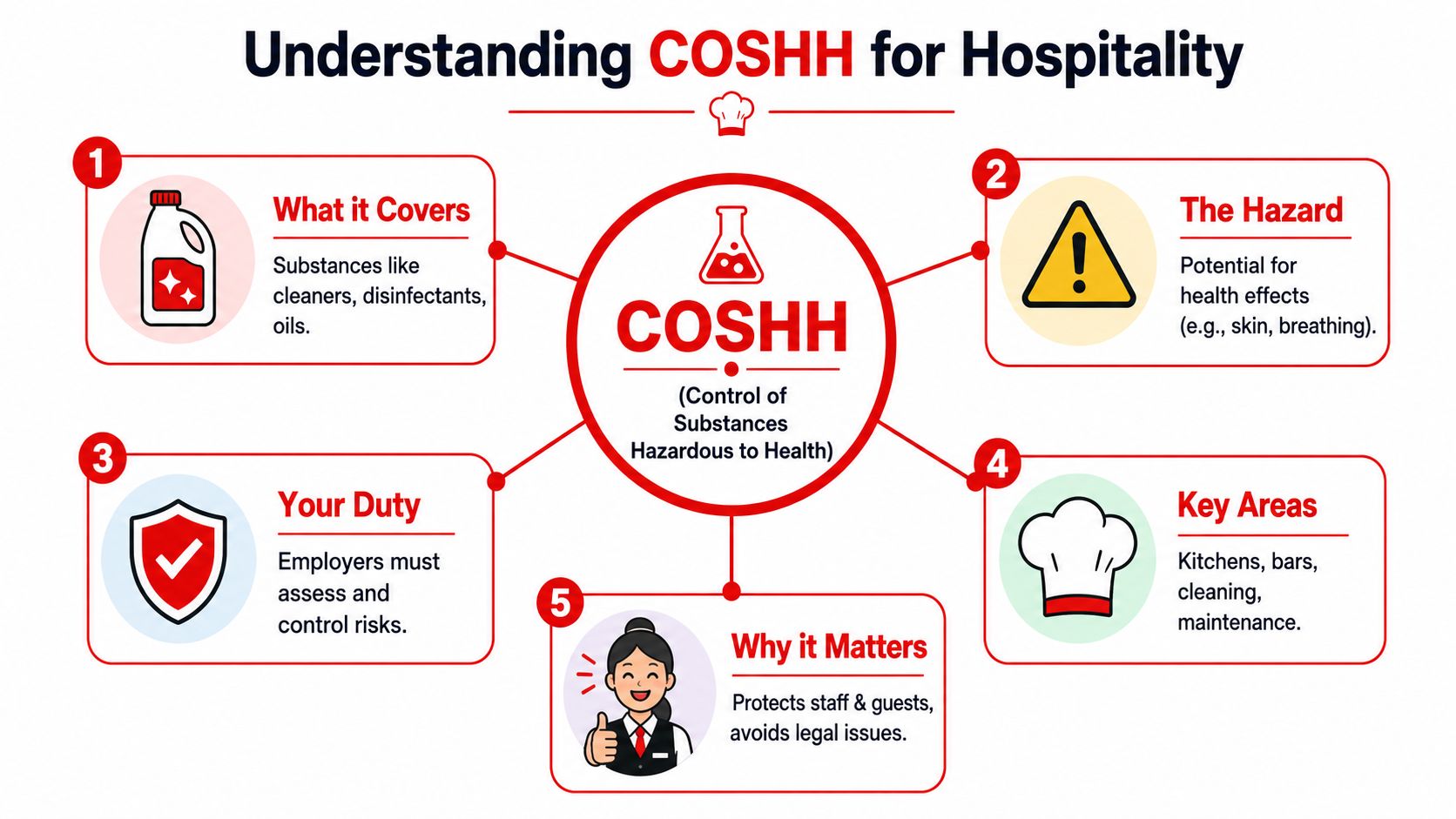
In plain English, if your business uses, stores, creates, or exposes people to substances that can harm health, you have duties under COSHH. This isn't optional and it isn't limited to factories or laboratories. It applies every day in hospitality.
What counts as a hazardous substance in a kitchen
Most operators think of bleach and drain cleaner first. Those count, but the list is wider than that.
In hospitality, common examples include:
- Cleaning products: Oven cleaner, degreaser, sanitiser, descaler, dishwasher chemicals, glasswash chemicals
- Airborne exposure: Cooking fumes, aerosol sprays, flour dust, smoke, steam carrying chemical residue
- Cellar and maintenance risks: Carbon dioxide in cellar areas, refrigerant-related risks, maintenance chemicals
- Biological hazards: Mould, bacteria, contaminated waste, body-fluid clean-up products
- Mixed-use site risks: Laundry chemicals, pool chemicals, spa treatment products in hotels and leisure venues
A good test is straightforward. If the substance can harm skin, eyes, lungs, or long-term health through contact, breathing, or accidental ingestion, treat it as a COSHH issue until you've checked properly.
What COSHH means operationally
COSHH isn't asking you to create a huge folder and leave it in the office. It requires you to identify exposure risks, decide how people could be harmed, put controls in place, and keep those controls working in practice.
That matters in hospitality because the same venue often has multiple risk environments under one roof. The kitchen uses chemical cleaners and creates fumes. Housekeeping uses descalers and laundry products. Bars and cellars may involve gas systems. Maintenance introduces specialist products that kitchen staff may not normally handle.
A venue can have excellent food, a strong brigade, and a clean audit trail on food hygiene, yet still fall down on COSHH because nobody mapped how substances are actually used on shift.
Where managers get caught out
The biggest mistake is assuming COSHH only applies to chemicals in original bottles.
It also applies to what your operation creates. If your kitchen generates fumes, mist, dust, or contamination risks, that's part of the job. Another common miss is treating all sites the same. A boutique hotel in Windsor, a village pub in Devon, and a busy city operation in Bristol won't have identical substance risks, even if they buy from the same supplier.
For hospitality teams, COSHH regulations explained properly means this. Know what the substance is, know who is exposed, know the route of exposure, and make the control practical enough that staff will follow it during a busy service.
Your Legal Duties as an Employer Under COSHH
The law expects more than good intentions. Employers must assess exposure risks, implement suitable controls, maintain those controls, provide training and supervision, and take action when controls aren't working. In hospitality, that duty sits with the business, not with the product supplier and not with the temporary worker who walked in for one shift.
Workplace exposure can cause serious long-term harm. HSE-linked figures cited in industry guidance report around 12,000 lung disease deaths per year in the UK from past workplace exposures, as noted in Citation's explanation of why COSHH matters. That's why COSHH sets a real legal standard, including reducing certain exposures to as low a level as is reasonably practicable (ALARP).
The employer checklist that actually matters
If you run a kitchen, hotel, pub, or group site, your duties are practical.
Assess the risk before work starts
You need to know what substances are present, how they're used, and who may be exposed. That includes chefs, kitchen porters, housekeepers, maintenance staff, agency cleaners, and contractors.Prevent exposure where possible
If a hazardous product or process can be removed or replaced, that's the first question.Control exposure properly when it can't be prevented
The legal benchmark is not “we issued gloves”. Control is judged by whether your system is adequate.Keep control measures working
Extraction, storage arrangements, dosing systems, and other controls need maintenance and checking.Provide information, instruction, and training
Staff need to understand what they're handling, the health risk, and the correct method of use.Prepare for incidents and emergencies
Spills, splashes, accidental mixing, and exposure events need a clear response.Use health surveillance where needed
If a task creates a known health risk, you may need to monitor for signs of harm.
What “adequately controlled” really means
Many operators often misunderstand this aspect. Under COSHH, exposure is only considered adequately controlled when the employer applies the eight principles of good practice, keeps exposure below any relevant Workplace Exposure Limit, and reduces carcinogen, mutagen, or asthma-causing exposures to as low a level as is reasonably practicable.
That's a stricter standard than many venues realise.
| Duty area | What weak practice looks like | What good practice looks like |
|---|---|---|
| Assessment | Generic file in office | Task-specific assessment used on site |
| Training | One-off induction only | Briefing tied to actual substances and tasks |
| Controls | PPE handed out by default | Safer product, ventilation, dosing, supervision |
| Review | Updated only after an incident | Reviewed when products, tasks, or staff change |
Employee duties matter too
Staff also have responsibilities. They need to follow training, use control measures properly, report defects, and avoid unsafe shortcuts.
That's especially important if you're using short-term cover. A temporary chef still needs to work safely, but the venue has to make safe working possible from the start. If your current staffing model leaves too much to chance, it's worth reviewing the operational risks involved in working with temp agencies.
The law doesn't care whether your rota was a mess that week. If exposure happened because controls were poor, staffing pressure won't rescue the employer.
For a GM in Reading, a head chef in Bristol, or an operator running multiple pubs across Wales, the point is the same. COSHH duties sit inside daily management. If nobody owns them on shift, they don't get done.
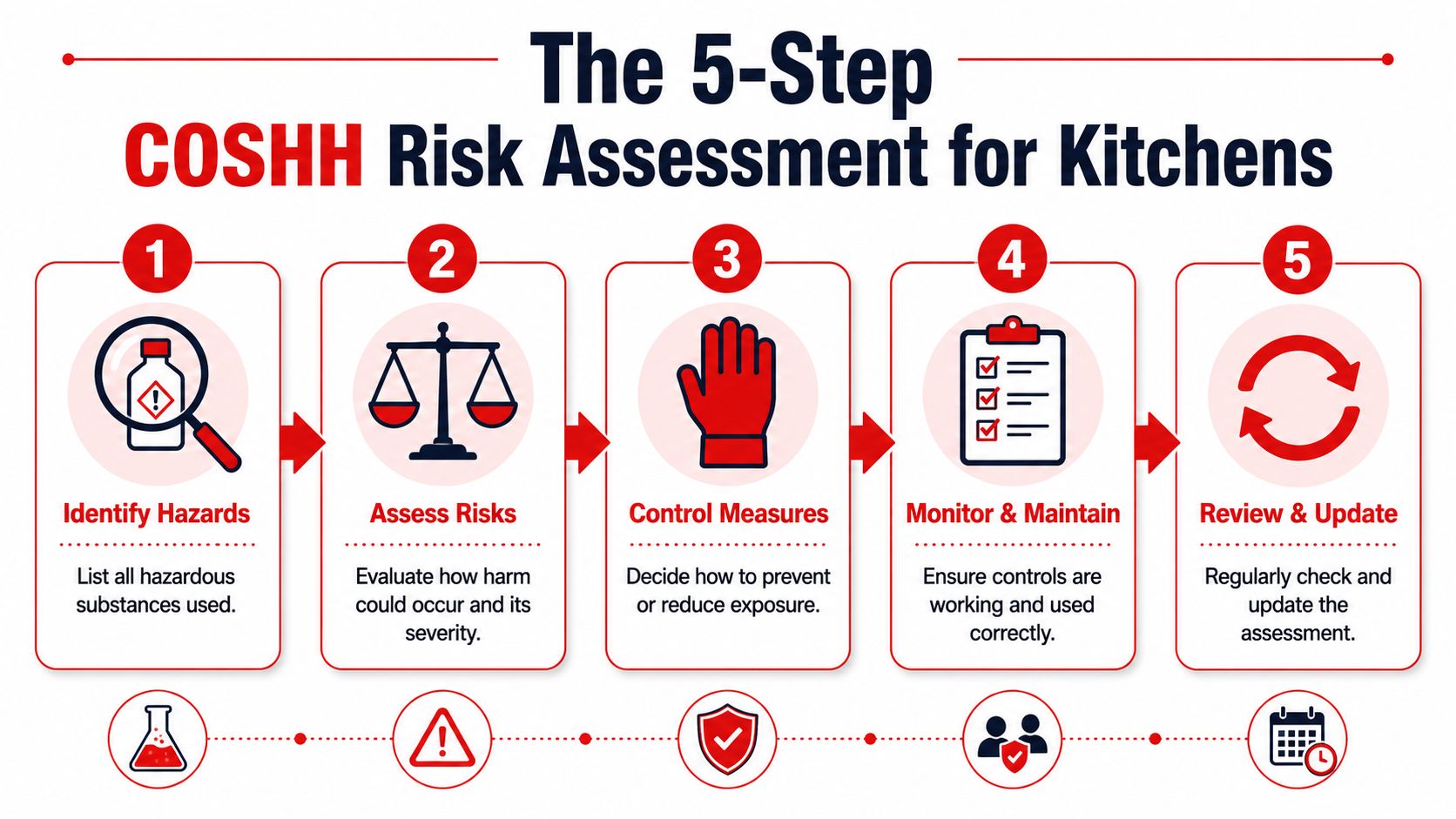
The 5-Step COSHH Risk Assessment for Kitchens
Most COSHH guides fall apart in real kitchens because they assume stable teams, clean handovers, and plenty of admin time. That isn't how hospitality works. You've got cover chefs, split shifts, stock substitutions, supplier changes, and deep cleans happening around trade.
That's also why this matters so much in smaller venues. Existing guidance underserves businesses with transient staff, and HSE data shows 40% of UK hospitality accidents occur in small businesses due to inadequate risk assessment during staffing churn, a risk made worse when temporary chefs don't know a site's specific chemical inventory.
Use a simple five-step method and make it repeatable.
Step 1 Identify the hazardous substances
Start with what's on site, not what the folder says should be there.
Walk the kitchen, bar, cellar, wash-up area, laundry, housekeeping stores, and waste area. Check cupboards, chemical racks, decanted bottles, probe wipe products, spray sanitisers, machine chemicals, and anything maintenance has left behind.
Ask:
- What is bought in: Branded cleaners, sanitisers, descalers, pest products
- What is generated by the work: Fumes, vapours, flour dust, smoke, grease aerosol
- What is borrowed or substituted: Emergency products from another site, supplier alternatives, contractor products
A COSHH file that misses the products in use is worse than useless because staff trust it.
Here's the process in visual form.
Step 2 Identify who could be harmed and how
Don't write “staff” and move on. Name the roles and the route of exposure.
A porter may be exposed through skin contact while dosing chemicals. A pastry chef may inhale flour dust. A relief chef covering grill may breathe in heavy fumes if canopy extraction is poor. A housekeeper may use bathroom descaler in a confined area. A cellar operative may face gas-related risk.
Kitchen reality: The person most at risk is often not the most senior one. It's the person doing the repetitive task quickly, late in the shift, with limited supervision.
Useful exposure routes to record:
- Inhalation: Fumes, sprays, vapours, dust
- Skin contact: Splashes, wet work, contaminated surfaces
- Eye contact: Decanting, spray use, pressure release
- Accidental ingestion: Poor hygiene, contaminated gloves, wrong storage near food areas
Step 3 Evaluate the risk and choose controls
Operators often jump straight to gloves. Don't.
Look at the task itself. Can you stop using the product? Can you use a safer one? Can you change the method, the equipment, the area, or the timing? Can you improve ventilation? Can you limit who does the task?
If a degreaser is being sprayed during prep, that's weak control. If the same task can be done with a safer product, clear dilution, correct cloth method, and out-of-service timing, you've reduced risk properly.
A useful way to judge each task is with a short decision table:
| Task | Exposure concern | Better control |
|---|---|---|
| Oven deep clean | Splash and fumes | Isolate task, ventilate area, use correct product and method |
| Flour refill | Dust inhalation | Decant slowly, reduce drop height, clean without dry sweeping |
| Grill clean-down | Residue and vapour | Cool equipment first, use specified product, supervise first use |
| Cellar line cleaning | Chemical and gas risk | Restrict access, use trained staff only, follow site procedure |
A practical training aid helps when the team is changing. This short video is useful for grounding the basics before a site-specific briefing.
Step 4 Record what you've found
Keep it lean enough to use.
A working kitchen doesn't need a beautifully written assessment that nobody reads. It needs a record that answers five questions fast:
- What is the substance or task
- What harm can it cause
- Who is exposed
- What controls must be in place
- What to do if something goes wrong
For high-turnover operations, attach the assessment to the area of work, not just the central office file. Put key instructions where the job happens. Wash-up. Chemical store. Housekeeping cupboard. Cellar.
Step 5 Review and update it
Review isn't annual box-ticking. Review means change triggers action.
Update the assessment when:
- A new product arrives
- A supplier substitutes stock
- A task changes
- Ventilation or dosing equipment fails
- There's a spill, near miss, complaint, or unexplained reaction
- A relief chef or temporary team member flags confusion about site practice
This is the part most venues miss with temporary staffing. A relief chef can walk into a new site and still work safely on day one, but only if the site gives a sharp handover. Show the chemical store. Show the key assessments. Explain any problem areas. Identify what not to use, where extraction is weak, and who to report to.
That's how COSHH works in a live kitchen. Short, specific, visible, and reviewed whenever circumstances change.
Practical COSHH Control Measures for Hospitality
Assessment on its own doesn't protect anyone. Control does.
Under COSHH, control is only adequate when the employer applies the eight principles of good practice, and the legal framework prioritises substitution and engineering controls over PPE, as set out in this NHS COSHH policy summary of the legal standard. That means gloves and goggles matter, but they sit at the bottom of the thinking, not the top.
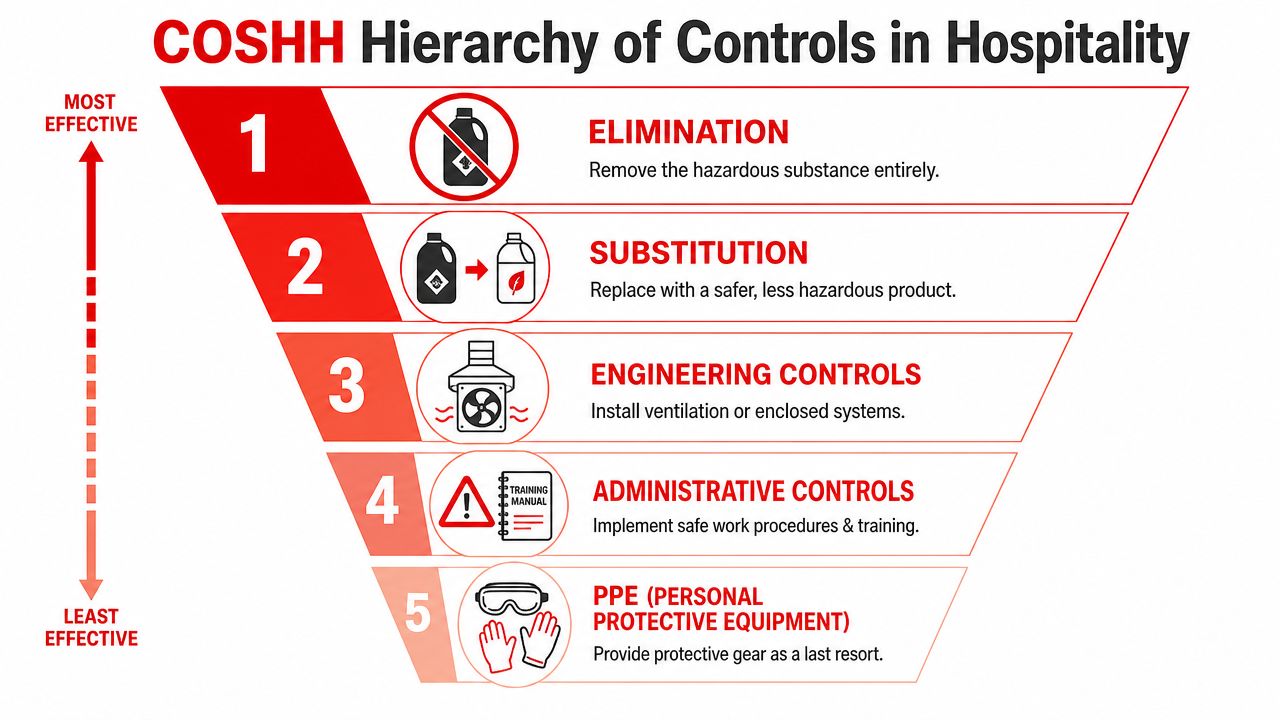
Start higher up the hierarchy
The strongest controls remove or reduce the hazard before it reaches the person.
- Elimination: Stop using the product or stop the task in that form. If a harsh chemical process is unnecessary, remove it.
- Substitution: Replace a stronger cleaner with a safer alternative that still gets the result.
- Engineering controls: Improve extraction, enclosed dosing, storage, or separation of task areas.
- Administrative controls: Restrict access, schedule tasks out of service, train properly, supervise first use, rotate exposure where sensible.
- PPE: Gloves, aprons, eye protection, masks where appropriate. Important, but last in the chain.
A lot of kitchens skip straight to PPE because it feels quick. It also pushes the burden onto the worker. If the product is still too harsh, the method is poor, and the ventilation is weak, PPE won't fix the system.
What good control looks like in hospitality
The best controls are practical enough to survive a Saturday night and simple enough for a temporary chef to follow without guesswork.
Examples that work:
- Chemical dosing systems instead of free-pouring from large containers
- Ready-labelled spray bottles with controlled decanting points
- Deep cleans scheduled outside food prep windows
- Extractor and canopy maintenance treated as a live safety issue, not a background maintenance task
- Task-specific storage so the wrong product doesn't drift into the wrong area
- Clear handover notes for incoming cover staff, especially where one venue does things differently from another
If you need a cleaner site process for relief shifts, structured handover documentation for hospitality teams helps remove the usual gaps.
PPE is what you add after you've improved the product, the process, and the environment. It isn't the whole answer.
Stay current with what's on your shelves
Another operational trap is assuming the old COSHH file still fits the current stockroom.
Suppliers change formulations. Product lines get refreshed. Venues trial “natural” alternatives that are still concentrated enough to cause harm if used badly. High-concentration cleaners, aerosol products, and specialist maintenance chemicals all need checking against the current safety information and your actual site conditions.
This matters in coastal hotels, countryside pubs, and seasonal venues where products get ordered quickly under pressure. A Dorset holiday site, a Devon pub, or a Berkshire hotel can all drift into non-compliance because stock changed faster than the paperwork and briefing process.
Good COSHH control is usually boring when it's done properly. Safer product. Better ventilation. Clear labels. Short briefing. Correct storage. No drama. That's exactly the point.
Training Records Enforcement and When Things Go Wrong
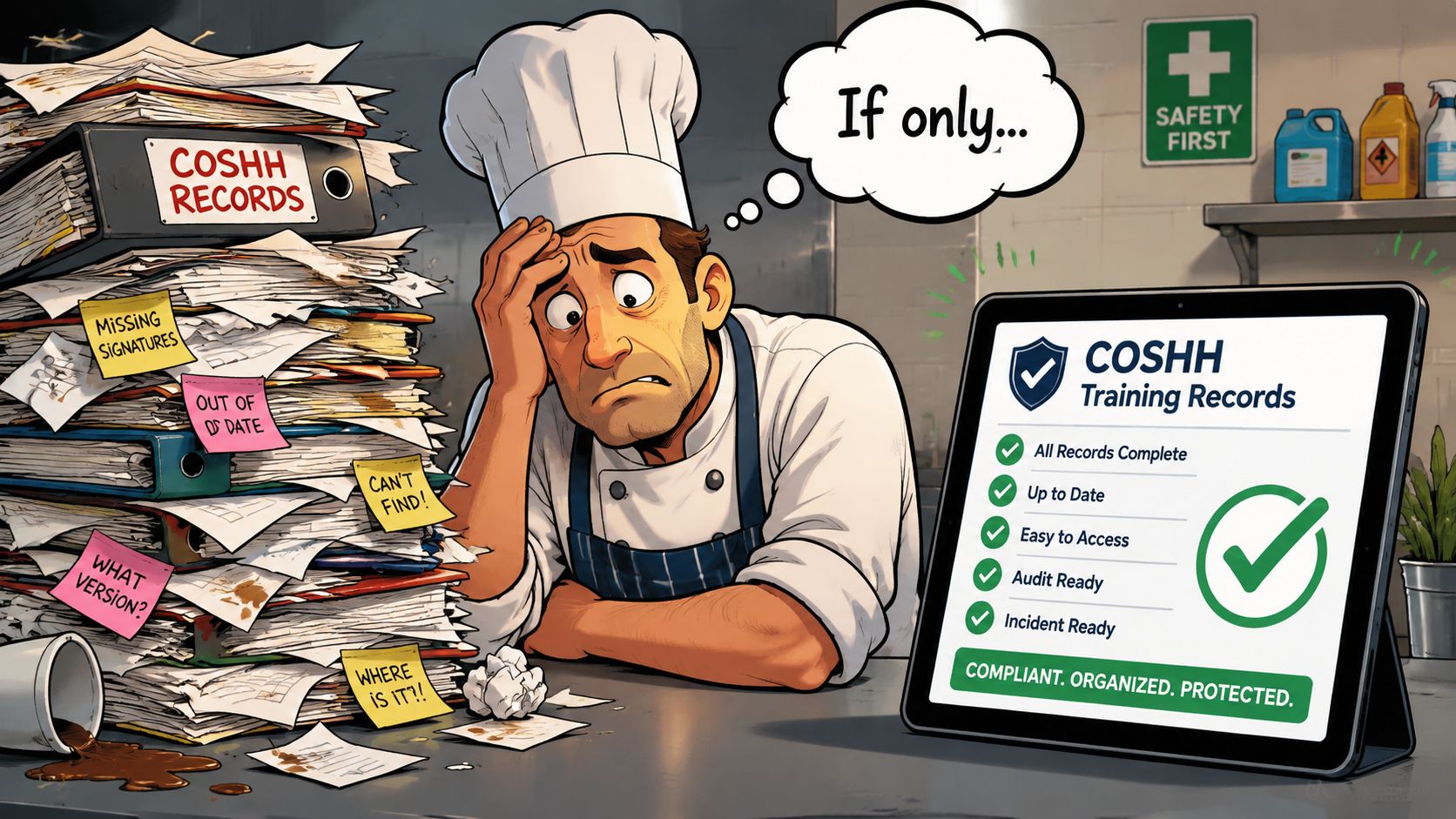
Training records are where good intentions become proof.
When an inspector, insurer, or senior manager asks how a worker was briefed on a hazardous product, “they've used it before” won't do. In high-turnover hospitality businesses, records matter even more because the people on shift may change week to week.
Keep records that a busy site can actually use
COSHH compliance isn't a one-off exercise. It requires a closed-loop control system that starts with assessment, then moves through controls, monitoring, maintenance, health surveillance where needed, emergency planning, training, and review when substances or processes change, as explained in ECL's outline of COSHH as an ongoing management system.
For hospitality, that means your records should be live documents.
A useful site pack usually includes:
- Current COSHH assessments for all relevant substances and hazardous tasks
- Safety data sheets stored where managers can access them quickly
- Training sign-offs tied to specific products or processes
- Maintenance records for extraction, dosing equipment, and other controls
- Incident logs for spills, splashes, exposure concerns, and near misses
A simple relief chef safety briefing sheet
If you use temporary or relief chefs, create a one-page briefing sheet for every site.
Include:
- Key hazardous substances on site
- Where COSHH assessments are stored
- Which products are restricted or manager-only
- Known exposure issues such as weak extraction, cellar access rules, or strong cleaning products
- PPE requirements for specific tasks
- Who to report defects, spills, or symptoms to
- What to do in an emergency
That briefing should be part of arrival, not something left for later.
When things go wrong
If a worker reports breathing irritation, chemical splash, dizziness, skin reaction, or a near miss, treat it as a management event. Stop the task if needed. Check the substance. Check whether the control failed. Record the details properly and review the assessment.
Your incident procedure should connect directly to your wider accident reporting procedures for hospitality teams. If COSHH and accident reporting are handled separately, details get missed and the same problem repeats.
A strong COSHH system protects more than staff health. It protects continuity. The kitchen keeps moving because the rules are clear before the pressure arrives.
Poor COSHH management can lead to enforcement action, claims, lost time, reputational damage, and serious disruption. For small businesses, that can hit hard. For larger groups, repeated failure usually points to a weak operating culture.
The commercial answer is straightforward. Build simple systems, keep them current, brief every worker properly, and don't accept vague handovers when the site is under pressure.
If your kitchen needs safe, dependable cover at short notice, Relief Chefs UK can help. Established in 2013, we support pubs, restaurants, hotels, private households, yachts and villas across the UK with relief chefs, temporary chefs, permanent chef recruitment, yacht chefs, villa chefs, and wider hospitality staffing support. We understand the reality of short notice sickness, seasonal demand, chef shortages, agency reliability issues, and the need for kitchen stability. If you need vetted chef cover that protects standards and keeps service moving, contact Relief Chefs UK today.