
Flexible Shift Patterns for UK Hospitality Venues
28 August 2026

Friday, 4pm. Your sous chef has just texted to say they're ill, the booking sheet shows 120 covers, and the duty manager is already ringing around for help. The menu may need cutting, the remaining brigade is bracing for a punishing service, and every unavailable chef seems to have the same answer, “Sorry, I can't get there at this notice.”
That situation is familiar across pubs in Devon, restaurants in Bristol, hotels in Berkshire and seasonal businesses in Dorset and Wales. Demand changes quickly, sickness rarely arrives at a convenient time, and a fixed rota often leaves you with too much labour in the quiet periods and too little when the pass is full.
Flexible shift patterns give operators a way to adjust cover without repeatedly exhausting the core team or committing to permanent hours that the business doesn't need every week. But flexibility can't mean unlimited last-minute changes. With UK employment protections moving towards guaranteed hours, reasonable notice and compensation for cancelled or curtailed shifts, the venues that win will be those that build agility into a controlled, documented rota system.
Why Flexible Shift Patterns Matter for UK Hospitality
A rigid rota assumes that demand is predictable. Hospitality trading rarely is. A sunny weekend can transform footfall for a coastal pub, a cancelled event can empty a hotel restaurant, and a last-minute group booking can put immediate pressure on a kitchen that looked adequately staffed at breakfast.
The UK already has a substantial shift-working labour market. Government guidance reports that around 14% of the working population, approximately 3.6 million people, usually worked shifts, after the proportion peaked at roughly 15% in 2000. The same guidance identifies late, early, weekend, split and continental shifts as established patterns, rather than unusual staffing arrangements. UK government shift-work guidance provides useful context for the scale and variety of shift-based work.
Flexibility protects the service and the brigade
A venue with no flexible layer has limited options when a chef calls in sick. Managers either ask existing staff to extend their shifts, reduce the menu, pay for emergency agency cover or accept a slower service. Each choice carries a cost, whether that cost appears on the wage report, in guest feedback or in staff retention.
A better structure separates the guaranteed core from the variable demand layer. Your key chefs retain dependable hours and ownership of standards. Additional shifts then cover known peaks, banqueting, weddings, bank holidays, seasonal surges and short-notice gaps.
Operational rule: Flexibility should absorb changing demand, not transfer all the uncertainty to your staff.
Flexible work isn't distributed evenly across the wider labour market. The Office for National Statistics reported that 28% of working adults in Great Britain hybrid worked between January and March 2025, but access was strongly associated with qualifications and pay, while hospitality has limited opportunity for remote work. The ONS analysis of access to hybrid working underlines an important point for venue operators. Hospitality flexibility is usually about start times, shift swaps, predictable rotas and access to additional cover, not working from home.
The legal direction is changing
The right to request flexible working has developed through several UK legal milestones. It began in April 2003 for parents and certain carers, expanded to wider groups, became available to employees with 26 weeks' continuous service in 2014, and was updated in April 2024 so employees can make two requests each year, employers must respond within two months and refusals must include a reason. The legal definition includes changes to hours, location and working pattern, which is directly relevant to shift-based hospitality. The House of Commons Library briefing on flexible working sets out that history.
The practical challenge is clear. You need enough flexibility to keep service running, but you also need a rota that gives people a fair degree of predictability and leaves a defensible record of how hours are allocated.
What Flexible Shift Patterns Actually Mean in Hospitality
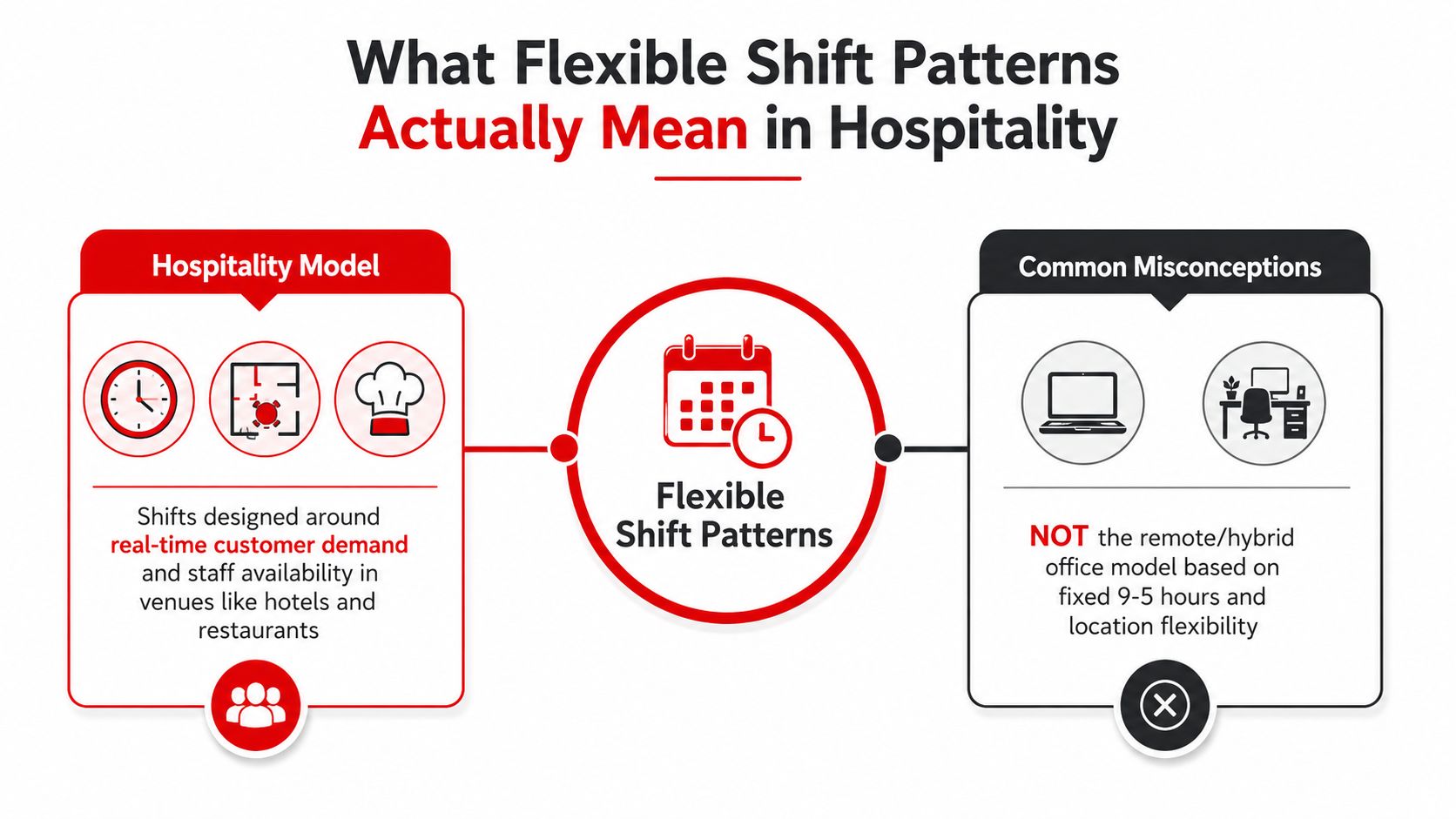
Flexible shift patterns in a kitchen, hotel or restaurant change when people work, how long they work and how often they work in response to trading requirements and agreed availability. They aren't the same as hybrid office arrangements, where an employee may choose between a home and office location while broadly working standard daytime hours.
A hospitality team has to be physically present for preparation, service, cleaning, deliveries and close-down. Flexibility therefore happens inside the operation.
The main mechanisms
Staggered starts bring chefs in at different points across the day. A hotel breakfast team might begin at 5am, while a second team arrives later for lunch preparation and the evening service. A late bar or restaurant team could finish at 1am, so sequencing the rota matters as much as the total number of people booked.
Split shifts divide a working day around separate trading periods. A chef may work through lunch, leave during the afternoon lull and return for dinner. This can fit a pub or fine-dining restaurant with distinct services, but repeated use can make travel, childcare and recovery difficult.
Compressed patterns place agreed hours across fewer working days. A senior hotel chef may prefer a four-day arrangement that creates longer recovery blocks, while the venue gains continuity on demanding service days. The pattern still needs careful checks around rest and fatigue.
On-call and zero-hours arrangements provide a pool for uncertain demand. A relief chef might cover a three-day weekend block, or a standby chef could be contacted for a banqueting event if confirmed bookings reach an agreed threshold.
The distinction between two types of flexibility is important:
- Employer-led flexibility: The venue changes the shift according to demand. This offers operational control, but frequent alterations can damage trust and may create legal exposure.
- Employee-led flexibility: The worker requests a different start, finish, day or pattern. This supports retention and reflects the UK's flexible-working framework, but the manager still has to protect cover, fairness and service standards.
Flexibility must include boundaries
A shift swap isn't automatically safe just because two employees agree to it. The replacement chef needs the right skills, the manager needs visibility, and payroll needs an accurate record of the hours worked.
Write the rules down. State who may approve swaps, how much notice people should give, which roles require equivalent experience and what happens if a replacement cancels. That turns an informal favour into a controlled staffing process.
Benefits and Risks of Flexible Shifting for Venues
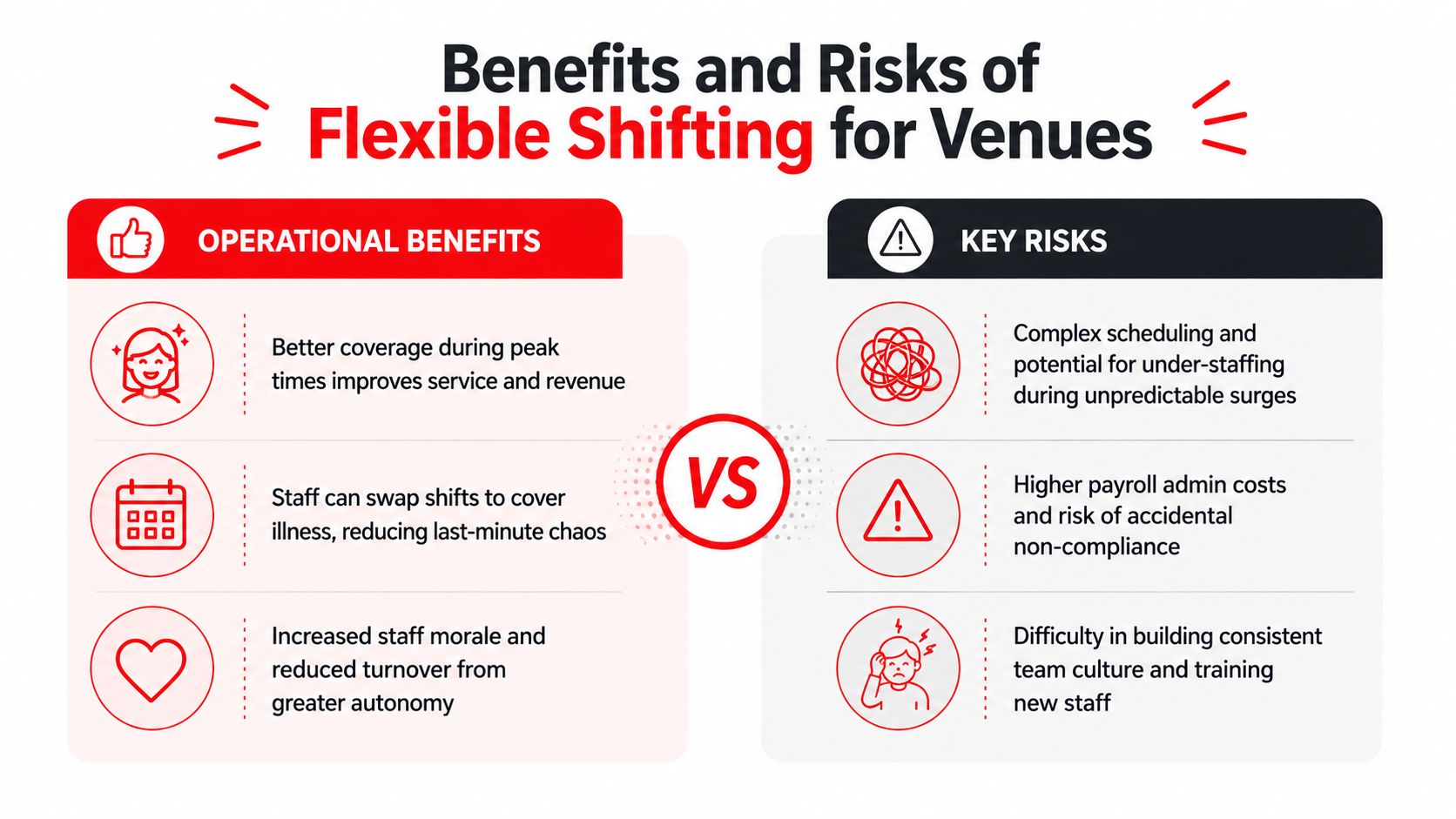
Flexible shifting can improve a rota, but only when the structure matches the venue. The benefit isn't flexibility by itself. The benefit comes from placing the right skill level in the right part of the trading curve without constantly asking the same people to rescue the service.
CIPD's 2025 survey found that 59% of employers offered some form of flexibility. In the same survey, shift swaps accounted for 35% of the reported forms, while flexible start and finish times and flexibility in shift or rota scheduling each accounted for 32%. CIPD's flexible working report is especially relevant to hospitality because these operational forms are more useful to a kitchen than a generic hybrid-work policy.
Where the model earns its place
A high-volume pub can use staggered starts and approved swaps to handle busy Fridays, match kitchen hours to covers and reduce the need to keep a full brigade on site through a quiet afternoon. The trade-off is that speed of change can create confusion if the manager doesn't control who is qualified for each section.
A boutique hotel may gain more from compressed patterns, breakfast cover and a flexible outer layer for weddings or private dining. Continuity matters, particularly when the same chef needs to understand the hotel's menus, suppliers and service expectations. Bringing in too many unfamiliar people can save a gap on paper while weakening consistency.
A fine-dining restaurant needs flexibility, but not at the expense of brigade development. A small team may use part-time support for prep or events, while core chefs retain stable service responsibilities. A split shift can match the lunch and dinner curve, but overusing it often creates complaints about unpaid travel time, long days and the difficulty of maintaining a life outside work.
The hidden cost of poorly designed flexibility
The first risk is fragmentation. If chefs arrive and leave at inconsistent times, handovers become rushed and prep responsibility becomes unclear. A sauce, stock or pastry component may be technically prepared but not properly labelled, checked or communicated.
The second is administration. A complex rota needs accurate records of offers, acceptances, swaps, cancellations, actual hours and payroll adjustments. A spreadsheet can work for a small operation, but it becomes fragile when several departments, sites or agencies share cover.
The third is dependency. A venue that relies heavily on casual staff may struggle to retain people who can find steadier work elsewhere. Flexible shifts should supplement a stable team, not replace the need to offer dependable employment where the business has a regular requirement.
Flexibility lowers operational pressure only when managers can explain who is working, why they were scheduled and what happens if the plan changes.
The legal risk is also moving closer to day-to-day rota decisions. UKHospitality describes proposed rights around guaranteed hours, reasonable notice and compensation for shifts cancelled or curtailed at short notice. Its guidance on notice of shifts explains why rota data and clear processes will become increasingly important.
Common Shift Models Used in UK Kitchens and Hotels
There isn't one perfect rota for UK hospitality. The right choice depends on service windows, location, menu complexity, staff availability and how much demand can be forecast. A hotel near Windsor may need dependable breakfast and conference cover, while a coastal restaurant in Devon may experience sharp seasonal swings.
| Shift Model | Best Suited Venue | Trading Pattern | Key Trade-Off |
|---|---|---|---|
| Split shift | Pubs, restaurants and fine dining | Separate lunch and dinner services | Covers peaks efficiently, but can harm retention when travel and unpaid downtime become burdensome |
| Compressed four-day week | Hotels and larger kitchens | Longer working days across fewer days | Can support recruitment and continuity, but requires careful fatigue and rest management |
| Rolling rota with staggered starts | High-volume casual dining | Variable covers across preparation and service | Matches labour to demand, but handovers need strong controls |
| On-call or standby | Banqueting, events and seasonal venues | Demand confirmed close to service | Protects against uncertain bookings, but short notice can create fairness and compliance concerns |
| Core rota with flexible outer layer | Independent hotels and multi-site groups | Stable base plus weekend and event cover | Balances continuity and agility, but needs reliable additional staffing |
Split shifts
Split shifts remain common where lunch and dinner are separate commercial peaks. They can reduce idle labour during the afternoon, but managers should account for the practical burden on staff. A chef who spends hours travelling home and back may see the pattern as a long, unpaid day rather than a convenient arrangement.
Compressed patterns
Compressed rotas can help a hotel compete for chefs who value longer blocks away from work. They suit teams with clear section ownership and predictable service rhythms. They aren't a shortcut around rest requirements, and the manager must check the sequence of late finishes followed by early starts.
Rolling and standby models
A rolling rota works well when the venue has changing cover levels but can still identify likely peaks. On-call cover is more suitable for events, banqueting and uncertain bookings, provided the venue communicates expectations clearly and doesn't treat every standby request as guaranteed attendance.
A practical hybrid often works best. Keep a fixed core for head chefs, sous chefs and key section leaders, then use approved swaps, part-time staff, agency support and relief chefs around the edges. For a broader operational framework, see this hotel staffing guide for UK venues.
Navigating UK Employment Law and Payroll Compliance
Many operators still treat flexibility as a payroll choice. It isn't. The moment a venue regularly schedules someone for a pattern, offers repeated hours or changes confirmed shifts at short notice, the rota becomes part of the employment-risk picture.
The Employment Rights Act 2025 is expected to introduce rights around reasonable notice of shifts, proportionate pay when shifts are cancelled or curtailed at short notice, and predictable working patterns, with implementation expected from 2026 to 2027 rather than immediately, according to hospitality-focused legal analysis of the Act. The detail and timing matter, so operators should prepare without presenting future provisions as if they already apply.
Build records before the rules arrive
UKHospitality and employment-law coverage indicate that qualifying workers on zero-hours or low-hours arrangements may receive a right to guaranteed hours reflecting their regular pattern over a reference period. Guidance has discussed a 12-week reference period, so venues should be able to review actual hours, offers, refusals, cancellations and changes across that period. Coverage of the proposed guaranteed-hours framework explains the importance of maintaining reliable scheduling data.
A zero-hours contract generally means the business isn't obliged to offer guaranteed hours and the worker isn't obliged to accept work. That doesn't remove core protections. Workers still retain rights including National Minimum Wage, paid annual leave, rest breaks and protection from discrimination, as outlined in UK guidance on zero-hours arrangements in hospitality.
Check the rota against working time
Flexible scheduling can create a hidden rest breach. A chef finishing late and returning early may not receive the required 11-hour daily rest period. Managers should also monitor weekly working time, rest breaks and any 48-hour opt-out arrangements rather than assuming that a worker's willingness to accept a shift makes the sequence safe.
Payroll needs the same discipline. Record actual hours, including required pre-service preparation and post-service duties where applicable. Check that split-shift breaks are unpaid and free time, and calculate holiday pay for variable-hours workers using the applicable reference rules. A venue should also review whether a worker's practical relationship with the business matches their stated employment status.
Records matter: If you can't reconstruct the rota, the hours worked and the reason for a change, you may struggle to defend the decision later.
Use a rota system that connects scheduling with payroll where possible, restricts unauthorised edits and keeps an audit trail. Managers should consult staff before major pattern changes and give workers a clear route to request more predictable hours. For the core rest and scheduling framework, review this guide to UK working time directives.
How to Implement Flexible Shift Patterns Successfully
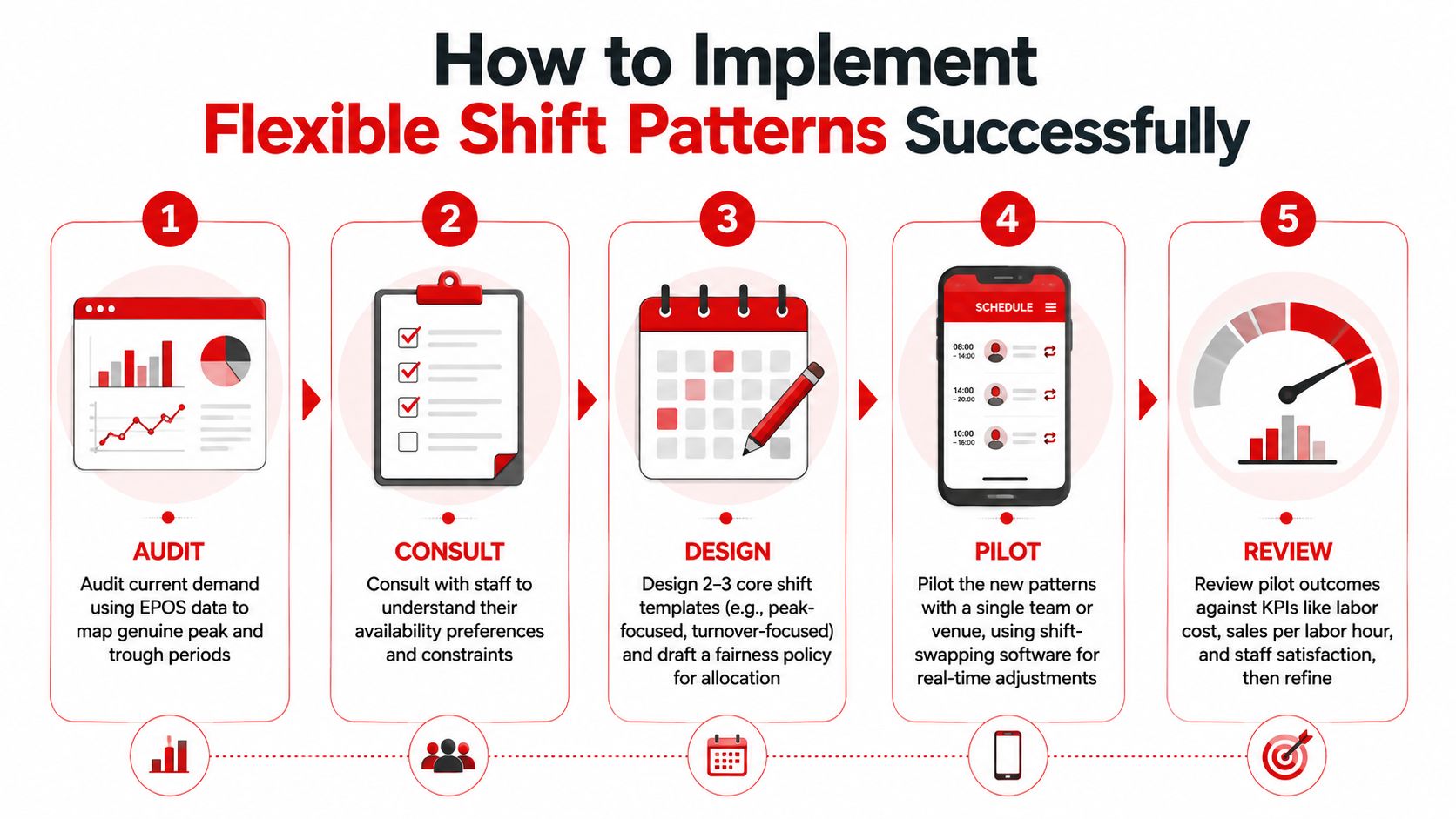
Start with evidence, not assumptions. Pull EPOS and booking data to identify when preparation, service and close-down require labour. A restaurant that assumes its Saturday lunch is busy may discover that the pressure falls during a shorter evening window, while a hotel may need consistent early cover even when dinner trade varies.
Use a controlled implementation sequence
Audit demand and current hours. Compare covers, sales, booking patterns, actual clock-ins and overtime. Look for under-staffed peaks and paid hours that sit outside genuine operational need.
Ask staff about availability. Record childcare, study, travel, second jobs and preferred working patterns without promising every request can be accepted. Consultation also identifies employees who prefer fixed shifts and may resent constant changes.
Create a dependable core. Give key roles a stable base of agreed hours, then add flexible shifts for peaks, events, sickness cover and seasonal demand. Keep section leadership consistent wherever possible.
Write the swap rules. Define who can swap, the minimum notice expected, which substitutions need manager approval and how the change reaches payroll. A commis chef shouldn't replace a section leader just because both names appear on the rota.
Pilot before scaling. Test the pattern with one team or venue, review the results and adjust the templates. A short pilot exposes practical failures, such as poor handovers, unreliable notifications or repeated late finishes.
Measure the operation, not just attendance
Track labour cost against revenue by shift, fill rates, no-shows, cancellations and average hours per cover. Add a short staff pulse survey so you can see whether flexibility is improving control or creating uncertainty.
The technology should support the rules. Choose rota software that sends automated notifications, records changes, supports approval workflows and exports accurate payroll information. Technology won't fix an unfair rota, but it will show where the process is failing.
Managers also need a human communication plan. Explain why the pattern is changing, publish the principles used to allocate desirable shifts and give staff a route to challenge an error. If the system only benefits the business, chefs will quickly treat it as another name for instability.
This short video gives a visual introduction to the implementation process:
How Relief Chefs UK Supports Flexible Staffing Needs
Even a well-designed rota can't prevent every absence. A sous chef will still wake up ill, a seasonal booking will still grow, and a hotel may still need a specialist chef for a trial service before making a permanent appointment.
Relief Chefs UK is a nationwide chef recruitment agency established in 2013. Its staffing support covers relief chefs, temporary chefs, permanent chef recruitment, yacht chefs and villa chefs, helping independent pubs, restaurants, hotels, private households and hospitality groups manage changing requirements without carrying every contingency as permanent payroll.
A relief chef can cover a Saturday sous chef absence, support a bank holiday weekend in Dorset, strengthen a seasonal operation in Devon or provide extra kitchen capacity for a hotel near Windsor, Reading or Slough. The same approach can help a venue test a cuisine specialist before committing to a permanent role, or maintain kitchen stability during recruitment.
The compliance advantage comes from using an established staffing partner rather than building an unmanaged casual bank. Relief Chefs UK handles relevant employment administration, right-to-work checks and payroll for its placements, while the venue retains control of the service brief, kitchen standards and booking requirements. Its flexible staffing solutions are designed for short-term cover and changing hospitality demands.
A flexible rota is strongest when the outer layer is dependable. Build your relief-chef relationship before the peak season, not when the dinner booking is already on the books and the rota has fallen apart.
Relief Chefs UK can supply vetted relief and temporary chefs for short-notice sickness, seasonal peaks, events and planned cover, alongside permanent chef recruitment and specialist yacht or villa chef placements. Visit Relief Chefs UK to discuss your staffing requirements and put reliable cover in place before your next difficult service.
Call the team.
Office 01392 715474 · info@reliefchefs.co.uk