
Food Cost Management for UK Hospitality: A Practical Guide
31 August 2026
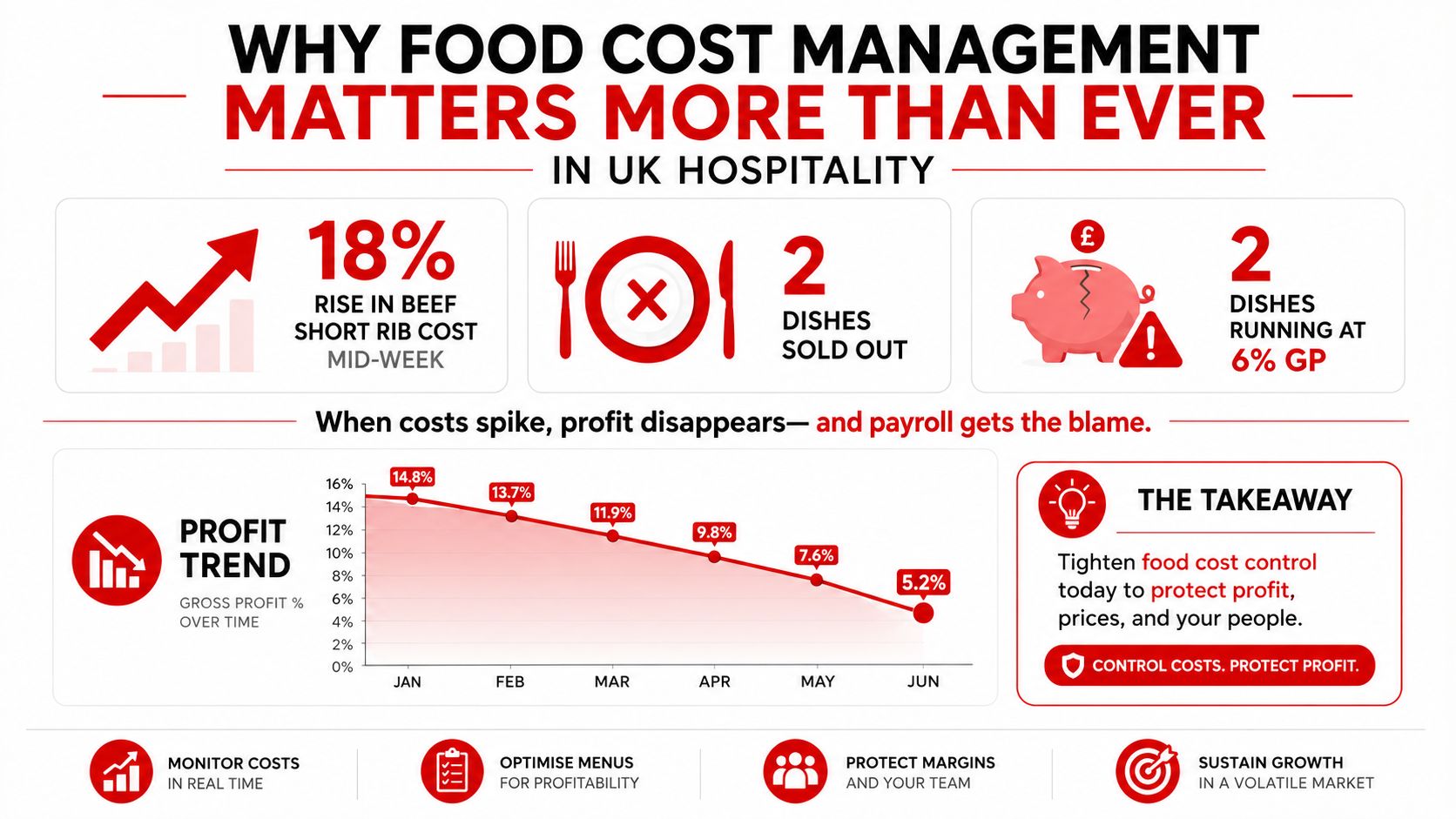
Friday night is where food cost management gets real. The board is full, the pass is hot, and someone in the kitchen has just told you the beef short rib landed at a higher cost than expected, two dishes have already sold out, and a couple of plates are sitting at ugly margins while the floor manager is staring at the till and the payroll forecast.
That's not a budgeting problem. It's a service problem, a stock problem, and a staffing problem all at once. In UK hospitality, food cost management has to work as a shock-resilience discipline, because food inflation has moved faster than the rest of the cost base at key points since 2022, and the gap between food prices and headline inflation has been large enough to squeeze gross margin when menu prices lag ONS food and beverage CPIH series.
If the kitchen isn't stable, the numbers won't be either. No food plan survives a busy service if the team is undertrained, the portion specs drift, or relief cover turns up late and doesn't know the menu. That's why the practical answer isn't just “buy better”, it's tighter procurement, tighter prep, tighter cover, and a menu that can flex when the market moves.
The operators who handle this well usually end up with four things. They know their weekly food cost percentage properly, they keep variance under control, they respond to suppliers faster, and they build menus that can change without damaging guest experience. Relief Chefs UK, a nationwide chef recruitment agency established in 2013, sits in that operational reality every day, because temporary chefs, relief chefs, permanent chef recruitment, yacht chefs, villa chefs, and wider hospitality staffing support all affect whether the cost plan holds in service.
For a working system you can use this week, keep the exact calculations, weekly stock routine, waste controls, and KPI dashboard tight enough to act on before the next busy booking wave hits.
Why Food Cost Management Matters More Than Ever in UK Hospitality
A bad Friday exposes a weak food system within minutes. Tickets keep landing, the grill section stretches portions, and the manager sees the margin problem only after the gross profit has disappeared.
Food cost management must function as a live operating control. The UK government's inflation series records food and non-alcoholic beverage CPIH inflation peaking at 19.2% in March 2023, while overall CPIH peaked earlier at 9.6% in October 2022 ONS food and beverage CPIH series. Food inflation remained 4.5% at the end of 2025, compared with 3.6% for all items, then stood at 2.2% in the 12 months to May 2026. Uneven supplier pressure makes a fixed annual target difficult to manage.
What changes in the kitchen when the market moves
A sudden supplier increase usually exposes prep discipline and portion control first. One cost spike may be manageable. Repeated increases create untracked adjustments, as chefs alter portions, substitutions, or yields to keep service moving. Those changes often remain invisible in the spreadsheet until month-end.
Practical rule: if the menu cannot flex, the kitchen absorbs the shock, and the kitchen usually loses first.
Kitchen stability protects margin. Short-notice sickness, seasonal demand, and unreliable relief cover leave fewer experienced people carrying the section. Spec drift, over-portioning, and waste then rise together. Even a well-costed recipe can fail when the person cooking it changes each shift and the replacement does not know the standard.
Relief Chefs UK, a nationwide chef recruitment agency established in 2013, operates in that pressure point through temporary chefs, relief chefs, permanent chef recruitment, yacht chefs, villa chefs, and wider hospitality staffing support. Staffing decisions affect whether portion specifications, prep plans, and purchasing controls survive a busy service.
Move the control point closer to service. Procurement reviews, recipe re-costing, and stock checks need a rhythm that catches the next supplier increase before it reaches the pass. Practical operational cost reduction support can help reduce labour and process pressure while the site tightens margin control.
The working outcomes are clear: accurate weekly food cost percentage, controlled variance, faster supplier responses, and a menu that can change when inputs move. In Devon, Bristol, Wales, Berkshire, Windsor, Reading, Slough, Dorset, and other busy hospitality markets, staffing pressure and guest volume can shift together, making kitchen resilience part of food cost control.
Calculating Your Food Cost Percentage the Right Way
A supplier can raise the price of a key ingredient between two deliveries. If the site only reviews invoices at month end, the margin loss has already reached the menu. Weekly food cost calculation gives operators an earlier warning and shows whether the problem sits in purchasing, yield, or kitchen execution.
Start with VAT-exclusive numbers
Use VAT-exclusive figures for the calculation. Compare net food sales with the true cost of food used, rather than purchases alone. The formula is:
Actual food cost percentage = Food used ÷ Net food sales
Calculate food used as:
Opening stock + Purchases − Closing stock
Here is a workable example for a 60-cover bistro over one week.
| Worked Food Cost Percentage Example (60-cover bistro, one week) | Value (£) | Notes |
|---|---|---|
| Opening stock | 4,200 | Net value at start of week |
| Purchases | 9,800 | Food bought during week |
| Closing stock | 3,600 | Net value at end of week |
| Food used | 10,400 | Opening stock + purchases − closing stock |
| Food sales ex-VAT | 28,750 | Net revenue |
| Actual food cost percentage | 36.2% | Food used ÷ food sales |
| Theoretical food cost percentage | 31.4% | Recipe card cost applied to sales mix |
| Variance | 4.8 points | Actual minus theoretical |
The 4.8-point gap is the control signal. It shows that the kitchen used more food value than the menu mix should require. The causes may include supplier pricing, poor yield, over-portioning, waste, or inconsistent preparation. A single percentage cannot identify the cause, so the number needs an operational review behind it.
Use theoretical cost to separate sales from execution
Theoretical food cost comes from recipe-level cost cards and the sales mix. It reflects what each dish should have consumed at its approved specification. If a steak dish sells well but trimming, portioning, or yield control slips, its gross margin falls even when the menu price appears healthy.
Useful check: if actual cost keeps running above theoretical cost, inspect prep, trimming, portions, and waste before blaming the sales report.
For UK full-service operators, a common food cost target sits around 28% to 32% food cost percentage guidance. Higher figures may still suit premium steakhouse formats, remote sites, or yacht provisioning, where the operating model and guest expectations differ.
Review actual against theoretical cost every week, particularly after a sudden supplier increase or a change in chef cover. Recipe cards expose the expected cost; the variance shows whether the kitchen is delivering it. Use both figures to protect margin without cutting portions blindly or allowing service standards to drift.
Running Stocktakes and Variance Analysis Every Week
Weekly stocktakes sound tedious until you see how quickly they expose the leak. In practice, a good stocktake tells you whether the kitchen lost money on price, yield, or waste, and it does that before the problem becomes normal.
Run the count the same way every week
For a 60-cover site, the job should be finishable in under 90 minutes if the process is tight. Start with printed count sheets grouped by store location, then pull the previous week's closing file and the EPoS sales data before service starts.
Count in the same order every time, dry store, walk-in, fridge, freezer. Record stock at delivered cost, not selling price, and use the correct unit conversion every time, kilos, litres, each, trays. That sounds basic, but inconsistent counting creates fake variance faster than many realise.
The formula is simple:
Opening + Purchases − Closing = Used
Once that's done, compare used against the theoretical usage from the recipe cards. The difference is your variance, and that variance needs to be split into buckets you can act on.
The best buckets are price, yield, and waste. Price covers supplier increases. Yield covers trim loss, butchery loss, or fish filleting loss that wasn't built into the spec. Waste covers over-production, spoilage, and over-portioning.
A working variance split
In the same 60-cover bistro example, a 4.8-point variance can be broken out like this.
| Weekly Variance Breakdown (60-cover bistro example) | £ impact | Points of food cost | Likely cause |
|---|---|---|---|
| Price | 210 | 0.7 | Supplier increase on sirloin |
| Yield | 185 | 0.6 | Trim loss on ribeye not built into spec |
| Waste | 395 | 1.4 | Over-portioning on fish specials and spoilt sourdough starter |
That split gives you something useful to chase. If the gap is mostly price, procurement needs to move. If it's yield, the recipe card needs tightening. If it's waste, the team needs retraining and prep limits.
A simple rule keeps the pace up. Anything over 2 points should trigger a same-week investigation, not a month-end post-mortem. By the time the month closes, the team has already repeated the mistake several times.
The internal discipline behind this is stock control, rotation, and buying consistency, which is why the practical approach on stock rotation methods matters so much once you start measuring the numbers properly.
Count what you use, not just what you buy. Buying alone hides the real story.
Cutting Waste with Prep Forecasts and Portion Control
A Cotswolds pub serving 40 covers on a Saturday night can lose margin through small, repeated errors. Trim, prep mistakes and excess production may each look minor, yet together they send usable food to the bin and leave the kitchen exposed when supplier prices jump.
The issue was forecasting based on gut feel rather than sales data. Stable kitchen cover and portion discipline therefore matter as much as purchasing decisions when protecting margin under sudden cost pressure.
Forecast prep from sales mix, then cut it back
Build a sales-mix forecast from the last four Saturdays, then convert expected covers into ingredient weights using recipe sheets. Prep to 90% of forecast, with a 15-minute top-up rule for the final push. This keeps the first wave controlled without leaving the section unable to respond to late demand.
The strongest controls are practical. Weighed proteins stop generous hands drifting. Count-out garnish trays keep portions consistent. Scoop-controlled sides remove guesswork on busy sections. Vague briefs allow plates to grow, so every dish needs a visible portion standard.
Tighten the brief before the ticket rush
Make the portion specification part of the pre-service briefing. Tell each section where the line sits, then have the chef on pass call out inflation as soon as plates start getting larger. If a dish looks short, review the recipe and yield rather than reshaping the plate around the problem.
A daily control list can include:
- Build the sales forecast: Use EPOS history from comparable service periods.
- Calculate portions: Convert covers into recipe yields and prep weights.
- Set par levels: Decide the maximum safe prep before service.
- Train the section: Use scales and scoops, not “eye it”.
- Track trim and over-production: Log what gets binned before the next prep cycle.
Practical rule: if a prep item cannot be portioned, it will eventually be over-produced.
The same control applies off-site. On yacht charters, a same-day reforecast based on guest counts can reduce avoidable waste when bookings change late. Provisioning for the wrong headcount quickly cuts into margin at sea.
If prep is leaking margin, use these food waste reduction methods alongside clear staffing and training standards. A clean stock system still fails if the team cannot hold the portion specification.
Suppliers, Menu Engineering and Pricing Triggers That Protect Margin
When supplier prices jump without warning, margin protection depends on decisions the operation can make immediately. Supplier discipline, menu structure, pricing triggers, and stable kitchen cover give you room to respond before a temporary shock becomes a permanent loss.
Push suppliers without burning the relationship
Set a regular review rhythm. Quarterly price reviews tied to published indices keep discussions grounded in market movement rather than service-to-service panic. If one protein cut becomes unworkable, change the specification or find a suitable substitute instead of carrying the same dish at a weaker margin.
Consolidated ordering can reduce delivery charges where storage and shelf life allow it. The saving disappears if extra stock loses freshness or ties up cash. Challenger quotes provide a useful price check, but use them to pressure-test terms while protecting a supply relationship that consistently delivers. In hospitality, dependable deliveries can matter more than the lowest headline price.
Food and non-alcoholic beverage inflation ran hotter than all-items inflation during the shock period and remained above the broader basket into 2026, as noted earlier. Annual contract renewals therefore leave too much time between a cost change and an operational response.
Engineer the menu around contribution, not tradition
Menu engineering starts with two measures: popularity and profit. Keep high-performing dishes visible, re-cost popular dishes with weak contribution, and remove low-selling items that consume labour, storage, and specialist ingredients without earning their place.
| Menu engineering matrix with margin and popularity scoring | Profit | Popularity | Action | Example |
|---|---|---|---|---|
| Star | High | High | Keep promoted | Signature burger or best-selling fish dish |
| Ploughhorse | Low | High | Re-cost or adjust portion | Popular roast with weak margin |
| Puzzle | High | Low | Reposition or train front of house | Premium starter with good GP |
| Dog | Low | Low | Remove or replace | Slow seller using niche stock |
Re-engineering does not always mean removing a dish. A side change, smaller portion, or different protein can preserve the guest experience while restoring contribution. Check the kitchen impact too. A cheaper ingredient that creates extra prep, slower service, or more chef cover may deliver less saving than the recipe sheet suggests.
Useful trigger: if ingredient cost jumps, review the dish before the next quarter.
Set a clear response point. When a key ingredient rises by 5%, either lift the menu price by 3% to 4% or change the dish within 14 days. The trigger keeps pricing decisions practical and prevents the team from absorbing a supplier increase while waiting for costs to reverse.
Chef cover protects this process during disruption. If the kitchen is stretched and a revised menu brief needs immediate implementation, Relief Chefs UK can supply relief chefs, temporary chefs, permanent chef recruitment, yacht chefs, villa chefs, and hospitality staffing support while the team resets the specification and pricing grid. Margin control depends on portion discipline and execution, so an unfilled shift can undo a well-costed menu quickly.
KPIs, Reporting Cadence and a 14-Day Implementation Plan
If the numbers live in three different spreadsheets, nothing changes quickly enough. The dashboard needs to be simple enough that the head chef, GM, and owner can all read it without a meeting.
Use one control sheet, not six separate reports
Track food cost %, gross profit, stock variance, waste %, theoretical vs actual usage, menu mix, and a simple price-tracker index. That gives you a daily and weekly view without drowning the team in admin.
Keep the cadence tight:
- Daily GP flash: Catch obvious drift before service compounds it.
- Weekly stocktake variance: Separate price, yield, and waste.
- Monthly menu engineering review: Remove weak dishes and re-cost winners.
- Quarterly supplier reset: Review pricing, spec, and alternatives.
Practical rule: a report that arrives late is only useful for history, not control.
A 14-day rollout that kitchen teams can actually survive
Days 1 to 3, baseline current food cost and waste. Pull the last clean numbers, accept the uncomfortable truth, and write down the gap without dressing it up.
Days 4 to 7, tighten portion sheets and recipe cards. The chef team needs clarity, not a lecture. If a prep item has drifted, fix the portion, the scoop, or the serving vessel.
Days 8 to 10, start the weekly stocktake system. Make one person accountable, keep the count sheets consistent, and review the variance same day while the numbers still mean something.
Days 11 to 12, run a menu engineering review. Cut the obvious low performers, re-cost the high movers, and check whether the guest-facing layout is helping the right dishes sell.
Days 13 to 14, lock the dashboard and set pricing triggers. Decide what causes a recipe change, what causes a supplier challenge, and what causes a menu price review.
If the rollout lands during a period of sickness, holidays, or seasonal pressure, use temporary kitchen support to protect service while the team implements the changes. Relief Chefs UK works across the UK with vetted chefs who can keep the pass moving while standards and controls are reset.
If you need to tighten food cost management without destabilising service, talk to Relief Chefs UK about relief chefs, temporary chefs, permanent chef recruitment, yacht chefs, villa chefs, and wider hospitality staffing support. Visit Relief Chefs UK and get the right kitchen cover in place while you protect margin, hold standards, and stop the next cost spike turning into a service problem.
Call the team.
Office 01392 715474 · info@reliefchefs.co.uk