
How to Reduce Staff Turnover: A 2026 Strategy
30 August 2026
A CDP calls in sick at 11am on a Saturday. The pass is already four tables deep, the prep list is unfinished, and the general manager is ringing former colleagues for a favour. By service, the head chef is covering the vacant section, another chef is working beyond a safe limit, and guests are waiting longer for food. A staffing problem has become a revenue problem in a matter of hours.
That pattern is why how to reduce staff turnover should be treated as an operations question first. Engagement matters, but predictable rotas, immediate sickness cover and visible progression do more to protect a kitchen than another staff survey or a motivational poster. This guide gives UK hospitality operators a practical retention plan for pubs, restaurants, hotels, cafés, contract caterers, yacht operations and private households.
The Real Cost of Losing Another Chef This Month
The immediate cost of a resignation isn't limited to the vacancy. A chef leaves, the remaining team absorbs the work, service becomes harder to control and the manager starts making decisions under pressure. Recruitment then competes with daily operations, which means the replacement process is slower and less thorough than it should be.
There are direct costs, including advertising, interviews, onboarding and agency support. There are also operational costs that rarely appear on a recruitment invoice, such as overtime, reduced capacity, weaker consistency and the time a head chef spends training someone new instead of running the kitchen.
Practical rule: Never measure a resignation only by the cost of finding a replacement. Measure the pressure it puts on the team that stays.
Consider a restaurant in Bristol with one experienced line chef missing from the rota. The sous chef moves onto the section, the head chef loses time on ordering and training, and the kitchen may reduce bookings because it can't promise a stable service. In a hotel in Berkshire or Windsor, the same gap can affect breakfast, events and room service across the same day. In Devon, Dorset or Wales, seasonal demand can make a replacement even harder to secure at short notice.
The people who stay also carry the hidden bill. They work extra shifts, lose rest days and watch management struggle to provide cover. Some will eventually start looking elsewhere, particularly if they believe every absence will become their responsibility.
Use a structured view of the cost of employing hospitality staff alongside your payroll figures. The point isn't to produce a perfect finance model. It's to compare the cost of stabilising the team with the cost of repeatedly replacing the people who keep the kitchen functioning.
Don't assume retention requires a large culture programme. It may require a reliable relief plan, a rota that staff can trust and a manager who deals with problems before they become resignations. Once the immediate service pressure is removed, you can identify which operational habits are driving people out.
What UK Hospitality Turnover Actually Looks Like in 2026
Hospitality operators aren't dealing with a normal level of churn. The CIPD employee turnover benchmark reports average UK worker turnover at 34%, while hospitality reaches 52%, the highest-turnover sector in the country. CIPD splits the national figure into 27.4% moving to a new employer and 6.6% not working one year later, which shows why retention also means preventing people from leaving the sector altogether.
A separate dataset covering more than 4,000 accounts records hospitality and catering turnover at 38.7%, with substantial differences between operating models. Bars and clubs reach 47%, quick-service restaurants 43.2%, restaurants and cafés 39.1%, catering and events 34%, and delis and bakeries 30%, as reported by HR DataHub's industry turnover analysis.
| Sub-sector | Approx. turnover | Dominant churn driver |
|---|---|---|
| Bars and clubs | 47% | Late hours, fluctuating demand and rota instability |
| Quick-service restaurants | 43.2% | High service intensity and repetitive section pressure |
| Restaurants and cafés | 39.1% | Skill shortages, inconsistent cover and manager variation |
| Hospitality and catering overall | 38.7% | Labour volatility across different operating models |
| Catering and events | 34% | Peaks, contract changes and irregular demand |
| Delis and bakeries | 30% | Smaller teams and limited progression routes |
These figures aren't interchangeable benchmarks for every venue. A pub in Reading may have a different staffing profile from a boutique hotel in Slough, while a restaurant in Bristol may face a different skills shortage from a large events operation in Wales. Use the range to decide how aggressive your operating response needs to be.
A venue sitting near the lower end may need tighter onboarding and better manager consistency. A business closer to the higher end needs operational redesign, especially around rota planning, cover and progression. The difference between 30% and 47% is the difference between a manageable people issue and a structural labour problem.
Run a four-stage diagnosis in week one
Stage one, examine the last 12 months of exits. Pull payroll and HR records, then compare the official reason with what managers knew before the person left. Ask whether resignations cluster around one site, shift pattern, manager, role or length of service.
Stage two, run stay interviews. Speak to the people you need to keep, not only the people who have already resigned. Ask, “What would have to be true for you to leave within six months?” and “Which part of the current rota creates the most difficulty?”
Stage three, audit the rota. Check how many shifts changed in the last fortnight, how often staff received short notice and whether clopeners or single-day rest patterns appear regularly. Staff often describe these issues as “the job”, but they are management choices.
Stage four, test manager consistency. Ask each chef when their direct manager last held a one-to-one with them. Compare answers across shifts and sites. If the experience changes dramatically depending on who runs the pass, manager turnover may be hiding inside your staff turnover.
Record a baseline before changing anything. Diagnosis without a number, date or department comparison is only opinion. For a broader view of the pressures behind recruitment and retention, review the current hospitality industry challenges affecting UK operators.
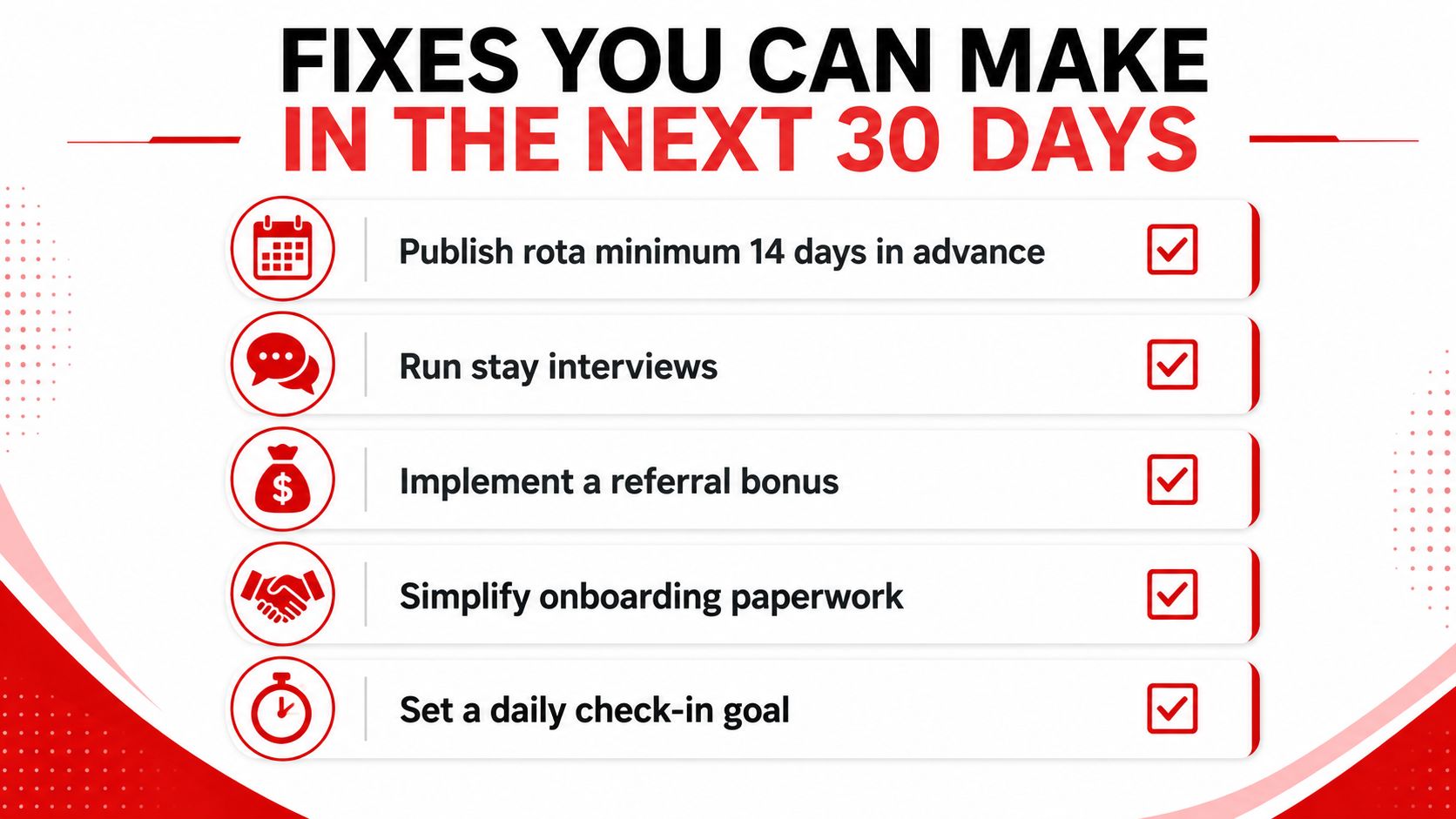
Fixes You Can Make in the Next 30 Days
Retention work often fails because managers start with long-term culture projects while tonight's kitchen remains exposed. Fix the operating leaks first.
Week one
Audit rota practice and pay bands by role and region. Compare what a commis, CDP, sous chef and head chef can earn locally, then check whether your offer matches the responsibility and working pattern. A role in Devon may need a different package from one in central Bristol, Berkshire or Windsor.
Week two
Agree a standing relief arrangement for short-notice sickness, holidays and sudden demand. The aim isn't to replace your permanent team. It's to stop one absence from forcing three reliable chefs into overtime or making the venue reduce service.
Week three
Remove the small policy leaks that damage trust. Pay staff correctly and on time, protect breaks, explain zero-hours arrangements clearly and don't use unpaid trial shifts. These details may look administrative, but chefs notice them quickly.
Week four
Tell the team exactly what has changed and measure whether managers follow through. Publish the rota at a consistent point, record late amendments and ask staff whether cover arrives before pressure spreads through the kitchen. Use a practical guide to reducing overtime costs to connect retention decisions with labour control.
The accompanying video gives managers another practical reference point:
Don't wait for perfect policy wording. A clear rota rule, dependable cover and honest pay review will improve the working week sooner than a lengthy employee engagement exercise.
Building Rota Predictability That Stops Leaks
Unpredictable scheduling pushes people out even when the job, venue and wage are otherwise acceptable. A UK hospitality workforce study found voluntary turnover at 34% in the lowest schedule-predictability group, 26% in the middle group and 19% in the highest group, a 15 percentage-point difference between low and high predictability (study on schedule predictability and hospitality turnover).
Predictability doesn't mean a rota can never change. It means staff know the expected pattern, understand the escalation process and aren't constantly reorganising childcare, travel or second jobs around management decisions.
Run a 14-day publishing cycle. Have section heads sign off the next rota during a fixed weekly meeting, then use a written escalation route for changes inside 72 hours. Keep a relief option available for genuine emergencies rather than treating every absence as a reason to rewrite the whole team's week.
| Symptom | Likely cause | Operational fix |
|---|---|---|
| Rota published inside seven days | Planning starts too late | Set a fixed publication deadline |
| Frequent same-week swaps | Hours aren't matched to availability | Confirm availability before sign-off |
| Repeated late amendments | No cover buffer | Maintain an agreed relief route |
| Clopeners and broken rest patterns | Sections planned in isolation | Review the full employee pattern |
| New starters leaving quickly | Early shifts feel unstable | Audit first-90-day scheduling separately |
Track the percentage of shifts published inside seven days, the average notice given for changes and same-week swaps per team member. A manager who can't answer those questions is managing by anecdote.
Predictable rotas protect the kitchen twice. They help people stay, and they give managers enough warning to arrange cover before service is compromised.
Creating Career Pathways That Keep Good People
Chefs leave when the next step is vague, delayed or reserved for an external hire. A promotion pathway gives strong performers a reason to build capability inside your business instead of taking their skills to another kitchen.
A 2025 analysis of more than 35,000 hospitality employees found sector turnover fell from 75% to 67% year-on-year, and linked lower turnover statistically to internal promotion pathways for managers (Restaurant Online's internal promotion report). The lesson is practical. Name the route before a vacancy appears.
| Role | 90-day milestone | 6-month milestone | Decision rights |
|---|---|---|---|
| Commis chef | Master an agreed station and lead it on quieter services | Train a new starter on core preparation | Organise own prep and flag stock needs |
| Chef de partie | Run a section consistently and complete service checks | Own ordering input and support stock control | Adjust section prep and delegate tasks |
| Junior sous chef | Coordinate a service with head chef support | Train starters and manage a section handover | Allocate tasks and escalate service risks |
| Sous chef | Cover two services with controlled standards | Understand ordering, stock control and labour decisions | Lead service and make operational calls |
Hold quarterly progression reviews with evidence, not theatre. Review service performance, food safety, attendance, training completed and the decisions the chef can now make without supervision. If the criteria are met, record the next step and the support required.
Don't advertise every supervisory vacancy externally before internal candidates have had a fair conversation. A commis who can see a route to CDP, then sous chef or relief lead, has a reason to master the current role. For long-term placements and multi-site accounts, make the route visible with a 90-day review, a 6-month competency milestone and a named senior position.
Measuring Retention So You Know It's Working
Retention belongs on the operating dashboard, not in an annual HR report. A GM should be able to see whether a site is losing people, which roles are affected and whether the problem starts during recruitment, onboarding, rota planning or management.
Use four monthly calculations.
- Annualised turnover: leavers ÷ average headcount × 100. Compare sites, departments and role families rather than relying only on a group average.
- First-90-day attrition: new starters who leave inside probation ÷ all hires × 100. This shows whether recruitment promises match the job.
- Voluntary versus involuntary exits: resignations and other employee-led departures compared with dismissals or redundancies. The split tells you whether staff are choosing to leave or managers are removing poor fits.
- Retention rate: 1 minus turnover. Keep the calculation consistent so the trend remains useful.
| Metric | Formula | Healthy benchmark | Red flag or action |
|---|---|---|---|
| Annualised turnover | Leavers ÷ average headcount × 100 | Set a site baseline and improve it consistently | A rising trend requires a role and manager review |
| First-90-day attrition | Early leavers ÷ all hires × 100 | Keep early exits low and investigate every pattern | Above 25% signals recruitment or onboarding failure |
| Voluntary exit share | Resignations ÷ total exits | Monitor by manager and department | Below 70% of total exits suggests managers may be driving departures |
| Hospitality voluntary turnover | Voluntary leavers ÷ average headcount × 100 | Stay below 35% | Above 35% signals systemic problems |
| Retention rate | 1 minus turnover | Improve month by month | A falling rate needs immediate operational action |
These thresholds are management triggers, not excuses to ignore context. Pull rota data from scheduling software, leaver dates and reasons from payroll or HR records, and hiring dates from your recruitment tracker. A spreadsheet is enough if the definitions stay consistent.
Review rota stability weekly, turnover by department and site monthly, and kitchens, front of house and management cohorts quarterly. If chef turnover rises while front of house remains stable, don't launch a company-wide initiative. Fix the kitchen system causing the loss.
Your Retention Plan and When to Bring in Cover
Retention becomes manageable when you sequence the work. Trying to fix pay, management, rotas, onboarding and progression simultaneously usually produces a long action list and little operational change.
Weeks one and two
Audit rota notice periods at every site and hold three stay interviews per location. Ask direct questions about notice, rest, manager behaviour, pay clarity and the conditions that would make the chef leave. Record the answers by role and shift, not just as anonymous comments.
Identify the service periods most exposed to absence. A hotel in Wales may need cover around weddings and events, while a restaurant in Bristol may need a stronger Friday and Saturday plan. A pub in Dorset or Devon may need seasonal reinforcement when local labour becomes difficult to secure.
Month one
Lock a two-week rota publishing rule and review pay against local competitors and role expectations. Publish the rule to the team, explain exceptions and record every late change. At the same time, agree how the business will respond to short-notice sickness without immediately calling the same two chefs.
Months two and three
Launch the internal progression route. Name the chefs who are working towards CDP, junior sous and sous responsibilities, then ring-fence suitable opportunities for existing staff before searching externally. Give each person a review date, specific skills to demonstrate and a manager accountable for coaching them.
Permanent recruitment still has a role. If the internal pipeline can't meet the requirement, use permanent chef recruitment to add capability rather than repeatedly filling emergency gaps. Yacht chefs, villa chefs, hotel chefs and senior kitchen leaders often require a more targeted search than a general vacancy advert.
Months four to six
Formalise relief cover so sickness and holiday gaps can be filled quickly by chefs who understand professional kitchen standards. Temporary cover isn't a substitute for retention. It gives the permanent team enough headroom to train, take rest days, run reviews and maintain service while recruitment continues.
Relief Chefs UK is one option for this part of the plan, providing relief chefs, temporary chefs, permanent chef recruitment, yacht chefs, villa chefs and wider hospitality staffing support across the UK. The business was established in 2013 and works with independent pubs, restaurants, private households, yachts and boutique hotels, including operators in Devon, Bristol, Wales, Berkshire, Windsor, Reading and Slough.
Start Monday with six actions:
- Set the rota notice rule.
- Agree a relief cover contract.
- Put stay interviews in the diary.
- Set a pay review date.
- Write the promotion pathway.
- Build the monthly retention dashboard.
The Migration Advisory Committee identifies chefs as one of hospitality's clearest shortage occupations, with chefs listed under Standard Occupational Classification code 5434, while also describing hospitality vacancies as high compared with pre-pandemic levels because demand has fluctuated sharply since COVID-19 (Migration Advisory Committee shortage review). That makes operational cover more important, not less.
The latest ONS business survey found 52% of accommodation and food service businesses reported decreased turnover in January 2026, a 21 percentage point rise from December 2025 (ONS Business Insights and Conditions Survey). When trading conditions change quickly, a flexible staffing plan protects both the rota and the permanent team.
Contact Relief Chefs UK for vetted relief and temporary chefs, permanent recruitment, yacht and villa chef placements, and ongoing hospitality staffing support across the UK. Set up dependable cover for sickness, seasonal peaks and vacancies so your managers can focus on progression, rota stability and keeping good chefs in the business.
Call the team.
Office 01392 715474 · info@reliefchefs.co.uk