
You open the walk-in before service and spot it straight away. A sleeve of smoked salmon behind the new delivery. Two tubs of cream dated for yesterday. Prep labels missing on sauces no one wants to claim. By the time someone checks the low boy fridge, the waste has already happened.
Most kitchens don't lose money on stock because the team doesn't care. They lose it because the system breaks under pressure. A chef calls in sick. The weekend trade comes in harder than expected. Deliveries arrive during prep. A junior puts fresh stock in front because it's quicker. Then everyone spends the rest of the shift firefighting.
Good stock rotation methods aren't admin. They protect gross profit, keep service stable, and stop standards slipping when the kitchen is stretched.
Why Poor Stock Rotation Is Costing You More Than Just Food
Food waste is the obvious loss. The hidden damage is usually worse.
When stock isn't rotated properly, the kitchen starts making bad decisions all day. Chefs over-order because they no longer trust what's in the fridges. Managers approve emergency purchases at poor margin. Prep gets duplicated because no one knows what's usable. Then service gets hit when a key product has expired in the back while the team thought they were covered.
The wider UK picture shows how serious this is. The hospitality and food service sector contributed roughly 1.1 million tonnes of food waste in 2021, according to WRAP monitoring cited by ShipBob's overview of stock rotation. For operators, even a small reduction in spoilage can mean lower purchasing costs and more reliable availability.
Waste hurts GP and service at the same time
In practice, poor rotation creates four commercial problems at once:
- Write-offs increase: Ingredients you paid for never reach the plate.
- Menu consistency drops: A missing garnish, sauce, or protein forces substitutions and weakens standards.
- Labour gets wasted: Chefs spend time searching, rechecking, re-prepping, and explaining gaps.
- Buying discipline disappears: Once the team loses trust in stock accuracy, over-ordering follows.
That last point matters. A kitchen with weak stock discipline nearly always carries too much of the wrong thing and not enough of the right thing.
Practical rule: If you're binning stock and still running out of ingredients mid-service, you don't have a purchasing problem. You have a rotation problem.
Staffing instability makes the problem worse
Many hospitality businesses are often caught out. The rotation system may look fine on paper, but it relies on people following it every shift.
When you're dealing with short notice sickness, chef shortages, unreliable agency cover, or a seasonal jump in trade, routines break first. Deliveries aren't checked properly. Labels go missing. New stock gets shoved wherever there's space. The team starts working around the system instead of through it.
That's why stock control and labour planning belong in the same conversation. If your rota is constantly under strain, your stock standards won't stay consistent either. The same pressure that pushes overtime up also pushes waste up, which is why it's worth looking at broader kitchen cost control such as reducing overtime costs in hospitality.
A stable kitchen doesn't just cook better. It stores better, labels better, and wastes less.
FIFO vs FEFO Choosing the Right Method for Your Menu
Most kitchens talk about FIFO. Fewer apply FEFO properly. The difference matters.
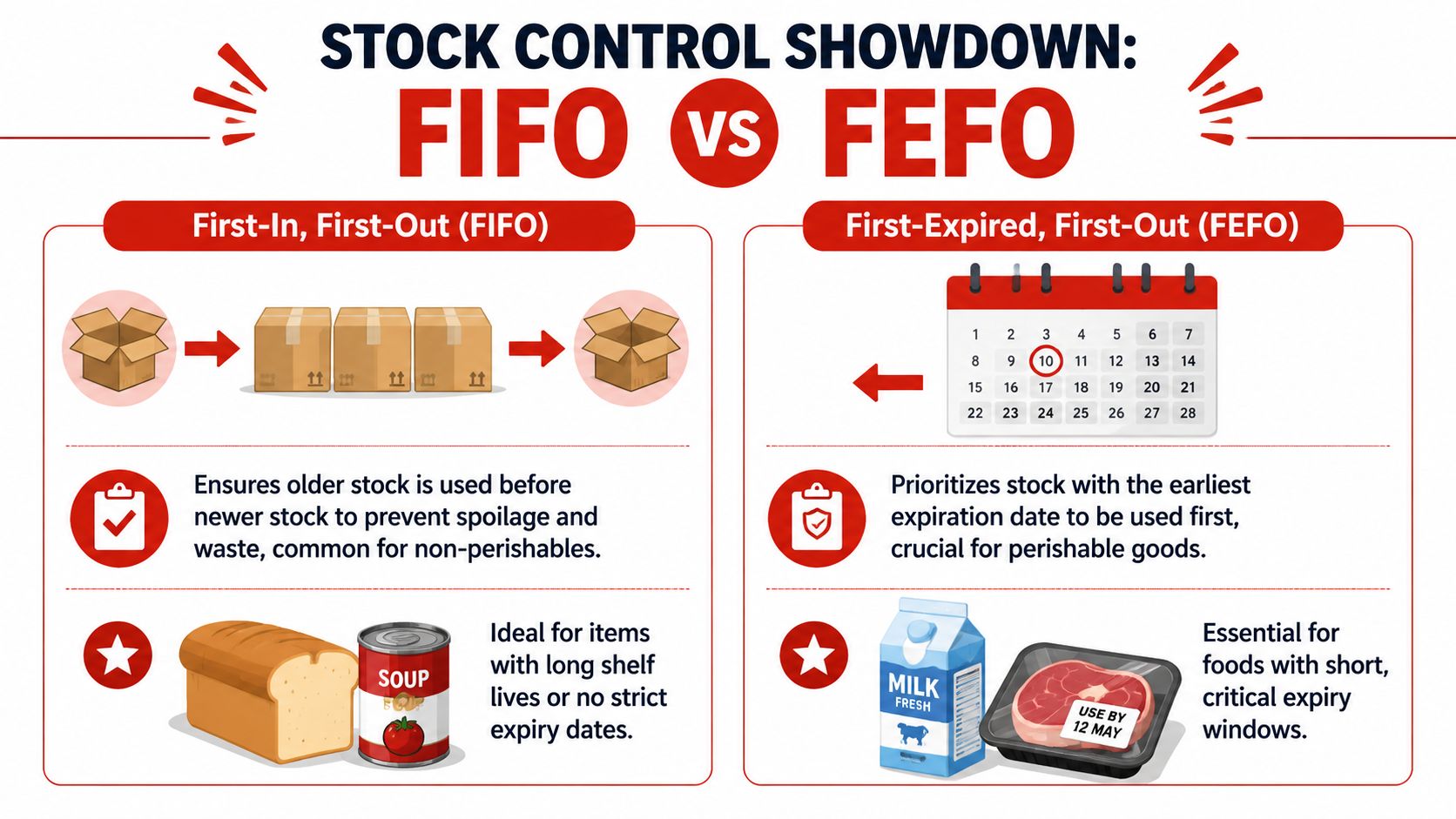
FIFO means first in, first out. You use the oldest received stock first. That works well for goods where receipt date is the main rotation point, especially ambient products and some frozen items.
FEFO means first expired, first out. You use the item with the nearest expiry first, regardless of when it arrived. That matters for products where the date code is the key risk.
What the law and dates mean in practice
For UK food businesses, stock rotation links directly to date marking. The Food Standards Agency guidance cited in Flowspace's stock rotation article makes the distinction clear. “Use by” dates apply to many ready-to-eat chilled foods because after that date the food may be unsafe. “Best before” dates relate to quality on less perishable products.
That's why FIFO is standard in many stores and kitchens, but FEFO is critical for date-sensitive products.
Here's the simple operational test:
| Product type | Better method | Why |
|---|---|---|
| Tinned tomatoes, dried pasta, flour | FIFO | Older delivered stock should be used first |
| Bottled sauces with longer shelf life | FIFO | Date pressure is usually less immediate |
| Milk, cream, cooked meats, fresh desserts | FEFO | Nearest expiry matters more than delivery order |
| Chilled ready-to-eat items | FEFO | Safety and date compliance come first |
What this looks like in a live kitchen
In a Bristol pub dry store, FIFO is usually enough for canned beans, oils, vinegar, and carton stock. New deliveries go to the back, existing stock comes forward, and the oldest case gets opened first.
In a Windsor hotel breakfast kitchen, FEFO matters more for yoghurt, sliced ham, cream, and soft fruit. A case delivered today can still need using before one delivered earlier if the date is shorter. If the team follows FIFO there without checking expiry, they can serve the wrong product first and leave the risky stock behind.
Use FIFO when age in storage drives the decision. Use FEFO when the printed date drives the decision.
What doesn't work
Some venues mix methods without realising it. They run FIFO in the dry store, then lazily apply the same habit to dairy, fresh fish, desserts, and prepared items. That's where losses start.
Another common failure is relying on memory. If a chef has to stop and think about what should be used first, the system is too weak.
Avoid LIFO in food service. Last in, first out might make sense in other sectors, but in kitchens it usually pushes older stock deeper into storage and increases the chance of spoilage, date breaches, and waste.
The best stock rotation methods are the ones your team can apply quickly, correctly, and under pressure.
A Step by Step Guide to Implementing Stock Control
Friday night service is ten minutes out. A relief chef is covering grill, a junior has been moved onto larder, and a delivery that should have been checked at 11am is still sitting half worked through in the walk-in. That is how stock control breaks down in real kitchens. It rarely fails because the rule is unclear. It fails because the handover is weak, the team is stretched, and no one has made the right action easy.
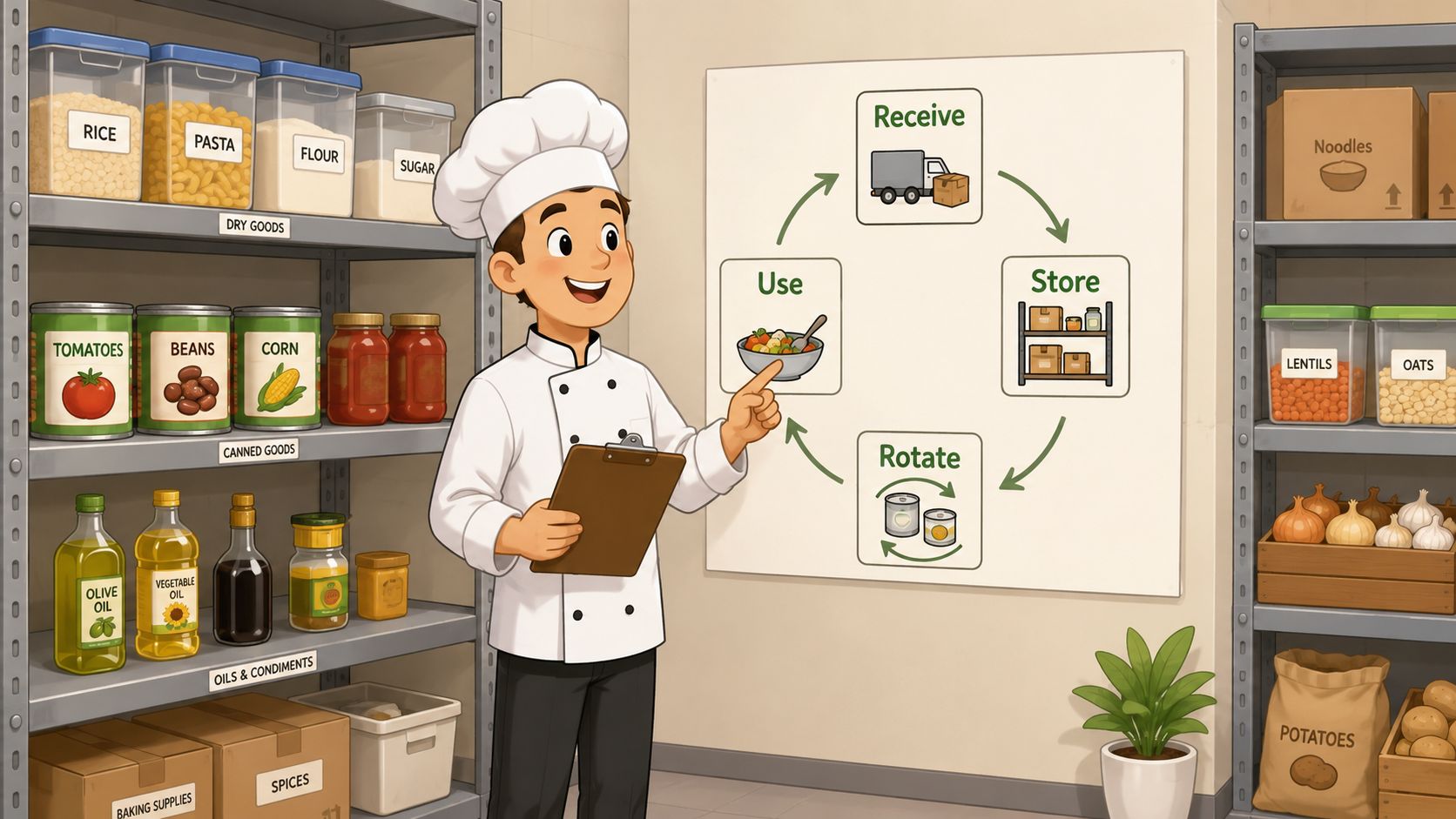
Start with goods in
Stock control starts at delivery, because that is the only point where you can still refuse a problem before it becomes waste.
One person on each shift needs clear ownership of goods in. If that changes daily because staffing is unstable, the check must be simple enough that a relief chef or senior section chef can run it properly without guesswork. Product, condition, pack integrity, and use-by date need checking before anything is put away. If short-dated stock does not fit your service pattern, reject it there and then.
A workable goods-in routine looks like this:
- Check date-led products first: Dairy, cooked meats, fish, desserts, and prepared chilled lines lose value fastest when they are left waiting.
- Keep the date visible: If the outer case hides the expiry once opened, mark the tray or inner pack before it goes into storage.
- Record what matters: Use receiving dates where they help the team identify age in storage, especially on cases that get split across sections.
- Put stock away straight away: Chilled product left in a corridor during prep is already off standard before service starts.
If this step is loose, GP diminishes. Short dates get missed, over-ordering follows, and the next chef loses trust in what is on the shelf.
Set the storage up to survive a busy shift
Good rotation does not come from reminders. It comes from layout.
A cramped fridge with mixed products, hidden labels, and no fixed shelf plan asks the team to make judgment calls under pressure. They will get some right and some wrong. In a stable brigade, that causes drift. In a kitchen using agency cover, split shifts, or frequent relief support, it causes waste fast because every handover resets the standard.
Set each area so the correct choice is obvious. Group by product type first. Then organise by the method that applies to that category. Keep labels facing forward. Leave enough space to move stock without unloading the whole shelf. If the team has to reshuffle half the fridge to reach the older cream, the system is poorly built.
The best storage plan is the one a tired chef can still follow at 9pm.
The head chef sets that standard, then makes sure section leaders hold it every day. That sits squarely inside the responsibilities of a head chef in running kitchen systems, because stock discipline affects margin, prep flow, and service reliability as much as any menu decision.
Carry the rule into prep and service
Many kitchens lose control after goods in. The walk-in looks tidy at noon, then the service fridges, prep benches, and garnish stations undo the work by dinner.
Opened products, prepped components, portioned proteins, sauces, and desserts need clear labels that tell the next chef exactly what they are and when they were opened or made. If a container has no identity, it should not stay in use because nobody can make a safe or profitable decision on it. That point matters even more when one team preps and another team serves. Staffing instability always exposes weak labelling because the person inheriting the station cannot rely on memory.
Keep service areas tight:
- Hold only what service needs: Backup stock belongs in the walk-in, not packed into every undercounter fridge.
- Give each item one home: If the same product is stored in three places, duplicate opens and missed stock become normal.
- Rotate during top-up: Every refill is a stock check, not just a refill.
- Reset at close: The morning team should receive an organised station, not a clean-up job disguised as a handover.
This walkthrough is useful if you want to show the team the rhythm visually before rewriting your kitchen routine:
Check the system in small passes
Month-end stocktake tells you the result. It does not protect today's margin.
Short checks during the day work better. A quick review of chilled stock in the morning, a label check after prep, and a close-down scan of service fridges will catch the problems that usually turn into write-offs. Missing dates, duplicate opens, old stock trapped behind new, and products sitting in the wrong section are all easier to fix in minutes than in a weekly clear-out.
A true test is whether the process survives staff movement. If it only works when your strongest sous chef is on shift, it is not a system yet. It is one person holding the kitchen together.
How to Turn Stock Rotation into a Team Habit
Friday night. Two covers in, the fridge is already under pressure, one chef is covering a section they do not usually run, and nobody is fully sure which open tub needs using first. That is how waste starts. Not with one big mistake, but with small misses under pressure.
Stock rotation becomes a habit when the kitchen can hold its standard during those shifts, not only when the usual senior team is in place. Weak labelling, loose shelf discipline, and handovers that rely on memory all break the system fast. Staffing instability makes it worse. Temporary cover, rushed onboarding, and last-minute replacements expose every gap in the process.
Build one clear SOP
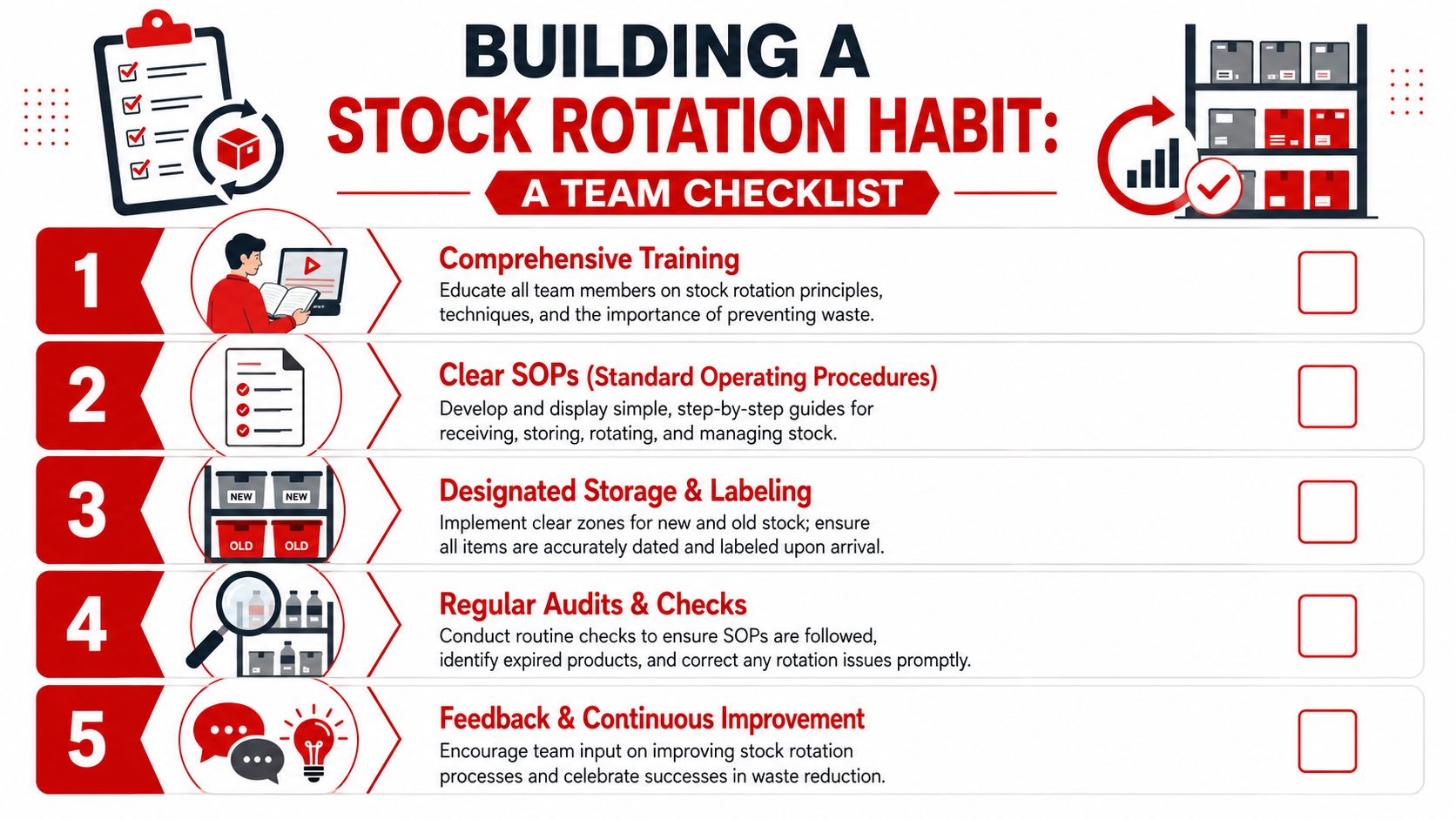
A usable stock rotation SOP should fit on one page. If it needs a manager standing beside someone to explain it every shift, it will fail as soon as the rota gets stretched.
Keep it practical and visible near the walk-in, dry store, or prep area. The rule should cover what the team does on shift:
- Purpose: Protect GP, reduce waste, and keep service consistent.
- Scope: Deliveries, walk-ins, freezers, dry stores, prep fridges, and service stations.
- Method by category: FEFO for short-life items, FIFO for ambient and longer-life goods.
- Labelling rule: What gets labelled, who labels it, and when.
- Shift checks: Clear opening, pre-service, and close-down responsibilities.
- Escalation: What happens with unlabelled, expired, or short-dated stock.
The document matters. The placement matters just as much. Chefs need to see it while working, not buried in a folder in the office.
Train in the real kitchen
Rotation standards are easy to agree with in briefing. They fall apart during prep and service if training stays theoretical.
Train people in the storage areas they use. Put a commis in front of the dairy shelf and show them what "use first" looks like. Show a KP how to spot an open product with no date. Show a section chef how to refill a service fridge without burying older stock behind fresh prep. That is how habits stick.
This matters even more when the team changes from week to week. Relief chefs, agency cover, and new starters can protect standards or weaken them within one shift. A proper kitchen handover documentation process gives incoming staff a usable picture of stock position, prep status, and date risk before service starts.
If handover is vague, stock rotation turns into guesswork.
Make responsibility visible on the rota
Shared responsibility usually means no real responsibility. Someone has to own each check.
The structure can be simple. A sous chef may own chilled high-risk stock. Section chefs may own their service fridges. A closing chef may sign off labels and open products before the kitchen shuts. The exact names matter less than the fact that everyone knows who is checking what.
Run a simple routine for two weeks:
- At open: One named chef checks short-life shelves and flags any date risk.
- Before service: Each section pulls oldest usable stock forward and removes anything that should not be on the station.
- At close: One person signs off labels, open containers, and waste notes.
That routine protects margin because it removes ambiguity. It also protects standards when staffing is unstable. Kitchens that rely on one organised sous chef usually lose control the minute that person is off. Kitchens with a clear routine and disciplined handover hold up far better, even when cover is brought in at short notice.
That is the true test. If the process survives staff changes, it is a team habit. If it collapses with one rota gap, it is still just goodwill.
Measuring Success and Solving Common Rotation Problems
If you can't see whether your rotation system is improving, the team will treat it as background noise.
You don't need complicated reporting to judge whether it's working. Start with a short weekly review. Look at what was thrown away, what was written off, which products ran out unexpectedly, and where the mistakes came from. That gives you a clearer picture than a lecture about standards.
What to track in a practical way
A useful review usually covers:
- Waste notes by product line: Which ingredients are repeatedly expiring or being over-prepped.
- Stock age concerns: Which shelves hold items that are drifting too long.
- Stockouts during service: Products that should have been available but weren't.
- Delivery issues: Short-dated or poorly handled items from suppliers.
- Repeat process failures: Missing labels, mixed dates, or badly organised prep fridges.
This doesn't need to be fancy. A clipboard sheet, shared kitchen log, or stock app can all work if the team uses them.
Common problems and what fixes them
One of the most common failures is speed-based grabbing during service. A junior chef takes the newest tub because it's nearest. That's a layout problem as much as a training problem. Put oldest usable stock at the front and remove visual clutter.
Another issue is supplier date pressure. A delivery can arrive in good condition but still be wrong for your menu cycle if the life left on it is too short. If you keep accepting it, your kitchen ends up carrying the loss.
For some sites, manual systems remain enough. For others, they stop being enough. The harder question is when stock rotation needs to go beyond labels and shelf order. As noted in Intuendi's discussion of stock rotation and digital traceability, UK operators are under pressure from tighter margins, food waste reporting, and compliance demands. That's where FEFO by batch, barcode capture, or digital traceability can become more cost-effective than a purely manual FIFO routine.
Multi-site groups, busy hotels, and kitchens with frequent team changes usually reach that point sooner than owner-operated single sites.
If your current method only works when one strong chef is on duty, it isn't a system yet.
Your Stock Rotation Questions Answered and Next Steps
How do I manage stock rotation in a small kitchen with almost no storage space
Use fewer product lines, smaller delivery frequencies where possible, and stricter zoning. In compact cafés and pubs, the mistake is usually trying to store too much. If shelves are overloaded, rotation becomes awkward and staff stop following it. Tight spaces need clearer labels and harder limits on what can sit in service fridges.
Should agency or temporary chefs be expected to follow my system immediately
Yes, but only if the system is visible and simple. A relief chef can work well in an unfamiliar kitchen when shelves are organised, labels are clear, and handover is solid. If the method lives only in the head chef's head, even a good chef will lose time figuring it out.
What should I do with unlabelled prep
Treat it as a control failure. If you can't identify what it is, when it was made, or whether it is still within your kitchen standard, don't build service around guesswork. Then fix the reason it happened, whether that's rushed close-down, weak training, or no ownership on a section.
Is FIFO enough for every kitchen
No. It works for plenty of stock lines, especially ambient goods, but chilled date-coded items often need FEFO thinking. The right choice depends on whether delivery order or expiry date is the bigger risk.
How often should stock rotation be checked
Daily. Not necessarily through a full stocktake, but through repeated short checks in goods-in, storage, prep, and close-down. The strongest kitchens make rotation part of opening and closing routines instead of treating it as a separate task.
Why does stock control usually slip when staffing is unstable
Because rotation depends on consistency. Short notice sickness, chef shortages, seasonal peaks, and weak shift handovers all interrupt basic disciplines. Deliveries get rushed. Labels get missed. Senior chefs focus on service and leave the fridges for later. That's why kitchen stability matters just as much as stock policy.
The practical takeaway is simple. Stock rotation methods only save money when the team can carry them out properly, every shift, under pressure. A clean shelf plan, strong SOP, and sensible method choice matter. So does having competent chefs in place to protect standards when the rota changes at the last minute.
If staffing gaps are making it harder to maintain stock control, service standards, and kitchen stability, speak to Relief Chefs UK. Established in 2013, they support hospitality businesses across the UK with relief chefs, temporary chefs, permanent chef recruitment, yacht chefs, villa chefs, and wider hospitality staffing support. Whether you're running a pub in Devon, a hotel in Berkshire, a restaurant in Bristol, or a seasonal site in Dorset or Wales, the right chef cover helps stop waste, protect GP, and keep your kitchen organised when it matters most. Contact Relief Chefs UK to secure dependable support before the next staffing gap turns into another stock loss.