
Food Labelling Regulations UK: A Practical Guide
29 August 2026
Friday night, a café assistant slides a grab-and-go chicken salad across the counter. The customer asks whether it contains nuts. The assistant turns to the kitchen, where one chef is plating, another is off sick, and a relief chef is still learning the prep list. Nobody can answer with confidence. The sticker shows a name and price, but no complete ingredients list.
That moment exposes the problem with food labelling regulations in the UK. Compliance doesn't live in a folder on the manager's desk. It lives in recipe cards, supplier specifications, prep labels, display counters, menus, storage shelves, and the handover given to the chef covering tomorrow's service.
For pubs in Devon, hotels around Windsor and Berkshire, restaurants in Bristol, and caterers working across Wales, Dorset, Reading, Slough and other busy hospitality areas, the pressure is familiar. Short-notice sickness, seasonal demand, agency reliability and ongoing chef shortages all make consistency harder. A label that was correct last week can become wrong when a supplier changes, a recipe is adapted, or a temporary chef walks into the kitchen mid-week.
Why Food Labelling Regulations Matter in a Busy Kitchen
A customer asking about nuts isn't making a difficult request. They're asking the kitchen to provide information that may affect whether they can safely eat the food. If the team can't identify the ingredients, separate known allergens from possible cross-contact, or find the correct label, the service has already exposed a workflow failure.
The UK framework was built in stages. The Food Labelling Regulations 1996 came into force on 1 July 1996, while the Food Information Regulations 2014 were laid before Parliament on 14 July 2014 and mostly came into force on 13 December 2014. The 2014 rules established core consumer information requirements, including the food name, warnings where needed, net quantity, ingredients, origin where required, and storage or cooking instructions. The underlying legislation is set out in the Food Information Regulations 2014.
The rule is only useful if the kitchen can deliver it
The modern pressure point is allergen transparency. On 1 October 2021, new rules took effect in England, Wales and Northern Ireland for prepacked for direct sale, or PPDS, food, requiring a full ingredients list with allergens emphasised. That brought food prepared and packed on site closer to the information standard applied to prepacked products, as explained in Food Standards Agency allergen guidance.
A missed declaration can lead to a local authority investigation, criminal prosecution and potentially unlimited fines. Local authorities enforce allergen requirements, so a neatly organised compliance folder won't protect a venue if the product on the counter, menu or pass doesn't match the records. The government guidance on what food labels must show also makes clear that labels must not mislead customers.
Practical rule: If a relief chef can't understand the label trail during the first service, the process isn't robust enough.
This is why labelling needs an operational owner. The head chef should control recipe versions, the kitchen manager should verify daily production, and front-of-house should know where the current allergen information sits. A temporary chef arriving after a sickness call shouldn't have to reconstruct the menu from memory.
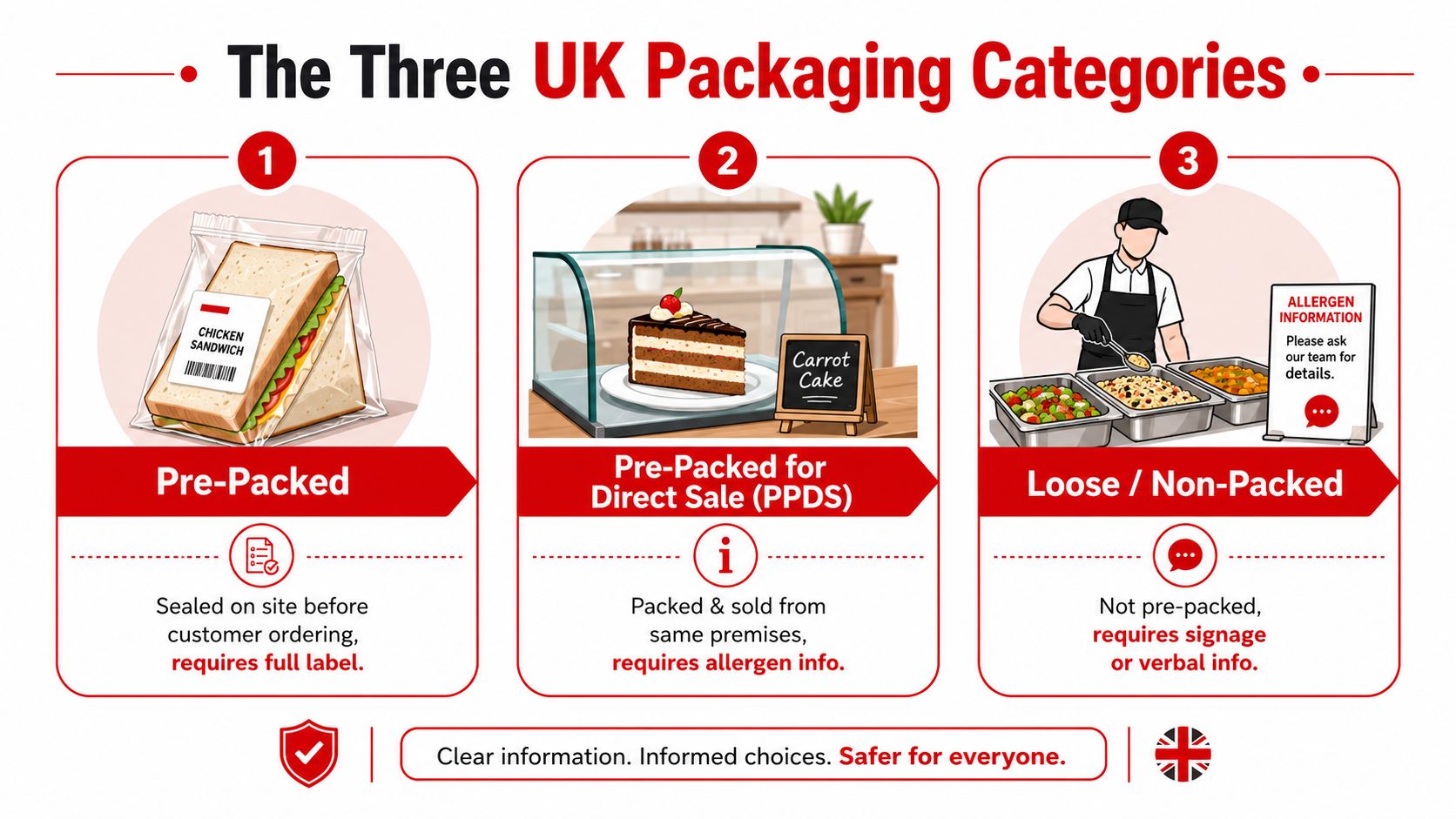
Understanding the Three Packaging Categories UK Law Uses
The packaging category determines what information must reach the customer and when. The key question isn't whether the food is wrapped. Ask whether it was packed before the customer chose or ordered it, whether it was packed for direct sale on the same premises, or whether it's being sold loose.
Prepacked food
A wrapped slice of cake prepared in a hotel kitchen, sealed before it reaches the lobby counter, is generally treated as prepacked food. The customer can pick it up without speaking to staff, so the packaging needs to carry the required information, including the food name and ingredients list where applicable.
A factory-made dessert supplied to a restaurant follows the same basic principle. The receiving team should check that the label remains legible, the date mark is present, and the supplier information matches the product being stored and sold.
PPDS food
A deli counter sandwich made and packed on the same premises before a customer orders it is the classic PPDS example. A paper bag with only a price sticker isn't sufficient. PPDS food requires ingredients to appear directly on the package or an attached label, with allergens emphasised in the ingredients list.
The definition also covers food packed on the same premises where it's sold, including a mobile stall or vehicle operated by the packer, as set out in the official PPDS introduction. This catches hotel breakfast boxes, café salads, sandwiches prepared ahead for a conference, and pastries packed for a takeaway display.
Non-prepacked food
A plated pub meal, buffet dish or sandwich assembled after the customer orders is non-prepacked. Allergen information still matters, but it may be supplied through a menu, chalkboard, written notice or a trained verbal handover, depending on the service arrangement and the information available.
The common mistake is treating every item in a bag, tray or takeaway box as non-prepacked. The packaging itself isn't the deciding factor. The timing of packing and the customer's ability to access information before purchase are what matter.
Allergen Labelling and Natasha's Law in Practice
During a busy prep shift, a chef changes a wrap filling, prints the old grab-and-go sticker and sends it to the counter. That workflow failure is exactly where Natasha's Law creates risk. In England, Northern Ireland and Wales, the law applies to PPDS food from 1 October 2021. Packaged food prepared on the premises for sale must carry a full ingredients list, with allergenic ingredients clearly emphasised. The Food Standards Agency's Natasha's Law guidance covers food packed where it is sold, including a mobile stall or vehicle operated by the packer.
The 14 regulated allergens are:
- Cereals containing gluten, such as wheat, rye, barley and oats
- Crustaceans
- Eggs
- Fish
- Peanuts
- Soybeans
- Milk
- Nuts
- Celery
- Mustard
- Sesame
- Lupin
- Molluscs
- Sulphur dioxide and sulphites
Make emphasis visible
Use bold type, a different font style, contrasting colour or another clear treatment so allergens stand out in the ingredients list. A small footnote mentioning walnut, or a generic allergen statement placed elsewhere, leaves too much room for doubt.
Consider a chicken and walnut wrap whose branded filling has been replaced with an in-house recipe. The supplier's original specification no longer controls the dish. The kitchen must sequence the new ingredients, review allergens and approve a new label. If walnut remains in the recipe but disappears from the sticker, the prep, packaging and service teams are working from conflicting information.
Put the revised control into the daily workflow:
- Update the recipe card and allergen matrix.
- Check each supplier specification used in the wrap.
- Mark the new recipe version clearly on the prep list.
- Replace the grab-and-go label template.
- Brief the till and counter team before sale.
- Add the dish to the relief chef handover sheet.
A practical allergen list template keeps the information together. Assign an owner and review it whenever a recipe, supplier or packaging format changes.
Loose food needs a controlled conversation
For plated meals and buffet dishes, information may sit on a menu, sign or with a trained staff member. “Ask a member of staff” is only workable when that person can access current information without guessing.
The handover sheet should cover every dish for that week, its recipe version, allergen profile and supplier changes. A relief chef arriving in Bristol or at a hotel in North Wales needs those details before service, not after a customer raises an allergen question.
Date Marks, Storage Instructions and Batch Tracking
Date marks serve different purposes, and confusing them creates one of the most serious routine errors in a commercial kitchen. Most prepacked food must carry either a best-before or use-by date. A use-by date concerns safety, while a best-before date concerns quality, as explained in official UK food labelling guidance.
A prepared lamb shank for a Monday tasting menu needs a clear use-by control where safety depends on the date. A bottled gastropub ale may carry a best-before date because its quality can decline after that point without the date representing the same safety threshold.
| Date Mark | Meaning | Typical Examples | Kitchen Action |
|---|---|---|---|
| Use-by | A safety limit for foods that may become unsafe after the date | High-risk prepared foods and other perishable items | Don't sell or serve after the date. Selling food past its use-by date is a criminal offence |
| Best-before | A quality indication | Longer-life packaged goods and bottled drinks | Assess quality, storage history and business policy before use or sale |
Labels must tell the next chef enough
A label should be readable at the speed of service. Include the product name, production date, relevant date mark, storage instruction and batch or preparation reference. The official ingredients-list guidance requires ingredients to appear in descending order by weight and explains that a lot or batch number may be used unless the date mark already identifies the batch sufficiently.
For a relief chef, “chicken mix, Tuesday” isn't a strong traceability record. “Chicken and walnut wrap filling, recipe version 4, prepared Tuesday, use by Wednesday, keep refrigerated, batch linked to supplier delivery” gives the next person a usable control.
Storage instructions need to match the product. Chilled PPDS food should carry the relevant refrigeration instruction, while dry goods need suitable ambient storage wording where required. The label printer should produce these details consistently rather than relying on handwritten shorthand that changes from chef to chef.
The practical test is simple. Can the team trace a finished product back to the supplier delivery, recipe version and preparation shift without asking the person who made it? If not, the batch system needs rebuilding. The stock rotation methods guide can support that wider process.
Origin, QUID and the Other Mandatory Label Details
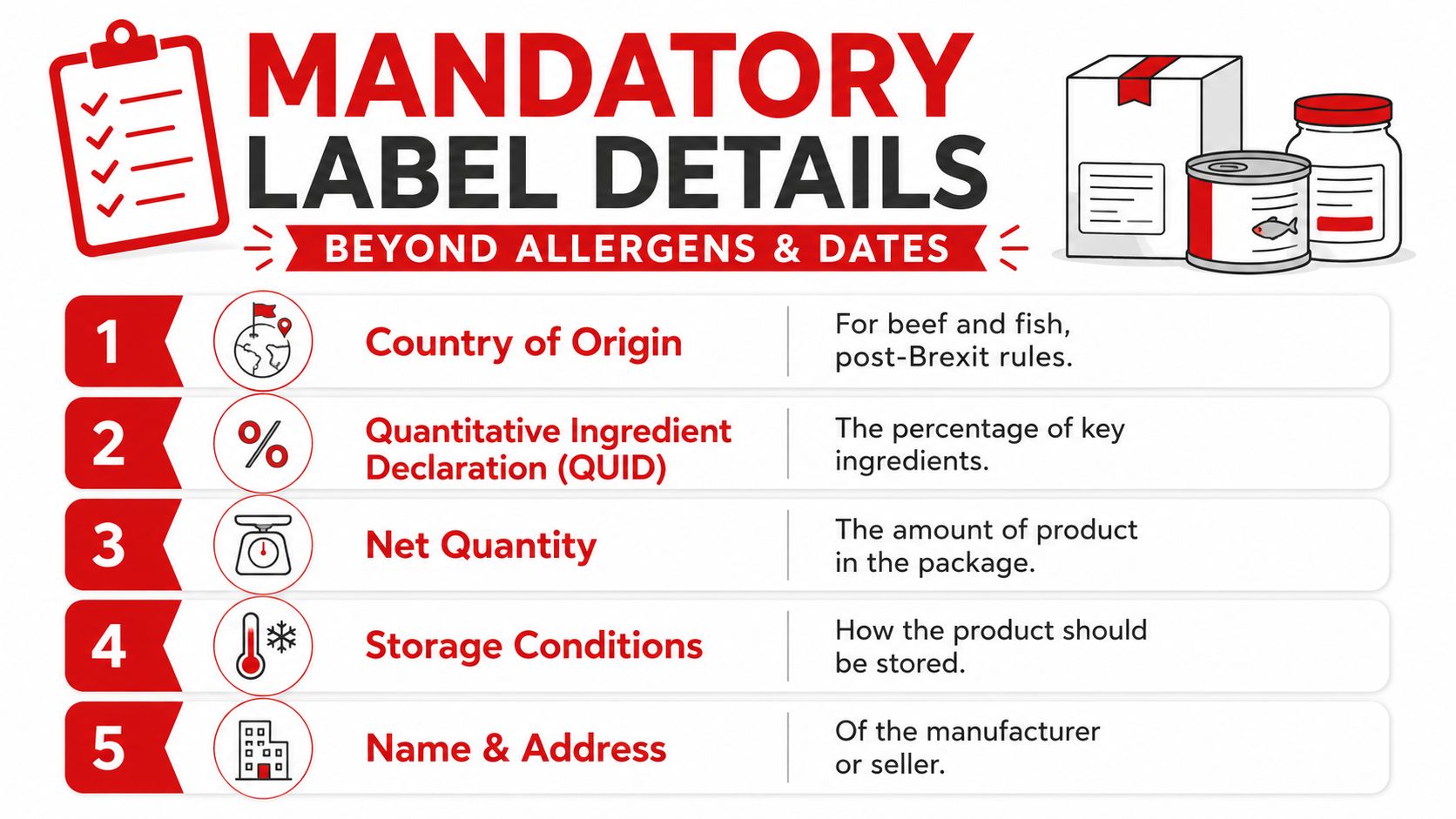
A label can pass an allergen check and still fail elsewhere. Inspectors may also expect the product name, ingredients in descending weight order, net quantity, required origin information, storage conditions, cooking instructions and the responsible food business operator's details. Those details must match the item leaving the kitchen, not the template saved in the manager's folder.
Country-of-origin wording needs evidence behind it. The government's food labelling requirements cover foods including beef, pork, poultry, fish, honey, olive oil, fruit and vegetables. A board stating “British beef” must agree with the supply chain and product records. A hotel buying through Great Britain and the EU should check the product's legal origin rather than copy the distributor's location onto the label.
QUID makes headline ingredients accountable
Quantitative Ingredient Declaration, or QUID, states the proportion of an ingredient highlighted in a product's name, description or imagery. A product called a pork sausage roll may need its relevant meat quantity declared. A cheese board naming a particular cheese must not suggest that the named ingredient is present in a quantity or form the product cannot support. The Food Standards Agency's QUID guidance provides the specific rules to check when recipes or descriptions change.
Build the label around the product the customer receives:
- Food name: Identify the product clearly.
- Ingredients: List ingredients by descending weight and emphasise regulated allergens.
- Quantity: Show net quantity where required, with QUID for highlighted ingredients.
- Storage and cooking: State instructions that reflect the actual product and preparation method.
- Origin: Include it where required, or where a claim makes it relevant.
- Operator details: Give the responsible business name and address.
For GB businesses, a food business operator's UK, Channel Islands or Isle of Man address has been required on broader prepacked food labelling from 1 January 2024, according to government food labelling guidance. An EU supplier address alone may leave a GB label incomplete. Procurement, recipe control and label printing therefore need one shared update process. A relief chef should not have to guess whether the printed operator details still match the current supplier arrangement.
Northern Ireland requires a separate check. From 1 July 2025, the Retail Movement Scheme expanded product-level “Not for EU” labelling to categories including prepacked fruit and vegetables, fish, eggs, honey, shelf-stable composite products, and some chilled or frozen composite products. Caterers buying prepared foods should identify which SKUs need individual marking and keep Great Britain and Northern Ireland workflows separate where required. The government packaging and labelling guidance sets out the relevant marking requirements.
Where Inspectors Actually Catch Venues Out
A folder full of supplier printouts doesn't prove that the service team is controlling allergens. Inspectors can look at what a customer receives, ask staff about a dish, examine a PPDS item on the counter and follow the label trail back to the recipe and supplier.
The failures that cause the greatest concern are usually operational:
- Unlabelled PPDS items: Sandwiches, salads or cakes packed in the kitchen and left for customers to choose.
- Allergen mismatch: The menu says one thing, but a substituted sauce, stock or garnish changes the recipe.
- Cross-contact during service: Shared tongs, fryer oil, chopping boards or gloves transfer allergenic ingredients.
- Misleading origin wording: A board or menu makes a country claim that the purchasing records don't support.
- Stale information: Staff use an old allergen matrix after a recipe or supplier changes.
Enforcement follows the customer journey
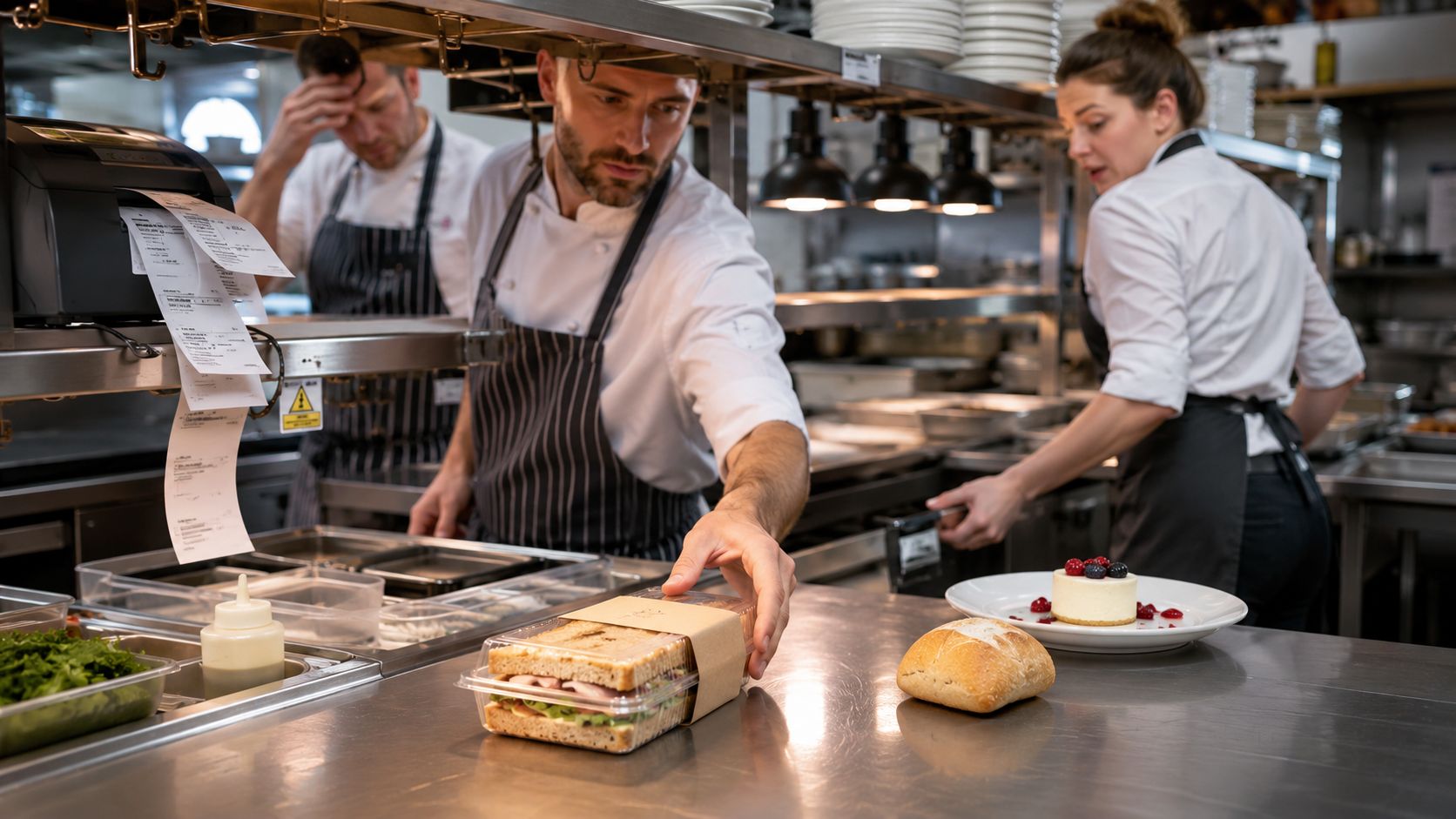
Local authorities enforce allergen requirements. Breaches can result in criminal prosecution and potentially unlimited fines. That means the inspection risk isn't confined to factory-style packaging. A pub in Dorset, a café in Reading or a hotel in Windsor can face scrutiny over a wrap made that morning or an allergen answer given by a waiter.
An inspector may order a menu item, ask what it contains, then ask the kitchen to show the recipe, supplier specification and label used for the same preparation. If those records disagree, the venue has more than a paperwork problem.
The strongest compliance evidence is a consistent trail from delivery, to recipe, to label, to customer conversation.
This is also why new or temporary staff need structured induction. A rushed agency placement who receives only a verbal “watch for nuts” warning is being set up to fail. The venue needs a clear handover, accessible records and a named person responsible for checking the product before it reaches the counter.
A Practical Compliance Workflow for Hospitality Teams
A kitchen can turn food labelling into a repeatable service control by assigning each stage to a person and time. The process below works for an independent pub, a hotel breakfast operation or a multi-site catering team.
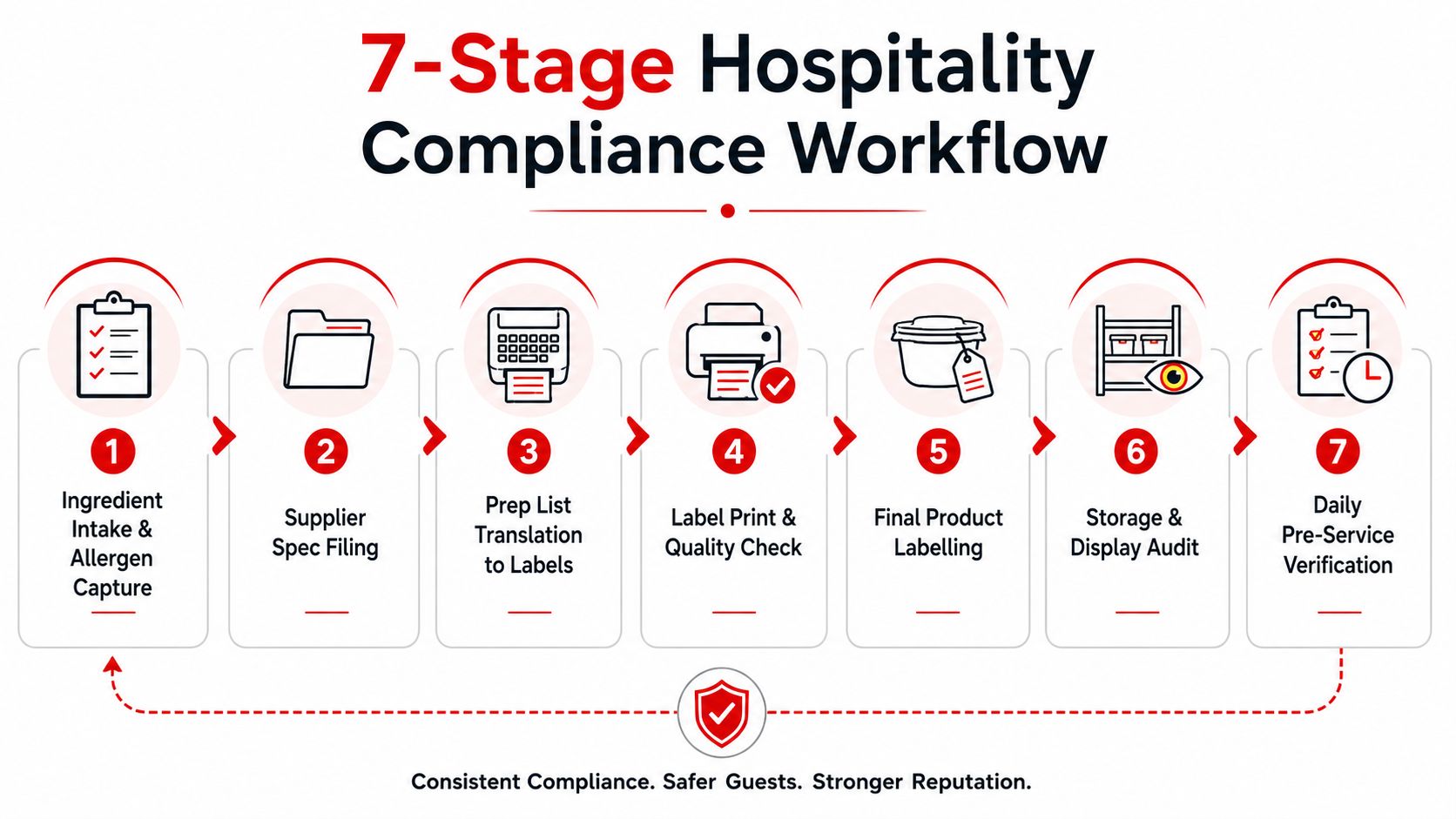
Build the seven-stage routine
Ingredient intake and allergen capture: At goods-in, the chef or designated receiver checks the product, label and supplier paperwork. Any changed specification is flagged before the ingredient enters prep.
Supplier specification filing: Keep current specifications in a named digital folder and a clearly marked kitchen location. Remove obsolete versions so a chef can't pick up last season's recipe information.
Prep list translation: The sous chef or kitchen manager identifies which preparations become prepacked, PPDS or loose food. That decision determines whether a full label, menu information or a controlled verbal process is needed.
Label print and quality check: Before production, check the template for the correct recipe name, ingredients, date mark, storage wording and allergen emphasis. One person prints and another verifies when staffing permits.
Final product labelling: The chef who packs the product applies the correct label immediately. Don't leave a tray of identical items waiting for someone to remember which sticker belongs to which batch.
Storage and display audit: The shift leader checks labels, dates, packaging integrity and display conditions during the day. This catches items moved from the kitchen to the counter without their information attached.
Daily pre-service verification: At handover, the incoming chef confirms menu changes, substitutions, allergen questions and remaining PPDS stock. The health and safety compliance resource can sit alongside the venue's own SOPs.
A short training video can reinforce the routine for new starters:
Protect the handover when a relief chef arrives
Give the covering chef the allergen matrix location, label printer location, current menu version, supplier specification folder and sign-off process during the first 30 minutes. Show one completed label, one rejected label and one example of a PPDS item that must not go onto the counter without approval.
Relief Chefs UK is a nationwide chef recruitment agency established in 2013, offering relief chefs, temporary chefs, permanent chef recruitment, yacht chefs, villa chefs and broader hospitality staffing support. For a venue facing short-notice sickness or a seasonal gap, the useful question isn't only whether a chef can cook. It is whether the chef can follow the venue's controls without destabilising service.
Document the workflow, photograph the correct label placement and rehearse the handover. If the system exists only in the head of one head chef, it isn't a system.
FAQs and How Relief Chefs UK Supports Compliance
Can allergen information be verbal only?
For non-prepacked food, information may be provided verbally where the business has a suitable process and tells customers how to obtain it. Staff must have accurate information available, and they shouldn't guess. For PPDS food, the package or attached label needs the full ingredients list with allergens emphasised.
What counts as PPDS packaging?
Food packed on the same premises where it's sold, before the customer selects or orders it, can be PPDS. Examples include a sandwich wrapped for a café display, a hotel breakfast box prepared ahead and a salad packed for a conference counter. A meal assembled after the customer orders is generally treated differently.
How should buffet items be labelled?
Use clear signs or menu information and make sure staff can answer questions consistently. Each dish needs a current allergen profile, especially when recipes change or serving utensils are shared.
Do home-delivered meals need full labels?
The answer depends on how and when the food is packed, where it's sold, and whether it falls within the prepacked or PPDS categories. Map the delivery process from kitchen preparation to customer receipt, then confirm the applicable requirements with your local authority or competent food labelling adviser.
How long should records be kept?
There isn't one universal retention period stated in the verified information for every hospitality record. Set a documented retention policy for supplier specifications, recipe versions, batch references and label checks, and confirm any sector-specific expectations with the enforcing local authority.
Staffing changes shouldn't interrupt that control. A relief chef arriving in Devon, Bristol, Wales or Berkshire needs a concise briefing on the allergen matrix, label printer, supplier folder and menu changes before taking responsibility for prep. Relief Chefs UK can provide cover chef support for holidays, sickness, sudden events, seasonal pressure and longer recruitment needs, including temporary and permanent placements.
If your kitchen needs a chef who can follow your labelling workflow as well as deliver service, contact Relief Chefs UK to discuss relief chef cover, temporary staffing or permanent chef recruitment. Share your location, service pattern and staffing gap, and ask for support that keeps the kitchen stable while your compliance controls remain active.
Call the team.
Office 01392 715474 · info@reliefchefs.co.uk