
Friday lunch is building, one chef has called in sick, the prep list is behind, and a function starts before your evening team is fully on site. That's when health and safety compliance usually gets treated as tomorrow's problem. In hospitality, that's a mistake.
A shaky rota doesn't just slow service. It changes who is handling deliveries, who is checking probe temperatures, who is lifting stock, who is cleaning down, and who is making judgement calls under pressure. If the wrong person covers the wrong task, the risk isn't theoretical. It shows up in burns, slips, allergen mistakes, missed records, and awkward questions from an inspector after an incident.
For busy pubs, hotels, restaurants, and multi-site groups across places like Devon, Bristol, Wales, Berkshire, Windsor, Reading, Slough, and Dorset, compliance only works when it survives a bad week. It has to hold when your head chef is off, when seasonal demand hits, when agency cover is inconsistent, and when chef shortages force managers to stretch teams further than they should.
Kitchen Chaos and Compliance Your Two Biggest Risks
The link between staffing pressure and compliance failure is obvious on the kitchen floor, even if many businesses still treat them as separate issues.
A pub in Devon loses a chef on a Saturday morning. The sous chef shifts onto garnish. A front-of-house supervisor helps with desserts. Deliveries get put away late. Nobody is quite sure who checked the walk-in temperatures. The floor near pot wash stays wet through service because the kitchen porter is covering bins and stock at the same time. Nothing has “gone wrong” yet, but the kitchen is already operating without the normal guard rails.
That's what makes health and safety compliance a live operational issue, not a back-office file.
The wider market is making this harder. Over 60% of UK hospitality businesses report staff shortages, and 42% reduced weekend opening hours in 2023 because of those shortages, according to UK hospitality staffing trends data. If you run a hotel in Bristol or a restaurant in Windsor, that won't sound surprising. The pressure is familiar.
What instability looks like in practice
Short notice sickness creates a chain reaction:
- Prep gets compressed: Staff rush routine jobs and skip the usual checks.
- Supervision weakens: Senior chefs spend service firefighting instead of watching standards.
- Cleaning slips: Deep clean tasks and end-of-shift checks get pushed into “if there's time”.
- Temporary cover arrives cold: The chef may be capable, but site-specific hazards still need managing.
Those are the moments when slips, cross-contamination, poor manual handling, and fire risks creep in.
Practical rule: If your compliance system only works with your full permanent team in place, it isn't a reliable system.
The real trade-off managers face
Most General Managers don't ignore safety because they don't care. They ignore it because they're trying to keep service moving, labour under control, and guest complaints off the desk.
That's the commercial reality. But there's a bad trade-off hidden in it. Saving a shift by using whoever is available, without proper briefing or clear checks, often creates a bigger operational problem later. One incident can wipe out the margin you thought you protected.
What works is different. Strong operators build compliance into the rota itself. They decide in advance who signs deliveries, who owns temperature logs, who checks extraction and fire routes, and who supervises any temporary chef on arrival. They don't leave those decisions to the rush of service.
That's the difference between being busy and being exposed.
Your Legal Duties as a Hospitality Employer
A service can look under control from the pass and still leave you exposed. A relief chef has arrived ten minutes before prep. Your head chef is off. The duty manager is covering the floor. If nobody can show who briefed that chef on allergens, chemical storage, fire exits, and site-specific equipment, the problem is no longer staffing. It is legal exposure.
Hospitality law matters most at that point. Your duty is to run a safe workplace for employees, agency workers, contractors, guests, and anyone affected by the business. In a kitchen, that means work has to stay safe even when the rota changes at short notice.
The duties that matter on site
The legal framework starts with the Health and Safety at Work etc. Act 1974. The principle is simple. Employers must protect staff and others affected by the business so far as is reasonably practicable. In hospitality, that only counts if it works on a live shift, not just in a policy file.
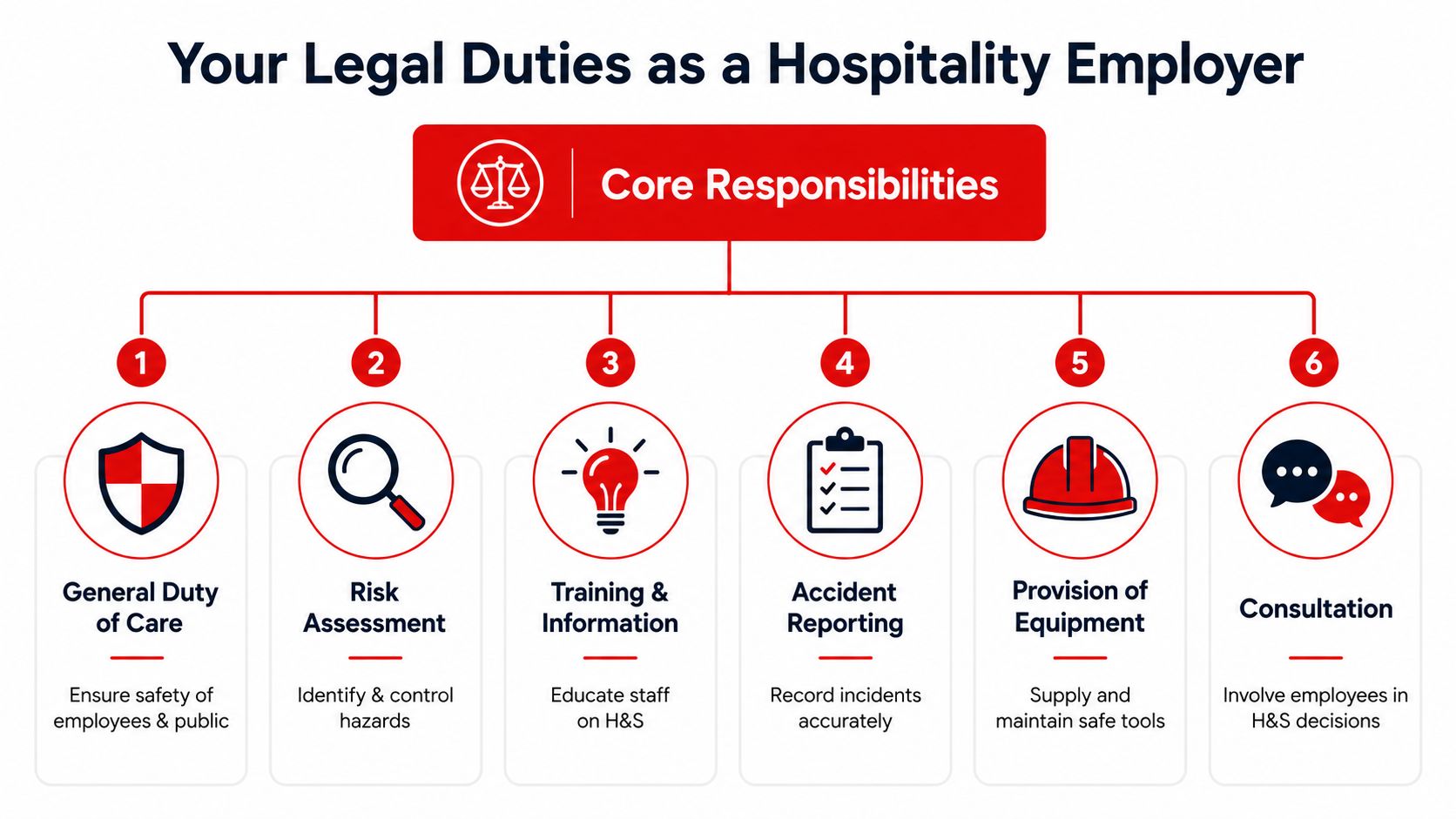
A venue that stays compliant usually has these six areas under control:
General duty of care
Provide safe systems of work, suitable equipment, proper supervision, and a workplace that does not put people at avoidable risk.Risk assessment
Identify hazards, decide who could be harmed, put controls in place, and review them when operations change. Temporary staffing is one of those changes.Training and information
Staff need clear, job-specific instruction. That includes agency and relief chefs, who may be experienced in kitchens generally but unfamiliar with your layout, kit, storage, and reporting lines.Accident reporting
Record accidents, near misses, and dangerous occurrences properly. If an incident repeats, you need evidence that the business recognised the pattern and acted.Safe equipment and substances
Fridges, extraction, probes, slicers, gas equipment, and fire controls need maintenance and checks. Cleaning products and other hazardous substances also need proper control. If you need a practical refresher, our guide to COSHH regulations for hospitality teams covers the basics clearly.Consultation with staff
Good managers listen when chefs and kitchen porters flag recurring risks. A blocked fire exit, a faulty fridge seal, or a wet blind corner rarely becomes safer by being tolerated for another week.
Fire safety and food safety carry direct management responsibility
Fire safety is governed by the Regulatory Reform (Fire Safety) Order 2005. Each premises must have a responsible person. That person must assess fire risk, put preventive measures in place, maintain routes and equipment, and make sure staff know what to do.
The penalties are serious. The Health and Safety Executive explains that health and safety offences can lead to substantial fines and, in some cases, imprisonment. For a General Manager, the practical point is simpler. If alarm tests are inconsistent, exits are obstructed, or temporary staff have not been shown escape routes, the venue is exposed before an inspector says a word.
Food safety sits alongside that. Under UK food law, you need procedures based on HACCP principles, and those procedures have to reflect what happens in your kitchen. Relief cover creates a pressure point here. A capable chef can still miss your allergen process, your probe calibration routine, or your separate storage rules if nobody owns the induction.
A compliant kitchen is not the one with the thickest folder. It is the one that can absorb a staffing gap without dropping its controls.
What a manager should be able to answer immediately
If an Environmental Health Officer or Fire Officer arrived during a busy shift, the duty manager should be able to answer these on the spot:
- Who is the responsible person for fire safety at this venue?
- Where is the current risk assessment, and when was it last reviewed?
- How are relief chefs and other temporary staff briefed before they start work?
- Who checks critical food safety records each day, including when the head chef is off?
- What happens after an accident, near miss, or equipment fault?
If those answers depend on one individual being present, the system is fragile. Reliable operators remove that risk. They make compliance part of shift handover, agency induction, and manager sign-off, so standards hold up even when the kitchen is under pressure.
The Top 5 Kitchen Hazards and How to Assess Them
The kitchen hazards that cause the most trouble are rarely unusual. They're the everyday ones that managers stop noticing because the team works around them. That's why risk assessment matters. It turns normalised problems back into visible risks.
HSE data for 2024/25 recorded 4,233 injury reports from the accommodation and food services sector, a 5% increase on the previous year and a 13% rise since 2021/22. The same data highlights slips, trips, falls, fire hazards, and food safety risks as the most common problems in UK kitchens, according to UK workplace health and safety reporting.
Food safety failures
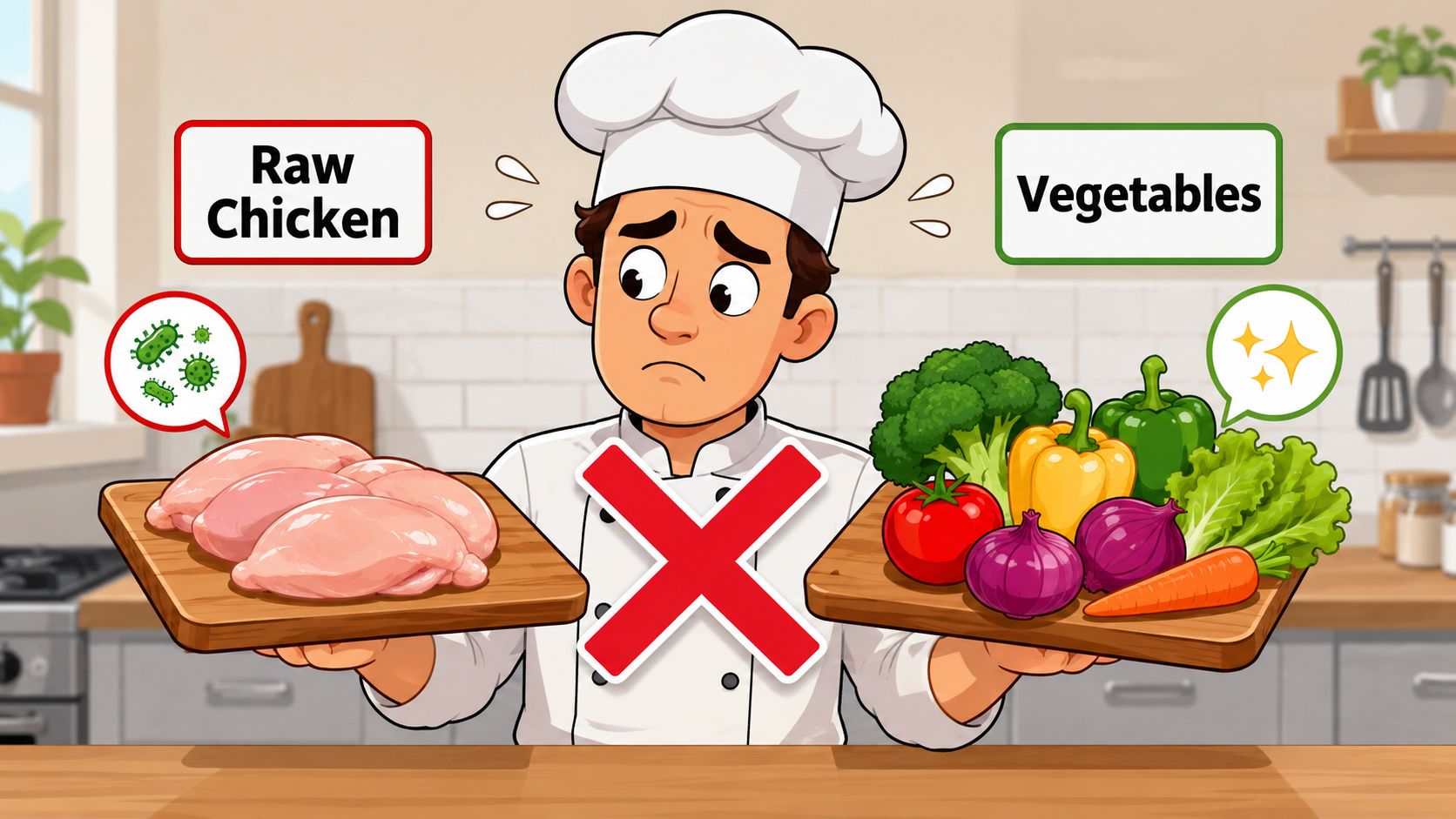
Cross-contamination is one of the fastest ways to move from a busy service into a serious incident. A common example is raw chicken prep happening next to ready-to-eat garnish because one station has been repurposed during a staffing gap.
Risk assessment here is practical:
- Map the flow: Goods in, storage, prep, cooking, holding, service.
- Separate clearly: Boards, knives, containers, shelves, and prep zones.
- Check controls: Probe use, fridge temperatures, labelling, and allergen procedures.
If you want a clearer handle on chemical handling alongside food safety controls, this guide to COSHH regulations explained is worth keeping in your wider compliance file.
Slips trips and falls
Most kitchens don't have one slippery floor. They have several recurring slip points that everyone has learned to dodge. That's not control. That's habit.
Look at where the risk spikes:
- pot wash overspray
- wet deliveries at back door entry
- grease near fryers
- ice from freezers and cold rooms
- trailing mats or damaged flooring
A useful risk assessment asks who walks through the area, when it gets busiest, and what changes at peak service. A floor that is manageable at 10am may be dangerous at 8pm when visibility, space, and cleaning response all deteriorate.
Wet floors aren't the whole issue. Poor housekeeping, bad layout, and unclear ownership usually sit behind repeated slips.
Fire and heat hazards
Fire risk in kitchens usually builds through routine shortcuts. A grill pan is left too close to a flame. Extraction cleaning slips behind schedule. Combustible items collect near heat sources. Staff use equipment they haven't been shown properly.
The assessment should cover ignition sources, fuel sources, escape routes, shutdown procedures, and who knows what to do when something goes wrong.
A quick visual reminder often helps teams absorb more than a written instruction alone:
Manual handling injuries
These injuries often get shrugged off because they don't always create an immediate dramatic incident. But repeated poor lifting of stock, kegs, oil containers, delivery boxes, and equipment wears people down and creates avoidable absence.
Assess the task, not just the item.
A crate may be light enough in theory, but if it's lifted from floor level in a tight dry store, then carried through a crowded prep area, the risk is higher. The control might be changing storage height, splitting loads, or assigning a two-person lift during deliveries.
Chemicals and COSHH
Cleaning products become dangerous when labels are ignored, decanted into the wrong container, mixed incorrectly, or left where food prep happens. Temporary staff are especially vulnerable if they know the chemical type but not your site's product range and storage routine.
Use a short checklist:
| Hazard area | What to inspect | Good control looks like |
|---|---|---|
| Food prep | Separation of raw and ready-to-eat | Clear zones, colour coding, labelled storage |
| Floors | Repeat wet spots and obstructions | Immediate cleanup, signage, housekeeping ownership |
| Fire | Heat sources and emergency access | Clean extraction, clear routes, working shutdown routine |
| Lifting | Stock movement and storage height | Safer storage layout, team lifts where needed |
| Chemicals | Storage and staff understanding | Labelled products, COSHH access, correct use briefing |
A strong risk assessment doesn't describe the kitchen in theory. It reflects the kitchen on a hard shift, with a stretched team, during a real service.
Implementing Your Essential Compliance Systems
Saturday, 6:30pm. Deliveries arrived late, one fridge is running warm, the head chef is covering the pass, and the relief chef has never worked your layout before. That is when compliance systems either hold the kitchen together or get exposed as paperwork nobody really uses.
In busy hospitality operations, the weak point is rarely the policy itself. It is the gap between the written process and what happens on shift, especially when temporary chefs are helping you cover absence, events, or holidays. A stable kitchen needs systems that still work when the team changes.
Build HACCP around the way your kitchen actually runs
Your HACCP plan should follow food through your site from delivery to disposal. The legal basis sits under the Food Standards Agency guidance on HACCP-based procedures. The practical point is simpler. If the flow on paper does not match the flow in your kitchen, staff will ignore it under pressure.
Set it up around the points where things commonly go wrong:
Goods in
Check temperatures, packaging condition, date codes, and obvious contamination before stock is accepted.Storage
Keep raw and ready-to-eat food apart. Label properly. Rotate stock so older product is used first.Preparation
Define how your site prevents cross-contamination. That includes board use, station setup, handwashing, sanitiser use, and allergen controls. If you rely on agency or relief cover, clear allergen awareness training for kitchen teams matters because allergen mistakes often happen during handover, substitutions, and rushed service.Cooking and reheating
Use calibrated probes and recorded checks. Appearance is not a control.Hot holding and cold holding
Decide who checks temperatures during service and who acts if something drifts out of range.Cooling, leftovers, and reuse
Set rules for what can be cooled, how it is labelled, where it is stored, and when it is thrown away.
For each control point, record four things. The hazard. The control. The person responsible. The evidence that the check happened. If any one of those is missing, standards slip fast on a busy shift.
Keep documents short enough to survive service
Managers often ask whether they need more forms. Usually they need fewer, used properly.
A kitchen with ten folders and poor discipline is in a weaker position than a kitchen with five live records reviewed every day. Relief chefs will not have time to learn a bloated filing system between prep and service. They need to find the right check sheet quickly, understand it at a glance, and know who signs what.
Your working records should usually cover:
- Temperature logs for fridges, freezers, probes, cooking, reheating, and hot hold
- Cleaning schedules split into daily, weekly, and periodic tasks
- Opening and closing checks for hazards, housekeeping, and key controls
- Maintenance reporting for equipment faults that affect food safety or safe operation
- Accident and near-miss logs with action taken
- Role-based training records so you can show who was briefed to do what
Daily Kitchen Health and Safety Checklist
| Check Area | Task | Time (Open/Close) | Sign-off |
|---|---|---|---|
| Fire safety | Confirm fire exits are clear and extinguishers accessible | Open | |
| Refrigeration | Check and record fridge and freezer temperatures | Open | |
| Food prep | Verify raw and ready-to-eat areas are set correctly | Open | |
| Equipment | Inspect probes, extraction, and key cooking equipment for obvious faults | Open | |
| Floors and walkways | Remove trip hazards and confirm spill response kit is available | Open | |
| Chemicals | Check cleaning products are stored correctly and labelled | Open | |
| Waste | Empty bins safely and keep refuse area controlled | Close | |
| Cleaning | Complete line clean, pot wash clean, and surface sanitising | Close | |
| Storage | Label, date, cover, and store food correctly | Close | |
| Shutdown | Turn off non-essential equipment and secure kitchen safely | Close |
Set systems up for mixed teams, not just your core brigade
This is the part many operators miss.
Permanent staff carry a lot of kitchen knowledge in their heads. Relief chefs do not have that advantage on day one, even if they are highly capable. If your compliance system depends on unwritten habits, verbal reminders, or one supervisor always being present, it will break the moment the rota changes.
Good systems for mixed teams have a few common features:
- Named ownership so each check belongs to a role on shift
- Clear placement so logs are kept where the task happens
- Simple wording so a chef new to site can follow it without a long explanation
- Fast escalation so faults, allergen risks, and temperature failures reach the duty manager quickly
- Visible site rules for points that vary between kitchens, such as waste routes, chemical storage, and delivery checks
That is the trade-off. The more complex your operation, the simpler your frontline controls need to be.
What holds up under pressure
Systems that work in hospitality are usually plain, repetitive, and easy to check.
Use systems that:
- fit on one page where possible
- assign responsibility to a named role
- can be completed during service, not after it
- get reviewed by management while the shift is still fresh
- reflect the actual kitchen layout and menu risk
Avoid systems that:
- get back-filled at the end of the day
- rely on generic templates from another site
- hide important records in an office drawer
- assume experienced chefs will all do things the same way
- fall apart when a relief chef joins the rota for one shift
If enforcement action ever follows, the issue is not whether a form existed. The issue is whether your business can show that controls were understood, used, checked, and corrected when something went wrong. That standard is much easier to meet when the system works on a wet Tuesday with two agency covers, not just during a pre-arranged audit.
Effective Training and Record-Keeping for Your Team
Training is where many compliance plans become real, or fall apart.
A good kitchen can absorb pressure when people know the site, the standards, and the essential requirements. A weakly trained team makes the same service twice as risky because mistakes spread. One person stores food badly, another copies it, and by the end of shift the wrong process feels normal.
Train in short bursts not long lectures
Long classroom sessions are rarely the answer in hospitality. Teams are tired, shifts move, and information gets forgotten.
Use a tighter rhythm:
- Induction brief on arrival: Fire points, slips, allergens, chemical storage, reporting lines, and key site rules.
- Station-specific coaching: Show the chef how this kitchen handles raw prep, probes, cleaning, and waste.
- Toolbox talks: Five-minute refreshers before service on one risk at a time.
- After-incident retraining: If something goes wrong, update behaviour quickly while the example is fresh.
That works far better than assuming a certificate covers every practical risk on your site.
Keep records that would stand up under scrutiny
Training records aren't just for audits. They are evidence that the business took reasonable steps to inform and protect staff.
A useful record should show:
- Who received the training
- What topic was covered
- When it happened
- Who delivered it
- Any follow-up needed
If you need stronger allergen procedures, this practical guide to allergen awareness training is a sensible reference point for hospitality teams.
If a chef says, “Nobody showed me that,” your paperwork should be able to prove otherwise.
Focus on the risky points of turnover
The highest-risk moment isn't always when a new person joins permanently. It's often when an experienced chef starts a short shift in an unfamiliar site and everyone assumes they'll just get on with it.
That assumption causes trouble. A capable relief chef may know food safety well, but still not know your extraction shutdown routine, your allergen folder location, your chemical cupboard setup, or which cold room door doesn't close cleanly unless pushed.
Good managers train for site reality, not job title. They also record those briefings properly. That protects standards, reduces disputes after incidents, and gives the kitchen more stability during busy periods.
How Relief Chefs UK Supports Your Compliance
Temporary staffing creates a specific compliance problem that many operators still underestimate. The chef may be skilled, but legal responsibility inside the venue doesn't disappear because the person is temporary.
That matters because employers must assess risks “including those from temporary workers,” yet only 38% of UK small businesses report having adapted risk assessments for short-term staff, according to health and safety legislation guidance for temporary workers. In hospitality, that gap usually shows up in a simple form. The shift is covered, but the briefing is weak, the responsibilities are assumed, and no one is fully clear who owns what.
Where temporary staffing usually goes wrong
The common failure points are predictable:
- No site-specific induction: The chef knows kitchens, but not your kitchen.
- Unclear supervision: Permanent staff assume the temp knows your systems.
- Missing documentation: Nobody records the briefing, handover, or assigned duties.
- Blurred accountability: The venue thinks the agency has covered compliance, while the agency assumes the venue has handled on-site control.
That's why compliance and staffing can't sit in separate boxes.
What a stronger staffing partner changes
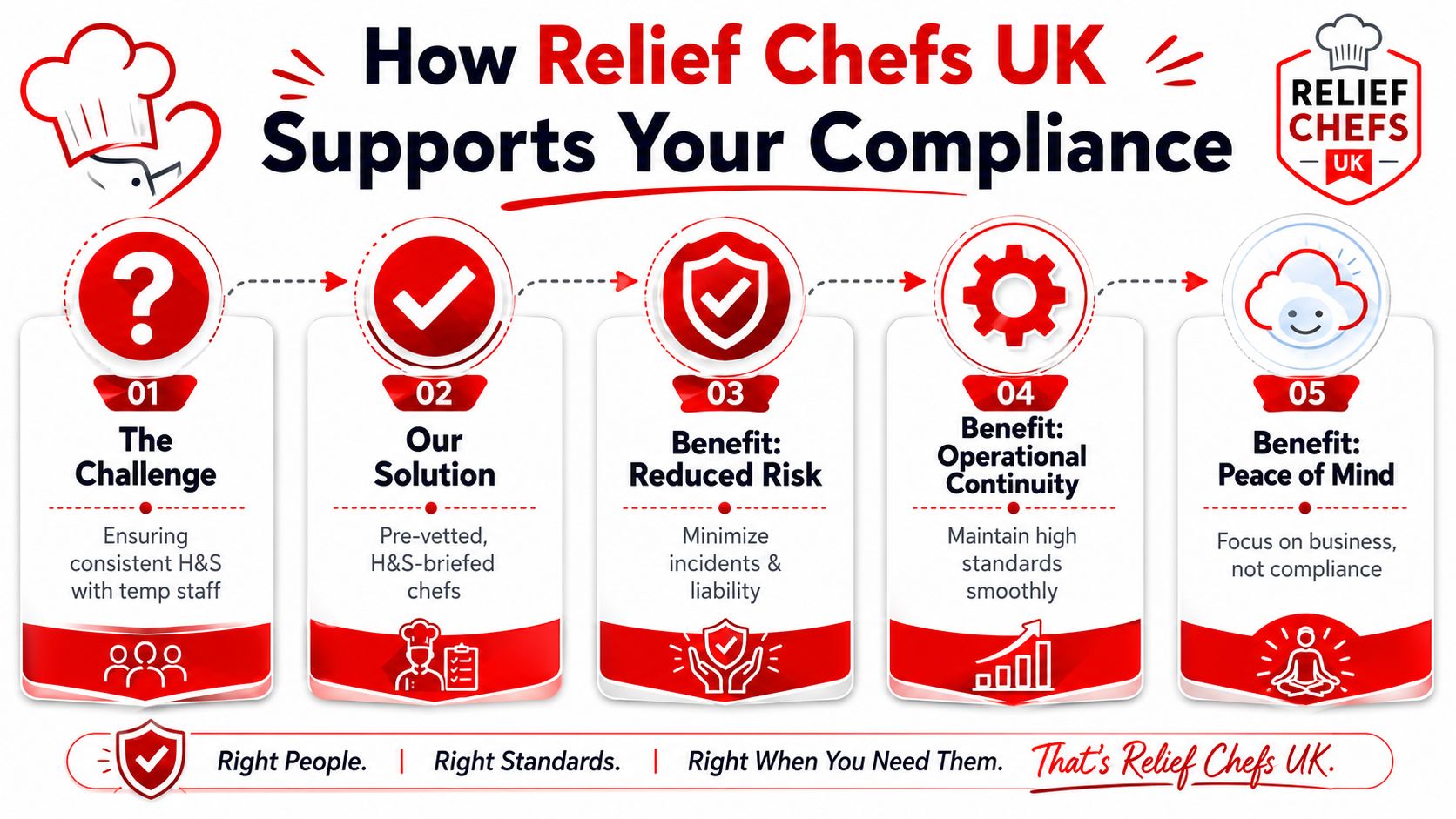
Relief Chefs UK has operated nationwide since 2013 and understands the operational reality behind short-notice cover, seasonal peaks, kitchen instability, and agency reliability concerns. The difference is that the service is built around hospitality practice, not just CV matching.
For a General Manager or Head Chef, that matters in practical ways:
- Vetted chefs arrive ready to slot in: Food hygiene credentials and right-to-work checks are handled before placement.
- The handover can be tighter: Site teams can focus on local risks, responsibilities, and workflow rather than starting from zero.
- Standards hold more easily: Temporary chefs, relief chefs, and permanent chef recruitment all work better when safety expectations are clear from the outset.
- Wider staffing needs stay under one roof: That includes yacht chefs, villa chefs, and broader hospitality staffing support for businesses that need flexibility across different settings.
The safest temporary placement is not the one with the best CV. It's the one backed by clear briefing, clear ownership, and clear records on day one.
A practical way to use temporary chefs safely
If you bring in relief support, your arrival routine should be consistent every time:
- Meet the chef and confirm who they report to.
- Walk the site hazards quickly. Floors, fire exits, chemicals, storage, and key equipment.
- Explain your allergen and temperature control process.
- Assign duties clearly. Don't leave high-risk tasks vague.
- Record that the briefing happened.
That's how temporary staffing supports compliance instead of weakening it.
Enforcement Consequences and Getting Expert Help
A lot of operators still think enforcement is something that happens to reckless businesses, not busy ones. That's the wrong mindset.
Most enforcement problems start with ordinary failures. Incomplete records. Poor follow-through after an accident. Inadequate induction. A missing risk review. A manager who assumed the issue would wait until next week.
What inspectors and enforcing authorities look for
If an incident happens or an inspection follows, the questions are usually practical:
- Were hazards identified properly?
- Did the business train staff for the task they were doing?
- Were records current and credible?
- Did managers act on known problems?
- Was temporary cover supervised and briefed appropriately?
If the answer to several of those is no, the business can face improvement notices, prohibition notices, prosecution, fines, and lasting disruption to trade.
The numbers show that enforcement is active. The HSE secured 246 criminal prosecutions in 2024/25 with a 96% conviction rate, resulting in fines exceeding £33 million, according to recent HSE prosecution and fine data.
The avoidable mistakes that keep causing damage
The same issues come up repeatedly:
- Poor record-keeping: Logs are incomplete, back-filled, or not reviewed.
- Weak induction: New starters and temporary chefs begin work without a proper site briefing.
- Assumed competence: Managers mistake general experience for site-specific understanding.
- No follow-up after incidents: The event is recorded, but nothing changes.
- Confused reporting lines: Nobody knows who owns the response when something goes wrong.
For many venues, improving reporting discipline is one of the quickest wins. This guide to accident reporting procedures is a useful place to tighten that part of the process.
A kitchen doesn't need to be chaotic to be non-compliant. It only needs a few weak habits that management stopped challenging.
The commercial point is simple. Health and safety compliance protects continuity. It helps you keep kitchens open, standards stable, and risk under control when staffing is under strain. That's especially important in sectors already dealing with chef shortages, last-minute sickness, seasonal peaks, and the cost of unreliable cover.
If your venue needs chefs who can support service without adding risk, contact Relief Chefs UK. Established in 2013, they provide nationwide support for relief chefs, temporary chefs, permanent chef recruitment, yacht chefs, villa chefs, and broader hospitality staffing support. For pubs, hotels, restaurants, and multi-site operators across Devon, Bristol, Wales, Berkshire, Windsor, Reading, Slough, Dorset, and beyond, they offer a practical route to a more stable kitchen. Reach out today to secure reliable cover and keep your operation safe, compliant, and running properly.