
Food Quality Assurance for UK Hospitality
3 September 2026
It's 5.30pm on a Friday. A chef phones in sick, the booking list is full, and your remaining team is already planning how to survive service. In that moment, food quality assurance can look like paperwork that can wait. It can't. When kitchen stability depends on one person remembering every temperature check, allergen control and corrective action, a short-notice absence can expose the entire operation.
UK hospitality businesses face this pressure across Bristol, Devon, Wales, Berkshire, Windsor, Reading, Slough, Dorset and every other busy food-service region. Seasonal demand rises, chefs leave, agency cover varies, and temporary teams arrive with different habits. The strongest operators build QA into the way the kitchen works, so standards remain controlled even when the rota changes.
The Friday Night Your Standards Nearly Slipped
At a busy Bristol pub, 92 covers are booked for Friday night. Ninety minutes before service, the head chef calls in sick. The junior sous chef takes the pass, the prep cook moves onto plating, and the kitchen starts making decisions at speed.
The first missed task seems harmless. Nobody checks the fridge temperatures because the usual logbook is in the office. Then a server asks about an allergen, and the binder can't be found quickly. The prep cook plates a new batch without the normal tasting sign-off. A dish that should have been held for lab analysis is sent to table 14 before anyone notices.
No one set out to ignore food quality assurance. The team lost its operating structure when the most experienced person disappeared.
Practical rule: If your QA system stops when one chef is absent, it isn't a system. It's personal memory with a clipboard beside it.
The missing chef wasn't the root cause. The primary failure was the lack of a clear handover, named ownership and accessible procedures. A strong kitchen should tell the replacement chef what to check, where to record it, what limits apply and who must be informed when something falls outside them.
That matters because food businesses aren't judged only by the quality of a dish during a calm lunch service. They must show that controls operate during sickness, seasonal recruitment, split shifts, menu changes and pressure at the pass. The UK Food Security Report 2024 records an average of 2,133 food safety incidents annually in England, Wales and Northern Ireland between 2019/20 and 2023/24, with Scotland recording an average of 115 incidents per year over the same period.
A dependable QA programme protects the kitchen when the rota doesn't. Without it, one short-notice sickness call can lead to an avoidable complaint, an enforcement concern or a serious loss of customer confidence.
What Food Quality Assurance Actually Means
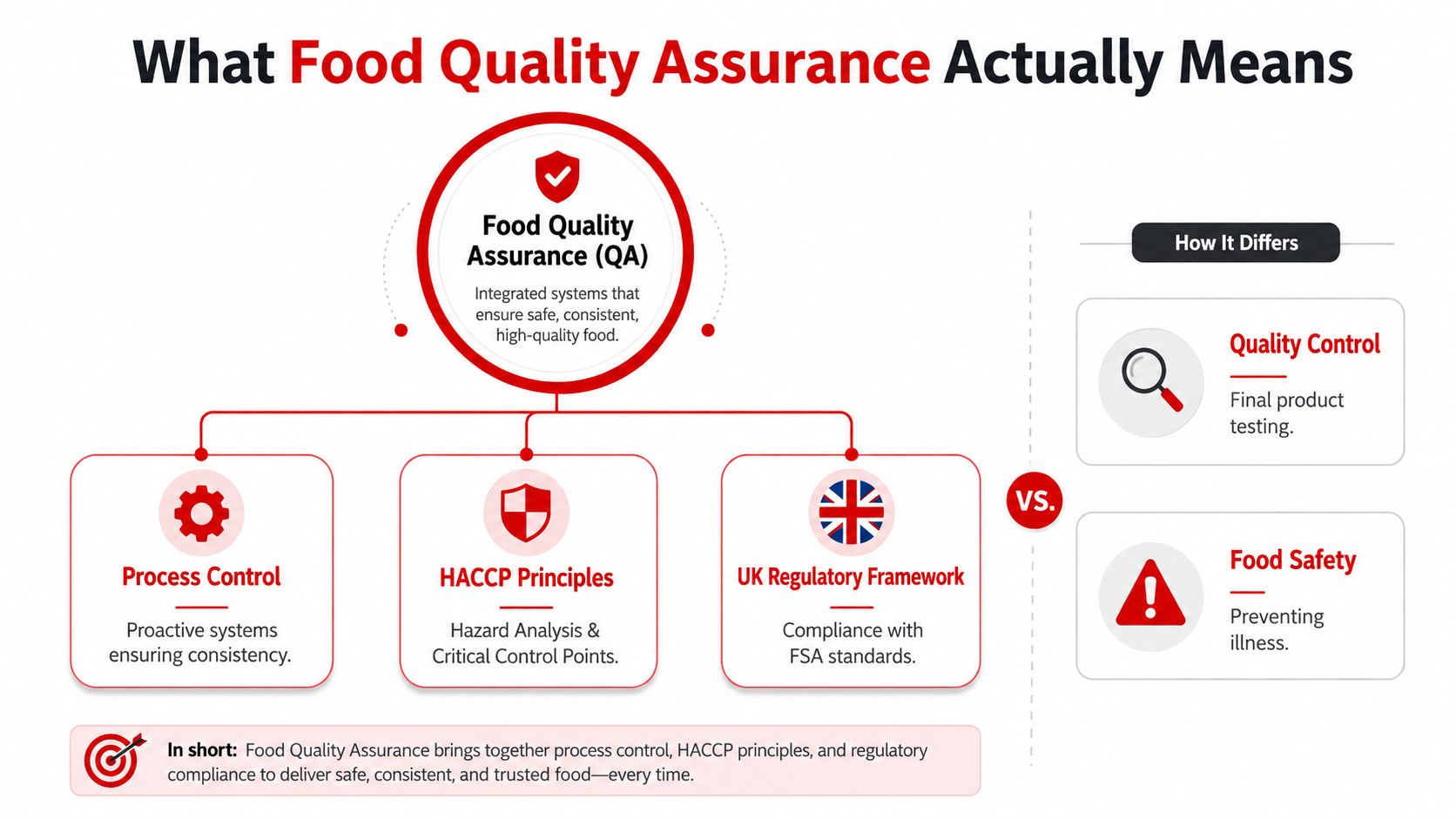
Food quality assurance is a proactive process-control discipline. It sets up the procedures, checks and records that should prevent failures before food reaches the customer. Quality control is narrower. It examines the product or process at a checkpoint, while food safety focuses specifically on preventing harm from biological, chemical, physical and allergen hazards.
The UK framework rests on the Food Safety Act 1990, which consolidated earlier food legislation. National oversight became more formalised when the Food Standards Agency was created on 1 April 2000 under the Food Standards Act 1999, separating food safety oversight from agricultural and commercial interests. Local authority environmental health officers then apply the framework through inspections, interventions and enforcement in individual businesses.
HACCP turns principles into kitchen behaviour
UK food businesses are expected to operate a permanent food-safety management system based on HACCP principles, as outlined by the Food Standards Agency. In a hospitality kitchen, the seven principles become practical controls:
- Hazard analysis: Identify contamination, allergen, temperature and traceability hazards.
- Critical control points: Identify where control is essential, such as cooking, cooling, storage or allergen segregation.
- Critical limits: Define the acceptable boundary for each control.
- Monitoring: Record who checks the control, when they check it and what they find.
- Corrective action: State what happens when a limit is missed.
- Verification: Confirm that the system works through reviews, audits, calibration and spot checks.
- Records: Keep evidence that the team followed the process.
The Food Hygiene Rating Scheme should also be understood accurately. Its rating is not a food-quality score and says nothing directly about taste or ingredient quality. It reflects hygiene standards found at inspection across hygienic food handling, the physical condition of the premises and management confidence that standards will be maintained.
Core Components of a Working QA Programme
A working programme doesn't need to be complicated, but it must produce evidence. Every important control should answer four questions: what happens, who owns it, when is it checked, and what happens if it fails?
| Component | What It Must Contain | Evidence Required |
|---|---|---|
| SOPs | Clear instructions for receiving, storage, preparation, cooking, cooling, cleaning, allergens and traceability | Dated, version-controlled documents signed by the head chef and a manager |
| Monitoring | Daily, weekly and monthly checks with named owners | Completed logs, sign-offs and reviewed exceptions |
| Supplier controls | Approved suppliers, product specifications and intake standards | Approved supplier list, delivery checks and traceability records |
| Training | Induction, allergen awareness, HACCP duties and role-specific competency | Training records, assessments and refresher evidence |
| Audits | Planned internal reviews of the system and kitchen practice | Rolling 12-month audit schedule, findings and follow-up |
| Corrective actions | Non-conformity, root cause, action, owner and deadline | Closed action records with verification |
| Documentation | An organised record set that supports inspection and investigation | Accessible temperature, cleaning, training, supplier and audit files |
Write procedures for the person covering the shift
An SOP shouldn't say “store food correctly”. It should show the operator what to do, what to record and what decision to make if the result is outside the approved limit. Keep the current version at the point of use, not hidden in a manager's inbox.
Supplier approval is another neglected area. A delivery note proves that something arrived. It doesn't prove that the supplier is approved, the product matches its specification or the batch can be traced. Intake checks should cover condition, date coding, packaging, temperature where relevant and acceptance or rejection.
Close the corrective action loop
A failed check is not a completed QA process. The team must isolate the issue, protect food, record the cause, assign an owner and verify closure. “Spoke to chef” isn't a corrective action record.
Cross-contamination controls need the same discipline. Use a written cross-contamination prevention procedure that covers equipment, raw and ready-to-eat separation, cleaning, storage and staff movement. Review it after menu changes, equipment changes or an incident.
The first records an environmental health officer requests are usually the records that demonstrate control, not the most polished policy in the folder. If staff can't find them during a busy shift, they aren't operational controls.
Where UK Hospitality Really Stands on Hygiene Ratings
A strong national average can hide an unstable kitchen. The official Food Hygiene Rating Scheme database covers food businesses across England, Wales, Northern Ireland and Scotland, and each published rating reflects conditions found on the inspection date.
Recent analysis of official FHRS data found that 72.33% of UK food establishments achieved a rating of 5, while 88.31% scored 4 or above. The same analysis reported that 19.5% of takeaways in England, Wales and Northern Ireland had a rating of 3 or below. The message is clear: most venues meet a high standard, while a significant minority remains below the level customers and owners expect.
What a Rating Tells You
The Food Hygiene Ratings Report reported that the average rating across England, Northern Ireland and Wales rose from 4.49 in 2022 to 4.58 in 2026, after falling to 4.47 in 2025. That improvement shows broad progress, but it cannot guarantee how a particular kitchen will perform at its next inspection.
The rating covers three areas:
- Hygienic food handling, including preparation and storage practice.
- Physical premises condition, including cleanliness, layout and equipment.
- Management confidence, meaning whether the business can demonstrate that standards will be maintained.
A venue may pass inspection while retaining weak supplier approval, allergen briefing or temporary-team induction. Inspectors see one visit. Customers experience every service.
The Staffing Effect
Coastal pubs, busy hotel kitchens and high-volume seasonal venues face the same operational risk: staffing changes faster than the QA system. A new chef may understand professional kitchen practice yet miss a site-specific allergen matrix, supplier requirement or closing check.
Relief cover exposes that weakness quickly. A temporary chef cannot protect standards that exist only in the head chef's memory. Relief Chefs UK protects the discipline by placing chefs into kitchens where procedures, handovers and expectations must remain usable under pressure.
Audit against your weakest shift, not your best inspection. Ask a chef arriving from another venue to complete the opening checks without assistance. If the process relies on local knowledge that has not been handed over, the rating is less secure than it looks.
QA in Action Across Real UK Venues
A Devon gastropub begins lunch service with a chilled prep desk showing unusual temperature movement. The opening chef records the reading, checks the probe, moves vulnerable ingredients into approved storage and alerts the manager before covers arrive. The incident is logged as a corrective action, and the equipment is checked rather than quietly reset.
That response protects the food and improves the system. The kitchen doesn't wait for a complaint to reveal that the fridge has drifted. It uses monitoring to identify a deviation while the team still has time to act.
A Berkshire group standardises the handover
A hotel group operating across four Berkshire sites uses one supplier approval process and one intake-checklist SOP. Each kitchen still has a different menu and service pattern, but the delivery evidence follows the same logic. A relief chef joining during a staffing gap is stopped during induction after skipping a delivery temperature record.
That isn't a reason to blame the chef. It identifies a training and supervision gap before it becomes a traceability problem. The head chef can correct the behaviour, document the action and confirm that the next intake follows the procedure.
A Dorset seasonal kitchen protects allergens
A Dorset seasonal site recruits a temporary chef during its busiest period. On the first shift, the opening checklist identifies that the allergen briefing hasn't been completed. The chef doesn't start independent prep until the briefing, equipment controls and recipe information are confirmed.
At close, the team records cleaning completion and any deviations. When a potential cross-contamination risk is discovered, the corrective-action log captures the affected area, the immediate control, the person responsible and the review. The process works because it doesn't assume that a new chef will understand local practice automatically.
A relief chef should inherit the system, not recreate it from memory.
The same architecture works in a Devon pub, a Berkshire hotel group or a Dorset seasonal site. The scale changes. The controls don't disappear.
Kitchen KPIs and a Practical QA Checklist
A QA programme becomes useful when the kitchen can measure whether people followed it. Put each KPI against a target, frequency and owner. Avoid vague language such as “check regularly” or “keep clean”.
| KPI | Target | Frequency | Owner |
|---|---|---|---|
| Fridge and freezer monitoring | Readings within the approved site limits, with exceptions recorded | At the frequency defined in the HACCP plan | Opening chef |
| Cooking control | Probe and record the site-approved cooking limit | Every relevant batch or dish | Section chef |
| Cooling control | Record the approved cooling process and act on deviations | Every relevant cooling cycle | Closing chef |
| Cleaning verification | Daily schedule signed, with weekly management review | Daily and weekly | Kitchen supervisor |
| Supplier intake | Each delivery accepted or rejected against specification | Every delivery | Receiving chef |
| Allergen control | Every relevant preparation and briefing completed | Each shift and menu change | Head chef |
| Internal audit | Findings recorded and assigned | According to the audit programme | General manager |
| Corrective actions | Every action has an owner and closure date | At every deviation | Duty manager |
| Training | New starters briefed before unsupervised work | At induction and scheduled refreshers | Head chef |
The Service Quality Assurance process should be visible to the person working the shift, including temporary cover. A relief chef must be able to follow the same flow as a permanent team member.
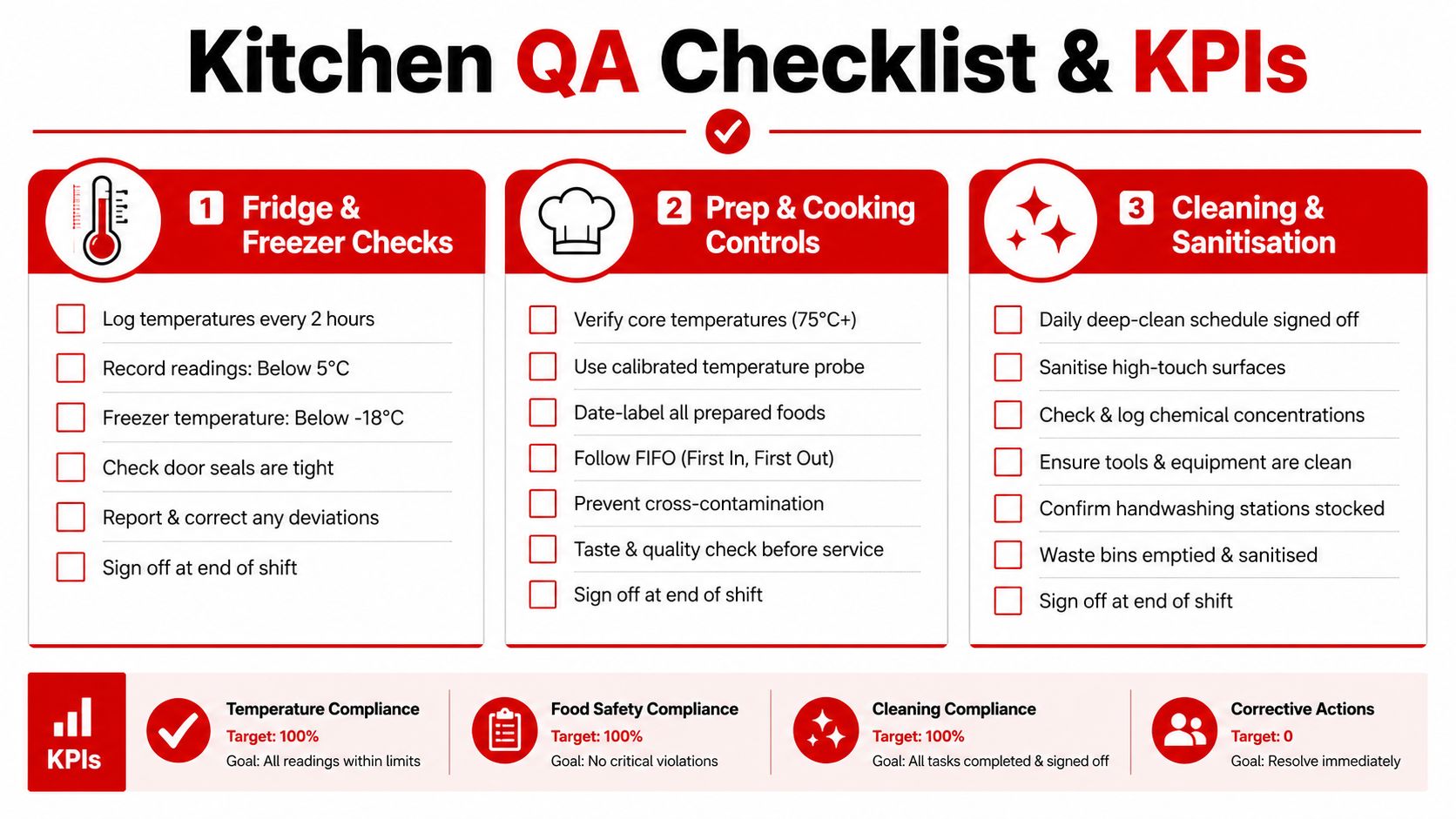
The practical shift sequence
- Receive: Check supplier, packaging, dates, condition and required temperature. Record acceptance or rejection.
- Store: Apply stock rotation, separation and date labelling. Record any storage deviation.
- Prepare: Confirm clean equipment, allergen controls and recipe specifications before production.
- Cook: Use the calibrated probe where required and record the result.
- Hold and serve: Check approved holding controls, labels and service equipment.
- Close: Complete cleaning, waste, stock and temperature records. Escalate anything unfinished.
- Handover: Leave the next chef a clear record of deviations, actions and outstanding checks.
The target isn't a perfect-looking folder. The target is a process that a chef can use at 7am, during Saturday service and when the usual head chef is off sick.
The Trust Gap Most QA Content Ignores
A strong hygiene rating matters, but it doesn't prove everything a customer wants to know about food. The FHRS itself states that the rating isn't a measure of food quality, taste or ingredient authenticity. It tells you what inspectors found across hygiene handling, premises condition and management confidence on a particular inspection date.
Consumer confidence exposes the wider challenge. The latest FSA Food and You 2 findings report that 89% of respondents were confident in the safety of food they purchased, while only 69% had confidence in the food supply chain. In one wave, confidence in the FSA to ensure food is safe and what it says it is fell from 78% to 69%.
| Metric | Hygiene Rating 5 Venues | Hygiene Rating 3-4 Venues |
|---|---|---|
| What the rating assesses | Hygiene handling, premises condition and management confidence | The same three inspection dimensions |
| What it doesn't establish | Taste, provenance or full ingredient authenticity | Taste, provenance or full ingredient authenticity |
| Operational implication | Maintain controls between inspections | Prioritise corrective action and management evidence |
Traceability needs more than a clean floor
Supplier assurance should show where ingredients came from, what specification was approved and which delivery or batch entered the kitchen. Imported seafood, premium meat and products with complex allergen profiles need particular attention because a customer can't verify provenance from the plate.
The same applies to authenticity. A kitchen may look immaculate while its records fail to explain substitutions, recipe changes or supplier variations. Customer feedback belongs in the QA loop too. Repeated questions about ingredients, allergen confidence or provenance are operational signals, not just front-of-house comments.
The Food Standards Agency's rating information helps operators track inspection outcomes, but it can't replace internal evidence. Genuine assurance follows the ingredient from approved supplier to finished dish.
How Relief Chefs UK Protects Your QA Standards
Staffing resilience is part of food quality assurance. When a permanent chef takes leave, falls ill or resigns, the replacement must preserve the venue's controls rather than improvise around them.
Relief Chefs UK was established in 2013 as a nationwide chef recruitment agency. Its staffing model supports venues dealing with short-notice sickness, seasonal demand, agency reliability problems, chef shortages and kitchen instability. The service includes relief chefs, temporary chefs, permanent chef recruitment, yacht chefs, villa chefs and wider hospitality staffing support for pubs, restaurants, hotels, private households and specialist operations.
Every relief chef placed through the network holds current Level 2 or Level 3 Food Safety certification, allergen awareness training and verified HACCP competence confirmed through reference checks with previous head chefs. That gives the venue a stronger starting point than a generic agency booking, but site-specific induction still matters.
Protect the handover, not just the rota
Before arrival, the chef should receive the venue's SOPs, supplier list, allergen information and critical control points. During the shift, the team needs a clear temperature-log handover. After service, the incoming chef should leave records complete enough for the permanent team to continue without reconstructing events.
The handover documentation process keeps that continuity visible. It helps preserve audit trails, corrective actions and daily records during the cover period.
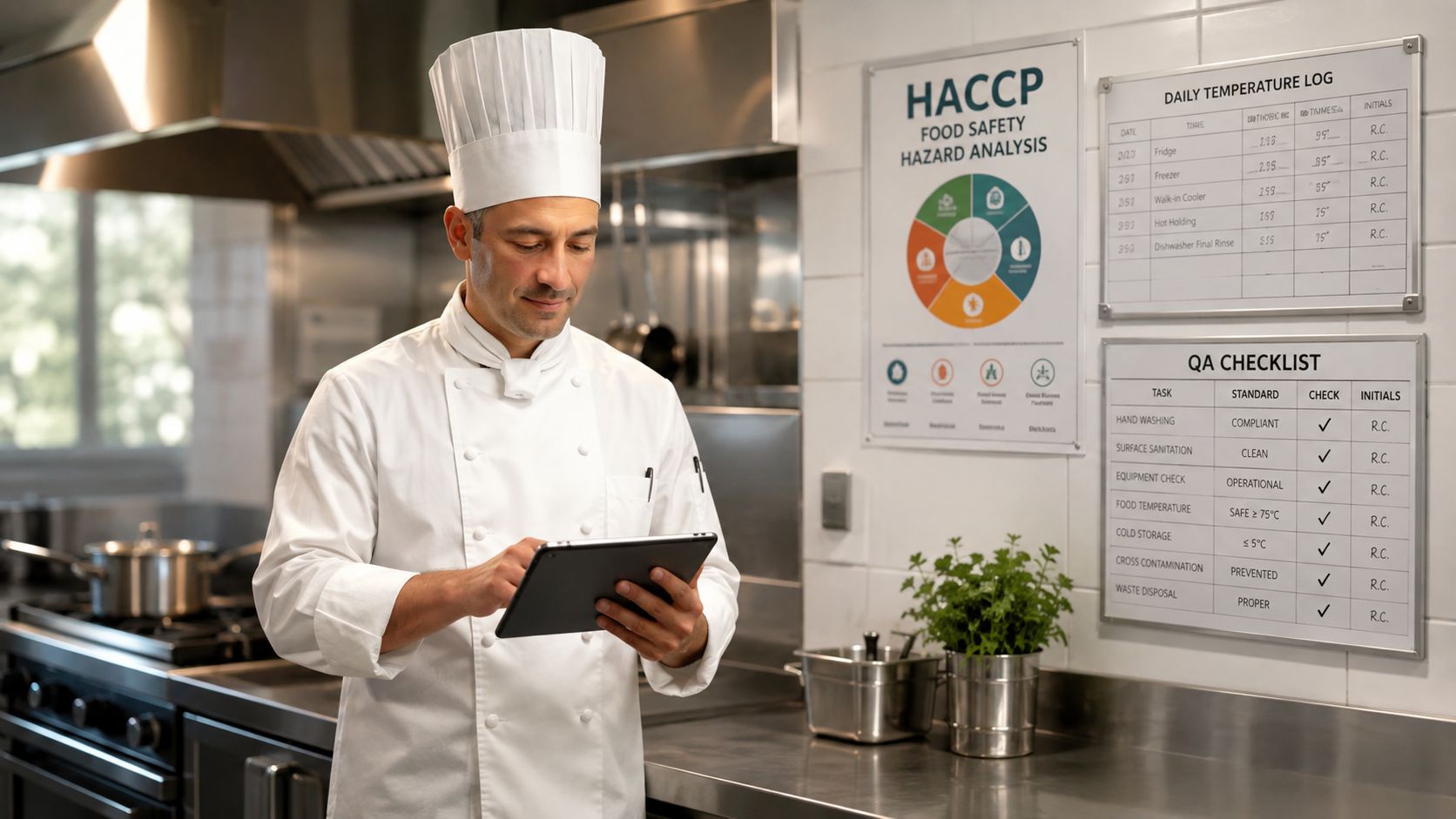
A typical agency approach sends a chef with general experience and expects the site to fill in the gaps. That creates risk during the exact shifts when managers are busiest. A better staffing partner integrates the chef into the existing QA programme, so the kitchen's SOPs, audit evidence and corrective-action records remain intact.
Relief Chefs UK can provide vetted relief and temporary chefs for urgent cover, permanent chef recruitment for longer-term stability, and specialist yacht or villa chefs across the UK. Visit Relief Chefs UK to protect your food quality assurance standards, stabilise your kitchen and request dependable staffing support before the next rota gap becomes a service problem.
Call the team.
Office 01392 715474 · info@reliefchefs.co.uk