
Friday night in a busy kitchen exposes every weak link. One section chef calls in sick, the agency promise sounds fine on the phone, and then the relief body turns up without the right prep, the right pace, or the right paperwork. The pass starts to back up, tickets drift, plates come back, the manager jumps on the line, and the whole room starts firefighting instead of cooking. That is service quality assurance in hospitality, not a theoretical scorecard exercise. It is the difference between a kitchen that keeps serving and a kitchen that folds under pressure.
The Friday Night Service That Proved the Point
The failure usually starts before the first ticket prints. A venue needs cover fast, so someone accepts a chef because they're available, not because the operation has checked fit, competence, and compliance. That's the mistake. Once the wrong person is on the rota, the rest of service becomes a chain reaction of small losses, under-prepped stations, slow handovers, and corrections that never quite catch up.
At the pass, those small losses become visible. The sauté section is waiting for garnish, the grill is behind, the starter tickets are piling up, and the head chef is forced to leave the pass and fix problems one by one. The food may still look acceptable on the plate, but the kitchen is no longer in control of timing, communication, or consistency. That is a QA failure in actual practice, because the system failed before the plate ever left the pass.
Why kitchens feel the pain first
A customer can forgive a delay if the team recovers cleanly. What they won't forgive is confusion, repeated mistakes, or a manager who's clearly improvising. In hospitality, quality assurance has to protect service continuity, because that is what keeps a Friday night open.
Practical rule: if the staffing decision creates chaos on the line, it was never a good quality decision in the first place.
This is why hospitality operators need to stop thinking about QA as a polite after-service review. It's a live operational control. If your relief chef, temporary chef, or agency cover can't step into the rhythm of the kitchen without disruption, the venue pays for it in waste, stress, and guest complaints. Relief Chefs UK, for example, is built around cover for exactly these pressure points, which is why the staffing process has to be treated as part of the quality system, not separate from it.
What Service Quality Assurance Actually Means
Service quality assurance is the planned, documented way a venue gives itself confidence that standards will be met before, during, and after service. In kitchen terms, it means you don't hope the dinner shift goes well, you build the conditions that make good service likely. That includes the right chef, the right brief, the right documentation, and the right checks at the right time.
QA is not the same as QC
Quality control checks the finished result. Did the plate leave correctly, did the portion match, did the sauce split, did the dish come back? Quality assurance is earlier and broader. It sets the system up so those faults are less likely to happen at all. Think of QA as the recipe, brigade spec sheet, and prep list. QC is the tasting at the pass.
That distinction matters because kitchens often over-invest in post-event checking and under-invest in prevention. A head chef can spend all night correcting errors, but if the briefing was vague, the prep standards weren't written down, and the relief chef wasn't properly matched, the same problems will return the next service. QA is about removing repeat failure, not just spotting it.
The UK has long treated quality as a traceable, documented matter, not just a private opinion. The Care Quality Commission was established under the Health and Social Care Act 2008 and began operating as England's independent regulator in 2009, and its model uses a 4-point rating scale, outstanding, good, requires improvement, inadequate, to make quality measurable and public-facing, not hidden inside one manager's opinion (AmplifAI summary of UK service quality regulation). That mindset translates neatly into hospitality, because the strongest QA systems are the ones you can prove, not just the ones you can describe.
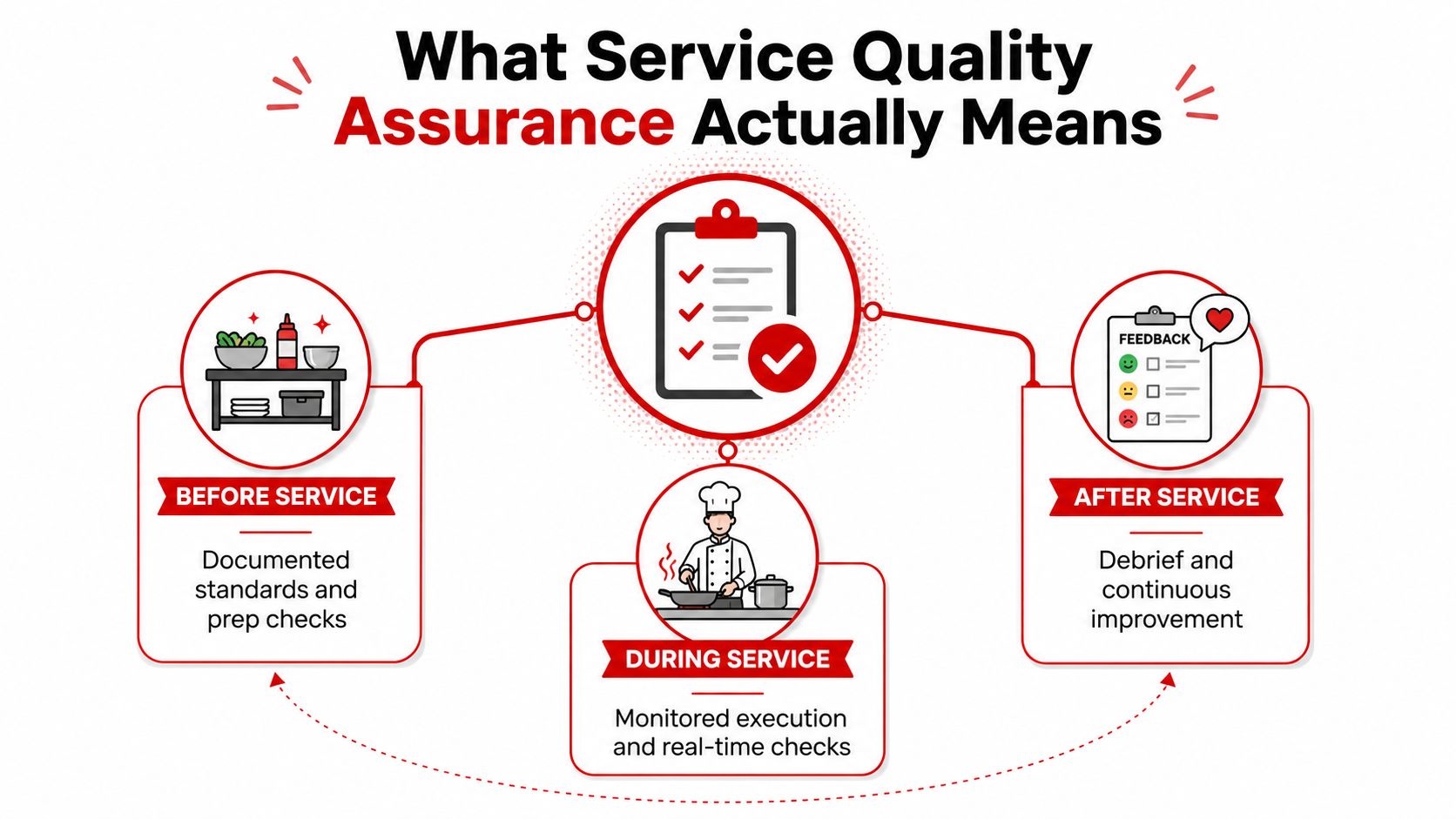
The simplest way to explain QA in a management meeting is this. Before service, set the standards. During service, watch the work. After service, review what broke and fix the system. If a venue only does the last part, it's managing symptoms, not quality.
The Four Building Blocks of a Kitchen QA System
A serious kitchen QA system stands on four blocks, and if one of them is weak, the whole thing starts to wobble. You need documented standards, audit cadence, training and competency, and feedback loops. Leave one out and you get drift. Leave two out and you get repeat failure disguised as “a busy night”.
Standards first, memory last
Documented standards are essential. Recipes, plating guides, prep targets, hygiene rules, allergen notes, handover expectations, and station-specific service behaviours all need to exist in writing, not in the head of the strongest chef on shift. The Construction Quality Assurance principle is blunt about this, quality needs planned and systematic actions that give confidence the product or service will meet requirements, and in practice that means the standard must live in the workflow, not in someone's memory (CCAA quality assurance definition).
Audits and competency keep drift under control
An audit cadence matters because kitchens drift when nobody checks them. Infrastructure quality guides call out the need for defined frequency of accuracy checks, named staff qualification, education, and experience, corrective actions, and internal audits (Iowa State QC guide). That's not a construction-only lesson. It's exactly how a hotel breakfast kitchen, a pub group, or a relief staffing operation should work. If the audit schedule is loose, standards soften.
Feedback loops make change stick
A proper feedback loop closes the gap between what happened and what gets fixed. Returned dishes, misfires, allergy near misses, and rushed handovers need to go into the next briefing, not die in someone's WhatsApp chat. The point of QA is not to collect paperwork. It's to make the next service safer and cleaner than the last one.
A kitchen that doesn't correct failure will repeat it under pressure.
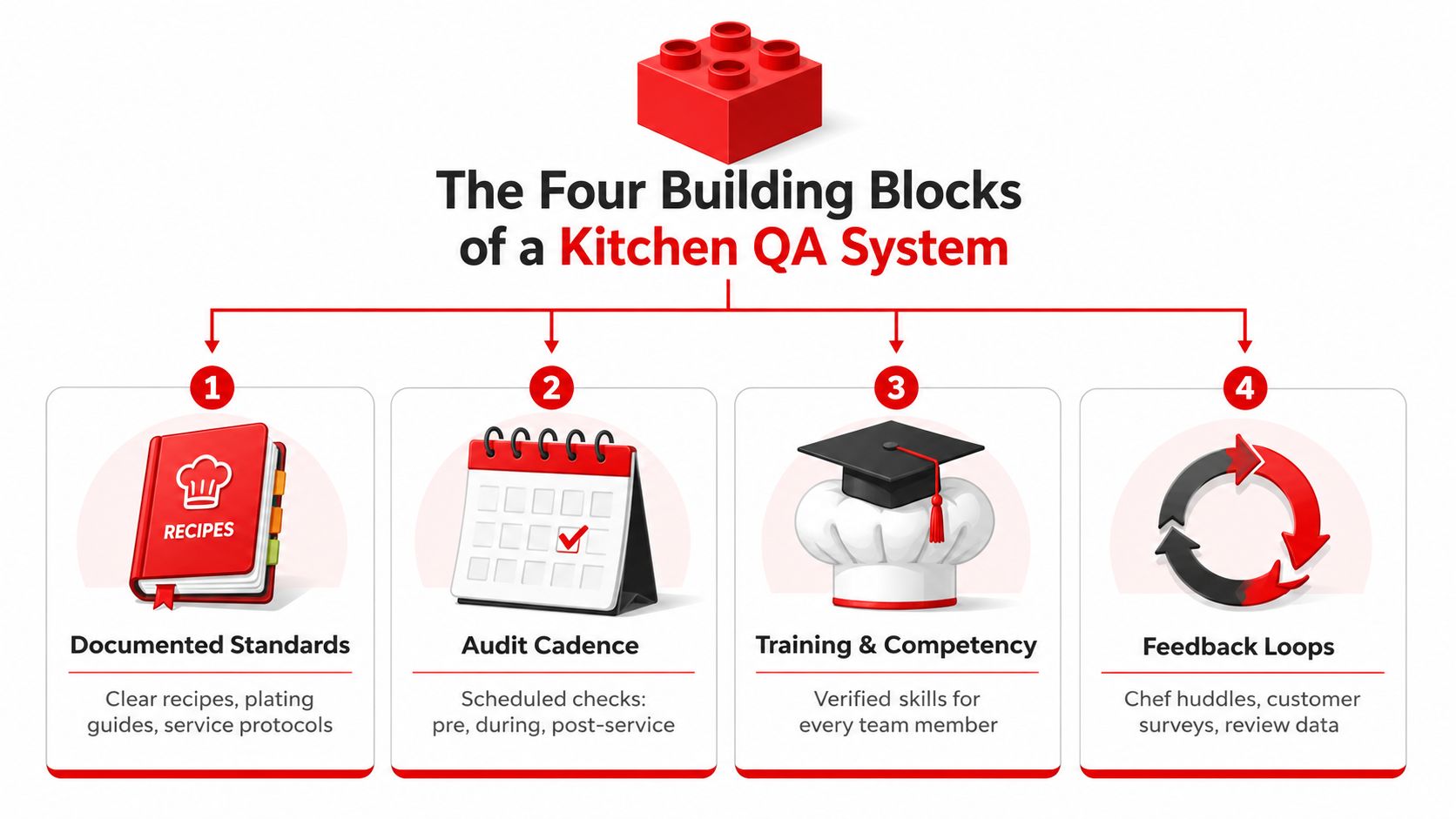
The operational reality is simple. If a venue can't verify the brief, check the work, train the team, and feed the learning back into the next service, it doesn't have a QA system. It has intentions. For a deeper look at how service standards become day-to-day behaviour, see continuous improvement culture.
KPIs That Actually Predict a Safe Service
The wrong metrics flatter the wrong teams. Monthly fill rates, vanity satisfaction scores, and generic service ratings don't tell a head chef whether Friday lunch will survive a sickness call. Hospitality needs KPIs that track continuity, speed, and first-time success, because that's what protects the kitchen when the room is under strain.
Measure the handover, not just the headcount
The most useful measures are practical. Track time-to-cover, first-shift success, first-contact resolution for complaints, and average speed of answer across phone and online enquiries. Those are the points where service either holds or slips. If a chef is technically available but arrives unbriefed, late, or mismatched to the menu, the rota still fails.
The digital service-quality world has the same warning. Aggregate averages hide the long tail of bad experiences, and ACM Queue recommends using the 95th and 99th percentiles to capture the actual user experience (ACM Queue on percentiles and service quality). In hospitality, that translates directly. A supplier can look fine on average while still missing the Friday and Saturday peak windows that matter most.
Use the KPI that matches the risk
If the risk is a closed pass, the KPI must reflect that risk. If the risk is a no-show, then replacement speed matters more than a simple booking count. If the risk is a bad handover, then first-shift success and repeat complaint rate matter more than a broad satisfaction score.
| KPI | What it measures | Why it matters for kitchens |
|---|---|---|
| Time-to-cover | How fast a shift is filled | Protects the kitchen during sickness, seasonal demand, and last-minute gaps |
| First-shift success | Whether the chef works out on the first deployment | Catches bad matching before it becomes a repeat disruption |
| First-contact resolution | Whether the issue is solved immediately | Reduces back-and-forth when the line is already under pressure |
| Average speed of answer | How quickly someone responds | Keeps venues from losing time while the rota burns |
| 95th percentile response time | The slowest tail of service performance | Exposes the bad nights averages hide |
UK hospitality needs this level of discipline because labour pressure is still real. The Office for National Statistics reported 84,000 vacancies in accommodation and food service activities in spring 2024 (ONS vacancy figure referenced in UK hospitality QA research), and service industries account for about 80% of UK gross value added (ONS service economy share referenced in UK service QA research). That's why kitchen QA isn't a side topic. It's core operations.
An Audit Template You Can Use on Monday
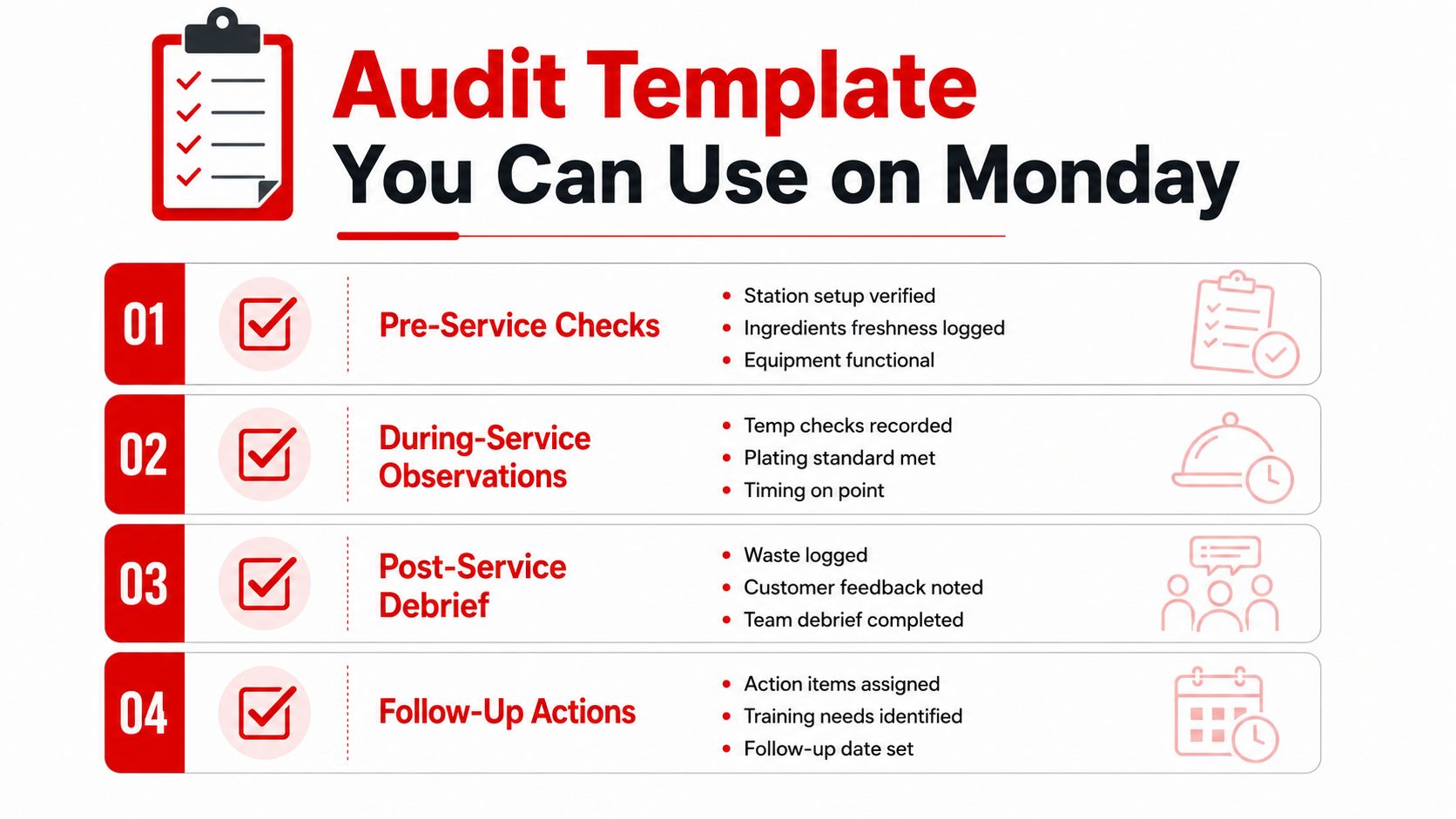
Many teams don't need a theory session. They need a sheet that a head chef, GM, or ops manager can use on the next shift. Keep it short, repeatable, and tied to proof. QA only works when the check leaves a trace.
Pre-service checks
Start with the basics. Is the station built, are the ingredients logged, is the equipment working, and has the chef been briefed on the menu and the cover risks? Use a written note for any mismatch, because memory disappears during service. The useful question is not “did we discuss it?” It's “can we prove we discussed it?”
During-service observations
Watch the live service, don't just judge the end result. Note ticket-time drift, misfire count, allergen handling, brigade communication, and any moment where the line loses rhythm. If a relief chef is on shift, you see whether the handover worked or just looked tidy on paper.
Post-service debrief and follow-up
End with three things, what went wrong, what held, and what must change before the next service. That ties directly to the QA principle that standards need traceable proof they were met, not just verbal reassurance (Concreted.org quality assurance on documenting standards). A short written trail also makes it easier to onboard locums and relief chefs quickly.
Use this script if you need one line for the team:
Debrief line: “What slowed the pass, what created rework, and what needs to be changed before the next cover shift?”
For venues that already struggle with handover discipline, a proper handover documentation process is the fastest way to stop details from falling through the cracks. If the relief chef arrives with the right brief, the kitchen wastes less time guessing.
Why Compliance and Right-to-Work Checks Are Part of QA
A kitchen can't call itself quality-assured if it ignores compliance. Missing right-to-work checks, lapsed insurance, or undocumented allergen controls aren't admin issues sitting beside QA. They are QA failures. If a chef can't legally work, the booking is broken before the pan heats up.
The UK framework is clear that employers must carry out compliant right-to-work checks before employment begins, and that pressure gets sharper when venues need temporary cover within hours. That's where hospitality operators get caught. They want fast service continuity, but rushed vetting creates legal exposure and audit risk at the same time. The answer is not to slow everything down. The answer is to build compliance into the same control system as the kitchen brief.
Two controls, one standard
A modern hospitality QA system has two halves. One half protects the guest-facing service standard, and the other protects compliance. Both matter. A chef who plates beautifully but hasn't been checked properly is not a safe placement, because the cover is still exposed.
That's why right-to-work verification belongs inside the quality process, not at the edge of it. Right-to-work, Food Hygiene Level 2, reference checks, and role fit should be handled before the chef ever touches a service rota. If those checks are rushed, the venue is gambling with continuity.
Fast cover without documented vetting is not assurance. It's exposure.
The temporary staffing market makes that point harder, not softer. Hospitality already runs under thin margins and short notice pressure, so any system that treats compliance as an afterthought is asking for trouble. The cleaner model is simple, no deployment without documented vetting, no exception for urgency, and no confusion between availability and readiness.
How Relief Chefs UK Embeds QA Into Every Placement
A staffing partner earns trust when it protects service before the chef reaches the pass. Relief Chefs UK works that way, with fully vetted, right-to-work-checked chefs, a response within two hours, and the ability for chefs to start within 48 hours when the brief is clear and the venue is ready to move. It covers relief chefs, temporary chefs, permanent chef recruitment, yacht chefs, villa chefs, and wider hospitality staffing support across the UK.
That matters most where pressure shows up first. Short-notice sickness in Bristol, seasonal demand in Devon and Dorset, cover around Windsor, Reading, and Slough in Berkshire, and multi-site hotel pipelines all expose weak staffing habits fast. If the vetting is loose, the rota breaks. If the matching is sloppy, the pass does too.
What the operating model looks like
Relief Chefs UK runs monthly plans across Starter, Growth, and Premium, with replacement guarantees, priority support, and a dedicated account manager on the higher tiers. It also offers 24/7 support, transparent pricing, and full insurance, which gives operators a cleaner way to manage last-minute cover without guesswork. The model suits venues that need continuity, not just another contact in a phone book.
Use Relief Chefs UK as the benchmark if you need a flexible chef staffing partner that treats vetting, right-to-work, and deployment as one quality process. That approach fits independent pubs, restaurants, hotels, private households, yachts, and villa work, where the test is whether service holds when someone calls in sick or a busy weekend lands early.