
Health and Safety Induction: Compliant Health & Safety
12 July 2026
A chef arrives at 2pm for a 5pm service. Your sous chef is off sick, deliveries are stacked in the corridor, the lunch close ran late, and nobody's got time for a slow, paper-heavy induction. That's exactly when poor health and safety induction decisions get made.
In hospitality, the problem isn't usually that managers don't care. It's that they're trying to keep service moving while plugging gaps caused by short notice sickness, seasonal pressure, unreliable agencies, and ongoing chef shortages in places like Bristol, Berkshire, Devon, Dorset and Wales. In that environment, induction often gets reduced to “there's the fire exit, sign this, crack on”.
That approach is expensive. It creates avoidable risk in the kitchen, confusion on the pass, and a weak audit trail if something goes wrong. A proper health and safety induction isn't a compliance luxury. It's an operational control that protects service, standards, and your business.
Beyond the Clipboard Health and Safety for Modern Hospitality
The old clipboard induction was built for stable teams, predictable starts, and permanent hires. That isn't how many hospitality businesses operate now.
Across the UK hospitality sector, 60% of businesses report staff shortages, forcing some to cut opening hours or close on specific days, with chefs among the hardest roles to fill, according to UK hospitality staffing trends. When a venue in Windsor needs a grill chef tonight, or a boutique hotel in Devon loses a breakfast chef at dawn, induction has to work under pressure.
Why rushed inductions fail
A weak induction doesn't just create a safety problem. It creates an operational one.
A chef who doesn't know your extraction shutdown point, your allergen separation routine, or where you keep chemical data sheets can slow the brigade down before service even starts. Front-of-house staff who haven't been shown delivery routes, wet-floor controls, or glass disposal points create unnecessary friction between teams.
The usual failure points are predictable:
- Too much paperwork first: Managers burn valuable time on forms that could've been handled before arrival.
- No site-specific briefing: The worker knows kitchens in general, but not your kitchen.
- No ownership: Everyone assumes someone else covered the basics.
- No proof: If there's an incident, the venue can't show what was explained.
Poor induction rarely looks dramatic at the start. It looks like speed. The cost shows up later.
What works in real operations
Busy sites need a health and safety induction process that is fast, repeatable, and specific to the shift ahead.
That means separating induction into two parts. First, the information that can be handled before arrival. Second, the on-site briefing that must happen in person because the risks are physical, local, and role-specific. If you're still trying to do everything on the day, you're creating delay and missing important details.
A practical induction system should help you:
| Pressure on site | Bad response | Better response |
|---|---|---|
| Chef starts at short notice | Skip induction | Use a short-form just-in-time induction |
| Manager is stretched | Delegate informally | Assign one named inducer per shift |
| Temporary cover | Rely on generic agency briefing | Add a site-specific safety walkthrough |
| Multi-site operations | Use different forms everywhere | Standardise core induction records |
Venues that tighten this up usually find the process becomes quicker, not slower. The kitchen gets a safer start, the new worker settles faster, and managers stop improvising.
For a wider compliance view, it helps to review practical health and safety compliance guidance for hospitality venues, especially if you're managing mixed teams across pubs, hotels and event sites.
The Pre-Arrival Briefing Compliance Before They Walk In
The easiest induction minute to save is the one you don't spend on site.
If a chef is travelling to Reading, Slough or Bristol for a shift, basic compliance content should already be in their hands before they arrive. The strongest systems push admin and baseline awareness forward, so the first on-site conversation can focus on the workplace itself.
A technically rigorous UK induction must include foundational training such as Health and Safety induction before Day 1, Fire Safety awareness, Manual Handling, and First Aid awareness, as outlined in this UK hospitality health and safety guide.
What to send before arrival
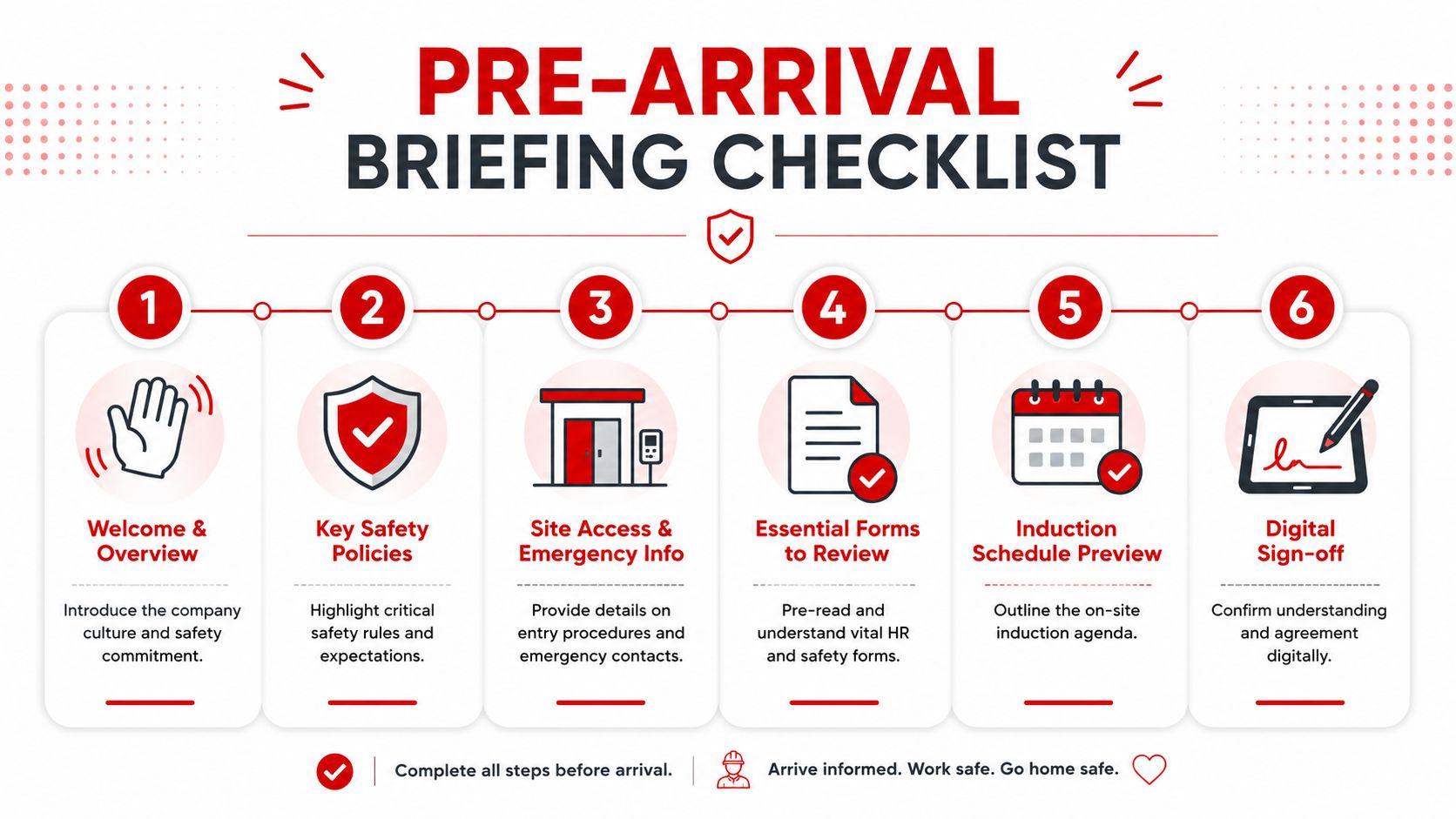
A good pre-arrival pack doesn't need to be fancy. It needs to be clear and usable on a phone.
Send a simple digital pack with these essentials:
- Welcome note: Confirm who they report to, arrival time, dress standard, and where to enter the building.
- Emergency basics: State the site's fire assembly point, emergency contact, and what to do if doors are locked on arrival.
- Key policies only: Include a short-form version of your health and safety rules, not a bloated handbook nobody reads before a train journey.
- Role-specific alerts: Flag known site issues such as cellar steps, tight galley spaces, fryer layout, or restricted prep areas.
- Read-and-confirm record: Ask them to confirm receipt before the shift.
Keep the pre-arrival pack lean
Most venues overload this stage. They attach the full staff handbook, every HR form they've ever created, and a generic policy folder from three managers ago. That doesn't improve compliance. It just means nothing gets read.
Use this filter:
| Include before arrival | Leave for on-site briefing |
|---|---|
| Arrival instructions | Physical fire exit routes |
| Emergency contact details | Equipment demonstration |
| Core safety rules | Site hazard walkthrough |
| Short policy summary | PPE issue and fit |
| Read-and-confirm step | Questions based on workspace |
Practical rule: If the worker must physically see it, touch it, or walk it, don't treat it as complete until it's covered on site.
How this helps temporary hospitality staff
This matters most when the booking is short notice. A temporary chef shouldn't arrive cold to a site that expects immediate performance. A pre-arrival briefing gives them context without wasting the first half-hour on preventable admin.
It also gives the manager a stronger start. Instead of asking, “Have you read the basics?”, you can ask, “Any questions before I show you the kitchen, the exits, and the main hazards?” That's a much better use of time.
The 15-Minute Site Tour A High-Impact On-Site Induction
The site tour is the part that managers most often rush and most often regret.
The HSE guidance on workers new to the job states that workers in the UK are as likely to have an accident during their first six months at work as during the entire remainder of their working life. In hospitality, that risk becomes more acute when someone starts in an unfamiliar, fast-moving kitchen and is expected to perform immediately.
Treat the site tour as a structured safety briefing, not a casual walk-round.
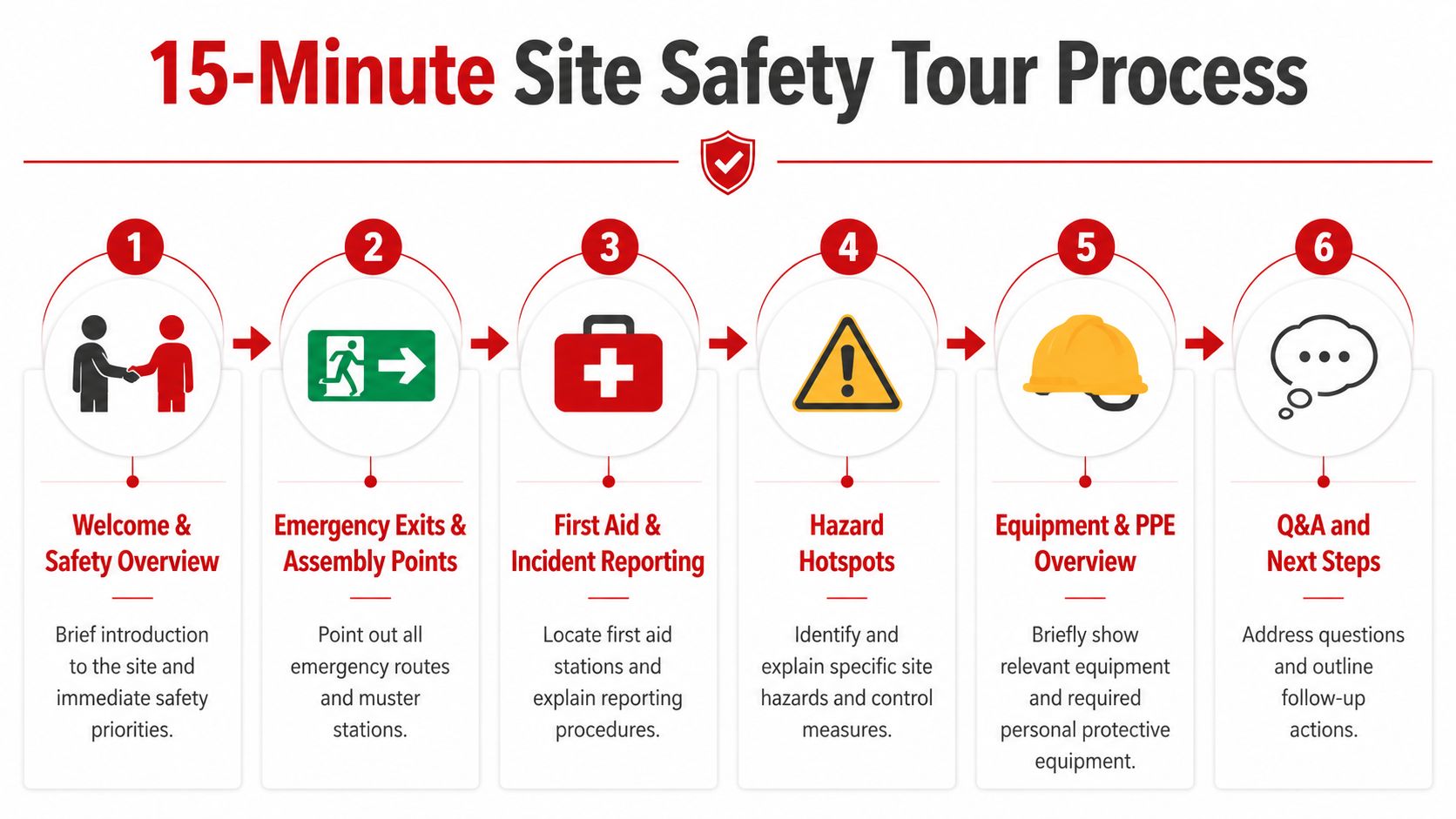
The non-negotiables for the first shift
If you've only got 15 minutes, cover what matters most for immediate safe working.
Fire exits and assembly point
Don't point vaguely. Walk the route. Show the nearest exit from the kitchen, then the secondary route if the main one is blocked.First aid and accident reporting
Show the first aid kit, identify the appointed person on shift, and explain how incidents and near misses are reported.Hazard hotspots
Identify your real risks. That might be a wet turn by the pot wash, a blind corner near hot pass traffic, or a low freezer lip that catches people carrying stock.Equipment danger points
Show the isolation or shutdown controls for fryers, combi ovens, extraction, gas, or other high-risk kit relevant to the role.PPE and safe access
Confirm any non-slip footwear rules, gloves, aprons, and where staff should and shouldn't move during service.
A manager in Berkshire might only need to cover a compact pub kitchen. A hotel in Bristol may need separate routes for prep, banqueting, and breakfast operations. The principle stays the same. Keep it specific to the shift the person is about to work.
Use demonstration, not speeches
Many inductions fall apart in this situation. A manager talks through everything at speed while walking ahead, and the new starter nods politely. That isn't confirmation of understanding.
Use prompts that force clarity:
- Show me the nearest fire exit from your section
- If oil ignites, who do you call first
- Where's the accident book kept
- Which floor area is usually slippery during service
- What do you do if a chemical bottle is unlabelled
That takes slightly longer than a monologue, but it produces better retention.
A short visual explainer can help managers standardise this process across sites:
A simple script managers can repeat
Use a consistent script so every starter gets the same baseline.
Start here. This is your main exit. If that route is blocked, use this second route. First aid is here. Report any cut, burn, slip, or near miss to me immediately. This area gets greasy by late service, and that corner is blind when runners come through. Don't use any equipment you haven't been shown.
That's plain, direct, and usable in a real kitchen.
New starters don't need a lecture. They need a safe route, clear hazards, and one manager who's paying attention.
Critical Hazard Briefings for Kitchen FOH and Specialist Roles
Generic induction language doesn't protect people from role-specific mistakes. “Be careful around hot surfaces” isn't a briefing. It's a slogan.
That matters even more for temporary staff. According to this report on induction failures and temporary workers, 22% of kitchen accidents involve temporary staff who received no site-specific induction beyond generic training. That's the gap many hospitality businesses still leave open.
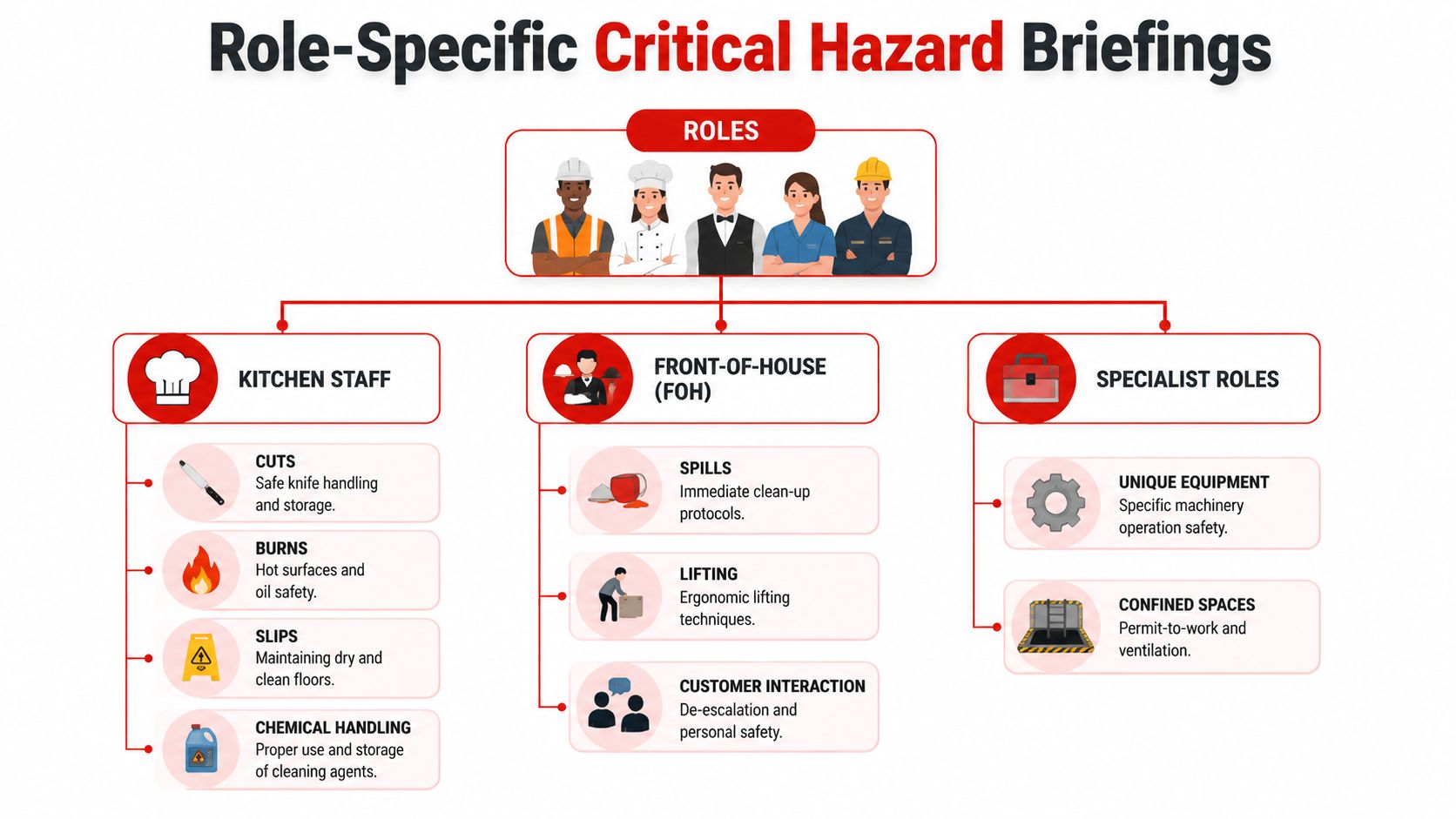
Kitchen staff need task-specific warning points
A chef may be highly experienced and still be unsafe in your kitchen if nobody explains how your site operates.
Focus the kitchen briefing on the hazards that change by venue:
- Knife and prep flow: Show where knives are stored, where damaged blades go, and whether there's a clean separation between raw prep and service assembly.
- Hot oil and open heat: Explain fryer controls, cooling routines, pan handle discipline, and what staff must do if a grease fire starts.
- Floors and drainage: Point out where grease builds up, when pot wash overflow usually happens, and who's responsible for immediate clean-down.
- Chemical handling: Cleaning chemicals cause problems when they're decanted badly, stored loosely, or left without clear control. Practical COSHH understanding matters, especially in mixed-use back-of-house areas. A useful refresher is this guide on COSHH regulations in hospitality settings.
A relief chef covering a weekend in Dorset doesn't need your full annual training archive. They need to know which slicer is temperamental, where the degreaser is kept, and whether your cellar staircase becomes a slip point during deliveries.
Front-of-house has different risks
FOH incidents often get underestimated because they don't look as dramatic as kitchen accidents. They still disrupt service and can injure staff badly.
Use FOH briefings to cover:
| FOH area | What to brief |
|---|---|
| Restaurant floor | Spill response, trip points, guest obstruction risks |
| Bar | Glass disposal, ice machine access, wet mats, stock movement |
| Cellar access | Manual handling limits, stair safety, lighting, door control |
| Terrace or garden | Uneven surfaces, weather exposure, carrying routes |
In practical terms, that means showing a new runner where not to stack plates, how to report broken glass, and which route avoids the tightest service pinch points.
Specialist roles need bespoke induction
Yacht chefs, villa chefs, and other specialist hospitality staff need a different briefing again. A galley has tighter movement space, different fire controls, and higher consequences if access routes are blocked. A private villa may have unfamiliar domestic equipment, lone working periods, and non-commercial cleaning products stored with poor labelling.
For these roles, cover:
- Confined workspace movement
- Unique suppression or shutdown systems
- Restricted exits
- Working alone or with minimal supervision
- Storage risks in non-standard prep areas
If the work setting is unusual, the induction must be unusual too. Generic forms won't catch site-specific danger.
The key point is simple. A one-size-fits-all health and safety induction leaves the highest-risk details untouched. Managers need to brief by role, by site, and by shift.
Documentation That Protects Your Business
Most businesses only discover the value of induction records after an accident.
That's too late. If a temporary chef slips, suffers a burn, or uses equipment incorrectly, your records need to show what was covered, when, and by whom. If all you've got is an unsigned paper sheet in a drawer, you haven't got much protection.
Industry data shows 38% of independent pubs struggle to verify induction records for temporary chefs, which can lead to insurance disputes when accidents occur, according to the Government induction checklist context referenced here.
Paper forms aren't enough for short-term cover
Paper gets lost. Signatures are unreadable. Dates are missing. Different managers use different versions. None of that helps when you need a clean record quickly.
A better system is a mobile-friendly digital induction record completed on a phone or tablet before the first full shift starts. Keep it short enough to use under pressure, but specific enough to stand up later.
Include these fields:
- Worker identity: Full name, role, site, date, and shift start time.
- Topics covered: Tick boxes for emergency routes, first aid, incident reporting, hazard hotspots, PPE, and equipment restrictions.
- Role-specific notes: A free-text field for local risks such as fryer bank, cellar stairs, galley hatch, or broken floor edge.
- Worker confirmation: A digital signature or typed confirmation that the induction was received and understood.
- Manager sign-off: Name of the person who delivered it.
What good records look like
The strongest records are clear enough that another manager can understand them without interpretation.
| Weak record | Strong record |
|---|---|
| “Induction completed” | “Fire exit route shown, assembly point confirmed, fryer isolation point demonstrated” |
| No site named | Site and department named |
| No inducer listed | Manager named |
| Generic checklist | Role-specific notes added |
| Paper only | Stored digitally and retrievable quickly |
Link your induction record to your broader accident reporting procedures for hospitality teams so the process doesn't break down after the first incident or near miss.
Documentation is part of risk control. If you can't prove the induction happened, you'll struggle to defend the standard of care you say you provided.
Keep the record usable
Don't turn this into a legal novel. A good induction record should take minutes, not ages. The test is simple. Can a duty manager complete it properly during a pressured handover without skipping half of it?
If the answer is no, simplify it until they can.
Health and Safety Induction FAQs for Hospitality Managers
Who is responsible for an agency chef's safety, the agency or the venue
The venue controls the workplace, the equipment, the layout, and the immediate hazards. That means the venue must handle the site-specific part of the induction. An agency or staffing partner may provide general checks, documents, and pre-placement information, but they can't physically brief someone on your exact fire route, your extraction shutoff, or the blind corner by pot wash.
If you rely on agency cover in Bristol, Reading or Slough, assume this rule. The more local the risk, the more clearly it sits with the venue.
Do I need to induct a chef who is only here for one or two shifts
Yes. The induction may be shorter, but it still needs to be real.
For short placements, strip the process back to what the person needs to work safely on that site that day. Focus on access, emergency procedures, first aid, hazard hotspots, restricted equipment, and who they report concerns to. Don't skip it because the booking is brief.
How do I induct someone with limited English
Use plain language, visual cues, and demonstration. Don't hide behind thick policy wording.
Good practice includes:
- Use simple words: Avoid long policy phrases and internal jargon.
- Show, don't just tell: Walk the route, point to the hazard, demonstrate the control.
- Check understanding: Ask the worker to show you the route or explain the next step back to you.
- Use translated support where possible: Even a simple translated hazard sheet can help if it matches the actual workplace.
Do I need to re-induct a relief chef who worked here before
If enough time has passed that the person may not reliably remember the site, re-induct them. If the layout, equipment, staffing pattern, or procedures have changed, re-induct them. If you can't verify what they were shown last time, re-induct them.
The short version is practical. Familiar face doesn't always mean current knowledge.
What should I do if service pressure makes the induction hard to complete
Change the timing, not the standard.
Move what you can to pre-arrival. Assign one person to deliver the on-site induction. Use a short, standard checklist. Don't spread responsibility loosely across a busy team. If nobody owns the induction, it won't be done properly.
How much detail is enough
Enough to let the worker perform safely without guessing.
That means they know where to go, what to avoid, what not to use, how to report a problem, and who's in charge. It does not mean reading every policy line aloud before service. Keep the induction focused on current working risk, then follow up with deeper training if the placement continues.
What if a chef says they already know everything
Experienced staff still need site-specific induction. A chef may know commercial kitchens well and still not know your gas shutoff, your allergen storage routine, or the broken tile near the walk-in.
That conversation should be respectful and direct. “I know you've worked in plenty of kitchens. I still need to show you this site's hazards and emergency points before you start.”
If you need dependable chefs who can step into service quickly and work within professional standards, contact Relief Chefs UK. Established in 2013, they support hospitality businesses nationwide with relief chefs, temporary chefs, permanent chef recruitment, yacht chefs, villa chefs, and wider hospitality staffing support. For pubs, restaurants, boutique hotels, private households and yachts dealing with short notice sickness, peak-season demand, chef shortages and kitchen instability, they're a trusted nationwide chef recruitment agency that understands what real operations require.
Call the team.
Office 01392 715474 · info@reliefchefs.co.uk