
Hours for a Chef: What UK Employers Need to Know
23 October 2026

A chef's typical working week is 40–45 hours, including evenings, weekends and bank holidays, but actual kitchen hours frequently run higher, with 44% of London chefs surveyed working more than 48 hours weekly.
If you're rewriting the rota after a sick call, that gap between advertised hours and actual cover probably feels familiar. The commercial question isn't whether someone will stay late. It's whether you can protect service without relying on tired chefs, invisible overtime or a rest arrangement that doesn't stand up to scrutiny.
How Many Hours Does a Chef Actually Work
Your Sous Chef texts in sick before breakfast prep on a fully booked weekend. The immediate temptation is to extend the Head Chef's day and ask the evening team to arrive early. You might rescue service, but you've also changed the working hours, recovery time and workload of everyone covering the absence.
The National Careers Service chef profile gives the typical working week as 40–45 hours, with evenings, weekends and bank holidays. Treat that as a career benchmark, not proof that your kitchen can deliver its entire service schedule within the same allocation.
Contracted hours aren't the whole requirement
A contract describes an employment arrangement. Your rota must also accommodate the work needed before customers arrive and after they leave.
For a pub serving lunch and dinner, the useful staffing question is whether the allocated hours cover preparation, service and closing properly. For a hotel, breakfast adds another demand that can't be absorbed by whoever finished dinner service.
Separate your assessment into:
- Contracted hours: What you've agreed with the chef.
- Scheduled hours: What the published rota requires.
- Actual working time: What the chef works, including authorised and unplanned extensions.
Practical rule: Build the rota around the work required, then check whether the people allocated can do it within their working-time and rest arrangements.
Don't judge the position from a quiet week. Compare the kitchen's ordinary operation with its busiest trading pattern and its likely absence cover.
The right answer to “hours for a chef” therefore depends on the role, service model and staffing structure. A breakfast chef, a restaurant Chef de Partie and a Head Chef managing ordering and administration may have very different schedules. What matters is that you can explain and record each schedule, rather than assume a full-time contract covers unlimited availability.
Common Chef Shift Patterns in UK Kitchens
A weekly total can look manageable while the daily pattern is poor. Start by naming the shift you need, then check its relationship with the chef's preceding and following duties.
Straight shifts keep the working day together. They can suit breakfast production, preparation or an evening service, but managers still need someone to cover breaks and complete the handover.
Split shifts divide work across lunch and dinner. They can align staffing with customer demand, but the interval only provides useful rest if the chef is released from duties.
Sample Weekly Rota Patterns for a Small UK Kitchen
These are illustrative shift allocations across a week, not a recommended complete rota for the same chef. The hours shown describe the attendance window before any genuine breaks are deducted.
| Shift Pattern | Typical Times | Hours on Site | Compliance Watch-Out |
|---|---|---|---|
| Breakfast straight shift | Example weekday, 6am–2pm | Eight-hour attendance window | Check the previous evening's finish and arrange break cover |
| Lunch straight shift | Example weekday, 10am–6pm | Eight-hour attendance window | Include preparation and handover rather than service alone |
| Split lunch and dinner | Example weekend day, 10am–3pm, then 5pm–11pm | Eleven scheduled attendance hours across a thirteen-hour span | Confirm the interval is genuinely free from work |
| Late restaurant close | Example weekend evening, 3pm–11pm | Eight-hour attendance window | Don't automatically allocate the next breakfast shift |
Early breakfast shifts need particular care in hotels and care settings. The chef must be ready for production before guests or residents expect food, so the relevant start is the preparation start, not the advertised breakfast opening.
Late closes need an equally honest finish time. Last orders aren't the end of the working day if the chef still has cleaning, storage checks and handover to complete.
Check the joins between shifts
Under UK rest-break guidance, adult workers generally have 11 consecutive hours of daily rest. An illustrative finish at 11pm followed by a 6am breakfast start falls short of that entitlement under the ordinary rule.
Exceptions and compensatory rest can affect particular arrangements, so assess the circumstances rather than assuming every late-to-early sequence is automatically permissible. Where an exception applies, identify the basis and plan the required recovery.
A better operational fix is often to separate breakfast and closing responsibilities. Don't use the split-shift interval as a reason to ignore overnight recovery. Review the transitions between days as carefully as the hours within them.
The Reality of Chef Overtime in the UK
The rota says the chef has finished. The ordering system, delivery note and unfinished close-down say otherwise.
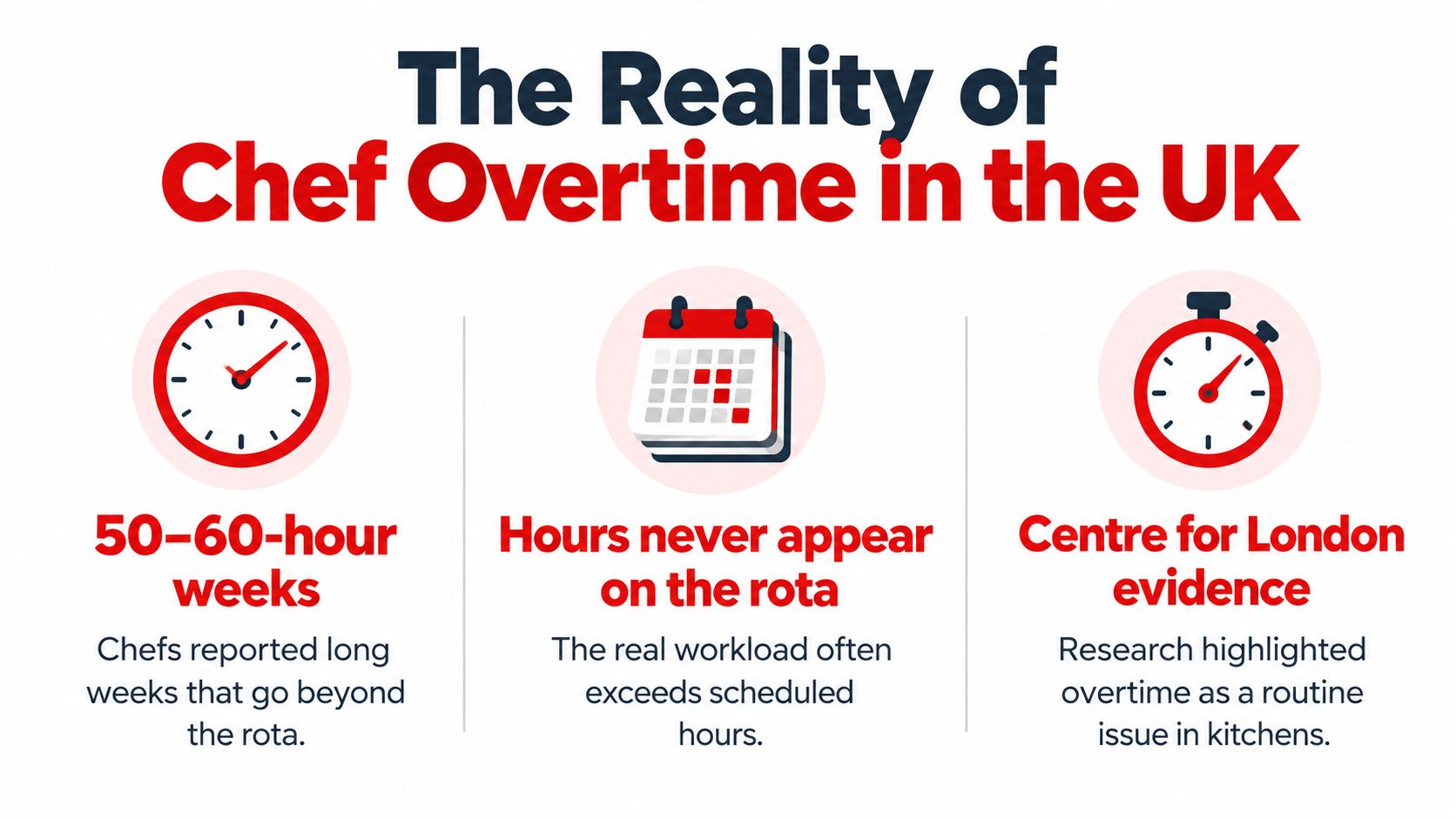
The Centre for London's Kitchen Skills report, published in 2019, recorded chefs describing average weeks of 50–60 hours, with 80–100-hour weeks during busy periods or staff absence. Its analysis also reported that only 20% of UK chefs were paid for working 45–51 hours weekly, while 10% were paid for more than 51 hours, highlighting the distinction between paid hours and the longer working weeks chefs described.
Find the work missing from the rota
Don't begin by accusing staff of poor time management. Ask what they're doing outside their scheduled attendance.
Typical tasks to investigate include:
- Before service: Receiving deliveries, checking produce and completing mise en place.
- After service: Cleaning equipment, storing food and completing the kitchen handover.
- Between services: Stock control, ordering and preparation that prevents the interval being genuine downtime.
- Away from the pass: Post-service administration and any required work across sites, assessed according to the actual arrangement.
A Head Chef who completes ordering after the team leaves is still carrying an operational workload. Moving that task off the printed rota doesn't make it disappear.
Compare records without hiding the difference
Place the contract, rota, payroll record and actual attendance record beside each other. Then ask the chef to explain the gaps.
Distinguish time on site from working time. A genuine off-duty interval isn't the same as preparation, and a payroll deduction shouldn't be treated as proof that a break happened.
Unpaid work isn't spare capacity. It's work your staffing plan hasn't properly accounted for.
Once you know which tasks cause extensions, choose the appropriate response. Improve delivery scheduling if interruptions are the problem. Allocate administration explicitly if it's being completed after closing. Add cover when the workload exceeds the available staffing.
The practical route to reducing chef overtime costs starts with that diagnosis. Telling everyone to finish on time while leaving the same work outstanding won't resolve the underlying gap.
Judge progress by whether chefs can complete a properly organised service within their allocated time, not whether fewer extra hours reach payroll.
The 48 Hour Rule and What It Means for Your Rota
The weekly limit is an average, not a blanket ban on a busy week. That distinction matters when you're planning weddings, Christmas functions or a temporary absence.
Under the Working Time Regulations, an adult worker's working time, including overtime, must generally average no more than 48 hours per seven-day period, over an applicable reference period normally lasting 17 weeks. An individual week can exceed 48 hours where the applicable average remains within the limit, or where a valid voluntary opt-out applies.
Use long weeks as a review trigger
Repeated 55- or 60-hour weeks should prompt a review against that statutory framework. They aren't, by themselves, enough information to determine compliance, but they're a clear reason to inspect the records rather than rely on the published rota.
The review should establish:
- Actual hours worked: Include overtime rather than checking contracted hours alone.
- Applicable arrangements: Confirm the reference period and whether a valid voluntary opt-out is in place.
- The operational cause: Identify whether the extra work comes from a temporary event, an unfilled role or an unrealistic service commitment.
- The recovery plan: Check rest separately and decide how the kitchen will return to a sustainable pattern.
Don't wait until the end of a demanding trading period to discover what happened. Review the developing position while you can still change cover, adjust duties or reduce the workload.
An opt-out isn't a staffing strategy
A chef's willingness to work longer doesn't answer every operational question. You still need to consider whether that chef can complete the work safely, recover between duties and maintain the standards the business expects.
Nor should managers treat an opt-out as permission to disregard other protections. Weekly averages and rest arrangements are different checks, and both need attention.
For a Dorset hotel preparing for wedding season, the sensible planning exercise is to identify event production, ordinary restaurant service and breakfast cover separately. Assign responsibility for each before asking the same senior chef to carry everything.
The practical guidance on working time directives for hospitality teams can support that review. Where an arrangement is uncertain, get advice on the actual facts rather than assuming kitchen custom overrides the rules.
Commercially, the objective isn't to operate as close as possible to a legal boundary. It's to preserve enough staffing flexibility that an absence doesn't immediately force everyone else into another extended week.
Breaks and Rest Periods for Kitchen Staff
A break written on the rota isn't necessarily a break taken. If the chef remains responsible for the pass, answers delivery queries or returns to the stove whenever tickets arrive, the arrangement needs reviewing.
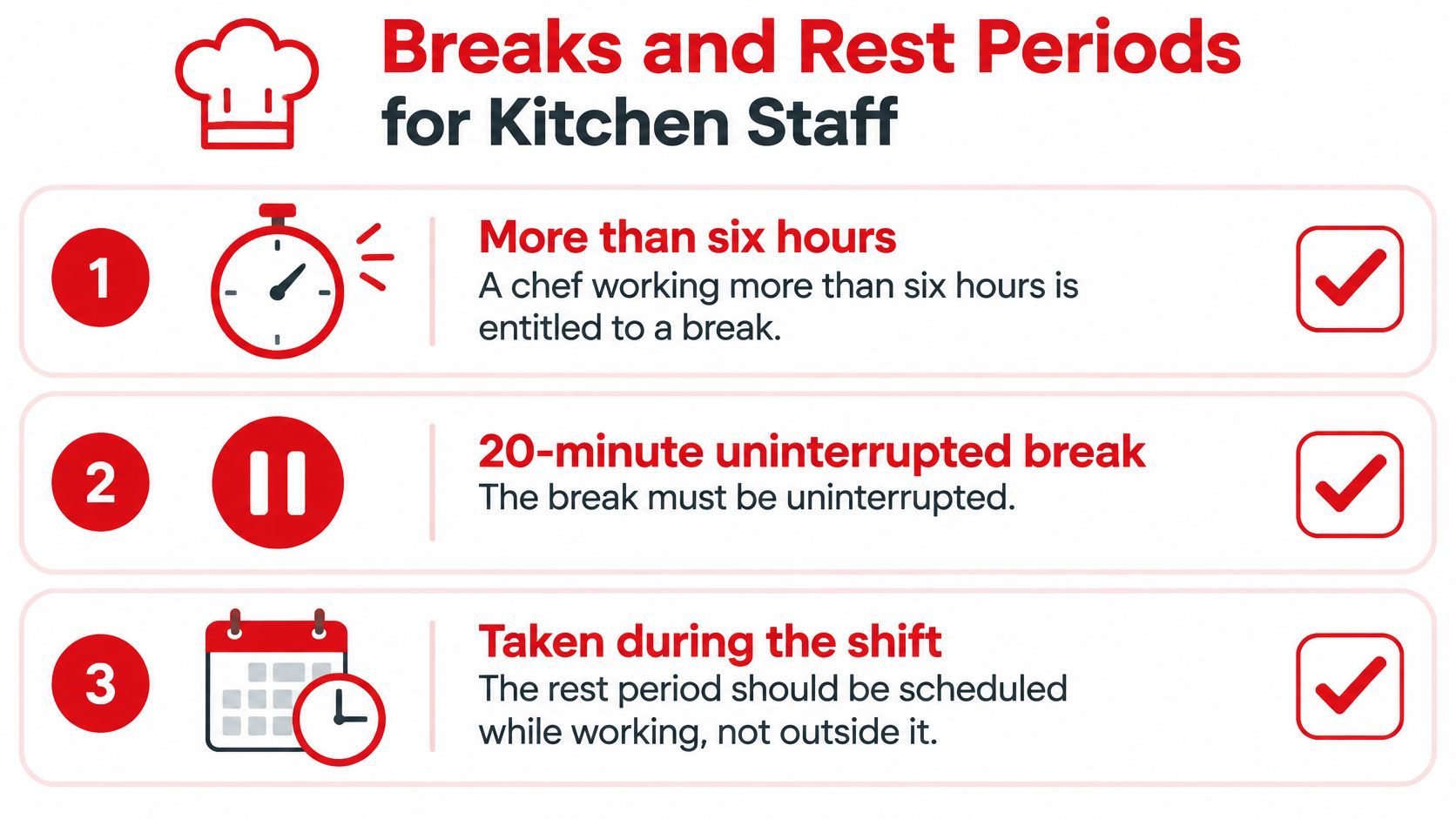
The HSE's working-time guidance sets out the ordinary adult entitlement to an uninterrupted break of at least 20 minutes when working more than six hours, taken during the working day and away from the workstation. It shouldn't be placed at the beginning or end of the shift, and it doesn't automatically have to be paid.
Assign someone to cover the break
Schedule breaks against the service plan, not against wishful thinking. Identify who takes over the section, who handles urgent questions and when the chef can step away.
On an extended kitchen day, a quieter period between meal services may offer a practical opportunity. It won't work if you fill that same period with deliveries, ordering and preparation that nobody else can handle.
Ask the chef whether the break was taken. If service prevented it, record what happened and arrange the appropriate response rather than leaving the original rota entry untouched.
A quick rota audit
Use this checklist before approving the week:
- Coverage: Can another competent person take responsibility while the chef is away?
- Timing: Is the break scheduled during work rather than attached to arrival or departure?
- Interruption: Can the chef leave the workstation without being routinely called back?
- Recording: Does the attendance record reflect what happened?
- Payroll: Are genuine unpaid breaks distinguished from working time and any contractual paid-break arrangements?
For payroll and minimum-wage checks, don't automatically deduct a scheduled break that the chef worked through. Check the facts and the contract.
Operational test: If nobody can explain who covers a chef's break, the rota hasn't yet provided for it.
Fatigue matters during knife work, hot-line cooking and food-safety-critical tasks. Treat repeated missed breaks as a management problem requiring cover or a change in workload, not as evidence that the team is committed enough to cope.
Seasonal Peaks and the Understaffing Trap
A demanding service and a chronically understaffed kitchen aren't the same thing. The distinction is whether managers can see an end to the pressure and have a credible plan for reaching it.
A 2025 survey of 460 chefs.pdf), including respondents working primarily in the UK and other English-speaking markets, reported unpaid overtime, chronic understaffing and expectations of 60–80-hour working weeks. That evidence challenges the idea that every long week should be accepted as part of professional cooking.
Plan for the demand you can already see
Christmas trading, wedding bookings and summer reservations give managers opportunities to act before the rota becomes an emergency.
For a tourism-facing operation in Devon, Dorset, Cornwall or Wales, compare the booking pattern with the kitchen team's available capacity. In Bristol, apply the same discipline to restaurant demand and event commitments. Use your own bookings and production requirements, not assumptions about what the existing team will somehow absorb.
Consider a hotel with breakfast guests, a wedding and its usual evening service. If the Sous Chef is absent, reallocating their responsibilities across already committed chefs may leave no credible cover for preparation or recovery.
A targeted temporary assignment might address the immediate gap. An ongoing vacancy needs a recruitment plan as well.
Compare the real alternatives
Don't compare an agency invoice solely with the apparent cost of salaried staff staying late. Assess the whole decision:
- Direct labour: Overtime payments, temporary cover and the supervision each option requires.
- Service delivery: Whether the menu and bookings remain achievable with the available skills.
- Management workload: Time spent rewriting rotas, covering sections and resolving preventable problems.
- Kitchen stability: Whether the arrangement preserves recovery and gives the permanent team a workable schedule.
Agency reliability belongs in that assessment. Confirm the chef's experience, arrival arrangements, responsibilities and escalation contact rather than booking on availability alone.
Chef shortages don't make every service commitment achievable. If appropriate cover isn't available, reducing the menu or limiting service can be more responsible than expecting the remaining team to compensate indefinitely.
Using Relief Chefs to Control Working Hours
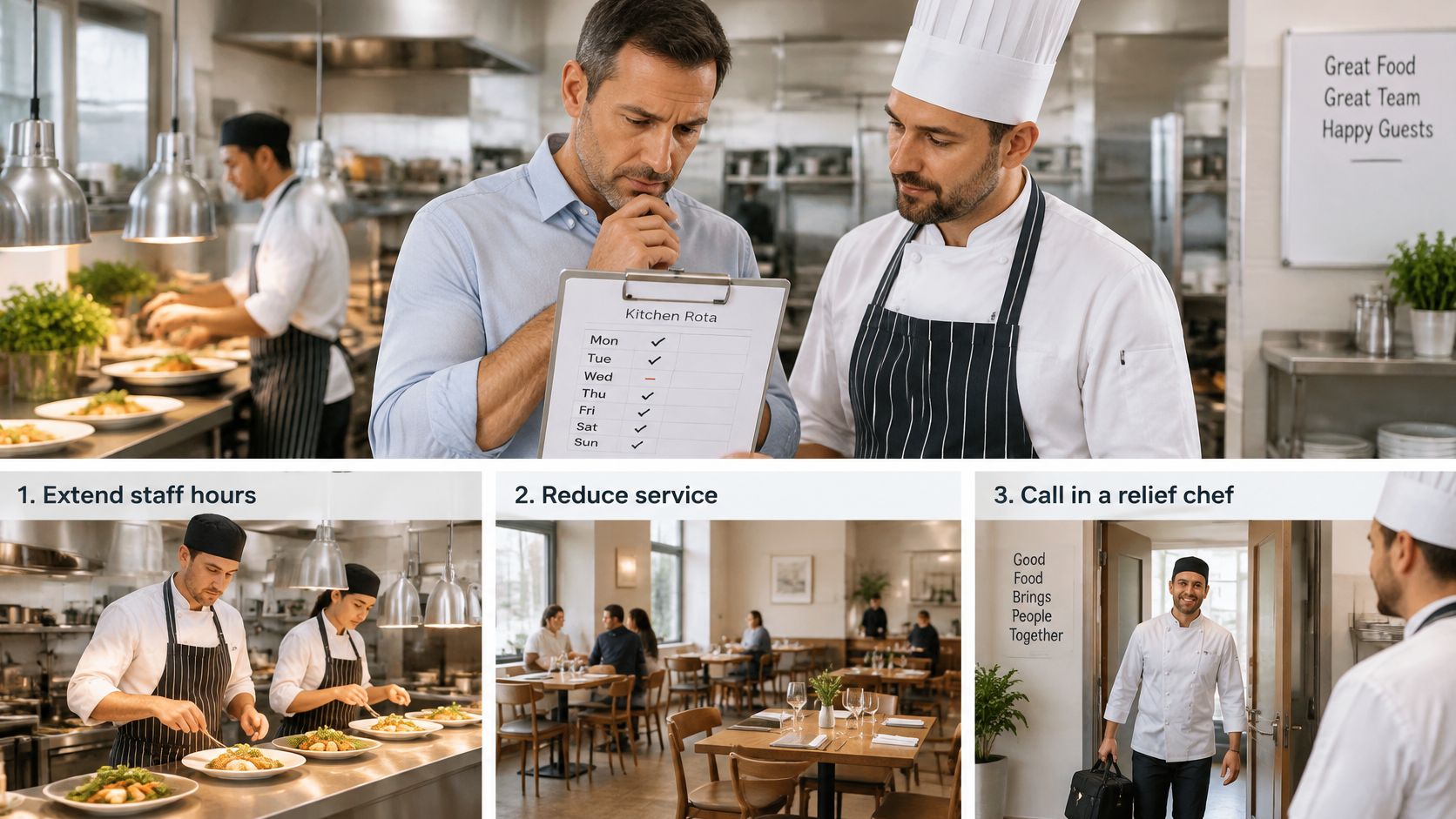
When a gap appears, there isn't a cost-free answer. Choose the option that matches the work, the available skills and the condition of the existing team.
| Option | When it can work | Main trade-off |
|---|---|---|
| Extend existing staff's hours | A genuinely short disruption with suitable capacity and recovery | Familiar staff, but less room for further disruption |
| Reduce the menu or service | Cover isn't available or demand can be managed | Lower production requirements, but a changed customer offer |
| Bring in temporary cover | A defined skills or attendance gap | Additional booking cost and induction, but a clearer allocation of work |
Book the missing capability
Don't request a chef without defining the assignment. A breakfast specialist, a Chef de Partie covering a busy section and a Sous Chef running service solve different problems.
Specify the role, location, dates, actual attendance requirements, menu, equipment and reporting line. Include accommodation or travel arrangements where relevant, particularly for rural properties and late finishes.
Relief Chefs UK is a chef-led nationwide recruitment agency established in 2013, offering vetted relief chefs, temporary Chef de Parties, Sous Chefs and Head Chefs, alongside 24/7 emergency assistance, permanent chef recruitment and wider hospitality staffing support. Its chef-on-hire service is an option for defined short-term gaps, subject to suitable availability.
The same approach applies to hotels in Berkshire, including Windsor, Reading and Slough: specify what the chef must deliver rather than request unlimited flexibility.
For yacht chefs, villa chefs and private placements, make the service expectations and off-duty arrangements explicit before confirming the booking. A live-in assignment needs a clear working arrangement, not an assumption of constant availability.
Send the team your actual cover requirement before extending the rota again. A precise enquiry makes it easier to assess whether temporary support or permanent recruitment is the appropriate response.
FAQs About Chef Working Hours
Do part-time and casual chefs have different break rights?
Part-time or casual status doesn't, by itself, remove applicable working-time protections. Check the person's status and actual duties rather than assuming a shorter contract means fewer safeguards.
Break and daily-rest requirements depend on the working pattern. Don't reduce an applicable break entitlement proportionately just because the chef works fewer days.
Must chefs be paid overtime?
Overtime pay depends on the contract and applicable pay requirements. Extra hours don't automatically attract an enhanced overtime rate, but employers still need accurate records and must check minimum-wage compliance.
Set out authorisation and payment arrangements clearly. An agreement about pay doesn't make additional working time irrelevant to the rota review.
How do private, villa and yacht chef hours differ?
Live-in arrangements can blur the distinction between availability and duties. Define shopping, preparation, meal services, clearing down and genuine off-duty periods before the placement starts.
For yacht work, don't assume the ordinary UK restaurant framework answers every question. Establish the applicable employment and maritime requirements for the particular assignment.
Can an employer ask a chef to stay late without notice?
You can ask, but whether the chef is obliged to agree depends on the contract and circumstances. Check the proposed extension against working-time limits and rest arrangements before treating it as confirmed cover.
Record the additional work and review the next shift. If late extensions become routine, change the coverage plan rather than continuing to describe them as emergencies.
Relief Chefs UK offers nationwide temporary chefs, emergency kitchen cover, permanent chef recruitment and hospitality staffing support to help you address gaps without making extended hours your default. Visit Relief Chefs UK with your location, required role, dates and service pattern, and ask the team to assess suitable cover for your kitchen.
Call the team.
Office 01392 715474 · info@reliefchefs.co.uk