
Independent Pub Group Management and Chef Staffing Guide
2 September 2026
A Saturday service is approaching across your sites in Devon and Bristol. One head chef phones in sick, the agency sends someone who hasn't worked a busy fresh-food kitchen, and the duty manager starts cutting dishes from the menu. The bar can still trade, but the kitchen can't deliver the covers that make the weekend viable.
That situation is becoming normal for the independent pub group. Pub kitchens have moved well beyond their traditional supporting role. They now carry a large share of the customer experience and revenue, so short-notice sickness, seasonal demand, chef shortages and unreliable agency cover create a direct trading risk. The answer isn't to keep adding permanent payroll until the rota looks safe. It's to build a core team with a dependable way to flex capacity.
What Defines an Independent Pub Group in the UK
Consider a small group with four venues, two in Devon, one near Bristol and another across the Welsh border. The owner controls the menus, pricing and hiring, but each general manager runs the daily operation. On a Friday afternoon, a chef absence at the busiest site leaves three options: move a chef from another kitchen, reduce the menu or close the kitchen early. The group may have a strong brand, but its resilience depends on how easily people and systems move between sites.
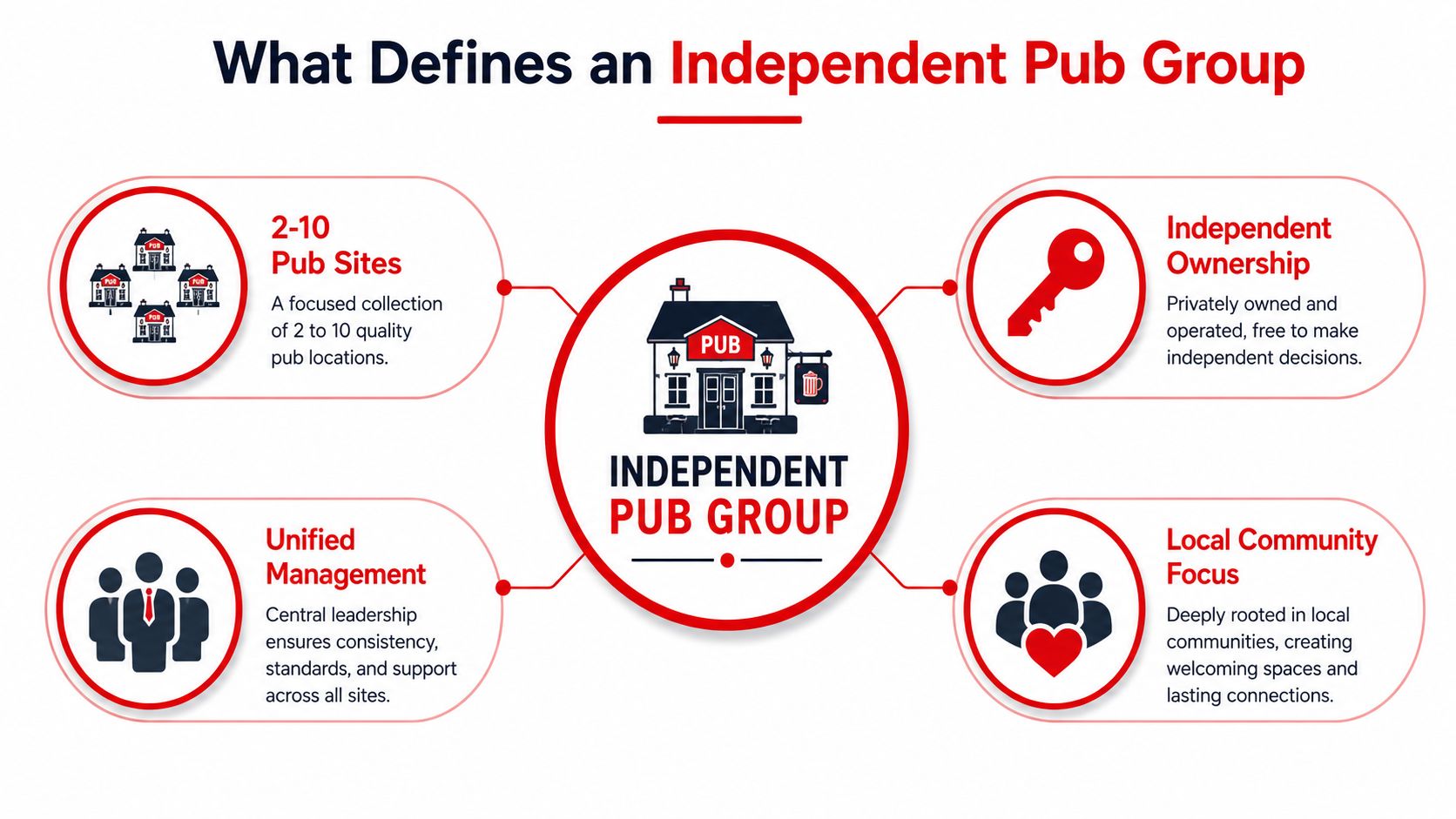
An independent pub group usually means several pubs under common ownership or management without the scale and central control of a national managed pub company. The group might be family-owned, privately owned or operated by a partnership. Its identity often comes from local decision-making, consistent leadership and a close relationship with its communities.
An independent operation should be distinguished from a free-of-tie pub, which has more freedom over where it buys beer and other products, and from a managed pub company, where the pub is operated within a larger corporate structure. In practice, the boundaries can overlap. A free-of-tie owner may run several sites, while a small independent group may centralise finance and procurement but leave each head chef responsible for their own menu.
Why the category matters
Independent pubs have a substantial footprint in British hospitality. A UK Parliament briefing on pubs recorded 47,200 public houses in the UK in 2019, including 23,400 independent pubs, compared with 13,900 owned by pub companies and 9,900 owned by breweries. Independents therefore represented just under half of the market at that point.
The same briefing recorded a fall of 13,600 pubs between 2000 and 2019, a decline of 22%, while noting that the UK had 58 pubs per 100,000 people in 2020. The market has contracted, but independent pubs remain locally important employers and customers for suppliers, recruitment partners and operational support.
Food has changed the staffing equation
ONS data shows that food-serving staff have outnumbered bar staff in pubs and bars since 2016. That reversed the earlier pattern seen in 2003, when bar staff represented roughly 40% of employees and food-service staff about 30%, as reported in the ONS pub industry release.
That shift changes the risk profile. In a food-led pub in Berkshire or Wales, a chef shortage doesn't only create an HR gap. It can remove the service line that drives bookings, table turns and customer satisfaction. Kitchen cover belongs in the operating plan, not only in the recruitment file.
Typical Organisational Structures and How They Affect Staffing
The owner-operator model works well while the owner can remain close to the kitchen, rota and suppliers. Once the business expands, informal knowledge becomes a weakness. A chef who knows how to cover every station may be carrying more operational knowledge than the management team realises.
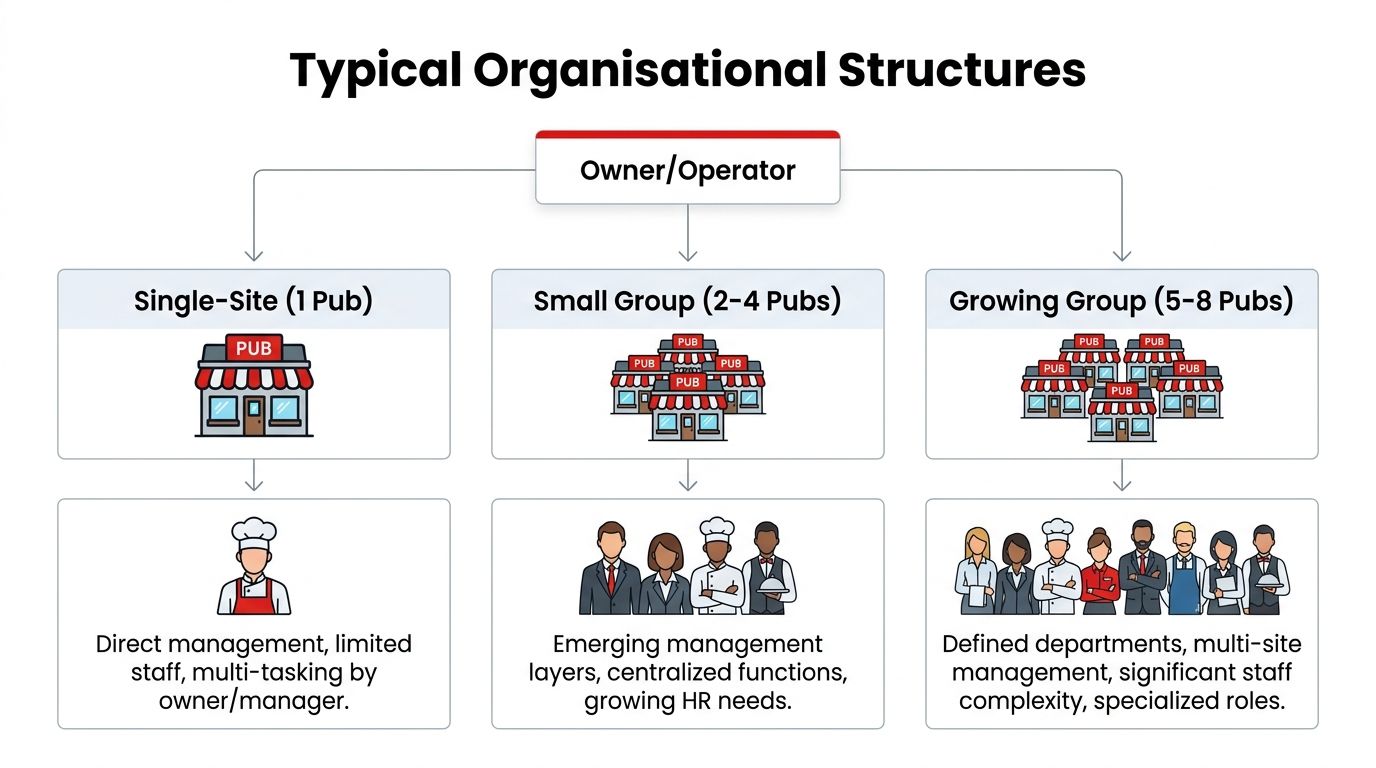
Most independent pub groups fall into one of three broad structures:
- Single-site operation: The owner or general manager makes most decisions, and the kitchen often depends on one head chef and a small core team.
- Small group: Several pubs share finance, purchasing, HR or senior management, while each site retains its own kitchen leadership.
- Growing group: A larger cluster may use area managers, group executive chefs, standardised recipes and shared recruitment, but still needs local flexibility.
Where structure helps or hurts
A family-run group in Windsor and Reading might centralise payroll and purchasing but give every site its own head chef. That protects local character, but it can create four separate recruitment problems. If one chef leaves, the other kitchens may not have enough spare capacity or familiarity with the vacant site's menu to help.
A hybrid structure is often more resilient. The group keeps a permanent kitchen leader at each venue, then shares prep systems, allergen information, supplier specifications and a small pool of cross-trained chefs. A chef from the Dorset site may not take over a full menu immediately, but they can cover a section, support prep or stabilise a service while a longer-term solution is found.
The weak structure is the one that looks efficient on payroll but has no cover plan. If every rota depends on one irreplaceable person, the group has transferred its operational risk into a single job title.
Operational test: Remove one key chef from the rota and ask whether each site can trade its planned menu without improvisation. If the answer is no, the structure needs a cover layer.
Make multi-site responsibility explicit
Assign someone to own group-wide kitchen resilience. That person should maintain a skills matrix, record which chefs can travel, and keep site information current. Travel time matters across rural Devon, West Wales and dispersed Berkshire locations, so a theoretical shared pool isn't enough.
For practical guidance on coordinating venues, rotas and shared resources, review multi-location pub management support.
A useful structure also defines decision rights. The site manager should know when to request cover, the area manager should know when to move labour, and the finance lead should understand which costs protect trading rather than increase payroll.
The Real Operational Challenges Independent Pub Groups Face
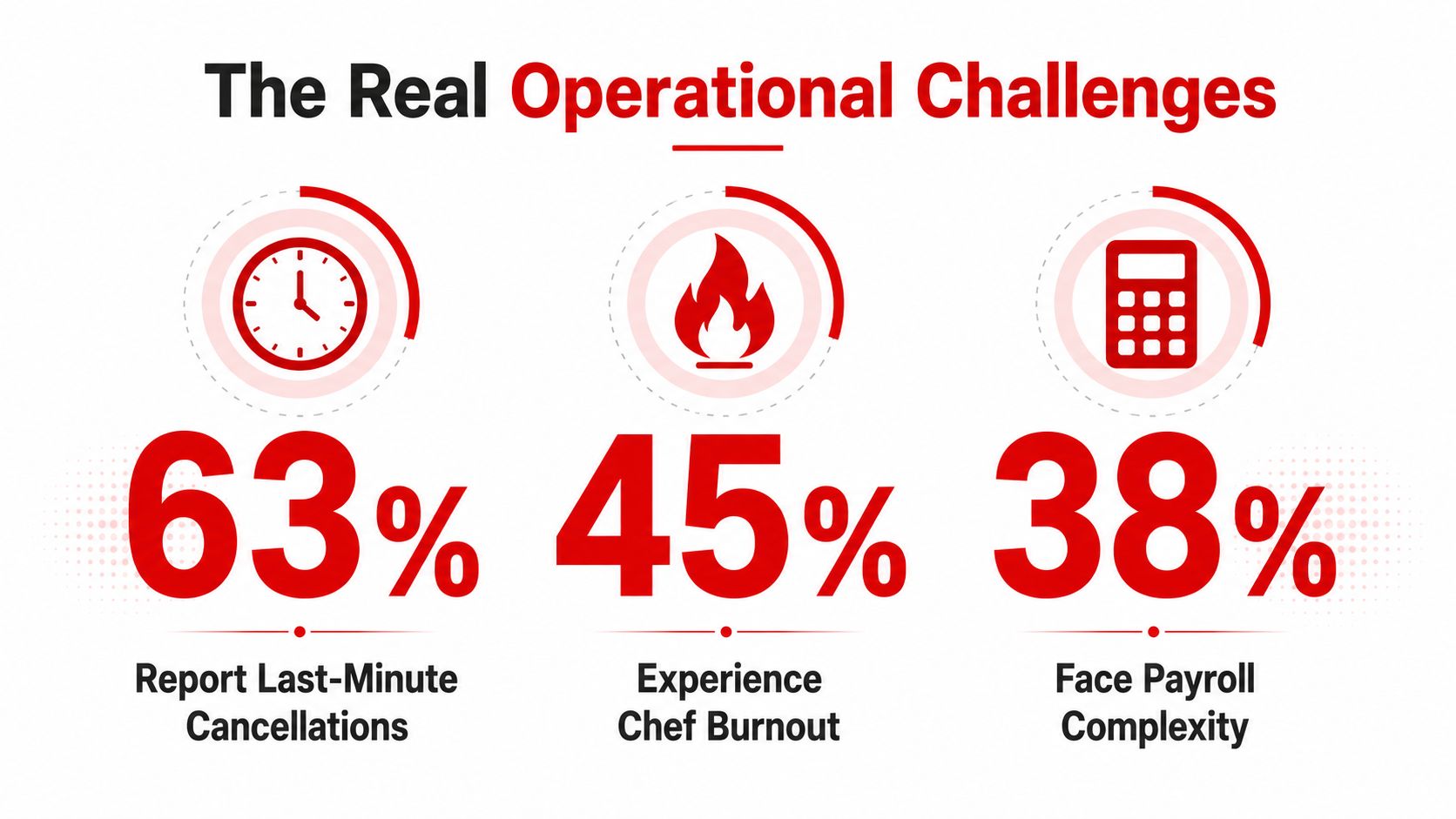
Chef shortages aren't the whole problem. The bigger issue is that independent pub groups often run with little slack, so sickness, demand spikes and poor agency matching combine quickly.
A chef calls at midday with a fever. The site has a wedding party booked, a reduced kitchen team and a menu built around fresh preparation. The manager contacts an agency, waits for confirmation, then learns that the proposed chef has no experience with the site's service style. The group may technically have found a candidate, but it hasn't solved the operational problem.
UKHospitality says the sector has 132,000 vacancies, 48% above pre-pandemic levels, and reports chef shortages ranging from 10% for head chefs to 21% for production chefs, according to its workforce campaign data. Those figures support a practical conclusion: chef cover is structural. It can't be managed as an occasional emergency.
The pressure compounds across locations
Seasonal demand makes the problem sharper in coastal and rural areas. A Devon or Dorset pub may need stronger kitchen capacity during holiday periods, while a venue near Bristol or Cardiff can experience sudden spikes from events, functions and weekend travel. A group that staffs every site to its quietest trading pattern will struggle during peaks. A group that staffs every site to its busiest pattern carries fixed-cost pressure through slower periods.
The staffing failure can also spread. If the strongest chef is moved from one site to another, the first kitchen may lose its own standard. If the group closes one service, guests may change their booking habits and staff may lose confidence in the rota. Cutting the menu can protect quality in the short term, but repeated restrictions can damage the venue's reputation.
Why conventional recruitment is too slow
Permanent recruitment remains essential for head chefs and stable core teams, but it rarely solves a same-week absence. Generic agencies can offer speed, yet reliability depends on vetting, availability, travel and the chef's ability to work at the required level.
The group therefore needs two linked systems:
- A permanent hiring process for long-term capability.
- A flexible cover arrangement for sickness, seasonal demand, holidays and unexpected peaks.
The useful question isn't, “Can we recruit a chef?” It's, “Can we protect the next service while recruiting the right permanent chef?”
Best Practice Management and Recruitment Strategies
Resilient staffing starts before the emergency. A small group should know which services are most exposed, which chefs can cover them and what information a replacement needs before arriving.
Build a site-by-site staffing map
Record the essentials for every kitchen:
- Service profile: Note covers, opening pattern, functions and the busiest trading periods.
- Skill requirements: Separate grill, pastry, prep, breakfast, rosette-level and high-volume experience.
- Travel reality: Map realistic journeys between sites in Bristol, Slough, Wales, Devon and surrounding areas.
- Fallback menu: Define dishes that can be removed without undermining the guest offer.
- Contact ownership: Give one person authority to request cover and approve the cost.
Keep the document operational, not aspirational. “Chef required” isn't enough. “Breakfast and lunch cover, confident on a combi oven, able to manage prep and service, own transport preferred” gives a staffing partner something useful to work with.
Recruit for the kitchen you actually run
Job descriptions should show the service pattern, not just list generic duties. A chef considering a pub in Slough wants to know whether the role involves fresh prep, functions, split shifts or high-volume Sunday service. Clear expectations reduce poor-fit applications and early departures.
During interviews, test judgement rather than only menu knowledge. Ask the candidate how they would respond if a key delivery arrived late, a commis failed to attend and the first sitting was already full. Their answer reveals more about service readiness than a list of dishes.
Retain the people who stabilise service
Pay matters, but so do predictable rotas, realistic prep levels and respectful management. Don't promise every weekend off if the business can't deliver it. Instead, agree how far ahead the rota will be published, how emergencies are handled and which duties belong to the head chef versus the general manager.
Cross-train selectively. A sous chef from Bristol might support a sister site in Wales for a planned peak, while a senior CDP in Berkshire learns the group's core prep and allergen process. Cross-training should produce documented competence, not vague assurances that “everyone can help”.
Establish cover before you need it
Build relationships with specialist recruitment partners while service is stable. Ask how they vet chefs, confirm right-to-work status, handle replacements, communicate availability and price multi-site support. A partner who understands your kitchens can respond more effectively than a new contact who receives a crisis call without context.
Run a quarterly cover drill. Test who makes the call, how the brief is written, how keys and accommodation are handled, and what happens if the first proposed chef declines. The exercise exposes gaps without putting a real Saturday service at risk.
Comparing Staffing Approaches for Independent Pub Groups
No single model suits every independent pub group. Permanent chefs provide continuity, but a permanently staffed rota can become expensive during quiet periods. Temporary cover provides flexibility, but poor matching can create training time and quality problems.
| Staffing Model | Best For | Response Time | Cost Structure | Flexibility |
|---|---|---|---|---|
| Permanent recruitment | Core leadership and stable long-term roles | Slower, dependent on notice periods | Fixed payroll and employment costs | Lower once appointed |
| Traditional recruitment agency | Long-term vacancies and candidate search | Variable | Recruitment fee or agreed placement cost | Moderate |
| Temp staffing platform | Short shifts and straightforward cover | Often fast, subject to availability | Shift-based cost | High, but quality can vary |
| Specialist relief chef partnership | Sickness, peaks, seasonal reinforcement and multi-site cover | Built around rapid response | Flexible service arrangement | High, with clearer operational support |
Permanent hiring
Use permanent recruitment for roles that shape standards, training and culture. A strong head chef can improve ordering, prep discipline and retention, but hiring too quickly just to fill a gap can create a costly mismatch. Keep recruiting for the right long-term person while using interim cover to protect service.
General agency cover
Traditional agencies can work well when the brief is clear and the role has enough notice. They're less effective when the group needs a chef who can arrive quickly, travel between locations and match a particular menu or service pace. The lowest hourly quote isn't necessarily the lowest operational cost if managers spend the shift retraining the replacement.
Specialist relief support
A specialist partnership is most useful when the group has recurring volatility. The operator retains a permanent core, then adds relief chefs or temporary chefs for sickness, holidays, seasonal demand and planned events. Flexible staffing solutions for hospitality groups can form part of that model.
Measure the decision against the cost of the alternative. Ask what happens if the kitchen closes, the menu is cut, a booking is refunded or the general manager works an extra shift. You don't need to invent a precise loss figure. You do need to include those consequences in the staffing decision.
How Relief Chefs UK Supports Independent Pub Groups
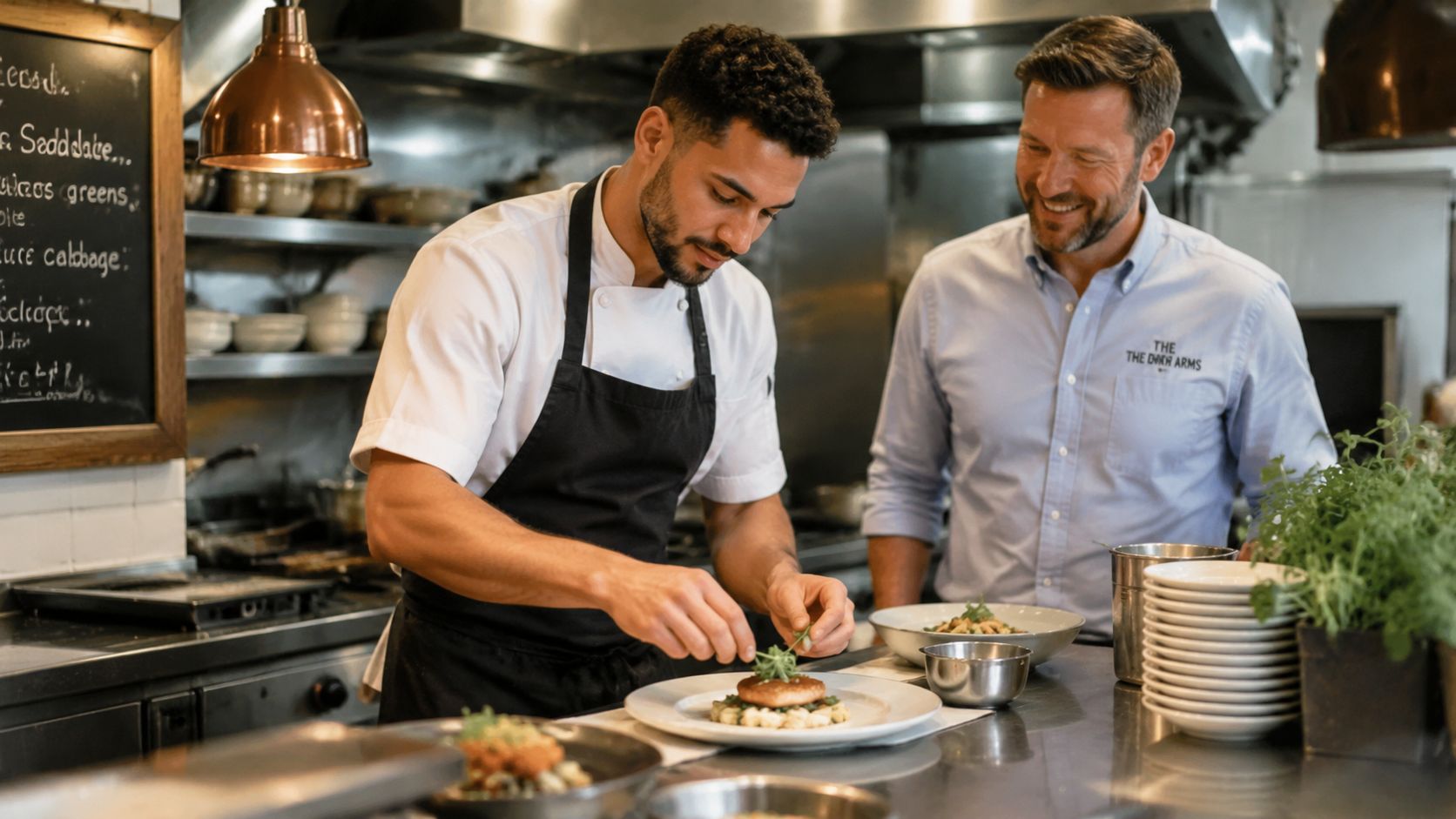
Independent pub groups need staffing support that understands service, not just vacancy administration. Relief Chefs UK is a nationwide chef recruitment agency established in 2013, and its team is run by chefs rather than recruiters. That distinction matters when a venue needs someone who can step into a working kitchen, follow standards and contribute without excessive hand-holding.
The company supports pubs, restaurants, boutique hotels, private households and multi-site operators through relief chefs, temporary chefs and permanent chef recruitment. It also handles specialist placements for yacht chefs and villa chefs, which can be useful for hospitality businesses with varied staffing requirements or private-service clients.
A practical response model
Venues can request cover through a short form or by phone and meet fully vetted, right-to-work-checked chefs, with an experienced recruitment team available 24/7 to help find the right cover, subject to availability. That gives an operator a defined process for a Friday sickness call, rather than relying on a chain of personal favours.
The service can support a single independent pub or a group with several venues, with cover quoted based on the role, location and dates, allowing the arrangement to scale with the operation.
That kind of arrangement doesn't remove the need for permanent recruitment. It creates a buffer around the permanent team, so the business can recruit carefully instead of appointing the first available applicant.
What to check before service
Relief Chefs UK states that its staffing support includes 24/7 availability, transparent pricing with no hidden agency fees and professionally vetted chefs who must hold valid public liability insurance. For a group operating between Windsor, Reading, Berkshire, Devon, Dorset, Bristol or Wales, the value lies in having those processes agreed before a site faces an absence.
The company reports that 400+ venues trust its services, while the Craft Guild of Chefs vacancy report recorded 237,601 hospitality and catering vacancy postings in Q2 2026, up 18.4% year-on-year, with chef postings at 40,395, up 74.8% quarter-on-quarter and 83.4% year-on-year. Those figures show why response speed and candidate quality both matter during peak trading.
For groups that want continuity rather than repeated emergency calls, a consistent recruitment team for chef staffing can keep site briefs, preferences and cover requirements organised.
Frequently Asked Questions About Chef Staffing for Pub Groups
How quickly can a relief chef start?
Relief Chefs UK's experienced recruitment team is available 24/7 to help you find the right cover, subject to availability. Give the staffing brief early whenever possible, especially for weekends, functions and seasonal peaks.
Are chefs checked before placement?
The service describes its chefs as fully vetted and right-to-work checked, with insurance included. Your site should still provide a clear brief covering menu style, kitchen equipment, allergens, service times, uniform and reporting arrangements.
Can one partner cover several pubs?
Yes, a group can structure support across multiple sites, but each venue needs its own practical profile. Include location, travel expectations, kitchen size, service pattern and the level of responsibility required.
What happens if the chef isn't suitable?
Ask about the replacement process before confirming an arrangement, and incorporate the agreed steps into your internal escalation plan.
Should a group replace permanent recruitment with temporary chefs?
Usually, no. Keep permanent chefs for leadership, culture and menu consistency, then use flexible cover for sickness, holidays, seasonal demand and peaks. That hybrid approach protects trading without forcing fixed payroll to carry every possible demand pattern.
Relief Chefs UK provides relief chefs, temporary chefs, permanent chef recruitment and wider hospitality staffing support for independent pubs and multi-site groups across the UK. Visit Relief Chefs UK to discuss your next absence, seasonal requirement or ongoing chef pipeline before it puts your service at risk.
Call the team.
Office 01392 715474 · info@reliefchefs.co.uk