
Multi Location Management for UK Hospitality: A Practical
27 August 2026
Friday service is already building when the flagship's head chef calls in sick. The deputy is committed to a split shift, the available agency chef hasn't seen the menu, and the other three kitchens are trading too heavily to release anyone. By the time the replacement arrives, the pass is behind, two specials are unavailable, and the area manager is taking calls from three venues instead of supporting one.
That failure isn't caused by a missing dashboard. It comes from weak multi-location management, unclear cover triggers, poor handovers, and a staffing pipeline that only gets tested when service is at risk. In a UK estate, one kitchen's disruption can affect guest reviews, labour variance, food availability, and the next day's rota across the group.
The practical answer is resilient execution. You need the right permanent structure, a reliable relief layer, clear operating controls, and a decision process that works at 2pm on a Friday, not just in a Monday planning meeting.
When One Site Slips, the Whole Group Feels It
A four-site pub group can look stable on paper while carrying significant operational risk. Each venue may have a head chef, a deputy, and a small permanent team. That works until one person is absent, a second chef is already working extended hours, and the only available cover arrives without the knowledge or confidence to take over the menu.
The immediate damage is visible. Service starts late. A popular dish is removed because nobody understands the prep or stock position. The kitchen adds overtime to recover, the general manager steps into an unfamiliar role, and the operations director spends Sunday rewriting rotas. The less visible cost is just as serious, because the group has lost management time and weakened confidence in its own staffing plan.
Practical rule: Treat every critical chef absence as an estate-level risk, even when only one venue is affected.
A venue doesn't trade in isolation. Guests recognise the brand across locations, staff compare how each kitchen is managed, and area managers inherit the consequences of local decisions. If the flagship underperforms on a busy night, the group may need to explain the result at the next performance review, even if the other sites traded well.
The cover failure usually starts earlier
Most short-notice failures aren't created on the day. They begin when nobody records which chefs can work across locations, which menus they can execute, or which sites have suitable accommodation and transport arrangements. They also begin when managers rely on an unnamed “agency option” rather than a tested escalation route.
A useful service continuity plan should identify the first redeployment option, the protected relief layer, the external staffing partner, and the person authorised to approve the cost. It should also contain site access information, menu notes, allergen procedures, equipment details, and the contact responsible for the handover.
Software can help distribute that information. It can't decide whether a relief chef is suitable for a high-volume hotel kitchen, whether moving a sous chef will destabilise another venue, or whether paying for cover is cheaper than damaging service. Those decisions belong to operators who understand the estate.
Why Multi-Site Kitchens Are Uniquely Exposed
A chef calls in sick at 4pm. One kitchen is already short, another has a private event, and the nearest experienced relief chef is an hour away. That is the core exposure in a multi-site estate. The problem is not just finding a replacement. It is deciding which venue can release staff, which menu can be executed safely, and what level of service the group can still deliver.
UK hospitality entered this operating environment with limited spare labour. Government reporting recorded 146,000 hospitality job vacancies in the three months to January 2023, with a 6.6% vacancy rate, the highest among the sectors covered by the cited ONS data. A group cannot assume that every site can recruit a suitable replacement quickly.
Skilled kitchen roles create greater pressure. The government's hospitality and tourism workforce report recorded that 39% of chef vacancies were hard to fill because the skills were hard to find, compared with a 17% sector average. UKHospitality also reported 132,000 vacancies, described as 48% above pre-pandemic levels, with shortages ranging from 10% for head chefs to 21% for production chefs. The figures appear in the cited hospitality workforce reporting and UKHospitality staffing coverage.
| Indicator | Hospitality | All UK industries | Impact on multi-site groups |
|---|---|---|---|
| Vacancies | 146,000 in the three months to January 2023 | The cited government data identifies hospitality as having the highest vacancy rate among covered sectors | Several sites can lose cover at the same time |
| Vacancy rate | 6.6% | Lower than hospitality in the cited comparison | Permanent teams have less spare capacity |
| Hard-to-fill vacancies caused by skills shortages | Chefs, 39% | Sector average, 17% | A replacement may be available without being service-ready |
| Reported vacancies | 132,000 | Stated as 48% above pre-pandemic levels | Recruitment and retention need a longer-term plan |
The ONS business activity and location data adds useful context. Only 58,000 of the UK's 2.768 million VAT and/or PAYE businesses operated from more than one site in 2022, so multi-location businesses represented about 2.1% of all VAT/PAYE businesses. The same release noted that total business sites fell by 0.1%, while retail recorded the largest reduction at 3,100 sites. Multi-site estates are concentrated networks, so a local staffing shock can affect group performance quickly.
Payroll makes the decision more immediate
Independent UK hospitality benchmarking cited by Ezii EPOS placed payroll at 28.3% of sales in the referenced report. It is a planning anchor, not a universal target. An uncovered shift can lead to overtime, emergency agency spending, reduced opening hours, or weaker service. Each choice carries a different margin and customer cost.
Seasonal demand exposes the same weakness at larger scale. Summer trading, Christmas events, weddings, and January movement between kitchens can all require experienced chefs at short notice. A cover plan built only for ordinary weeks will fail when several venues need help together.
Building the Chef Pipeline Across Locations
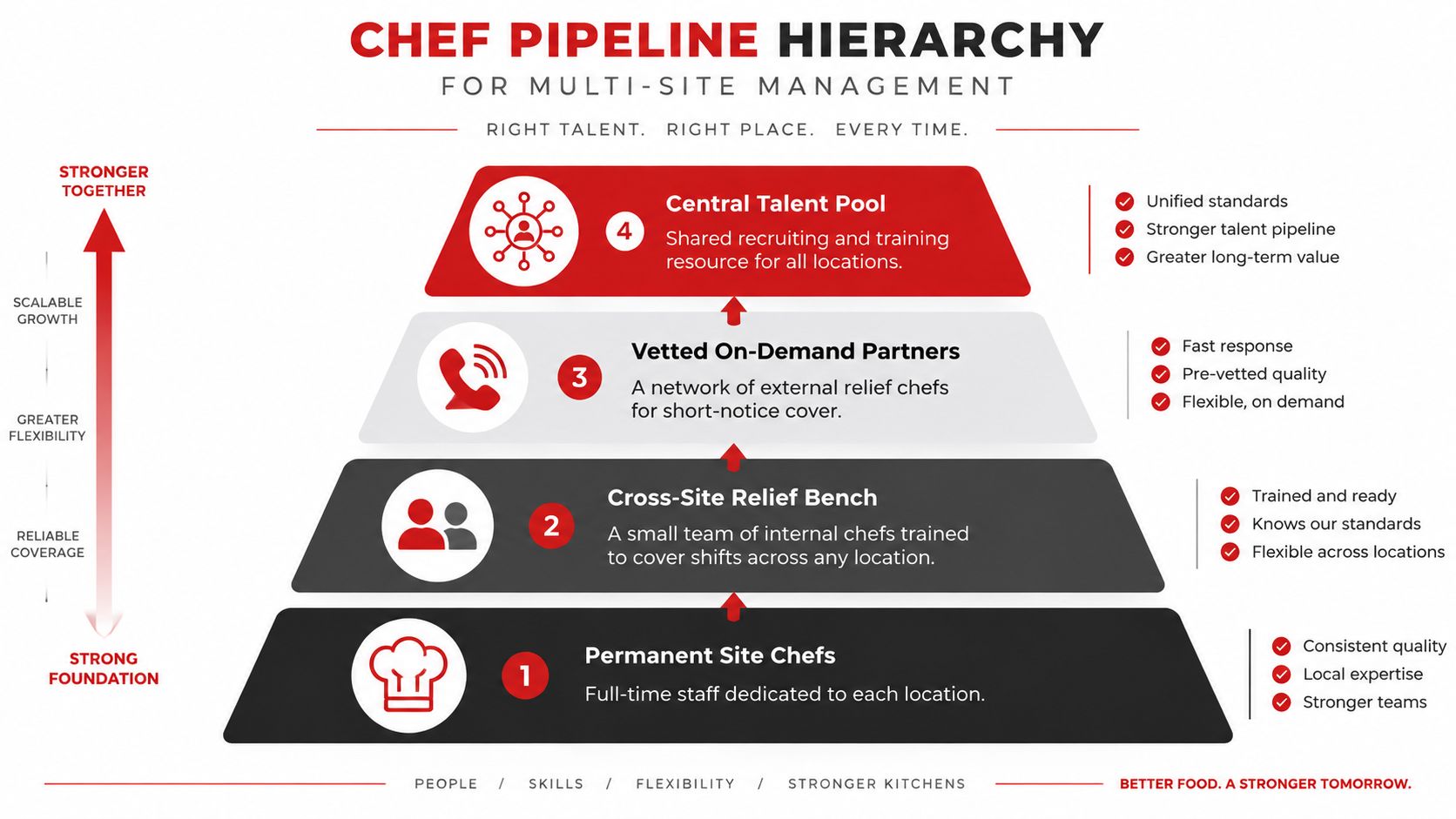
A resilient estate doesn't choose between permanent recruitment and temporary staffing. It uses both, with each layer activated for a different operational reason. The aim is to absorb ordinary disruption without buying expensive emergency cover for every absence.
Start with the permanent structure
Permanent chefs should provide the core capability at each location. Size that team against expected covers, menu complexity, trading pattern, contracted hours, and the minimum safe skill mix for each service. Don't build a rota that assumes every employee will be available every week. Planned leave, sickness, training, and resignation risk need room in the model.
The second layer is a cross-site relief bench. These might be chefs employed by the group or retained through an agreed arrangement, trained on the group's core standards and familiar with more than one kitchen. Deploy them when a site has a predictable absence, a short peak, or a vacancy that hasn't yet reached emergency status.
A small internal pool can be more economical than repeated external escalation, but it creates a trade-off. Those chefs need guaranteed work, travel arrangements, clear pay terms, and protection from becoming the default solution for every poorly planned rota.
Use external cover deliberately
The third layer is a vetted on-demand relief partner for short-notice cover. Relief chefs, temporary chefs, and wider hospitality staffing support can protect service without requiring the group to employ a large floating team.
The final layer is a contingency agency tier for a genuine emergency, such as a short-notice sickness call, an unexpected opening, or simultaneous absences at several venues. Agency escalation should have an approval route and a clear suitability check. The cheapest available chef isn't useful if they can't handle the menu, volume, allergens, or equipment.
Consider a five-site group operating at 32% labour cost. A two-person cross-site relief pool, combined with a trusted relief chef partner, can be designed to absorb roughly 80% of absences before agency rates are used. The exact result will depend on availability and demand, but the model illustrates the cost logic: fund a controlled first response, then reserve higher-cost cover for situations the first layers can't handle.
Every cover shift should produce recruitment intelligence. Record the chef's section, pace, technical ability, attitude, travel range, and manager feedback. A strong temporary chef may become a permanent appointment, while a weak match can be removed from future requests.
A documented talent pipeline management process helps turn isolated cover decisions into a shared estate resource. The pipeline should be visible to the operations team, not held in one manager's phone.
Rotas, Shift Cover, and Short-Notice Execution
Repeating last week's rota is fast, but it isn't management. Build the core rota from forecast demand, venue capacity, menu complexity, required skills, and contracted hours. Then add the changes caused by events, weather, holidays, private bookings, and absence.
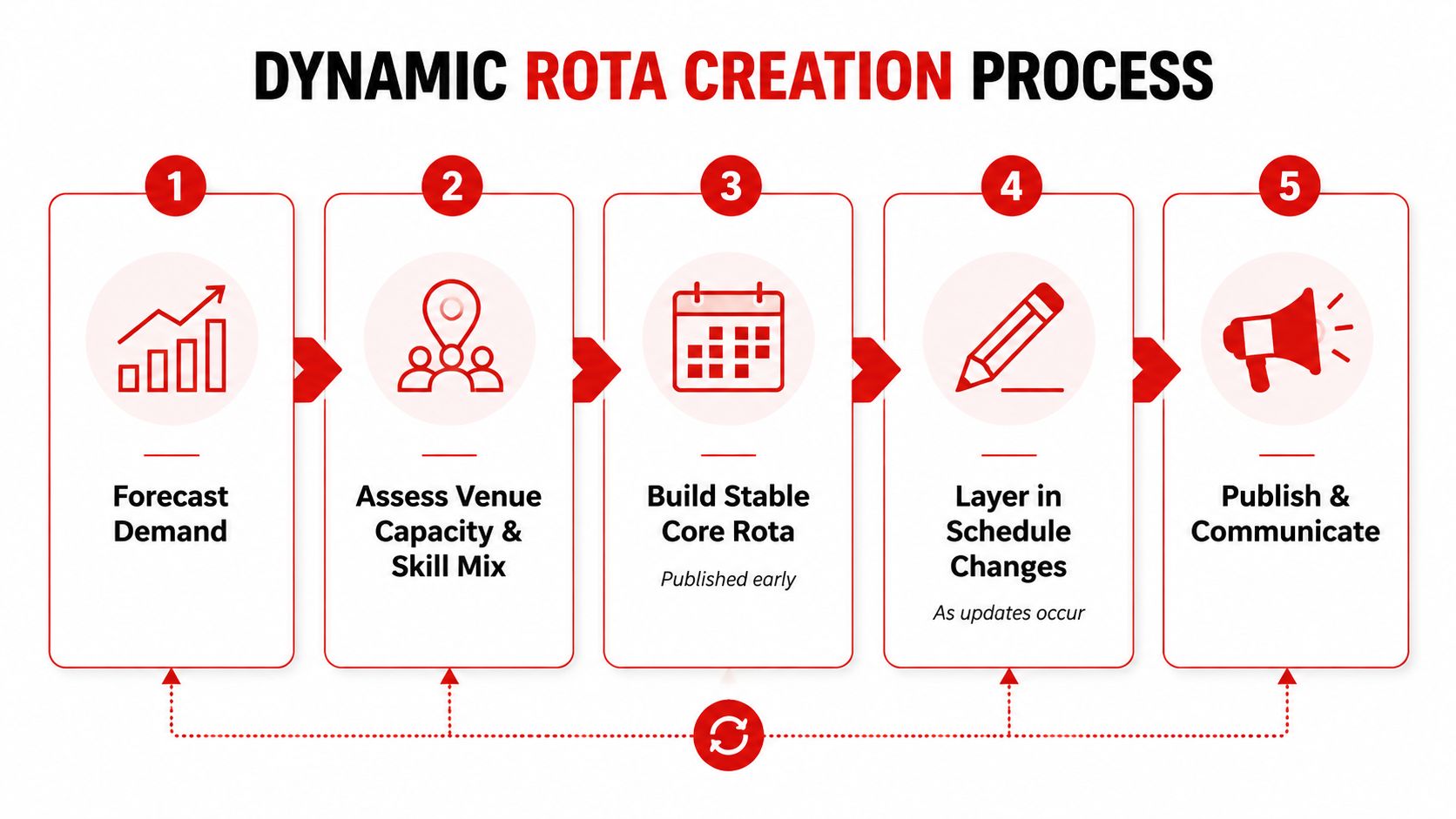
Publish a stable core rota early enough for chefs to plan their lives. Set a practical point after which changes require manager approval, while accepting that a sickness call can still override the rule. The purpose of a rota freeze isn't rigidity. It's to stop avoidable changes creating the same disruption as genuine emergencies.
Give every absence a sequence
A chef absence needs a named escalation path. The manager should know which action comes first, who can approve redeployment, and when to stop searching internally.
- Check the estate skills matrix. Find a permanent chef who can move without leaving another site unsafe. Match capability to menu and volume, not simply distance.
- Use the protected relief layer. Contact the cross-site bench or established temporary staffing partner before the absence becomes a service problem.
- Escalate to contingency cover. If the role remains unfilled, approve an emergency agency request with the correct start time, duties, and site information.
- Adjust the service plan. If suitable cover cannot be secured, change the menu or capacity transparently rather than allowing an unbriefed chef to fail at the pass.
For every request, create one job record containing the role, start time, location, access instructions, menu, allergen controls, stock position, equipment notes, and handover contact. Confirm identity, right-to-work checks, payroll details, and shift timing before service.
A relief chef should arrive with a workable brief, not a postcode and a start time.
Send the short digital handover before the shift. Include specials, prep priorities, supplier substitutions, expected covers, and the person who can make decisions on arrival. Review response time, unfilled shifts, cancellations, overtime, relief hours, and agency spend each week.
The accompanying dynamic scheduling guidance should support visibility across sites, but it shouldn't remove venue accountability. Managers still own the quality of the handover and the decision to protect service.
Keeping Standards Consistent Without Micromanaging
Central control works well for standards that protect safety, brand identity, and comparable reporting. It works badly when a central team tries to dictate every local decision during live service.
| Centralise | Keep with the venue |
|---|---|
| Recipe cards and allergen procedures | On-day service recovery |
| Portion specifications and supplier approvals | Local deployment of staff |
| Opening and closing checks | Practical response to local demand |
| Menu change control | Waste decisions during service |
| Group reporting definitions | Immediate communication with guests |
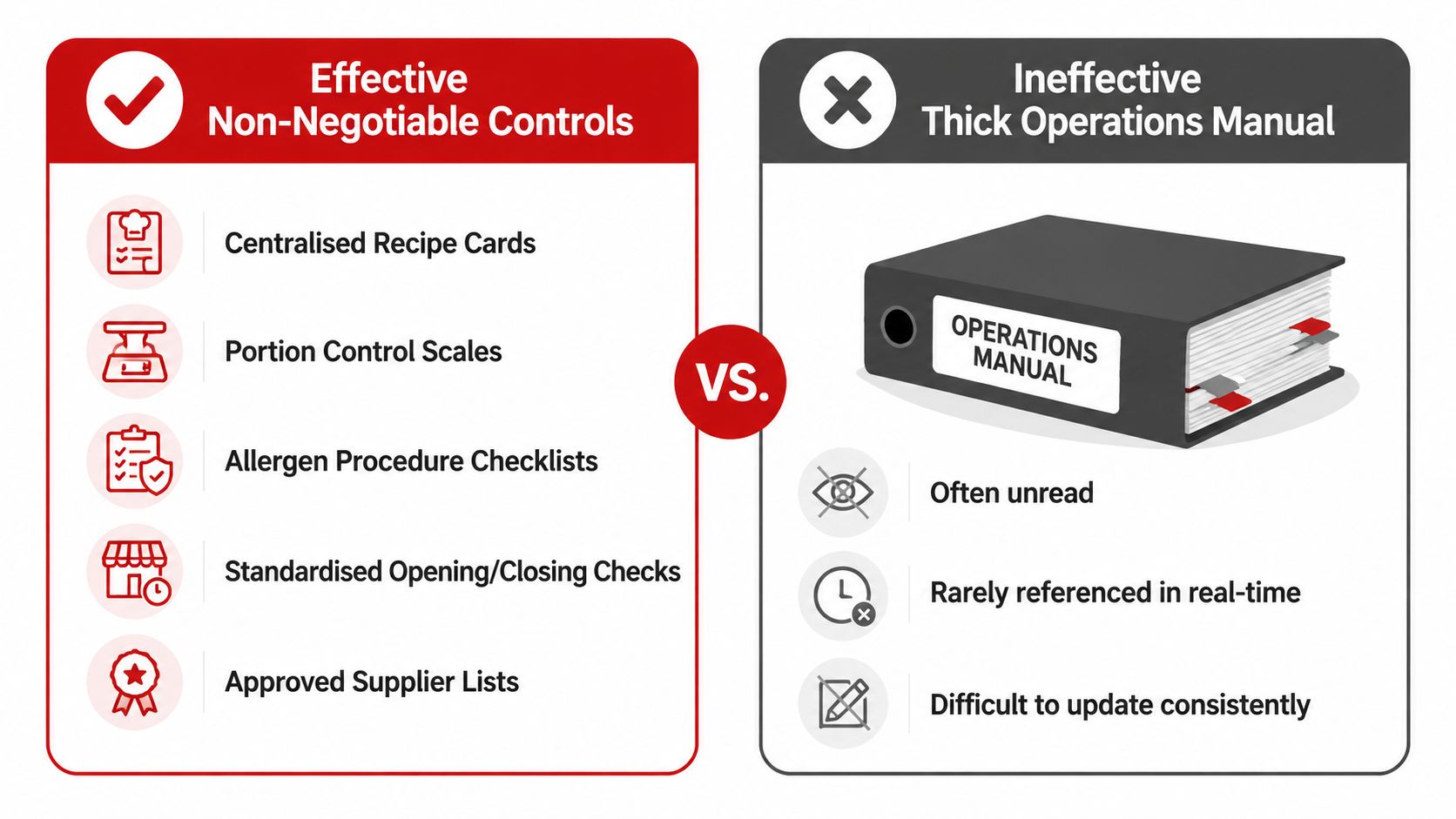
A thick operations manual looks thorough but usually fails at the pass. Chefs need concise controls they can use under pressure. Create a one-page standard for each critical station, with a photograph, acceptable tolerance, corrective action, and escalation point.
Control the important details
Centralise the recipe, allergen method, portion size, approved suppliers, and evidence required after service. Let the kitchen leader decide how to arrange the section, recover a delayed table, or handle a local delivery issue within those boundaries.
Training should be short and role-specific. Watching a presentation doesn't prove competence. Ask the chef to demonstrate the task, observe the result, and record any follow-up coaching. Site visits should then focus on exceptions rather than collecting identical notes from every venue.
A site with repeated late deliveries or abnormal waste deserves attention before a quiet venue that is trading within its controls. The group needs comparable reporting, but it doesn't need identical intervention at every location.
Keep a change log for recipes, menus, systems, and supplier products. Each change should have an owner, an impact assessment, a training requirement, and a rollout date. If a relief chef, head chef, and area manager disagree about a dish specification, the log gives the operations director a clear route to decide, communicate, and verify the change.
A written service level agreement can also clarify response expectations, replacement arrangements, and responsibilities when temporary cover is used. The document should support practical execution, not create another file that nobody opens during service.
The KPIs That Run a Multi-Site Estate
A dashboard earns its place when it shows which venue is drifting, why it is drifting, and who must act before service is affected. A long list of figures without thresholds, owners, or deadlines is reporting theatre.
Start with sales, labour cost, gross profit, stock variance, waste, availability, absenteeism, rota changes, and chef cover hours. Review each venue against its own trading pattern, daypart, capacity, menu cycle, and forecast volume. A large event kitchen and a small wet-led pub should not be judged by one group average. The comparison produces tidy numbers and weak decisions.
Payroll at 28.3% of sales can provide a planning anchor based on UK hospitality benchmarking, but it is not an automatic target for every venue. Menu complexity, service style, trading hours, and event mix can require a different labour model. The useful question is whether the agreed model protects service at the forecast volume.
| KPI | Why it matters | Action threshold |
|---|---|---|
| Sales against forecast | Shows whether staffing matches expected demand | Investigate a material variance by daypart |
| Labour cost as a share of sales | Identifies overspend and understaffing risk | Compare with the venue's agreed labour model |
| Gross profit | Connects menu, purchasing, waste, and labour decisions | Assign an owner when margin moves unexpectedly |
| Stock variance | Reveals receiving, transfer, portion, and recording problems | Reconcile before the next stock cycle |
| Food waste | Shows where prep or ordering exceeds demand | Review recurring waste by product and station |
| Availability | Links staffing and stock decisions to guest experience | Escalate repeated unavailable dishes |
| Relief and agency hours | Measures reliance on external cover | Review patterns, not isolated shifts |
| Time to fill and cancellations | Tests the staffing response | Change the escalation route when reliability drops |
| Absence and rota changes | Shows workforce instability | Create a site recovery plan for repeated movement |
Measure cover as an operational outcome
Track relief hours, agency hours, time to fill, cancellation rate, cost per hour, and every service interruption caused by an unfilled shift. These measures expose the labour shock hidden behind a clean labour percentage.
A venue that spends more on cover but protects its menu and service may be healthier than one reporting low labour cost because the head chef is working excessive hours or the team is cutting dishes. Cost control has to be read alongside execution.
Labour should also be assessed against forecast volume, not sales alone. Strong sales can hide an unstable kitchen when the team is understaffed, overtime is rising, or one exhausted chef is carrying the service. A short-notice cover failure should therefore appear in the operating review, even if revenue held up.
Use exceptions instead of centralising every decision
The operations director should own group-wide menu changes, supplier switches, new openings, and decisions affecting brand or safety. The venue should own immediate service recovery, on-day menus, waste action, and staff deployment during live trading. The KPI pack should make those boundaries visible rather than encouraging the central team to approve every small decision.
A simple exception register keeps the response practical:
- Capture: Record the issue, venue, service, impact, and immediate response.
- Owner: Name the person responsible for resolving it.
- Decision window: Set the point by which a decision must be made.
- Action: State what will change and how the team will know.
- Review: Confirm whether the fix worked at the next operating meeting.
Hold a standing 15-minute Monday call to resolve weekend failures before they become accepted practice. Cover only exceptions, decisions, and owners. If one site repeatedly loses chef cover, the response might be permanent recruitment, a revised relief bench, menu simplification, or a clearer agency escalation route. The KPI is useful only when it changes that decision.
Shared systems still matter for sales, labour, stock, and menu changes. They should give the group a common view without removing judgement from the venue. Layered governance keeps risk visible to the central team while allowing the kitchen to respond to guests in real time. Review the measures after each serious cover failure, because a threshold that never triggers an operational change is only decoration.
Your Multi-Site Readiness Checklist
Use this checklist before relying on a new opening, a busy season, or a lean permanent team. A regional manager should be able to audit it in a focused review and identify which gaps could interrupt service.
People
- Permanent capability: Confirm every site has the agreed minimum skill mix for its menu and trading pattern.
- Relief pool: Keep a current list of chefs who can work across locations, including skills, travel limits, availability, and previous feedback.
- Agency escalation: Name the first contact, approval owner, backup contact, and point at which external cover is activated.
- Site onboarding folder: Store access instructions, menu files, allergen controls, equipment notes, parking information, and the arrival contact for every venue.
- Recruitment feedback: Review each relief shift for suitability for permanent chef recruitment, repeat temporary work, or removal from the pool.
Process
- Rota publication: Set the core rota release date and the point after which changes need approval.
- Handover record: Use one job record for role, start time, duties, menu, stock, and service risks.
- Skills matrix: Match a chef to the kitchen's volume and menu instead of choosing the nearest available person.
- Allergen and GP checks: Verify allergen controls, recipe information, and gross profit assumptions whenever a menu or supplier changes.
- Monday review: Close weekend exceptions with an owner, deadline, and documented decision.
Protection
- Supplier backup: Identify approved alternatives for critical products and record who can authorise a substitution.
- Utility failure plan: Set out what happens if refrigeration, extraction, water, or power fails at one location.
- Weekend stock: Set par levels that protect one full weekend of planned trading, with clear transfer and reconciliation rules.
- Service recovery: Decide in advance when to reduce a menu, limit covers, or change booking communication.
- Accountability: Give the site leader authority to protect guests and safety, while escalating brand, cost, and menu decisions through the agreed governance route.
Technology earns its place. A single-login view of sales, labour, stock, and menus can help managers see problems earlier, but the operating team still needs a capable chef pipeline and a tested response plan. Multi location management works when information, authority, and people move together.
Relief Chefs UK provides nationwide relief chefs, temporary chefs, permanent chef recruitment, yacht chefs, villa chefs, and hospitality staffing support for pubs, restaurants, hotels, and multi-site groups, including short-notice cover across Devon, Bristol, Wales, Berkshire, Windsor, Reading, Slough, Dorset, and other UK hospitality areas. Contact Relief Chefs UK to discuss a dependable cover plan or recruitment pipeline for your estate.
Call the team.
Office 01392 715474 · info@reliefchefs.co.uk