
Talent Pipeline Management for UK Hospitality Kitchens
14 August 2026
The phone's ringing, the rota's already fragile, and one chef has just called in sick an hour before service. That's the situation for a lot of UK kitchens right now, whether you're running a pub in Dorset, a hotel in Berkshire, or a busy restaurant in Bristol. In that environment, talent pipeline management stops being an HR phrase and becomes a practical way to keep the pass open, protect standards, and avoid the familiar scramble for last-minute cover.
Why UK Hospitality Needs Structured Talent Pipelines Now
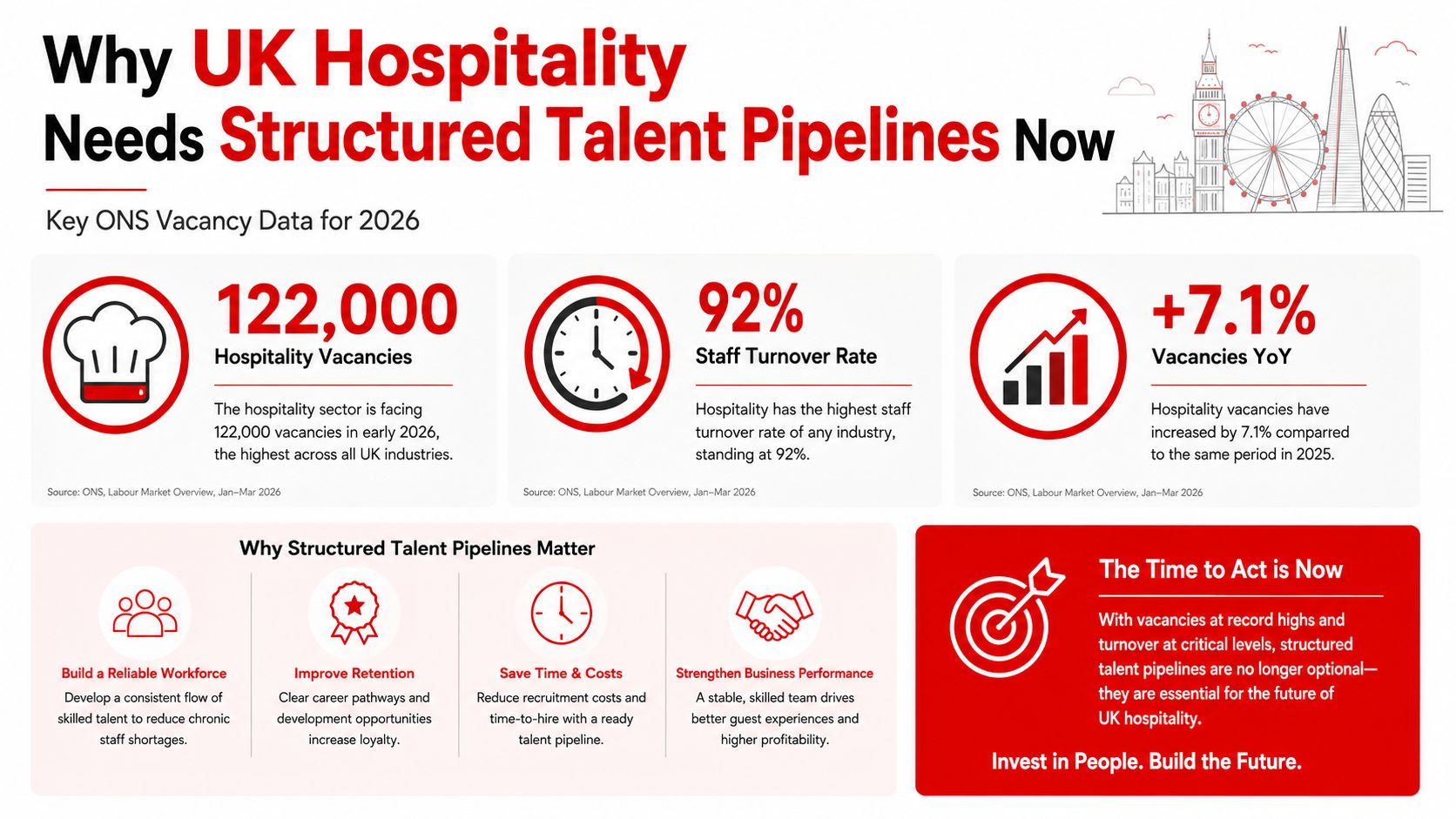
Hospitality teams in the UK don't need another theory about recruitment. They need a system that works when the breakfast shift is short, the dinner service is full, and the agency line isn't answering. The scale of the pressure is clear from the Office for National Statistics, which reported 107,000 vacancies in accommodation and food service activities in the three months to April 2024, one of the highest vacancy levels of any sector, while total UK vacancies stood at 898,000 in the same quarter. Accommodation and food service therefore accounted for roughly 11.9% of all vacancies, which is why reactive hiring keeps failing kitchens that need stability, not just applications. ONS vacancy data and hospitality labour pressure
Why last-minute hiring keeps breaking down
A kitchen vacancy isn't the same as an office vacancy. One missing chef changes prep, timing, plate quality, morale, and often the manager's whole day. In hospitality, the problem compounds because demand is lumpy, with weekends, events, holiday periods, weddings, and seasonal spikes all hitting at once.
That's why a structured pipeline matters. It keeps relationships warm before the role is urgent, so you're not starting from zero each time someone resigns or disappears. For venues in Devon and Dorset, the summer rush can expose weak staffing systems quickly, while city operators in Bristol, Reading, and Windsor often feel the pressure through event-driven peaks and short-notice sickness.
Practical rule: if you only recruit when the rota is already broken, you're not managing a pipeline. You're managing a crisis.
There's also a policy backdrop here. The UK government introduced the Apprenticeship Levy in April 2017, requiring employers with annual pay bills above £3 million to contribute 0.5% of that bill into apprenticeship funding. Apprenticeship participation in England reached 752,700 in the 2023/24 academic year, which shows how planned feeder routes remain part of the national skills picture. Apprenticeship Levy and participation data
For hospitality, the lesson is simple. If the market is tight, you don't wait for availability to appear, you build it. That means earlier contact with potential hires, stronger links with training routes, and a pipeline that's ready before peak trading lands on the diary.
Forecasting Your Kitchen Staffing Demand Accurately
A pipeline built for the wrong roles is just an expensive contact list. Before sourcing starts, the operation needs a clear view of what the kitchen needs by season, station, shift pattern, and location. The U.S. Chamber Foundation frames demand forecasting as part of an employer-led pipeline process, beginning with planning and forecasting demand before sourcing talent, which fits hospitality well because service demand changes by day, week, and trading period. TPM demand forecasting model
Start with the demand pattern, not the vacancy
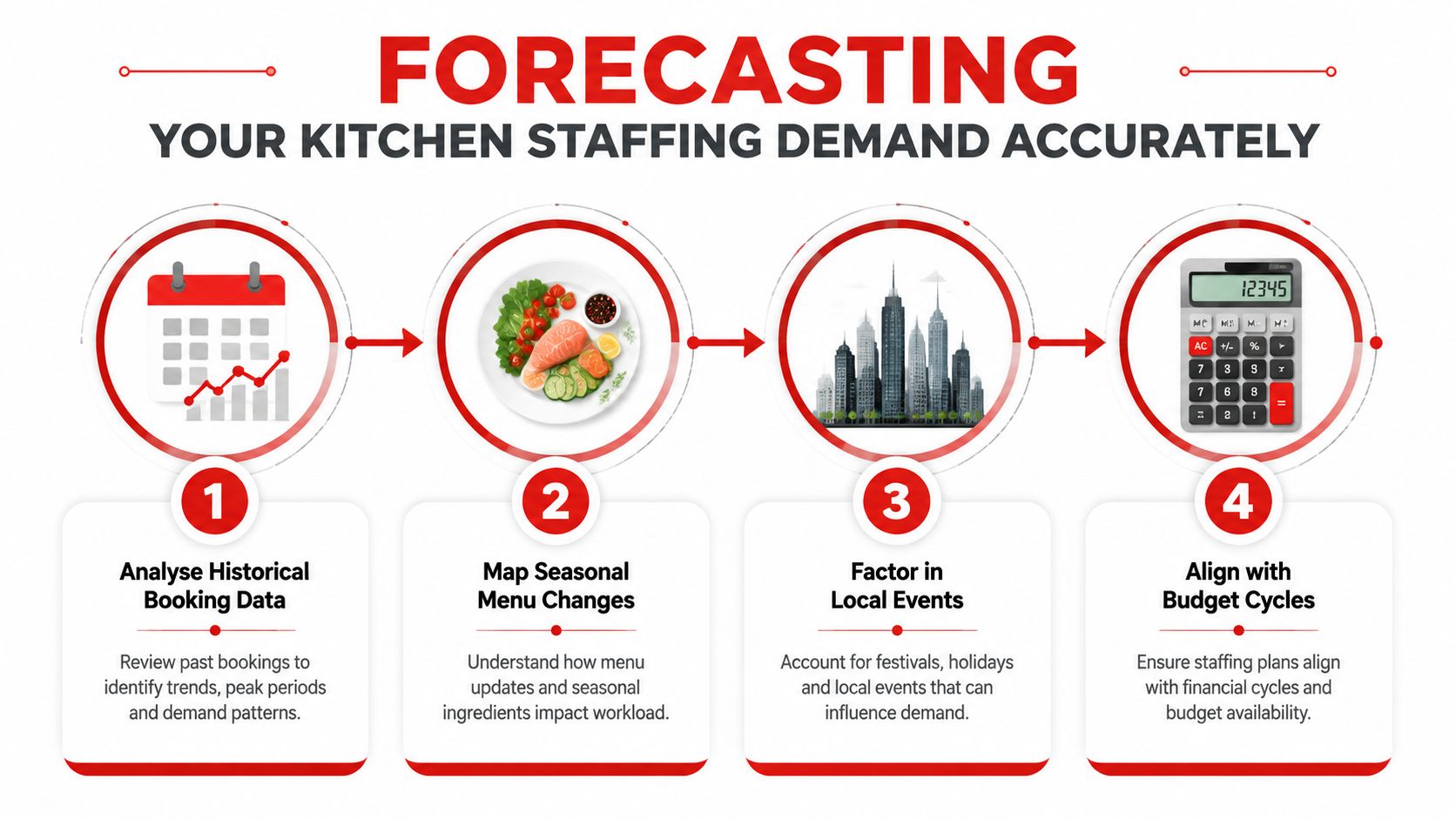
The first question is not, “Who do we need to hire?” It's, “When does the kitchen need extra hands?” Look at booking patterns, covers by day, menu changes, private events, banqueting, and local seasonality. A boutique hotel in Berkshire might need extra pastry and banqueting support around weddings, while a coastal venue in Devon can feel the pressure when holiday traffic spikes.
Use historical trading data alongside current diary bookings. Then separate baseline staffing from surge staffing, because a kitchen that runs fine on Tuesday lunch may collapse on Saturday night without the right cover. Many operators get caught out, they forecast vacancies, not workload.
The seasonal demand forecasting approach is useful here, because it helps map when your kitchen needs extra capacity and when it doesn't. Seasonal demand forecasting for hospitality kitchens
Build the model around roles and risk
Not every station fails in the same way. A missing breakfast chef, a sous chef, and a CDP each create different pressure points, so the demand model needs role families, not one generic headcount. Include sickness cover, holiday overlap, training absences, and the fact that some shifts are harder to fill than others.
A useful split is:
- Baseline cover, the minimum staffing needed to trade safely.
- Surge cover, the extra capacity needed for events, weekends, or seasonal peaks.
- Contingency cover, the people you can call when sickness or a walkout hits.
A good demand forecast also keeps budget conversations honest. If the business wants higher covers, longer opening hours, or more events, the kitchen needs either more staff or more flexibility. That's not a recruitment problem, it's an operations decision.
The point is to stop guessing. When the forecast is clear, you can build the pipeline for the roles that matter most, and you can do it before the next rush takes hold.
Building Your Chef Sourcing Channels Across the UK
If you only post jobs and wait, you will keep getting the same slow, patchy result. Kitchen sourcing needs several channels working at once, because the right chefs are not all looking in the same places and they are not all available at the same time. The U.S. Chamber Foundation describes TPM as employer-led, with clear competency requirements and partner alignment, which fits hospitality where quality and speed both matter. Employer-led TPM model

Use the channels that consistently produce suitable chefs
Apprenticeships still matter because they create a feeder route into the trade. Colleges, culinary schools, and employer-supported training partnerships do too, especially when you need junior talent that can grow into reliable kitchen roles over time. In a tight labour market, those routes help you stop relying only on people who happen to be looking this week.
Returning chefs, career changers, and geographically flexible candidates also deserve a place in the mix. A chef based in Wales might be open to work in Reading for the right rota and pay structure. A candidate in Windsor may be suitable for hotel banqueting but not for a split-shift pub kitchen, so the fit has to be precise.
Specialist agencies have a place as well. For a specialist overview of chef recruitment routes, see chef recruitment for UK hospitality. Relief Chefs UK, a nationwide chef recruitment agency established in 2013, is one practical option when a venue needs vetted relief or permanent chef support alongside its own sourcing channels.
Build relationships before you need them
The strongest sourcing channels are not just places to find CVs. They are places to build familiarity. That means staying in touch with college contacts, keeping former chefs in your orbit, and making sure the business has a clear, credible offer for people who care about kitchen culture as much as pay.
A sourcing channel is only useful if it keeps producing people you would confidently put on the pass.
The difference shows up in tough moments. When a chef resigns on a Sunday, a venue with real sourcing channels has options. A venue that depends on job boards has a problem.
Vetting and Engaging Pipeline Candidates Effectively
A pipeline only helps if the people in it are usable when the rota gets tight. That means proper vetting, clear records, and communication that keeps chefs interested without wasting their time. The Pepper Effect guidance on pipeline management is useful here, because it recommends tracking depth, conversion, time-to-shortlist, repeat placement, candidate NPS, ROI, and relationship tenure, while warning that weak stage hygiene and poor cadence ruin pipeline quality. Pipeline health and engagement guidance
Vet first, then nurture
Right-to-work checks, references, and skills verification should happen early, not the night before cover is needed. Trial shifts are useful in hospitality because they show pace, communication, cleanliness, and the way a chef handles pressure in a live kitchen.
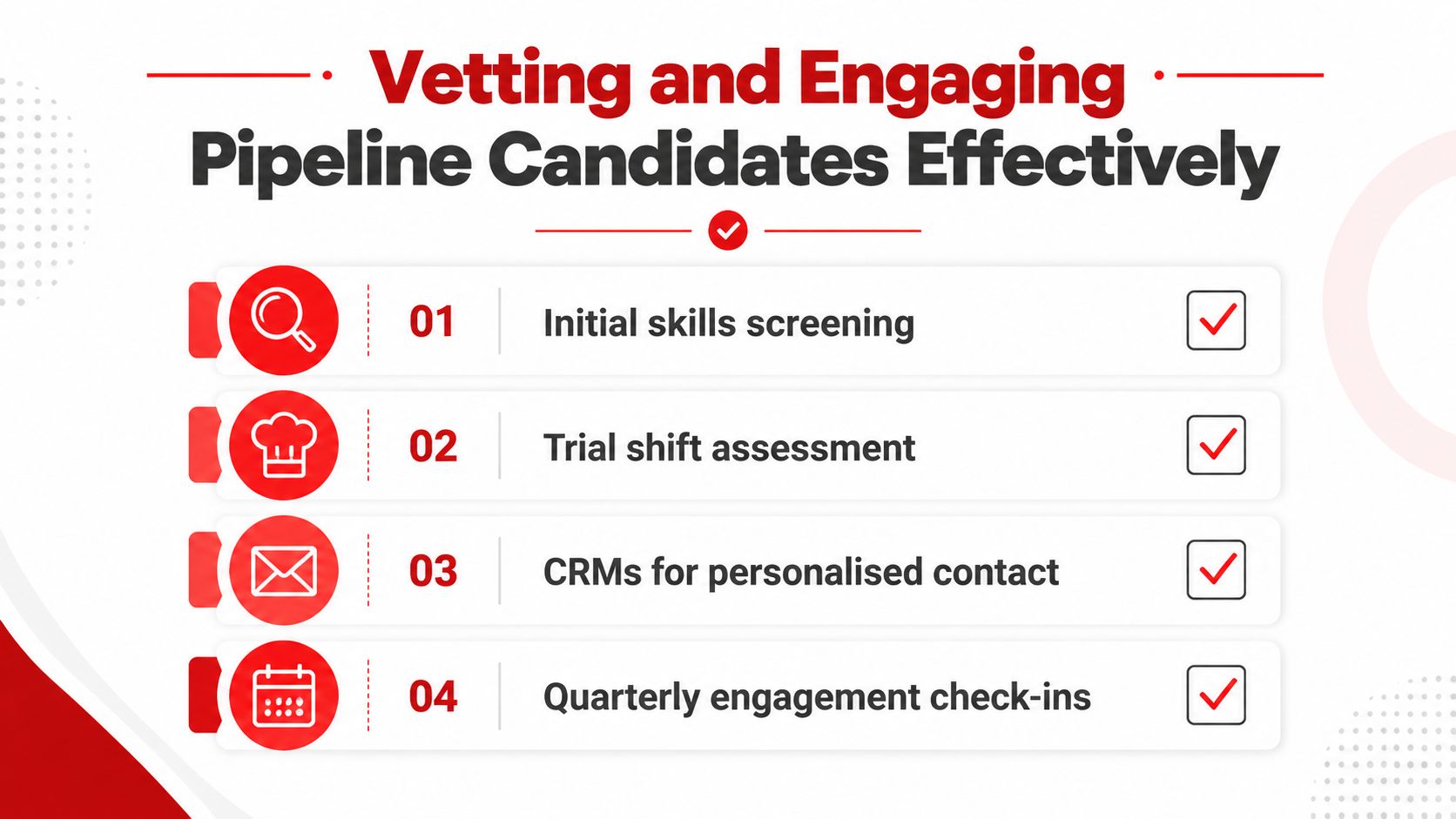
A practical sequence looks like this:
- Initial skills screening, to check core station competence and availability.
- Trial shift assessment, to see how they work with your team and your standards.
- Reference and compliance checks, so there are no surprises later.
- Ongoing segmenting, so the right chefs are tagged for short notice, seasonal, or permanent roles.
The employment verification process should be part of that screening, not an afterthought. Employment verification for hospitality candidates
Keep contact useful, not noisy
Good engagement feels relevant. A chef doesn't need weekly fluff. They need to know whether you still remember their preferences, whether you've got anything worth their attention, and whether your operation is still organised.
Segment candidates by role, seniority, geography, and availability. A relief chef who wants four days a week in Dorset needs different handling from a sous chef open to permanent work in Bristol. Quarterly check-ins work well for many operators, but high-demand venues often need shorter gaps between touches, especially before peak periods.
Practical rule: every contact should either add value, confirm availability, or improve trust. If it does none of those things, don't send it.
CRMs become useful, even in small businesses. You're not building a marketing list, you're keeping a live bench of people who know your standards and have already been screened. When service pressure hits, that difference matters.
Measuring Pipeline Health with the Right Metrics
A lot of kitchens think they have a pipeline because they have names in a spreadsheet. That's not enough. A usable pipeline shows up in the numbers, especially in conversion, speed, and relationship quality. One talent pipeline guide recommends reviewing health monthly or quarterly and tracking how many candidates are in each stage, conversion rates, relationship age, and how many pipeline candidates were hired in the past 90 days. Monthly and quarterly pipeline review guidance
The metrics that actually matter
The point isn't to track everything. It's to track the figures that tell you whether your pipeline can fill a shift before the kitchen feels the pain.
| Key Talent Pipeline Metrics for Hospitality | What It Measures | Review Frequency | Target Benchmark |
|---|---|---|---|
| Pipeline depth | How many viable candidates sit in each role family | Monthly or quarterly | Enough to cover recurring vacancies and peak periods |
| Engagement rate | Whether warm candidates still respond and stay interested | Monthly | Consistent contact without long drop-off periods |
| Conversion to hire | How many pipeline candidates become actual hires | Quarterly | Rising over time, not flat or falling |
| Time-to-shortlist | How fast you can produce credible options | Per vacancy | Faster than cold sourcing |
| Repeat-placement rate | Whether the same candidates work with you again | Quarterly | Steady repeat use from trusted chefs |
| Relationship age | How long candidates stay warm before use | Monthly | Fresh enough to remain current |
| Time-to-fill with pipeline | How quickly pipeline roles are staffed | Per vacancy | Shorter than roles without a pipeline |
The smart comparison is not between one venue and another. It's between roles with a pipeline and roles without one. That shows whether your sourcing and nurturing work is saving time.
Simple tracking beats fancy software
You don't need a huge HR system to do this well. A spreadsheet, a basic CRM, or a shared tracker can show stage movement, candidate availability, and response patterns. What matters is discipline.
Watch for bottlenecks. If candidates keep stalling after first contact, your outreach is weak. If they reach shortlist but never convert, the issue may be pay, timings, or how the role is framed. If you only hear from chefs when there's an immediate vacancy, then the pipeline is too cold to rely on.
The best metric in hospitality is the one that helps you keep the kitchen running without drama. If the numbers don't show that, the process needs work.
Why Job Quality Determines Pipeline Success
Some chefs never enter a pipeline because the job doesn't look worth the hassle. Others leave after hire because the rota, pay, progression, or working conditions don't justify the stress. That's the part most sourcing guides skip. MIT Sloan Review describes the “great training paradox”, where workers with more formal education get more employer investment, while less formally educated workers are often underserved and undervalued, which creates a real blind spot for hospitality employers. The overlooked partners that can build your talent pipeline
Retention starts before the job offer
If your kitchen is known for chaotic scheduling, weak handovers, and no progression, your pipeline will eventually reflect that. Strong candidates talk to each other, and word gets around quickly in hospitality. That means job quality is not a separate issue from recruitment, it shapes the size and quality of the bench you can build.
Pay matters, but it's not the only factor. So do rotas, split shifts, fairness, management tone, kitchen culture, and whether good people can see a path forward. A chef who feels respected is more likely to stay, recommend others, and return for future work.
Audit the parts people feel first
Look at the lived experience of the job, not just the advert. Short notice sickness, weekend pressure, and seasonal volume are normal in hospitality, but constant disorganisation isn't.
- Scheduling: Are shifts predictable enough that people can plan their lives?
- Progression: Can a commis see a route to CDP or sous chef?
- Working conditions: Is the kitchen set up to support quality, or only to survive the shift?
- Management behaviour: Do people get clear feedback, or just pressure?
If the job burns people out, the pipeline gets smaller every month.
The most sustainable pipelines are built in kitchens where decent people stay. That's why the recruitment conversation and the operations conversation have to be the same conversation.
Integrating Relief Chef Services into Your Pipeline Strategy
Temporary cover should not be treated as a separate world from talent pipeline management. It's part of the same system. Relief chefs give you breathing room during sickness, holidays, peak trading, and unexpected gaps, while also letting you test fit before a permanent move. Relief Chefs UK provides that support with options that scale from small venues to multi-site groups, quoted based on the role, location and dates, alongside 24/7 support, subject to availability.
Use relief chefs as a strategic bridge
When a chef is out, the immediate goal is stability. But the longer-term goal is to protect the kitchen while keeping the pipeline warm. That's where relief and permanent recruitment work together, not separately.
A good workflow is simple. Use relief chefs to hold service steady, use permanent chef recruitment for longer-term gaps, and keep your own candidate bench active so you're never forced into a bad hire. For operators in Slough, Dorset, Windsor, and elsewhere across the UK, that mix can reduce the pressure on managers who are already stretched.
The practical value is clear. You're not waiting for a crisis to create a hiring conversation, and you're not forcing every vacancy into one recruitment channel. You're matching the right type of chef to the right problem.
Make the first call before the rota breaks
If your operation needs reliable cover, the next step is to treat staffing like the operational risk it is. Pull together your main pinch points, the roles hardest to fill, the locations most exposed, and the dates where cover keeps failing.
Then speak to a specialist who understands kitchens, not just CVs. Relief Chefs UK can be part of a wider staffing plan that includes relief chefs, temporary chefs, permanent placements, yacht chefs, villa chefs, and hospitality staffing support, all aligned to the demands of UK service.
If your kitchen needs dependable chef cover, a stronger hiring bench, or a more stable way to handle seasonal pressure, speak to Relief Chefs UK today. Visit Relief Chefs UK to arrange support for relief chefs, temporary chefs, permanent chef recruitment, yacht chefs, villa chefs, and hospitality staffing that keeps service moving when the rota doesn't.
Call the team.
Office 01392 715474 · info@reliefchefs.co.uk