
Response Time Measurement for Hospitality Staffing
26 August 2026
At 17:40 on a Saturday, a gastro-pub head chef sends a message: the line cook is sick, the dining room opens at 19:00, and the kitchen is already carrying a full booking. The manager rings for cover, receives a quick acknowledgement, then waits. An agency phones back, another promises to check its rota, and a candidate finally confirms at 19:05. The doors are open, the pass is under pressure, and the useful response time was not the time someone answered the phone. It was the time a suitable chef could take responsibility in the kitchen.
That distinction matters in Devon pubs, Bristol restaurants, Welsh hotels, Berkshire wedding venues, Windsor private houses, Reading dining rooms, Slough contract catering sites, Dorset resorts, yachts and boutique hotels across the UK. Response time measurement turns an urgent staffing problem into something you can manage, compare and improve. It shows whether a staffing partner replies quickly or consistently gets the right person through the door before service suffers.
When a Chef Calls in Sick and the Clock Starts
The manager starts calling at 17:40. The first agency answers at once and says it will check availability. That acknowledgement feels reassuring, but it doesn't solve the gap. The kitchen still needs a line cook who can work the menu, arrive promptly, understand the standards and stay effective through service.
By 18:00, the on-call rota has produced no firm answer. A second provider sends a message saying a chef is being contacted. At 18:25, a candidate is interested but needs confirmation of the finish time and rate. At 18:50, the manager is still rearranging sections, asking the sous chef to cover prep and considering whether to reduce the menu.
At 19:05, a chef confirms. The restaurant is already open. The agency's first reply may have arrived within minutes, but the operational response took much longer. If the venue records only the first phone call, its supplier appears responsive. If it records chef confirmed and chef on site, the actual risk becomes visible.
The clock should measure the outcome that protects service, not the moment a supplier says, “We're looking into it.”
A proper staffing process separates acknowledgement from fulfilment. The first timestamp proves that the request entered the system. The later timestamp proves whether the supplier found a person who accepted the shift. The final timestamp shows whether that person arrived and could work.
For urgent requests, a venue needs a clear route rather than a list of disconnected numbers. A 24/7 recruitment solution from Relief Chefs UK can give managers a defined contact path when sickness occurs outside normal office planning. The same principle applies whether the venue is a gastro-pub in Bristol, a hotel in Wales or a yacht preparing for guests. Fast acknowledgement is useful, but dependable cover is the result that counts.
What Response Time Measurement Really Means in Hospitality
In plain English, response time measurement is the elapsed time between a defined trigger and a defined outcome. For chef staffing, the trigger is usually the venue's request for cover. The outcome might be an agency acknowledgement, a confirmed chef, or a qualified chef physically stepping onto the site.
Those outcomes aren't interchangeable. A provider can acknowledge a request promptly without having a suitable chef. It can send a shortlist without securing acceptance. It can confirm a chef who later cancels. Your measurement method must say exactly which event stops the clock.
Separate the SLA from the actual result
A service-level agreement, or SLA, sets the expected target and explains how performance will be measured. The actual response time is what your booking record shows after the shift request has been handled. A contract might require acknowledgement within a defined period and confirmation within another. Your log should then show whether both commitments were met.
For a 60-cover restaurant, the difference can affect the whole evening. A two-hour delay may force the head chef to remove dishes, move a commis onto a section or ask the general manager to manage guest expectations. In a boutique hotel, the same delay can disrupt breakfast preparation, a wedding menu or room service.
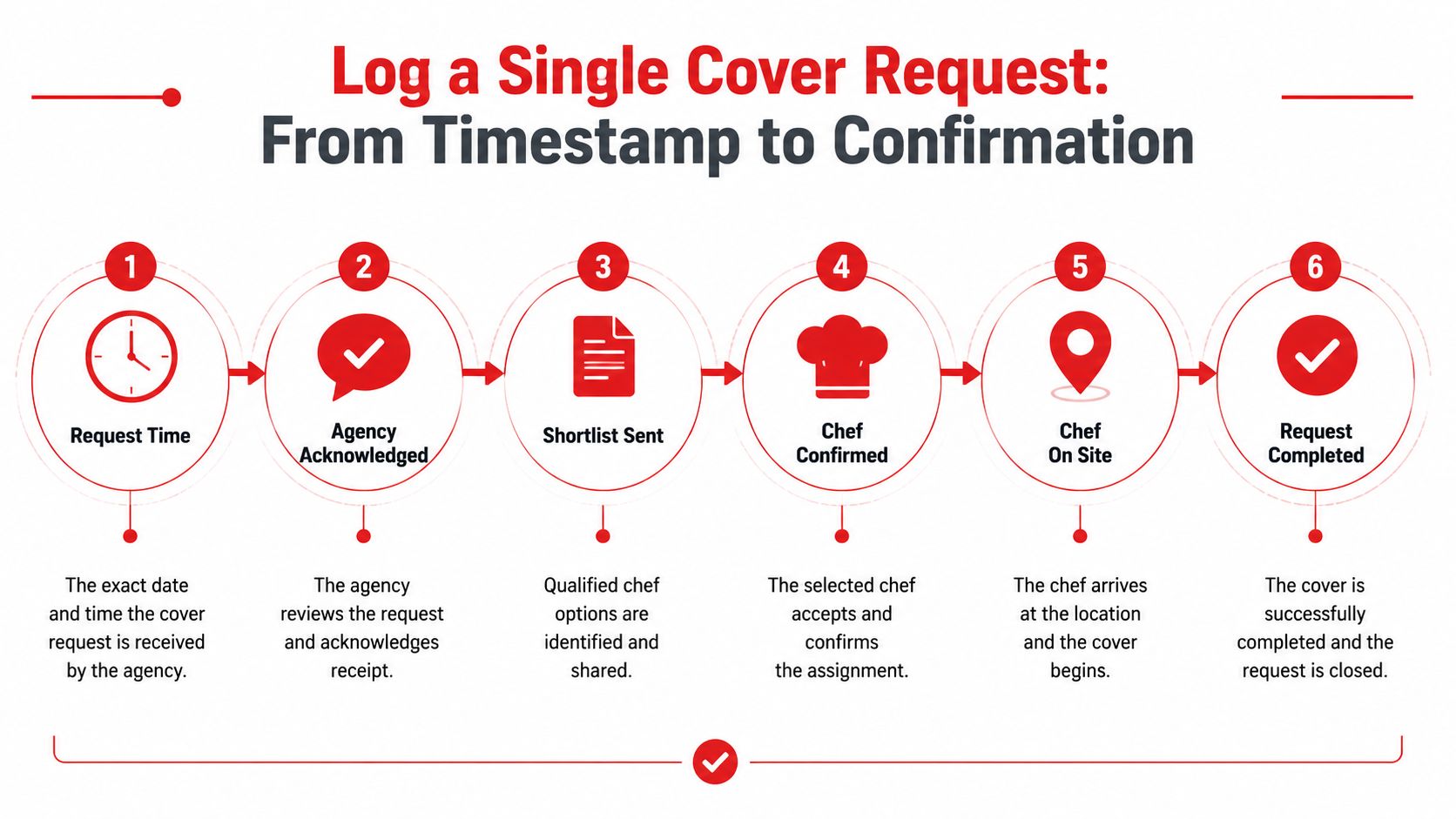
Use separate fields for each stage:
- Request received: The venue sends the staffing requirement.
- Agency acknowledged: A named person confirms ownership of the request.
- Shortlist sent: Suitable candidates are presented.
- Chef confirmed: The individual accepts the shift and key terms.
- Chef on site: The chef arrives and is ready to work.
A vague promise such as “we'll respond quickly” can't be audited. A measured process can. It also gives both sides a fair basis for discussing whether a miss resulted from late notice, unusual skills, distance, unclear instructions or supplier failure.
The Home Office's long-running fire response dataset demonstrates why definitions and recording systems matter. England has published fire response-time statistics covering financial years from 1994/95 onward, while the release explains that newer mobilisation software and the Incident Recording System improved measurement accuracy. Before May 2004, the London Fire Brigade recorded only full minutes, so individual incidents could have been under-recorded by up to 59 seconds. That Home Office explanation of fire response-time measurement is a useful reminder for hospitality managers: small differences in event definitions can change the apparent result.
The Key Metrics That Reveal True Response Performance
A useful dashboard doesn't need dozens of fields. It needs the right fields recorded consistently. The first question is always, “When did the clock start?” The second is, “What outcome are we measuring?”
For a staffing request, record the request time, acknowledgement time, shortlist time, confirmation time and arrival time. Then add the shift date, venue, role, location, notice period and outcome. A short-notice CDP request in Slough shouldn't be blended with a planned pastry chef requirement for a rural hotel in Dorset.
Mean performance is only the middle of the story
The mean response time shows what a typical request looks like across a selected period. It helps with routine planning, supplier comparison and monthly trend reviews. It can still hide the Saturday evening that causes the commercial damage.
The 90th percentile shows the slower edge of performance. In practical terms, most requests are completed within that time, but the difficult tail takes longer. That makes it more useful for planning peak periods, rural assignments, specialist roles and short-notice sickness.
Official ambulance standards illustrate why mean and percentile measures should sit together. England's framework measures the interval from receipt of a 999 call to vehicle arrival, with Category 1 using a 7-minute mean and 15-minute 90th-centile target, Category 2 using an 18-minute mean and 40-minute 90th-centile target, Category 3 requiring 90% within 120 minutes, and Category 4 requiring 90% within 180 minutes. The Government Statistical Service summary of UK ambulance response data explains the importance of category-specific measures rather than one blended figure.
| Metric | What it Measures | When to Use It |
|---|---|---|
| Clock-start time | The moment the cover request is received | Every request, especially short-notice cover |
| Clock-stop time | The agreed outcome, such as confirmation or arrival | To test the relevant SLA |
| Mean response | Typical elapsed time | Routine monthly performance |
| 90th percentile | Slower-tail performance | Busy Saturdays, specialist roles and peak seasons |
| Fill rate | Requests that result in an accepted placement | Reliability and supplier comparison |
| No-show rate | Confirmed shifts where the chef doesn't attend | Operational risk and escalation |
| Short notice versus planned | Speed by notice period | Staffing forecasts and rota design |
A provider quoting a five-minute acknowledgement average tells you little if its 90th percentile is three hours and one in four shifts goes unfilled. Response time measurement without fill rate measures conversation, not cover.
How to Track and Log Response Times in Your Venue
Start with the booking system timestamp. If a request arrives by email, phone or form, nominate one person to enter it immediately into a shared tracker. The first record should reflect when the venue made the request, not when someone remembered to update the spreadsheet.
For a single venue, a spreadsheet is usually sufficient. Create one row per cover request and include:
- Request details: Date, time, venue, role, shift, required skills and location.
- Contact trail: Agency acknowledgement, named owner and escalation contact.
- Fulfilment stages: Shortlist sent, chef confirmed and chef on site.
- Outcome: SLA hit or missed, filled or unfilled, attended or no-show.
- Reason code: Late request, unavailable skill, travel issue, candidate cancellation or supplier delay.
The log needs a weekly hygiene check. Compare the recorded timestamps with the email thread, booking form and call notes. Check blank entries first, because guessed times and missing arrival records will make performance look cleaner than it was.
Operators running several sites should export data from their applicant tracking system or booking platform where possible. An exported record is harder to alter after the event and makes comparisons between Devon, Bristol, Wales and the South East more credible.
Keep the log for at least 12 months so you can identify seasonal patterns and support supplier discussions. Don't judge a provider from a single difficult request. Review repeated misses by role, venue, day, location and notice period. A failed yacht chef placement has a different cause from a Sunday lunch sickness call, and the corrective action won't be the same.
Realistic Benchmarks for UK Chef Cover and Hospitality Staffing
Emergency services and hospitality staffing operate on different supply conditions. NHS and fire response systems use structured dispatch networks, defined categories and dedicated operational capacity. A chef agency must locate a qualified person who is available, willing to travel, suitable for the menu and legally able to work at the venue.
The NHS framework also shows why a target needs a precise definition. Under the older NHS 2010/11 ambulance framework, 75% of Category A calls were expected within 8 minutes, while transport for Category A patients had a 95% target of 19 minutes. Later reporting recorded average Category 1 response improving from 7 minutes 44 seconds in May 2018 to 6 minutes 54 seconds in May 2019, before reaching 9 minutes 13 seconds in December 2021, with a 90th percentile of 16 minutes 12 seconds. These figures are reported in the Nuffield Trust ambulance response-time summary, and they show that performance can move materially when demand and capacity change.
For hospitality, the useful comparison is not to copy an emergency-service number. It is to set a service promise that reflects real chef availability.
| Service or Cover Type | Target or Promise | Typical Actual |
|---|---|---|
| Emergency call connection | A tightly defined connection target | Dedicated emergency infrastructure |
| Ambulance Category 1 | 7-minute mean and 15-minute 90th-centile target | Performance varies with demand and capacity |
| Two-hour urgent community response | Clock stop at 120 minutes or less | Binary compliance against a fixed window |
| Short-notice urban chef cover | Confirmation within an agreed operational band | Depends on role, time, location and availability |
| Next-day chef cover | Confirmation planned around the following shift | Usually easier to resource than short-notice requests |
| Rural or specialist cover | A wider planning window | Pastry, yacht and specialist chefs may require longer sourcing |
NHS technical guidance defines the two-hour urgent community response as 120 minutes or less between clock start and clock stop. Its strict clock-based structure is relevant to staffing contracts because it makes timestamp accuracy and event definitions more important than a flattering average. The NHS technical guidance for the two-hour urgent community response standard provides that useful comparison.
For venue managers, the practical benchmark is an agreed confirmation window that distinguishes urban short-notice requests from rural or specialist assignments. Relief Chefs UK's industry best-practice guidance can sit alongside your own records when you set those expectations. A promise that ignores geography and skill level isn't a benchmark. It's a sales line.
Why the Fastest Promised Response Is Rarely the Best One
A two-minute response promise sounds attractive during a supplier search. It may mean that someone will acknowledge your call, not that a qualified chef will accept the shift, travel to the venue and work safely through service.
The underlying supply matters. A chef already working in Bristol can't instantly appear at a hotel in Dorset. A pastry sous chef, yacht chef or senior event chef may be excellent for the assignment but unavailable at short notice. An agency that claims universal instant confirmation may be padding the clock with a first reply or relying on a database that hasn't been checked recently.
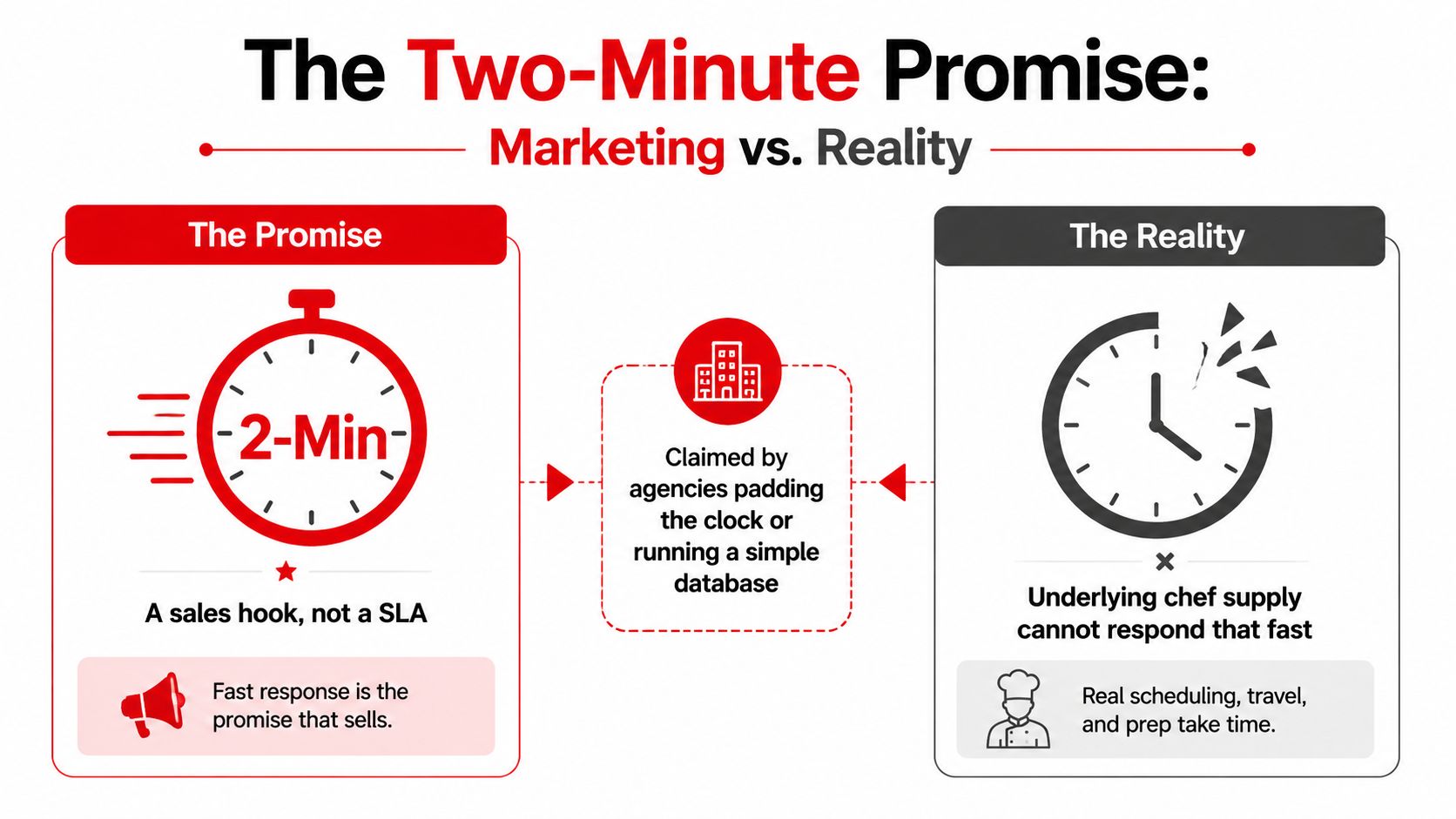
A slower, reliable confirmation is more valuable than a spectacular headline that collapses under pressure. A four-hour confirmation that arrives consistently can protect more services than a two-minute acknowledgement followed by ninety minutes of silence on a wet Saturday in Bristol.
Ask what happens after a miss
Supplier selection should focus on the shape of performance:
- Consistency: Does the provider meet the agreed window across ordinary and difficult requests?
- Tail risk: How long do the slowest requests take?
- Recovery: Who takes ownership when the first chef cancels?
- Transparency: Can the venue see the timestamps and reason code?
- Replacement: Is there a defined route for a no-show or unsuitable placement?
Set the contract against a difficult operating period, not the supplier's best week. Review the worst cluster of misses and ask whether the agency escalated promptly, offered alternatives and explained the constraint. The right question isn't “How quickly can you reply?” It's “How reliably can you protect service when supply tightens?”
Reporting Rhythm That Keeps Your Staffing Partner Honest
A venue doesn't need a procurement department to run disciplined supplier management. It needs one shared tracker, a named owner and a review rhythm that doesn't disappear when service gets busy.
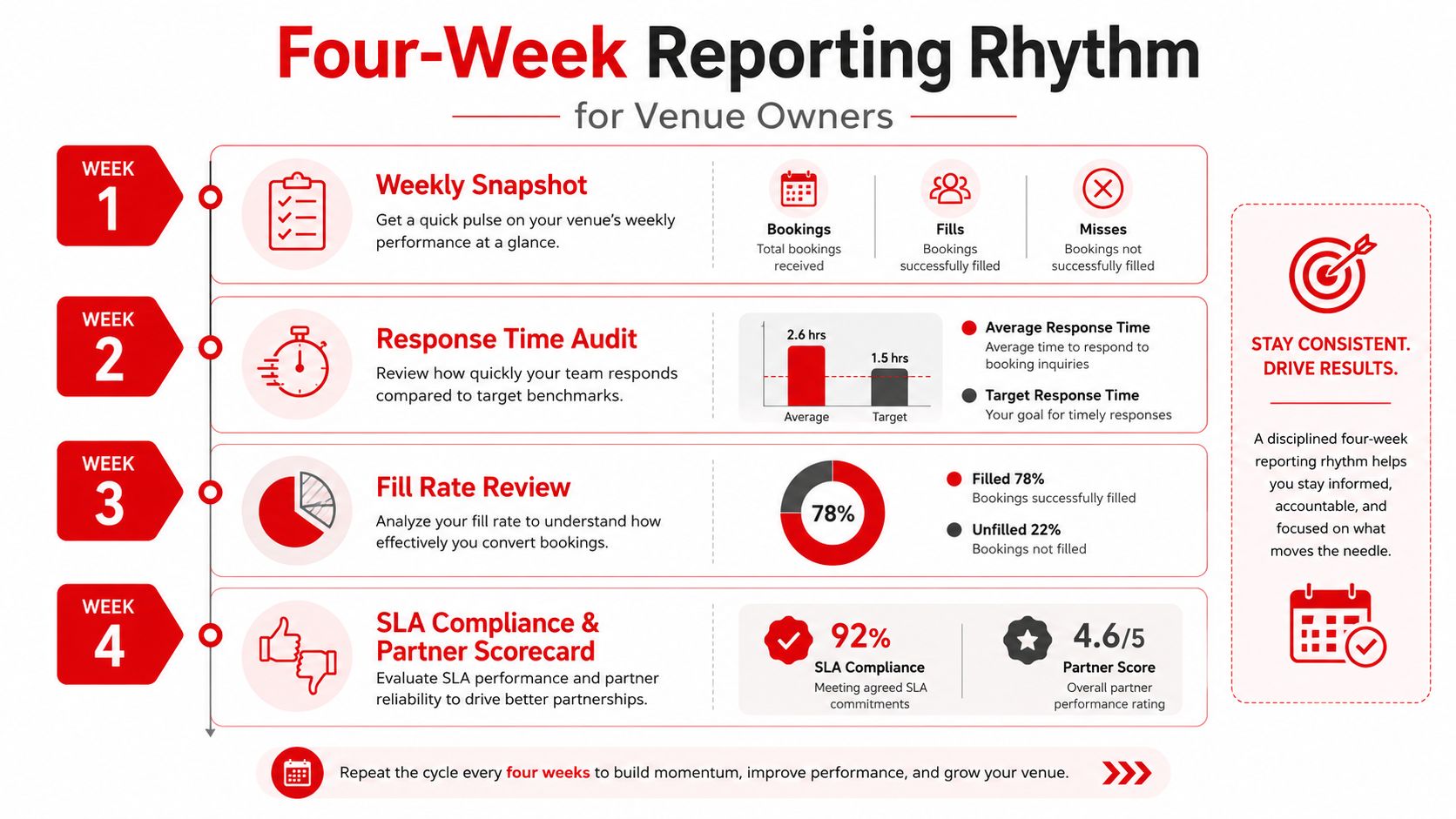
Use a four-week cycle:
Week one captures the operating picture
Create a one-page snapshot of bookings, filled requests, unfilled requests, cancellations and no-shows. Include the venue and shift type so a hotel group can distinguish breakfast cover from banqueting, and a pub group can separate planned weekend support from sickness calls.
Week two examines the difficult cases
Review the slowest responses and every request that missed its agreed window. Look at the email thread and call notes, then record whether the cause was notice, role scarcity, distance, unclear information or supplier handling. Don't use the meeting to argue over one timestamp. Use it to identify a repeat pattern.
Week three checks reliability
Compare accepted shifts with requests. A provider can appear responsive while leaving managers to solve the final placement themselves. Review replacement handling separately, because a confirmed chef who cancels creates a new operational problem.
Week four signs off performance
The month-end scorecard should show response performance against the SLA, fill rate, no-shows, unresolved issues and the owner responsible for each action. A quarterly business review can then examine average response, tail performance, cost per cover hour and repeated misses without relying on memory.
Keep the meeting to 15 minutes. The agenda is simple: what was requested, what was filled, what missed, why it missed and who owns the fix. Both sides should edit the shared tracker, while a manager signs off the monthly result.
A written service-level agreement for staffing response should define the clock, escalation route and reporting method before a dispute occurs. The cadence matters more than chasing a better headline number next month. It gives you evidence for a contract change before kitchen instability becomes normal.
Pin this checklist beside the duty rota:
- Log every request: Include the exact request time.
- Record each stage: Don't stop at acknowledgement.
- Code every miss: Use a specific operational reason.
- Review the tail: Discuss the slowest cases.
- Assign an owner: Give every action a name and date.
Practical Questions on Response Time Measurement Answered
What should a chef cover contract include?
Write the clock-start definition in plain language. State whether it begins when the venue emails, submits a form or speaks to an on-call person. Define the clock-stop event separately for acknowledgement, chef confirmation and arrival.
Name the escalation contacts and their working hours. Include the process for a cancellation, no-show or unsuitable chef. Reporting language should require a record of requests, outcomes, misses and reason codes, rather than a general statement that the supplier responded promptly.
What should happen after repeat misses?
Start with an evidence-based review, not an angry call during service. Check the request details, timestamps, role, notice period and communication trail. If the same failure repeats, issue a formal supplier warning and agree a recovery plan with a named owner.
Escalate to director level when the agreed recovery plan fails or when the venue faces recurring operational harm. Give the provider a defined opportunity to recover, but don't allow an open-ended trial while your head chef carries the risk.
When should a venue change provider?
Consider a change when the supplier repeatedly misses the agreed service window, hides the underlying timestamps, fails to provide credible explanations or allows fill reliability to deteriorate below the agreed threshold. One difficult rural assignment doesn't necessarily justify a switch. A pattern across comparable requests does.
How long should dispute records be retained?
Keep the request, communications, confirmation, attendance and invoice records in line with your internal document policy and the checks your business must support, including HMRC and right-to-work processes. The important point is that the staffing log should match the documents used to approve payment and verify the chef.
Should you keep a secondary agency?
A secondary provider can reduce dependence on one source, particularly for seasonal demand, weddings, yachts or sites outside major towns. Set clear rules for when the backup is contacted, who approves the extra cost and how duplicate bookings are prevented. A backup arrangement should be controlled, not an untracked scramble between agencies.
Relief Chefs UK is a nationwide chef recruitment agency established in 2013, offering relief chefs, temporary chefs, permanent chef recruitment, yacht chefs, villa chefs and wider hospitality staffing support for pubs, restaurants, private households and hotels. Its model gives venues a defined route for staffing requests, which makes it suitable for managers who want response-time records connected to practical cover rather than an isolated phone-answering statistic.
If short-notice sickness, seasonal demand or unreliable agency cover is putting kitchen stability at risk, contact Relief Chefs UK to discuss vetted relief chefs, temporary staffing, permanent recruitment or specialist yacht and villa chef requirements. Set a clear response clock, agree the outcome you need and build a dependable staffing plan for your venue.
Call the team.
Office 01392 715474 · info@reliefchefs.co.uk