
A head chef leaves midway through a charter. The replacement is available, but their flight lands after the yacht's planned departure, their ENG1 certificate has expired, or nobody has checked whether they're permitted to work in UK waters. Meanwhile, guests are arriving, provisions are already on board, and the captain is trying to protect service standards with a reduced galley team.
That's the reality behind an urgent search for yacht crew needed at short notice. Yacht staffing isn't only a hospitality recruitment exercise. The right person must be capable in a confined, high-pressure environment, hold the qualifications the role demands, and have the correct permission to join and work legally. A fast hire that fails any of those tests can create a larger operational problem than the original vacancy.
The Reality of Last-Minute Yacht Crew Shortages
The first call usually comes from a captain, yacht manager, or head of operations who has run out of options. A chef has gone home unexpectedly. A deckhand has missed a connection. A charter has been confirmed, but the crew roster still has a gap.
On land, a restaurant might rearrange shifts, simplify the menu, or ask a nearby venue for support. A yacht has fewer places to hide a staffing failure. The galley, guest areas, crew accommodation, provisioning and service schedule all operate within the same moving workplace. A chef who cannot manage the menu affects the interior team, the captain's timetable and the guest experience at once.
The immediate response should be operational rather than emotional:
- Protect the next service: Identify which meals, dietary requirements and guest commitments cannot be moved.
- Define the role precisely: Decide whether you need a head chef, sous chef, cook, deckhand, steward or another specialist.
- Separate essential duties from desirable extras: A chef who can stabilise the galley is more valuable than a candidate with an impressive but irrelevant list of skills.
- Confirm the deployment point: The marina, vessel location, joining date and planned movements determine whether a candidate can realistically arrive.
- Escalate compliance checks immediately: Availability means little if the person cannot legally join or perform the job.
Operational rule: Never solve a sailing problem by creating a compliance problem on board.
The pressure is structural, not limited to one difficult season. The UK leisure, superyacht and small marine commercial sector was estimated to generate £2.9 billion in revenue in 2021 to 2022 and employ more than 30,000 people, according to industry reporting on the British marine sector. A workforce of that scale needs a reliable flow of trained people across entry-level, senior officer and specialist positions.
The wider seafarer market adds another constraint. The UK government recorded 11,120 certificated officers, 10,510 ratings, 1,540 uncertificated officers and 1,380 officer cadets active at sea in the UK shipping sector in its 2025 seafarer statistics, while noting that many UK nationals working on yachts aren't fully captured in those totals. The Department for Transport's projection expects officer demand to rise by around 24% between 2024 and 2035, reaching just under 55,000, with rating demand reaching around 118,000 and a combined baseline shortfall of just under 9,000 seafarers, as set out in the UK seafarer statistics release.
Those figures don't describe every yacht role, but they explain why experienced technical and senior crew can be difficult to replace quickly. A standard hospitality database may produce a chef who can cook well. It won't necessarily confirm sea time, ENG1 status, STCW training, vessel experience or UK work permission.
The same issue affects coastal hospitality businesses. Independent industry reporting estimates 130,000 unfilled hospitality roles heading into summer 2026, with particular pressure on kitchen staff, experienced front-of-house workers and seasonal labour in coastal counties and the South West, as described in the UK summer hospitality staffing outlook. Devon, Dorset, Wales and the South West therefore face pressure from both land-based hospitality demand and marine operations.
Mapping Mandatory Qualifications and Sea Service
You can't put an unqualified person into a regulated yacht role because the vessel is short-staffed. Start with the duties, not the candidate's job title.
Start with the work the person will perform
An officer carrying out bridge, navigational or engine-room duties needs a Certificate of Competency or Certificate of Equivalent Competency. An engineer officer working on a vessel with power output of 750 kW or more also needs a CoC. The GOV.UK guidance on checking crew qualifications explains the relevant requirements and the need to match the qualification to the actual duties.
That distinction matters during an emergency. A candidate may describe themselves as an experienced deckhand, but that doesn't automatically authorise navigational watchkeeping. A hospitality professional may have worked around boats, but that doesn't replace MCA-recognised certification where the role requires it.
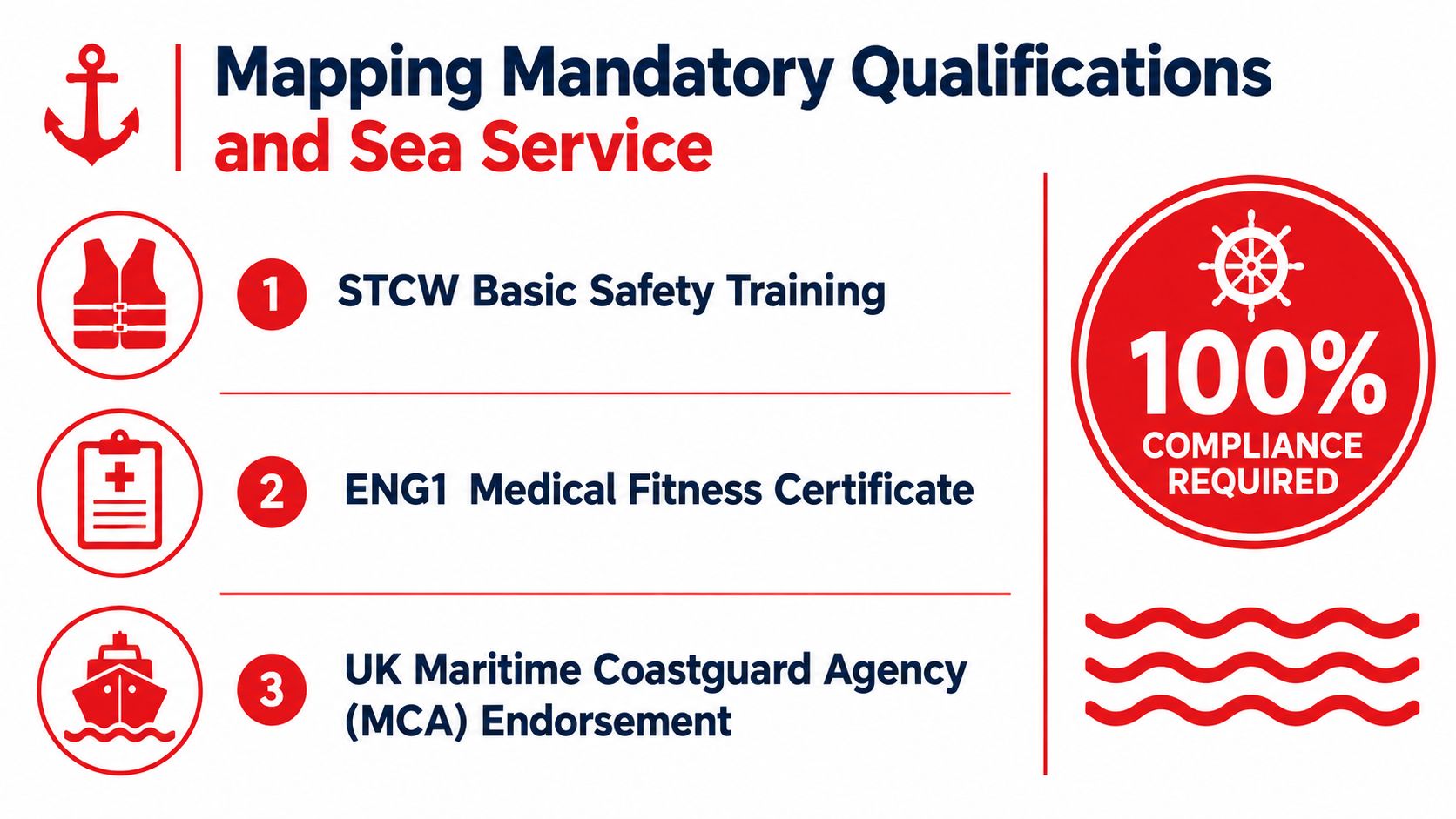
For a chef, the compliance picture is different but still specific. British Marine says STCW Basic Safety Certification is often considered essential for leisure-marine chef roles, and many employers also expect a recognised cookery qualification, such as a Level 3 Diploma in Professional Cookery or equivalent industry training, according to its career and training guidance. Yacht work guidance also identifies STCW Basic Safety Training as mandatory for charter-yacht work and commonly expects food safety and hygiene credentials, ENG1 medical clearance and, where cooking for 10 or more crew, a Ships Cook Assessment, as explained by yacht-work qualification guidance.
Verify the baseline stack in sequence
For many crew working in UK waters, the practical baseline includes an ENG1 medical, the four STCW basic safety modules and, depending on the position, an RYA Day Skipper level or MCA Yacht Rating Certificate. The safest order is:
- Check ENG1 first. Confirm the certificate is valid and suitable for the intended deployment. A medical issue discovered after travel has been arranged wastes time and money.
- Check the four STCW basics. Don't accept a general maritime course description without reviewing the actual modules and certificates.
- Review sea-service evidence. A certificate may depend on documented onboard service, not only a candidate's account of experience.
- Match the endorsement to the job. Deck, engineering, bridge and watch duties require the correct role-specific evidence.
- Check revalidation dates. Deck and engineering officers must revalidate every five years by showing 12 months' sea service in the previous five years, three months in the previous six months, or two and a half years in a relevant job, as set out in the government qualification guidance.
For Yacht Rating Certificate of Proficiency eligibility, the RYA commercial skipper and crew guidance identifies requirements including being at least 16 years old, six months of onboard yacht service, two months of seagoing service on vessels of 15 metres or more load line length, the four STCW basics, a training record book and valid ENG1. The MCA sets out the same core requirements in MSN 1862.
The practical lesson is simple. Don't treat course completion as proof of deployability. Verify the medical, training, vessel-size eligibility, sea service and endorsement as one connected record.
A chef recruitment route should reflect those realities. Yacht chef recruitment is not the same as sourcing a cook for a land-based kitchen, because the candidate must fit both the culinary brief and the working environment on board.
Navigating UK Border Rules and Right-to-Work Checks
A qualified chef can still be unable to join a yacht if the travel and work permissions haven't been checked. This is the hidden bottleneck that causes many last-minute placements to fail.
For crew arriving to join or change ships, nationality and immigration status affect the documents and entry clearance required. UK government guidance states that seafarers coming to the UK to work must have permission to do so, while people working on pleasure craft are treated as crew only when they work on board. Work on the UK landmass or in UK territorial waters remains restricted without the appropriate permission, as explained in the UK seafarer entry and work guidance.
Treat the joining journey as part of the hire
Ask these questions before confirming travel:
- What passport does the candidate hold?
- Are they a visa national or non-visa national?
- Are they joining from outside the UK, Ireland, the Isle of Man or the Channel Islands?
- Are they joining the same yacht, changing yachts or travelling to undertake another form of work?
- Will they remain on board, or will the role involve work on shore or in UK territorial waters?
- What documents will Border Force and the vessel representative expect to see?
Non-visa nationals now need an Electronic Travel Authorisation to travel to the UK, and yacht arrivals and departures require advance Pleasure Craft Reports. Non-British and non-Irish crew generally need Border Force permission when arriving from outside Ireland, the Isle of Man or the Channel Islands, according to current UK yacht clearance guidance.
That means a candidate living in Bristol may be straightforward to deploy to a yacht in Southampton, while a candidate flying from overseas may need a carefully managed document and arrival process. The person with the strongest CV isn't automatically the person who can board in time.
Build a document pack before booking flights
Keep copies of the candidate's passport, employment details, certificates, medical evidence and relevant entry documents with the captain or authorised yacht manager. Record who has checked each item and when. Don't rely on a WhatsApp message saying that a candidate has “worked yachts before”.
The best approach is to give immigration and right-to-work checks the same priority as skills checks. Right-to-work checks for self-employed contractors should form part of the placement process where the engagement structure involves a contractor.
A last-minute replacement also needs a realistic joining plan. Confirm the airport, marina transfer, reporting time, vessel movement and fallback contact. If the yacht leaves before the candidate has completed the required process, availability on paper won't help the operation.
Vetting Emergency Chefs for High-Pressure Galleys
A restaurant chef can produce excellent food and still be the wrong emergency yacht chef. The galley is smaller, storage is limited, provisioning can be unpredictable and the chef may be responsible for guests and crew with very different expectations. There may be no specialist purchaser, pastry section or large brigade to absorb mistakes.
The first interview should test how the candidate thinks, not just what dishes they can cook.
Ask questions that expose operating judgement
Use a short, focused conversation with questions such as:
- “The charter menu is agreed, but a key ingredient hasn't arrived. What changes first?” Look for a calm substitution process, not an insistence on following the original plan.
- “You have guests with allergies, a crew meal to prepare and limited refrigeration. How do you organise the galley?” A good answer should cover separation, labelling, timing and communication.
- “The yacht is underway and service is delayed. What do you tell the chief steward and captain?” The candidate needs to communicate early and offer a workable alternative.
- “How do you plan provisions when you don't know exactly what a remote port will have?” Listen for menu flexibility, shelf-life awareness and sensible use of local produce.
- “What would you inspect during your first hour on board?” Strong candidates ask about equipment, stock, cleaning standards, allergens, crew preferences, service times and reporting lines.
- “How do you handle a guest changing the menu shortly before service?” Adaptability matters, but so does the ability to protect food safety and the rest of the service.
Request a menu sample that reflects the actual brief. Don't ask for a restaurant tasting menu if the yacht needs varied family meals, allergen control, crew food and elegant guest service from one compact galley. A practical menu exercise reveals more than a polished CV.
Check the working fit, not only the food
Ask for references from people who have seen the candidate work under pressure. Verify the role they performed, the size and type of operation, the length of the engagement and whether they managed provisioning, dietary requirements and cleaning standards.
A candidate who needs a full team to operate may struggle where the head chef must plan, order, cook, clean and communicate with the interior department. Conversely, a chef with strong hotel, private-household or seasonal experience may transfer well if they understand the constraints of yacht life.
Review the chef CV guidance with a practical lens. Look for evidence of menus, covers, dietary management, purchasing, stock control and leadership rather than relying on job titles alone.
The emergency hire should reduce the captain's workload within hours, not create a second project for the crew to manage.
Give the candidate a clear brief before they travel. Explain the vessel, guest profile, expected cuisine, crew size, joining point, contract length, accommodation arrangements and who makes final decisions in the galley. Ambiguity creates friction quickly when people live and work in the same confined space.
Why Specialist Agencies Beat Ad-Hoc Networking
Personal referrals still have value, especially when a captain knows exactly how someone performs. They become risky when they replace verification.
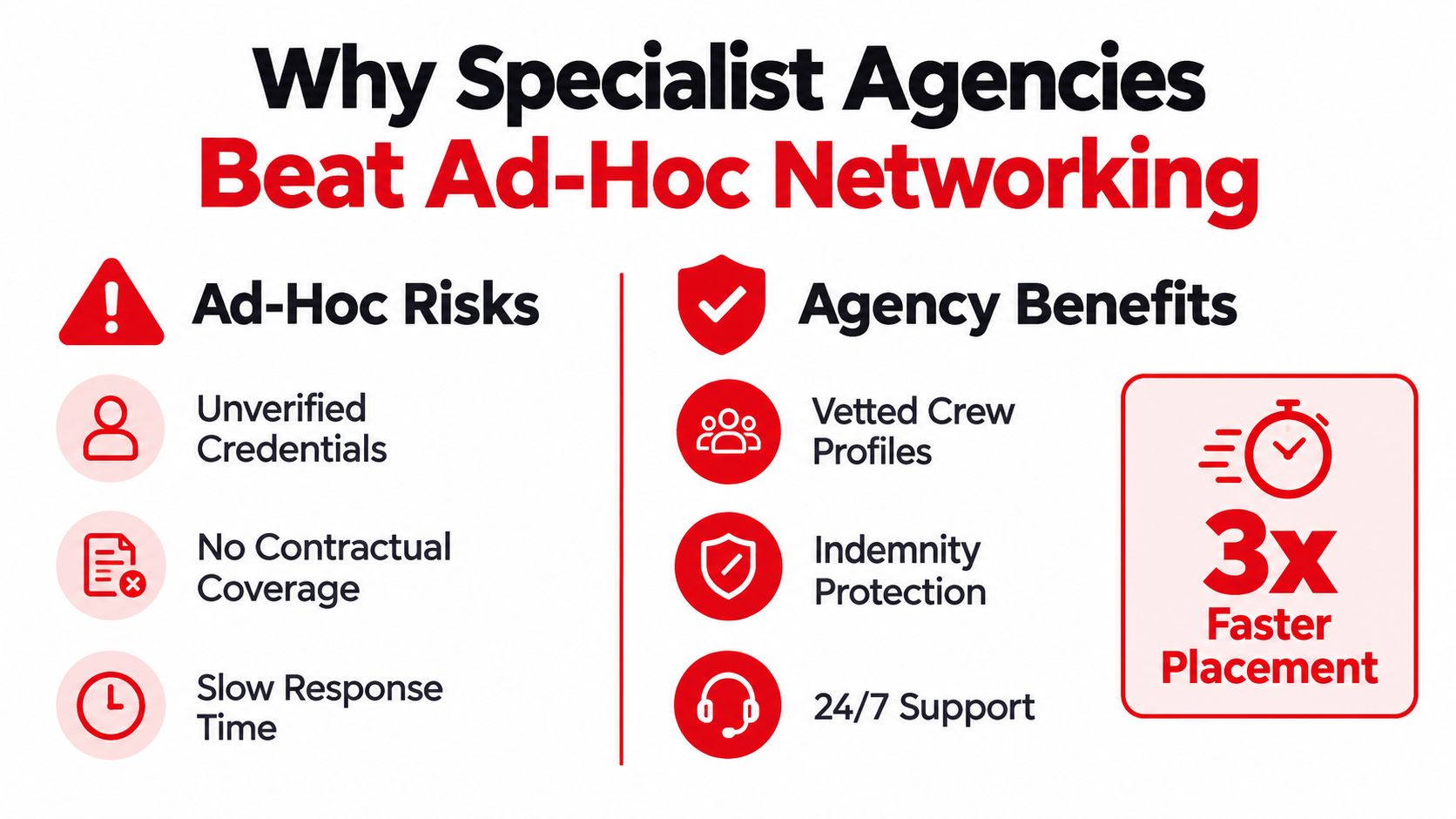
A WhatsApp recommendation may confirm that someone is personable and available. It doesn't necessarily confirm their ENG1, STCW modules, right-to-work position, references, insurance arrangements or replacement plan. A candidate who looks ideal at midday may be unreachable by the time travel documents need checking.
Compare the real cost of speed
Ad-hoc hiring appears inexpensive because there may be no visible recruitment fee. The hidden cost sits elsewhere:
| Ad-hoc approach | Specialist staffing approach |
|---|---|
| The captain checks credentials under pressure | Candidate records are reviewed before presentation |
| The yacht arranges documents separately | Travel, right-to-work and deployment details are considered together |
| A failed placement leaves the vessel exposed | The engagement has defined responsibilities and support |
| A replacement search starts from zero | The agency can work from an established candidate network |
The wrong emergency hire can disrupt a charter, damage guest confidence, increase the captain's workload and force another search. Those consequences are usually more expensive than paying for a structured service at the outset.
For a business serving yachts and hospitality venues across the UK, Relief Chefs UK was established in 2013 and provides relief chefs, temporary chefs, permanent chef recruitment, yacht chefs, villa chefs and wider hospitality staffing support. Its published service information describes fully vetted, right-to-work-checked chefs, nationwide and international coverage, short-form booking, rapid response, insurance, replacement guarantees and ongoing account support.
The agency model works when the provider understands both sides of the placement. A generic recruiter may identify a chef. A specialist hospitality staffing partner should also understand service pressure, kitchen hierarchy, guest expectations, short-notice sickness, seasonal demand and the difference between a stable kitchen and a merely occupied rota.
Use referrals intelligently
The answer isn't to ignore your network. Use referrals as leads, then apply the same checks to every person. Ask for documentation before agreeing to deployment, confirm the exact duties and keep a written record of the decision.
An agency should also be challenged on practical points. Ask who handles right-to-work checks, what happens if the chef is unsuitable, whether insurance is in place, how quickly a replacement can be proposed and who remains available after the person boards.
The embedded video provides another useful perspective on the difference between informal sourcing and managed staffing.
Choose one accountable route rather than posting the same vacancy everywhere. Multiple uncoordinated agencies can produce duplicate candidates, inconsistent briefs and confusion over who has checked what. One clear point of contact keeps the captain, manager, candidate and vessel aligned.
Fast-Track Onboarding and Contract Essentials
The hire isn't complete when the candidate reaches the marina. The first hours on board determine whether the replacement strengthens the operation or unsettles it further.
Send the joining pack before departure. It should include the vessel location, reporting contact, travel instructions, role description, expected start time, accommodation arrangements, uniform requirements, food brief and emergency contact details. The captain should know which documents have been checked and which items remain outstanding.
Put the agreement in writing
A short-term seafarer or crew agreement should define:
- Role and scope: State whether the person is head chef, sous chef, cook or another role, and identify who they report to.
- Dates and availability: Record the start date, expected finish, joining location and what happens if the yacht's movement changes.
- Pay and expenses: Clarify the rate, payment schedule, travel arrangements and approved expenses.
- Liability and insurance: Explain which party carries responsibility for the work and confirm the insurance position.
- Repatriation: Set out how the crew member returns home if the assignment ends, the vessel changes location or the placement fails.
- Confidentiality and conduct: Cover guest privacy, photography, alcohol, drugs, harassment, social media and professional behaviour.
- Food safety and authority: Make clear who approves menus, provisions, allergen controls and service changes.
Don't use a vague email that says “join the yacht and help in the galley”. A clear agreement protects the vessel and the crew member by removing assumptions before the first service.
Run a focused arrival briefing
The captain or department head should show the new crew member the emergency equipment, escape routes, muster arrangements, crew areas, galley systems, refrigeration, dry stores, waste process and reporting structure. The chef should also receive the current guest brief, allergies, preferences, provisioning records, menu commitments and crew meal expectations.
Give the chef a short handover rather than a pile of disconnected messages. Identify what has already been ordered, what is missing, which appliances are unreliable and when the next service must leave the galley. Then ask the chef to repeat the priorities back in their own words.
For a last-minute placement in Devon, Bristol, Wales, Berkshire, Windsor, Reading, Slough, Dorset or another UK hospitality hotspot, the same principle applies. Fast travel is useful only when the receiving operation is organised enough to make the first shift productive.
Kitchen stability also matters after the emergency ends. A relief chef can protect service while the business recruits permanently, a temporary chef can cover seasonal demand, and a permanent chef recruitment process can build continuity once the immediate pressure has passed. Villa chefs and broader hospitality staffing support may also be relevant where the same client manages private dining, hotels or guest accommodation alongside a yacht.
For urgent yacht chef cover, Relief Chefs UK can provide relief chefs, temporary chefs, permanent recruitment and wider hospitality staffing support with the compliance and service pressures of short-notice work in mind. Contact the team when a chef is absent, a charter is approaching or your yacht needs a dependable replacement, and visit Relief Chefs UK to arrange the next step.