
Silver Service Waitressing: Etiquette and Venue Checklist
20 October 2026
It's Saturday, the wedding breakfast is seated, and your kitchen is ready. Then a waitress leans across a guest, deposits an uneven portion, and clears a plate while the next seat is still eating. The food was fine. The service told a different story. Silver service waitressing either protects your reputation in those moments or exposes a team that's winging it.
What Silver Service Waitressing Actually Means in a Modern UK Venue
At a Berkshire wedding I briefed last season, the difference showed in ninety seconds. One table got calm, even portions, served without interrupting conversation. The next got hovering, clinking cutlery, and a server reaching in front of the host. Both teams carried the same food. Only one understood the job.
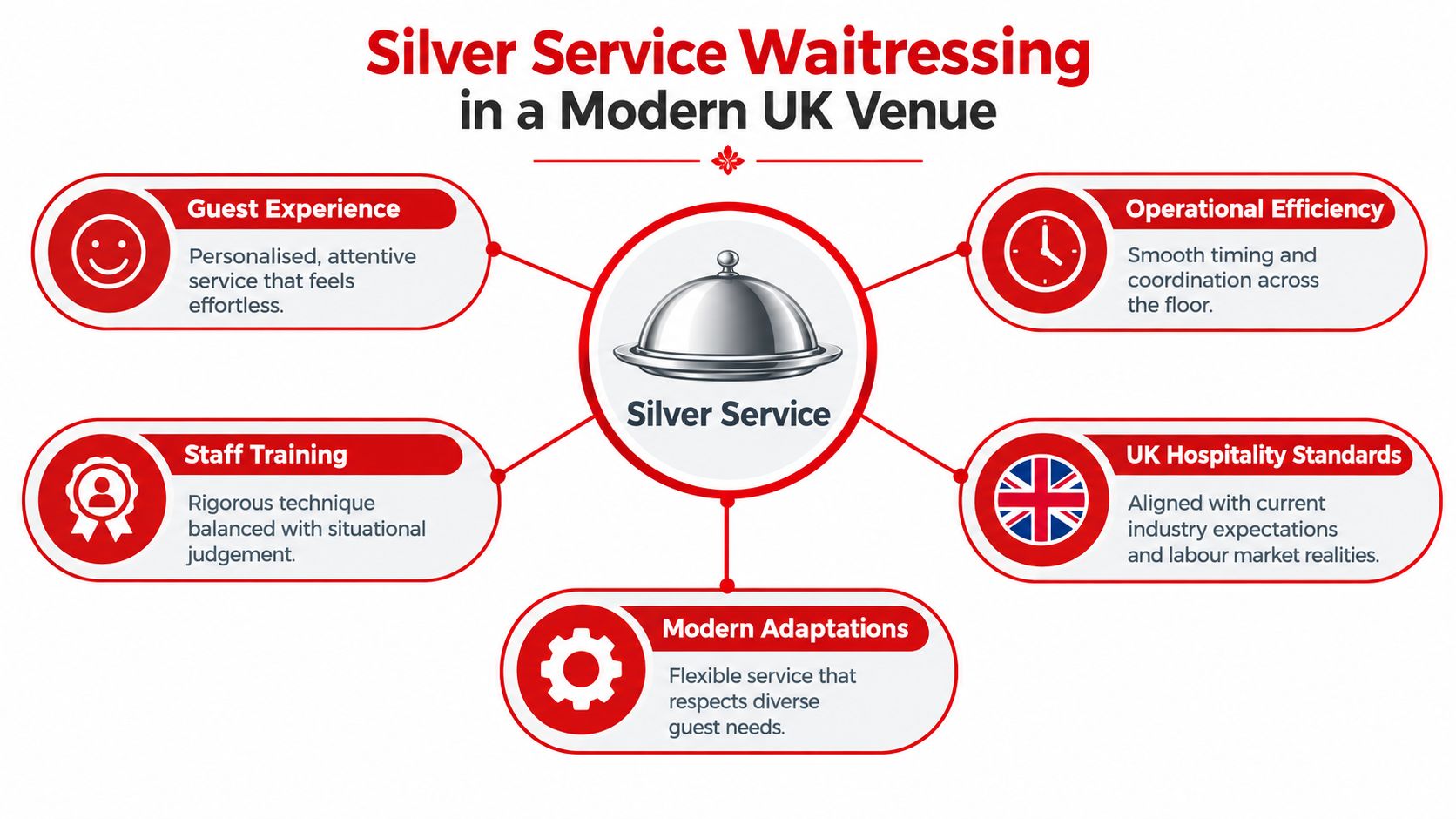
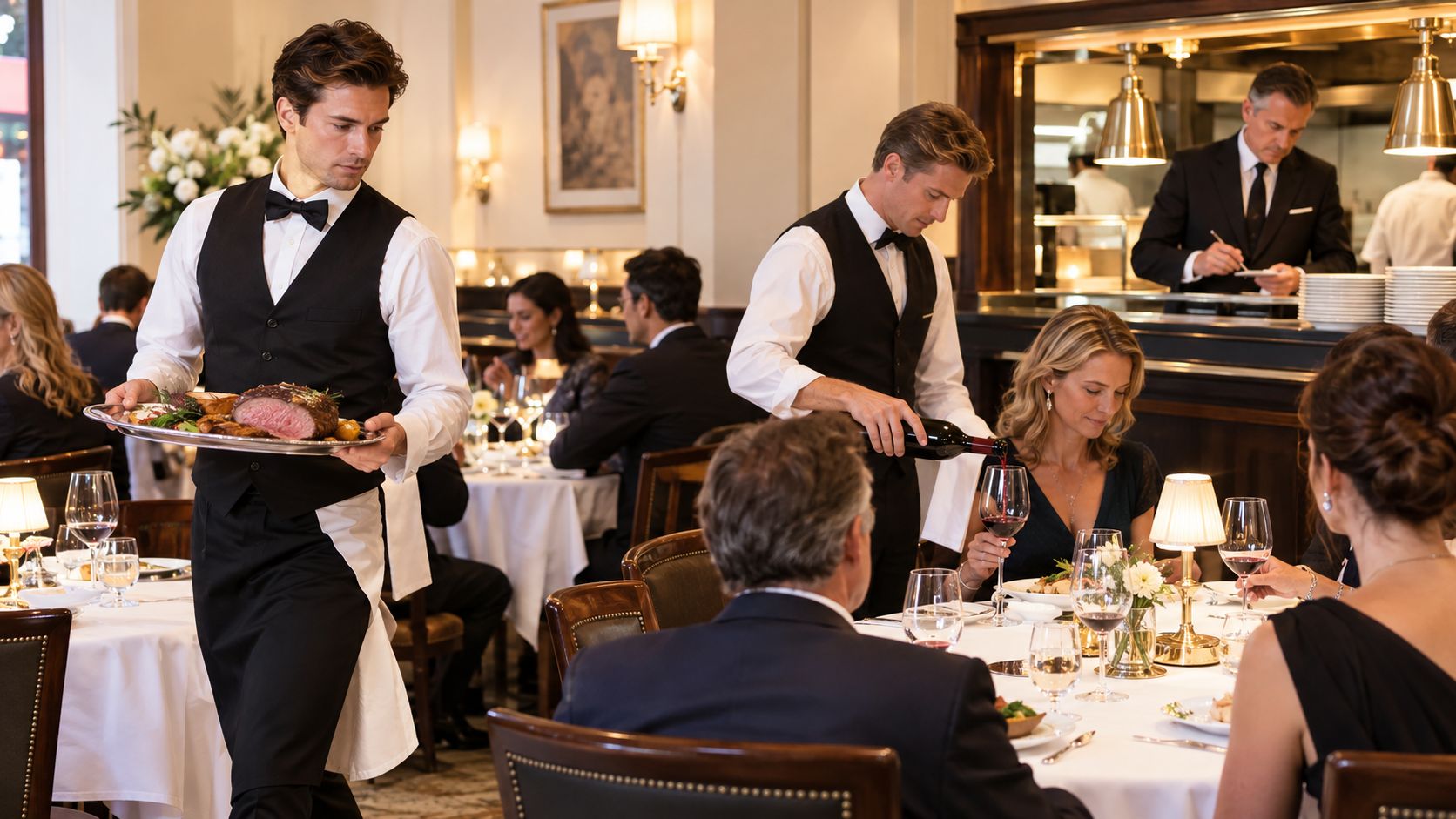
Silver service waitressing is controlled platter-to-plate service. The waitress presents food on a platter and transfers it to the guest's plate using a service spoon and fork. That's distinct from plated service, where the kitchen portions everything before it leaves the pass. If you're portioning at the table, you're accountable for portioning, posture, timing, and etiquette in front of the guest.
Where It Comes From
The practice is a British form of formal service developed from aristocratic household dining in the 17th and 18th centuries. Butlers served from a platter while moving around the table, and that household model later shaped standards in British hotels, restaurants, and banqueting rooms. Don't mistake it for silver tableware. It's a performance discipline.
Why It Still Matters Commercially
You'll see it in your booking diary, not in a museum. Weddings in Windsor, private dining in Bristol, fine dining in Dartmouth, and hotel banquets in Dorset still sell the theatre of tableside service. Guests pay for control and polish, and they notice when either disappears.
Treat it as a specialist capability, not general front-of-house experience. The slow disappearance of silver service linked to plated presentation and preference for casual working environments means you can't assume a competent casual server can do this. If your venue sells formal covers, staff them formally or stop selling them.
The Service Sequence That Holds a Formal Cover Together
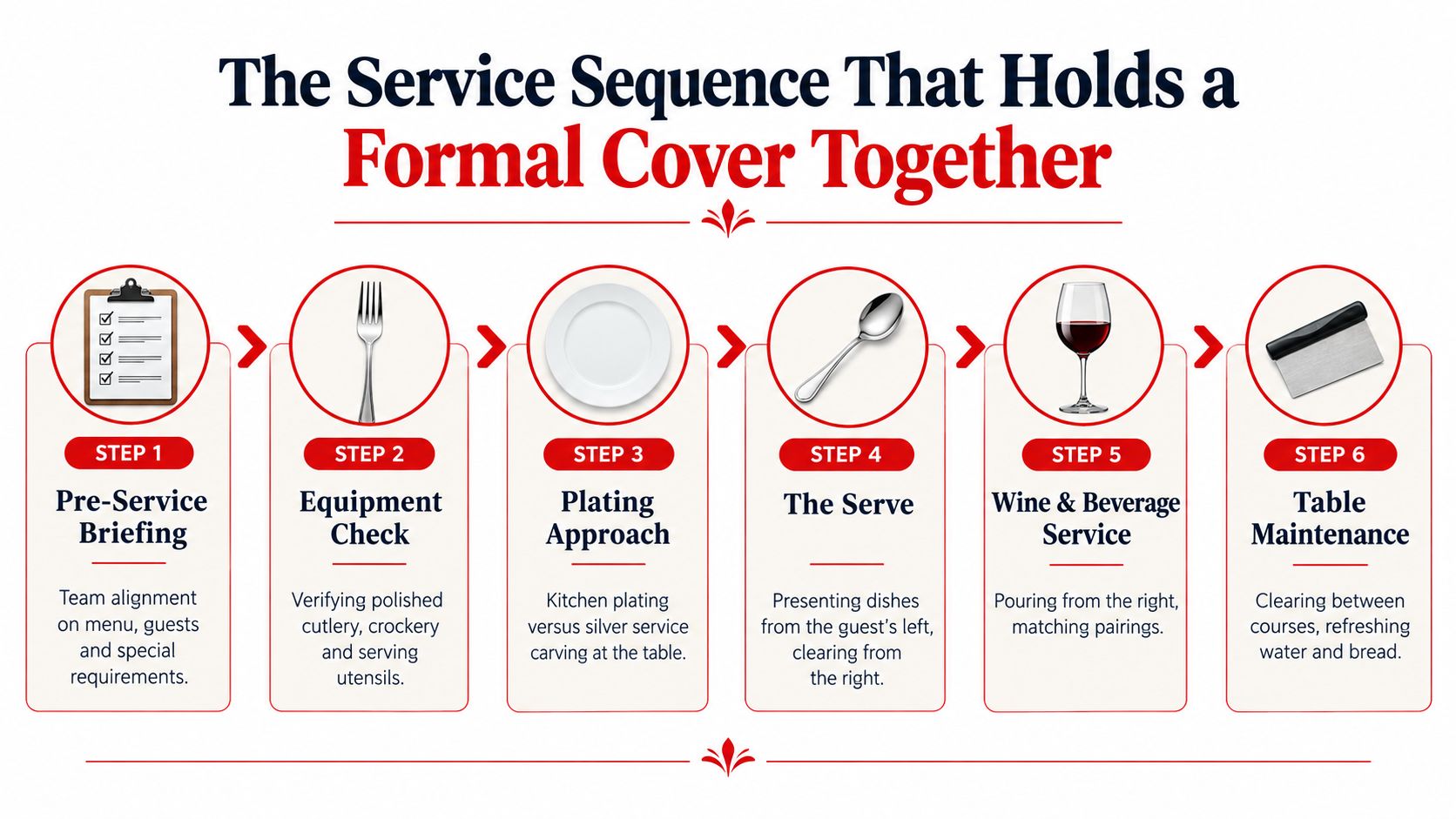
Run this sequence every time. Don't improvise the order because the room feels busy. Busy is exactly when sequence saves you.
Before Doors Open
Brief the team on menu composition, portion controls, table sequence, surplus-food handling, and incident escalation. Then inspect and polish every piece of service equipment. The UK National Occupational Standard requirement for clean, undamaged equipment and food arranged for easy service isn't paperwork. A bent service fork or a badly loaded platter makes clean transfer impossible.
Confirm the dish and the portion before you leave the pass. If a waitress doesn't know what she's carrying, how many portions it holds, or which table gets it first, she isn't ready to walk.
The Serve Itself
Position the food so it can be served cleanly, then transfer each portion with the designated spoon and fork in one controlled movement. Keep portions consistent from first guest to last. Don't give seat one a generous portion and seat eight the scrapings because you failed to count.
Work without obstructing guests. You are not the entertainment. Announce the dish briefly where your venue requires it, serve, and move on without forcing conversation.
Practical rule: If you have to lean, stretch, or apologise for your position, you approached from the wrong place. Reset before you serve the next guest.
Clearing Without Ruining It
- Wait for the table: Don't remove plates before the whole table has finished unless the guest clearly asks.
- Clear systematically: Work in the agreed sequence, keep noise down, and don't stack plates at the table.
- Reset properly: Replace required cutlery and remove debris so the next course lands on a clean cover.
The classic failures are predictable: approaching from the wrong side, leaning across guests, inconsistent portions, noisy clearing, and premature plate removal. Name them in the briefing. Then measure your own performance through plate-return accuracy, guest complaints, service-time variance, and observed procedural compliance. Don't claim a pass rate you can't evidence.
Allergen Control as a Front-of-House Discipline
Your waitress is the final communication link between kitchen and guest. If she gets allergen information wrong, nobody after her can fix it. Stop treating this as kitchen admin.
Before service, every server learns the menu's 14 regulated allergens from current written dish information. Not from memory. Not from what last week's menu contained. Build the habit with structured allergen awareness training for hospitality staff and refresh it when dishes change.
The Handover That Must Not Break
Record each request clearly and transmit it to the kitchen exactly as written. Confirm the special meal is identifiable at the pass, then verbally reconfirm the dish and allergen status when you present it. If you can't identify the plate, don't serve it. Send it back and ask.
The figures show why informality fails. Food Standards Agency findings in UK Government allergen labelling and information guidance record that 97% of food businesses provide some allergen training or information, yet only 50% of adults with food hypersensitivity believe staff are knowledgeable when asked, and only 52% of businesses routinely ask customers about allergens. That gap lives at your tables, not in your training file.
Pitfalls to Brief Out
Don't treat intolerance and allergy as interchangeable. Don't assume a garnish, sauce, or substitution is safe. Don't let a menu change go out without updating the floor, and don't allow unauthorised substitutions at the pass.
Escalate uncertainty rather than guess. A confident wrong answer is worse than a pause while you check. The Government recommends suitable allergen training at least annually, with accurate information readily available to staff. Make that information reachable during service, not locked in an office.
A waitress who says "I'll check" protects the guest. A waitress who guesses protects her pride.
When Traditional Etiquette Meets Real Guests
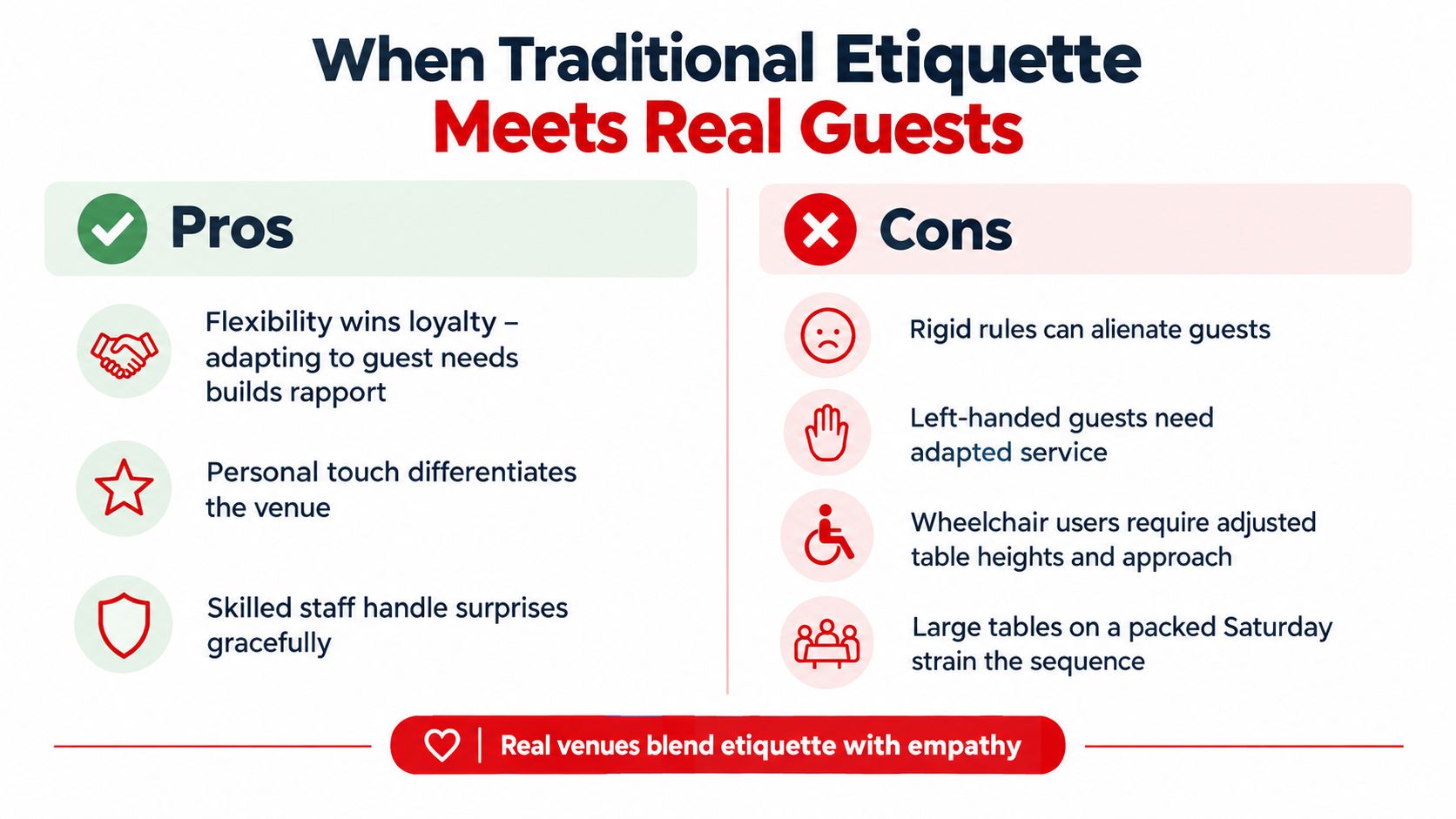
Serve from the left, clear from the right, move clockwise. Learn those defaults. Then learn when to break them, because rigid choreography in front of a real guest is bad service wearing a uniform.
Read the Table Before You Approach
A wheelchair user may not have space for you on the traditional side. A left-handed guest may be set differently. A partially sighted diner may need a brief, clear description of where food is placed. A crowded table for ten in a Reading hotel function room may leave no safe route at all on one side.
Don't force the rule. Choose the approach that's safe, dignified, and least intrusive, and tell your colleague so the sequence doesn't collide. Consistency across the team matters more than ceremonial purity.
That broader view matches how silver service training connects etiquette with operational knowledge, hygiene, and responses to unexpected situations. Train for judgement, not just movement. Your venue customer service standards should state when staff can override the sequence and who decides.
Language That Works
Ask rather than perform. "Would it be easier if I served from this side" respects the guest and gives you permission to adapt. Keep it brief, don't draw the table's attention to the adjustment, and don't apologise excessively.
The same applies to restricted mobility, a guest holding a child, or a cramped corner cover in a Slough restaurant. Correct silver service is controlled, safe, guest-centred execution within your documented procedures. If your procedure can't handle a real room, rewrite the procedure.
Running Formal Service When the Team Is Thin
Silver service doesn't usually fail because nobody taught the spoon-and-fork grip. It fails because you've got enough bodies to open and not enough trained people to run a synchronised room in Devon, Wales, or the South West on a peak Saturday.
The labour numbers explain the pressure. UK hospitality still had approximately 84,000 vacancies between January and March 2025, down from about 107,000 a year earlier, and separate reporting put accommodation and food service vacancies at 77,000 between September and November 2025, or three vacancies per 100 workers compared with 2.3 across all industries, in UK hospitality vacancy and pay reporting for 2025. BDO's Hotel Britain 2025 report on the UK hospitality worker shortage states the market was short of 132,000 workers in 2023, with vacancies 48% above pre-pandemic levels, and waiters among the most sought-after roles.
Your Minimum Viable Model
Decide in advance which duties need experience: coordinating the banquet pass, handling special diets, serving from a salver, and clearing a multi-course table. Pair every less-experienced server with a competent lead on a defined station. Don't scatter new starters across the room and hope.
- Brief tightly: Menu, allergens, portions, station ownership, and escalation route in writing.
- Use handover notes: Dietary covers, accessibility needs, and table sequence don't live in one person's head.
- Know your floor: Set a minimum staffing level below which you simplify the menu, pause a course, or reduce covers.
- Recover cleanly: Give staff agreed language for delays so guests hear one consistent message.
Cutting the team to save labour is a false economy when it produces slower clearing, missed dietary communication, and uneven portions. For short-notice sickness or seasonal peaks, hospitality temp staff support can fill a gap, and Relief Chefs UK, a nationwide chef recruitment agency established in 2013, supplies relief chefs, temporary chefs, permanent placements, and broader hospitality staffing support. Book cover early. Agency reliability problems get worse when you call at the last minute with no brief.
Checklists for Managers and the Floor
Pin this up. Memory fails under pressure, checklists don't.
Manager Checklist Before Service
- Menu and allergens: Current dish sheets checked, changes briefed, special meals identifiable.
- Portions and sequence: Portion controls, table order, and surplus-food handling confirmed with the kitchen.
- People and escalation: Stations allocated, competent lead named, incident route clear, breaks planned.
During service, watch the carry, the serve, and the clear. Listen for allergen reconfirmation at delivery. If you hear guessing, stop it immediately and reset that server's station.
Waitress Self-Check
- Equipment: Service spoon and fork clean, undamaged, and correct for the dish.
- Knowledge: I can name the dish, its allergens, and the portion I'm serving.
- Position: I can reach the guest safely without leaning, obstructing, or rushing.
- Finish: Table cleared at the right time, cutlery replaced, debris removed.
Review After Service
Track four indicators: time from kitchen release to table delivery, time waiting for cleared equipment, number of service errors, and whether staff breaks happened. Falling employee numbers make this discipline urgent, since ONS-based analysis in reporting on shrinking hospitality employment in 2025 showed payrolled employees fell from 2,111,898 in April 2025 to 2,100,827 in May 2025, with the sector 4.6% below May 2024.
If those indicators deteriorate, act: simplify the menu, reduce covers, or bring in experienced cover. Don't wait for a complaint to tell you the room was understaffed.
Frequently Asked Questions and Securing Reliable Cover
Is Silver Service Still Relevant
Yes, where the booking is formal. Weddings, banquets, private households, and luxury hotels in Bristol, Berkshire, Dorset, and Wales still use it because guests value controlled, visible service. Don't offer it for covers where plated service suits the price and pace better.
Can Standards Survive a Short Team
Only with a plan. Use written briefings, station allocation, competent leads, and a staffing floor below which you cut covers or simplify courses. Silver service waitressing delivered by exhausted, unbriefed staff isn't formal service. It's slow plated service with extra risk.
What Should Temporary Staff Bring
Verified experience where the role demands it, current allergen knowledge, and the discipline to follow your house procedure rather than their last venue's habits. Test the basics at induction: carry, transfer, clear, and escalate. Anything they can't do, pair or reassign before guests sit down.
When Should You Book Cover
Before sickness becomes a guest-facing failure. Seasonal demand, chef shortages, and kitchen instability compound each other, and a thin kitchen plus a thin floor will break a formal cover faster than either alone. Secure dependable cover while you still have time to brief properly.
If a formal cover in Devon, Bristol, Berkshire, Dorset, or Wales is at risk from sickness, seasonal demand, or a shortage of trained staff, don't let the service sequence collapse in front of paying guests. Relief Chefs UK provides relief chefs, temporary chefs, permanent chef recruitment, yacht chefs, villa chefs, and hospitality staffing support nationwide. Contact the team early, give a clear brief, and protect the standards your guests booked.
Call the team.
Office 01392 715474 · info@reliefchefs.co.uk