
Waste Reduction Strategies: 10 Ways to Cut Costs
8 September 2026
Avoidable food waste is a margin problem before it's a sustainability problem. In the UK, households, hospitality and food service, manufacturing, retail and farming produced 10.7 million tonnes of food waste in 2021, with households responsible for around 6.4 million tonnes, or about 60% by weight, according to UK waste data from the Department for Environment, Food and Rural Affairs. Hospitality operators feel their share through over-ordering, spoilage, oversized portions, prep errors and returned plates.
For a busy pub in Devon, a hotel in Berkshire or a restaurant in Bristol, the pressure increases when demand changes suddenly or a chef calls in sick at short notice. A waste reduction system must therefore do more than reduce bin contents. It should help permanent teams, relief chefs and temporary chefs work consistently, even when the kitchen is short-staffed or unfamiliar with the site.
This listicle follows the full operating cycle, from ordering and portioning to repurposing, disposal and measurement. Relief Chefs UK, established in 2013, supports venues nationwide with relief chefs and temporary chef staffing, permanent chef recruitment, yacht chefs, villa chefs and wider hospitality staffing support. Clear kitchen systems make that cover more effective because a new chef can follow documented standards instead of relying on one absent head chef's memory.
1. Precise Portion Control and Pre-Plating Systems
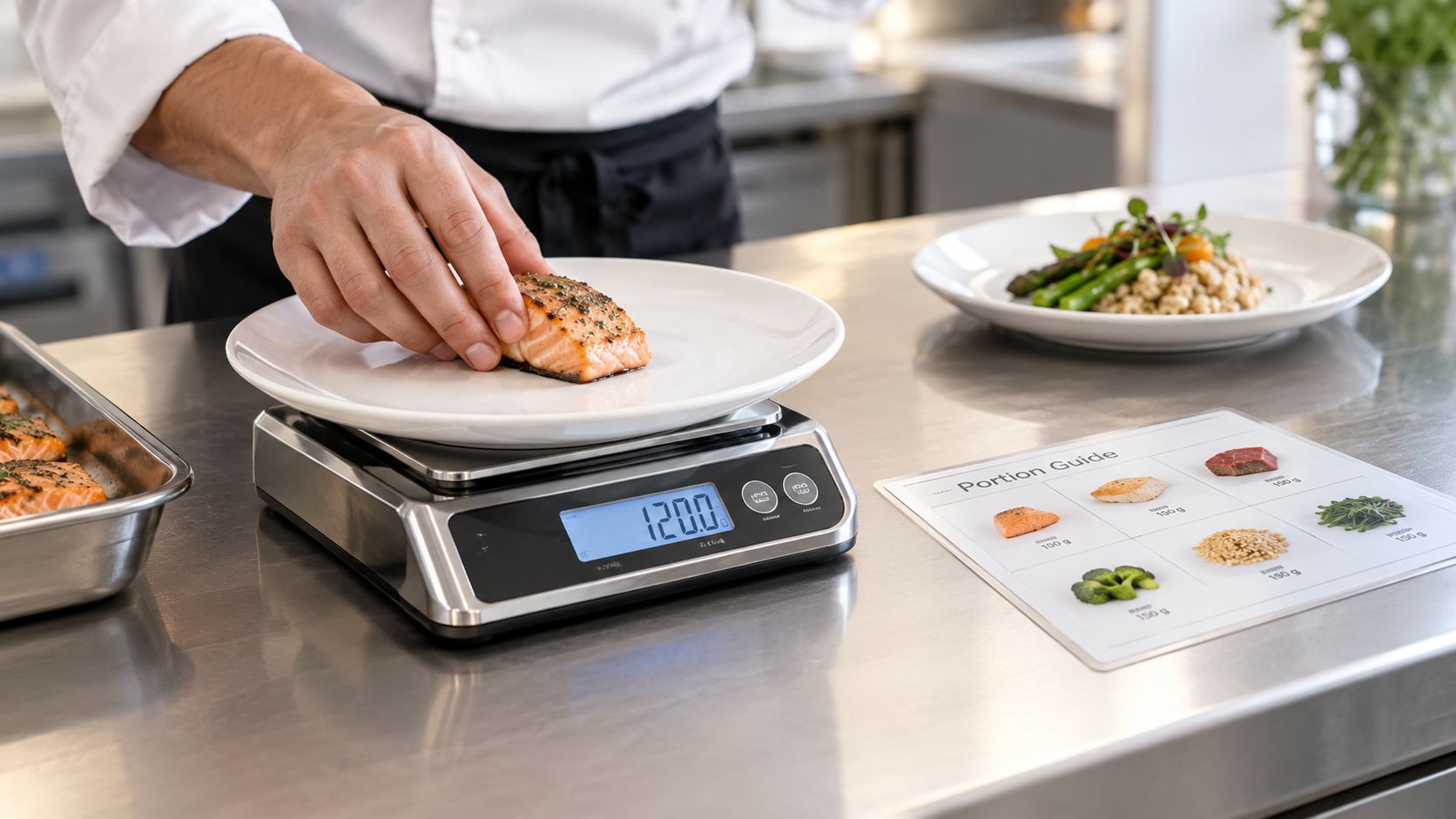
Portion control starts with a recipe card, not a chef's guess. Set a clear serving standard for proteins, carbohydrates, sauces, garnishes and sides, then make it visible at the preparation and plating stations. A digital scale is inexpensive compared with repeatedly sending oversized portions to the dining room.
Pre-plating can work particularly well for busy lunch services, banquets and set menus. Bristol restaurants using pre-plating for side dishes have reported a 20% reduction in vegetable waste, as noted in the supplied sector examples. The operational benefit is broader than waste alone. Guests receive a consistent plate, chefs spend less time correcting portions and temporary staff can follow the same method from their first service.
Make the standard easy to follow
Involve the head chef and senior kitchen team when setting portion sizes. They'll be more likely to enforce a system they helped build, and they can balance food cost with guest expectations.
- Post portion guides: Laminate photographs, weights and plating notes at each relevant station.
- Induct every chef: Agency chefs, relief chefs and temporary chefs should receive a short orientation before service.
- Review regularly: Compare waste records with customer feedback and adjust portions when the evidence supports a change.
An independent hotel group in Berkshire or Windsor might need different standards for à la carte, breakfast, afternoon tea and functions. Don't assume one portion guide suits every service. Relief chefs should know which standards apply before they begin plating.
A visual explanation can help teams understand how weighing supports consistency in a live kitchen.
2. Root-to-Stem and Nose-to-Tail Cooking Practices
A carrot top, herb stem, chicken carcass or beef bone isn't automatically waste. It may be a stock ingredient, garnish component, ferment, sauce base or menu special, provided the kitchen has a safe and controlled process for using it.
Boutique hotels in Devon and Dorset often have strong opportunities to turn vegetable scraps into house stocks. Reading gastropubs can use beef bones and chicken carcasses for broths, while Bristol restaurants may build specials around fermented vegetable tops or roasted stems. Fine-dining kitchens have also made offal and secondary cuts part of premium menus, showing that less familiar ingredients can create value when the preparation is deliberate.
The trade-off is skill and supervision. Root-to-stem cooking can reduce purchasing and create distinctive dishes, but it can also create inconsistent results if every chef uses trim differently. A relief chef with strong vegetable preparation or butchery experience can add real value, but only when the venue explains its recipes and expectations.
Practical rule: Start with one stock, broth or trim-based special that the team can execute safely and consistently. Expand only after the process works during a pressured service.
Document the useful parts
Write down which trimmings are suitable, how they're stored, how long they're held and which recipe uses them. Keep the recipe close to the preparation area rather than buried in a shared drive.
When booking cover through Relief Chefs UK, state whether the role needs advanced butchery, fish preparation or vegetable skills. A chef recruited for a straightforward service may not be the right fit for a kitchen that depends on nose-to-tail preparation.
3. Smart Inventory Management and FIFO Rotation
Stock rotation fails when it depends on one experienced chef knowing what arrived last Tuesday. A relief chef should be able to open a walk-in refrigerator and understand what must be used first within minutes.
Use first-in, first-out rotation, with delivery dates and use-by dates written clearly on every relevant container. Colour-coded tape by delivery day can help an independent hotel in Berkshire or Windsor, while a multi-site pub group across Wales may benefit from inventory software that flags items approaching expiry. A spreadsheet with conditional formatting can work just as well for a smaller restaurant if the team updates it consistently.
Restaurants in Reading and Slough have reported a 25% reduction in spoilage after introducing weekly stock audits, based on the supplied sector examples. The number matters less than the practice behind it. Regular checks expose over-ordering, forgotten containers and par levels that no longer reflect actual trade.
Build a rotation routine
- Label on receipt: Record the delivery date and use-by date in visible text.
- Set par levels: Fast-moving products need reliable minimum and maximum levels, not blanket over-ordering.
- Audit at a fixed time: A weekly routine makes responsibility clear and makes patterns easier to compare.
- Brief incoming chefs: Give relief and temporary chefs a five-minute walk-through of the labelling system before prep starts.
A dated photograph of the walk-in can also help a Devon or Dorset hotel track how quickly products move. It won't replace a stocktake, but it gives managers a useful visual record when ordering decisions are challenged.
For a practical reference point, use these stock rotation methods for hospitality kitchens. The strongest system is the one a tired team can follow after a late function, not the one with the most software.
4. Menu Engineering and Seasonal Ingredient Planning
A menu can create waste before the first order is placed. If one ingredient appears in a single slow-selling dish, the kitchen carries all the spoilage risk. If the same ingredient supports several dishes, specials and staff meals, purchasing becomes more flexible.
Bristol restaurants can build seasonal menus around spring greens, summer berries, autumn roots and winter squashes. Hotels in Devon and Dorset might feature the same local produce across a starter, side, soup and function menu. Reading gastropubs can plan around stored apples and root vegetables in the first quarter, asparagus and spring onions in the second, summer fruit and courgettes in the third, then mushrooms and game in the final quarter.
The right menu structure also helps during staffing gaps. A relief chef can learn a focused menu more quickly than a large list of unrelated dishes, particularly when the head chef is absent. Fewer unique ingredients mean fewer ordering decisions, simpler prep lists and less risk of a temporary team producing components the venue can't sell.
Use an ingredient matrix
Map each major ingredient against every dish that uses it. This shows where an item can be redirected if sales change and helps the ordering team see the consequences of adding or removing a dish.
Plan seasonal changes with the head chef well before the new menu launches. Record approved substitutions and preparation methods so a temporary chef understands the kitchen's logic rather than treating ingredient overlap as accidental repetition.
Track which seasonal dishes sell, which produce returns to the kitchen and which components remain unused. This creates a better starting point for the next menu cycle. The seasonal menu planning guidance from Relief Chefs UK can support that planning process without replacing local sales knowledge.
5. Vegetable and Protein Trimmings Valorisation
Freezing is useful when the kitchen can't process every suitable trim immediately. Create a clearly marked freezer section for vegetable trimmings, herb stems, poultry pieces and other approved ingredients. Date every container, keep strong aromatics separate where necessary and schedule a regular processing session.
Restaurants in Bristol and Bath may freeze trimmings during the week, then batch-cook stocks during a quieter period. A multi-site group across Wales could collect suitable trimmings centrally for bulk processing. Hotels in Devon and Dorset may also explore partnerships with animal sanctuaries for appropriate excess, while spent grain from local breweries can have a route into animal feed or compost.
This approach only works when the kitchen draws a firm line between usable trim and unsafe waste. Mouldy ingredients, contaminated food and items that could taint other products shouldn't enter a “use later” container. Food safety always outranks a desire to save every scrap.
Keep the process visible
Use labelled gastronorm containers or freezer bags with masking tape and dates. A simple poster should explain what belongs in the trim freezer and what goes into the organic waste stream.
Assign responsibility for turning frozen trimmings into stock every two to three weeks, based on the supplied operational guidance. If nobody owns the task, the freezer becomes another storage bottleneck. The same written process should be available to permanent chefs, relief chefs and temporary chefs, so the system survives sickness, holidays and turnover.
6. Waste Auditing and Data Tracking
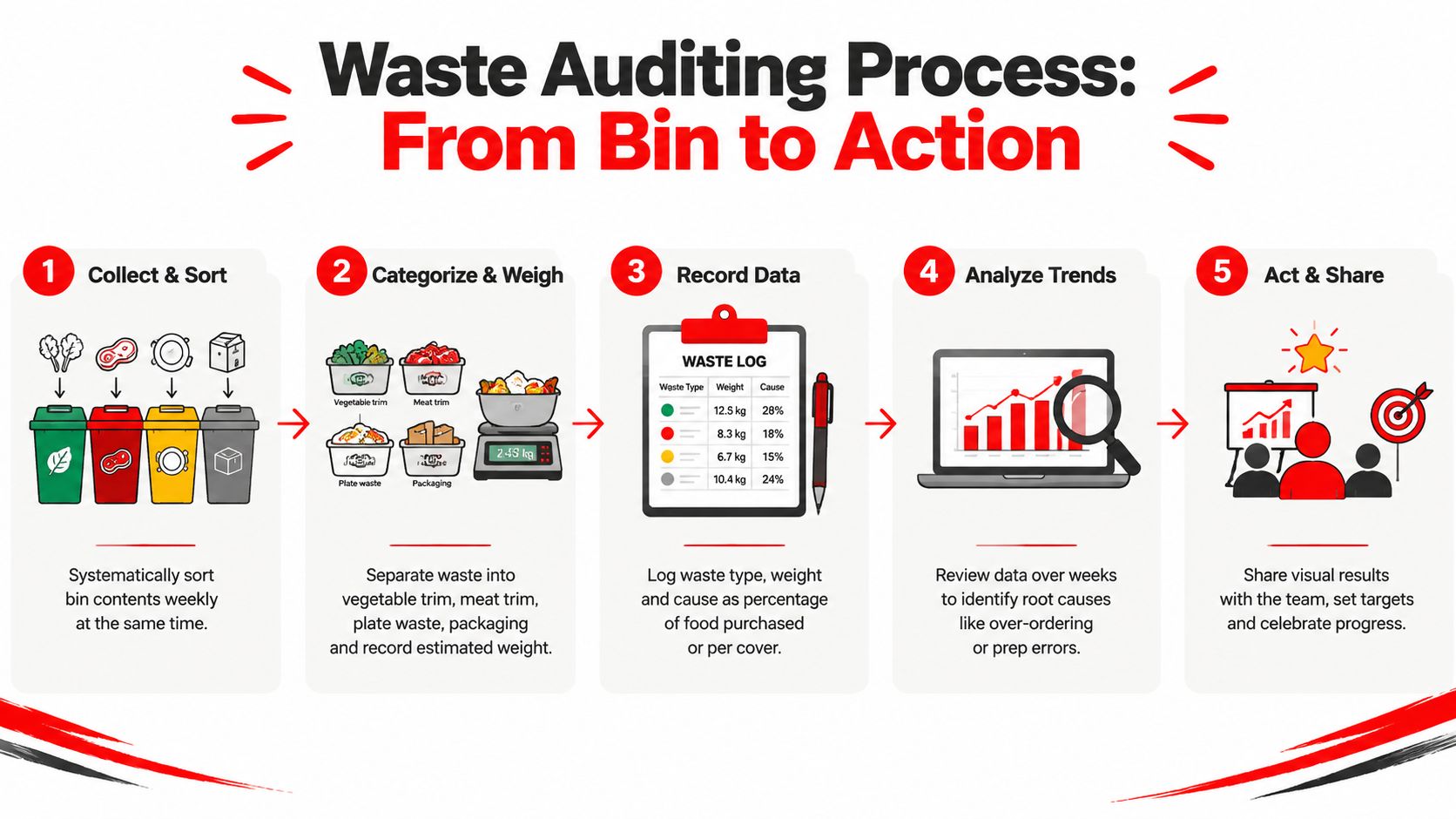
You can't fix a waste problem that you haven't separated. A bin audit means examining what the venue throws away and recording whether it came from preparation, spoilage, overproduction, returned plates, packaging or another source.
The UK hospitality and food service sector produces about 2.87 million tonnes of total solid waste each year, and 46% is recycled, anaerobically digested or composted, according to the CE-Hub hospitality report. The same report identifies around 920,000 tonnes of food waste annually, with roughly 75% avoidable or edible. That makes measurement essential, because disposal alone doesn't reveal where the preventable loss occurred.
WRAP's Food Waste Reduction Roadmap progress update says 30% of participating organisations measure and report food waste to WRAP, while 12% achieve reductions relative to food handled. The practical lesson is straightforward. Measurement is a management activity, not a sustainability poster.
Audit the point of failure
Use a simple sheet with categories such as vegetable trim, meat trim, plate waste, spoilage, overproduction and packaging. Estimate or weigh each category using the same method every time.
A Bristol restaurant may discover that lunch plate waste is driving the issue, while a Berkshire hotel may find that root vegetables are being over-trimmed. A gastropub in Devon can track waste alongside food cost to show the team how prep decisions affect margin.
Share the results at a short kitchen briefing. Incoming relief chefs should see the venue's main waste sources during induction, so they can focus effort immediately. Use the food waste reduction support from Relief Chefs UK alongside your own records to turn audit findings into specific changes.
7. Staff Training and Waste Reduction Culture Building
A waste policy has no value if the person covering a sickness shift hasn't seen it. Every chef should know how the venue portions, labels, stores, reuses and separates waste before service begins.
Short toolbox talks work better than an annual lecture. A Bristol restaurant might spend five minutes before service reviewing the previous audit. A hotel in Devon or Dorset can include waste procedures in its agency chef induction, while a pub group across Wales can run practical vegetable preparation training for several sites.
Make ownership shared
Nominate a waste reduction champion within the kitchen. This doesn't need to be a management position. A chef de partie or kitchen porter who understands the process can spot repeated mistakes and raise them before they become normal practice.
- Use practical demonstrations: Show the correct trim, storage container and portion rather than relying on written instructions alone.
- Buddy temporary staff: Pair an incoming chef with a permanent team member for the first briefing and service.
- Recognise progress: Share improvements in team meetings and link them to food cost, consistency and guest satisfaction.
- Keep records accessible: Posters, recipe cards and short digital videos should be available where work happens.
Relief Chefs UK can brief temporary and relief chefs on a venue's expectations before arrival. The venue still needs to provide a site-specific induction, but advance information reduces the time needed to get a new chef productive.
The best culture isn't punitive. If staff fear blame, they may hide spoilage or failed prep. Ask what caused the waste, then fix the ordering, recipe, equipment, training or forecasting problem behind it.
8. Purchasing and Ordering Optimisation
Ordering too much is often treated as a safer choice than running out. That decision protects availability but transfers the risk into spoilage, cash tied up in stock and extra preparation. A better approach combines historical sales, current bookings, weather, local events and known staffing capacity.
Use sales and ordering records to set ingredient-specific par levels. A restaurant in Bristol or Bath may prefer vegetables delivered several times a week rather than relying on one large delivery. A hotel in Berkshire or Windsor can work with suppliers on flexible delivery arrangements during shoulder seasons. Seafood and meat suppliers serving Reading and Slough may also offer more useful terms when the venue explains its demand pattern.
The supplied sector examples include operators that changed ordering frequency and reported lower spoilage. Those outcomes depend on local volumes, supplier reliability and storage capacity, so copy the process, not an unsupported target.
Forecast the kitchen you can actually run
Demand forecasting must include labour. If short-notice sickness leaves a reduced brigade, an ambitious prep plan can create overproduction. If seasonal demand rises and the venue relies on an unreliable agency, the team may over-order because nobody trusts the next delivery or prep shift.
Review orders with the head chef and supplier regularly. Communicate changes to the whole kitchen, including relief chefs, so nobody panic-orders a product that has already been reduced. A clear par sheet protects consistency when the usual ordering manager is away.
9. Scraps to Revenue Through Byproduct Creation
Some byproducts can become products, but revenue creation should follow operational control rather than distract from it. A house bone broth, fermented vegetable product, fruit preserve or retail stock may turn a trim stream into a useful secondary offer.
Restaurants in Bristol have launched house bone broth for retail sale. Hotels in Devon and Dorset can use fermented products in gift shops or supply local delis. A Reading gastropub might make preserves from surplus fruit and sell them at the bar or through local markets. These examples work because the products fit the venue's identity and use ingredients the kitchen can collect safely.
WRAP reports that UK hospitality and food service food waste costs around £3.2 billion annually, and avoidable waste averages about £0.97 per cover in restaurants, £0.52 in hotels and £0.41 in pubs, according to sector food waste cost guidance. A byproduct line can support margin, but it shouldn't become an excuse to generate extra labour or hold stock without demand.
Test one product carefully
Choose one product, confirm the food safety process, check registrations and insurance, and identify the sales channel before production starts. Packaging must communicate ingredients, storage and use instructions clearly.
A kitchen that grows retail demand may need extra prep time, dedicated storage and a chef with suitable production skills. If your regular chef is absent, confirm that your relief or temporary cover can maintain the recipe and labelling process. Otherwise, the new revenue stream can become another source of inconsistency.
10. Composting and Organic Waste Partnerships
Composting belongs after prevention, reuse and redistribution. Spoiled ingredients, inedible trim and plate waste that can't safely be reused still need a controlled route, but sending everything directly to compost can hide avoidable purchasing or portioning problems.
England's workplace recycling rules took effect on 31 March 2025, and the government's new workplace recycling rules form part of the wider Simpler Recycling reforms. Separate waste streams are now an operational requirement for relevant workplaces in England. Businesses with 10 or more full-time equivalent employees must comply from 31 March 2025, while businesses with fewer than 10 employees have until 31 March 2027, and food waste must be kept separate from general waste under the hospitality guidance from Affordable Waste Management.
Design the collection point around service
A small café may use an on-site Bokashi system or worm bin if it has the space and someone responsible for maintenance. A larger hotel or pub group may need a commercial collection service. Bristol and Bath venues can investigate community composting options, while businesses in Reading and Slough should check council and private schemes available locally.
- Label every container: Staff should identify food waste, recycling and general waste at a glance.
- Brief every chef: Relief chefs need the same separation instructions as permanent employees.
- Assign maintenance: On-site systems require ownership for moisture, mixing and collection.
- Record diversion: Track what leaves the residual stream and share the result with the team.
A composting partner may be able to return compost for venue gardens, local suppliers or community projects. Keep the arrangement practical, and never let the environmental story replace accurate measurement of what the kitchen is still wasting.
10-Point Waste Reduction Strategies Comparison
| Strategy | 🔄 Implementation Complexity | ⚡ Resource Requirements | 📊 Expected Outcomes | Ideal Use Cases | ⭐ Key Advantages / 💡 Quick Tip |
|---|---|---|---|---|---|
| Precise Portion Control & Pre‑Plating Systems | Medium, initial training and audits; ongoing discipline | Low–Medium, portion scales, laminated guides, training time | 15–25% reduction in plate waste; greater consistency | High‑volume services, multi‑site ops, frequent relief staff | Improves consistency and margins. Tip: laminate guides at plating stations and audit regularly. |
| Root‑to‑Stem & Nose‑to‑Tail Cooking | Medium–High, needs skilled technique and recipes | Low (labour‑intensive) + storage for offcuts | ~10–15% ingredient cost savings; reduced disposal | Restaurants seeking sustainability or signature dishes; skilled kitchens | Creates unique menu items and sustainability appeal. Tip: document recipes clearly for relief staff. |
| Smart Inventory Management & FIFO | Low–Medium, discipline and set routines | Low–Medium, labels, shelving, optional inventory software | 20–30% reduction in spoilage; fewer safety risks | All kitchens, especially multi‑site or high turnover | Prevents spoilage and improves cash flow. Tip: label with received/use‑by dates and run weekly audits. |
| Menu Engineering & Seasonal Planning | Medium, planning cadence and coordination | Low, planning time, supplier liaison | 15–25% ingredient waste reduction; improved freshness | Venues using local supply chains and seasonal menus | Lowers costs and simplifies ordering. Tip: build ingredient matrices and plan 6–8 weeks ahead. |
| Trimmings Valorisation (Freezing & Dry Storage) | Low, simple protocols and batch processing | Low, containers, freezer space, labelling supplies | 10–15% waste reduction; reliable stock creation | Small–medium kitchens with freezer capacity | Turns trim into flavour assets. Tip: designate freezer section and date containers. |
| Waste Auditing & Data Tracking | Low–Medium, regular, labour‑intensive process | Very low, time for audits; optional consultant fee | Identifies root causes; enables measurable targets and improvements | Operations starting waste programs or seeking accountability | Produces actionable insights for targeted change. Tip: do weekly audits and share visual results. |
| Staff Training & Culture Building | Medium, ongoing training and reinforcement | Low–Medium, training materials, manager time, incentives | 15–30% waste reductions via behaviour change; higher engagement | High turnover kitchens; venues using agency/relief chefs | Builds ownership and consistency. Tip: appoint a Waste Reduction Champion. |
| Purchasing & Ordering Optimisation | Medium, analysis + supplier negotiation | Very low, labour; possible software for forecasting | 15–25% reduction in over‑ordering and spoilage; better cash flow | Multi‑site or variable‑demand operations | Right‑sized orders reduce spoilage. Tip: use 3–6 months sales data to set pars. |
| Scraps to Revenue (Byproducts & Sales) | High, regulatory, production and marketing setup | Medium–High, packaging, hygiene certification, marketing | Secondary revenue stream (months to scale); reduced disposal | Venues with steady trim volume and retail channels | Converts waste into income and brand stories. Tip: start with one product and ensure compliance. |
| Composting & Organic Waste Partnerships | Low–Medium, set sorting routines or partner logistics | Low–Medium, containers, possible collection fees or on‑site kit | Diverts 10–20% of waste; may reduce disposal costs | Kitchens with unavoidable organic waste or gardens | Diverts landfill waste and supports sustainability claims. Tip: train staff on correct sorting to avoid contamination. |
Turn Waste Controls into a More Stable Kitchen
Start with measurement. For one service cycle, separate prep trim, spoilage, overproduction, returned food, plate waste, packaging and unavoidable organic waste. The categories will show whether your first priority is ordering, portioning, menu design, storage or training.
Next, fix the highest-cost causes. If the walk-in contains forgotten stock, establish FIFO and par levels. If plates return overloaded, review portion guides and speak with front of house. If preparation creates excessive trim, retrain the relevant station and test whether a different knife, recipe or supplier specification would improve yield.
Then document reuse, recycling and composting procedures. Write down what can be frozen, which trims belong in stock, how products are labelled and where each waste stream goes. A documented system protects standards when the head chef is away and lets a relief chef or temporary chef contribute without spending the whole shift asking basic questions.
The commercial case is substantial. UK hospitality and food service businesses generate around 1.1 million tonnes of food waste each year, and WRAP says 75% could have been eaten, costing businesses and organisations £3.2 billion annually, as reported in WRAP's overview of hospitality and food service waste. Food redistribution is also becoming more established. WRAP's 2024-25 UK Food and Drink Pact progress report says participating redistribution organisations received about 210,000 tonnes of surplus food in 2024, equivalent to roughly 500 million meals and valued at around £870 million. The same report records a 27% rise in redistributed surplus food between 2022 and 2024, and says 59% of participating businesses are reducing food waste against their baseline year. Read the UK Food and Drink Pact progress report for wider sector context.
Waste controls also protect service stability. A venue facing short-notice sickness, seasonal demand, chef shortages or unreliable agency cover needs systems that travel between people. That's particularly important for independent pubs in Dorset, restaurants in Bristol, hotels in Berkshire and Windsor, venues across Wales, and seasonal operations in Devon.
Frequently asked questions
How should a hospitality business start reducing waste?
Begin with a short, structured waste audit. Separate the main waste types, record when and where they occur, then address the largest avoidable source first. Don't launch ten new procedures at once. A team is more likely to maintain one clear stock rotation or portioning change than a complicated programme nobody owns.
Which metric should we track first?
Track the weight or estimated volume of food waste by category, alongside the service or production period that created it. Prep waste, spoilage and plate waste require different fixes, so a single total won't tell you what to change. Once the categories are reliable, compare them with purchasing, covers and food cost.
How do we maintain standards when chefs change?
Use recipe cards, portion photographs, labelled storage, prep lists and a short site induction. Tell relief chefs and temporary chefs what the venue's waste priorities are before service, then pair them with a permanent team member for the first briefing. Consistency comes from accessible systems, not from expecting every incoming chef to know your kitchen automatically.
Relief Chefs UK provides nationwide support for relief chefs, temporary chefs, permanent chef recruitment, yacht chefs, villa chefs and broader hospitality staffing. The service is relevant when a venue needs short-notice cover, seasonal reinforcement or a longer-term recruitment pipeline without compromising kitchen standards.
Relief Chefs UK can provide relief chefs, temporary chefs, permanent recruitment and specialist yacht or villa chefs to help your documented waste controls survive sickness, seasonal demand and chef shortages. Visit Relief Chefs UK to discuss dependable hospitality staffing support for your pub, restaurant, café, hotel or yacht.
Call the team.
Office 01392 715474 · info@reliefchefs.co.uk