
Find /relief-chefs-dorset: Vetted Kitchen Cover
9 May 2026

Friday service in Dorset can unravel in ten minutes.
You've got rooms in, terrace full, functions asking for timings, and a key chef calls in sick just as prep tips into service. The worst part isn't the gap on the rota. It's everything that follows. Section pressure. Slower tickets. Short tempers. Standards slipping in front of paying guests.
That's why /relief-chefs-dorset matters. Not as a nice-to-have. As operational cover for businesses that can't afford to gamble with service, labour compliance, or reputation when the kitchen goes thin.
The Dorset Hospitality Paradox Why Good Chefs Are So Hard to Find
A Dorset venue can be busy, profitable, and still one absence away from a bad night. Coastal trade spikes quickly. Weather changes the pattern. Walk-ins hit all at once. If the grill chef goes down or your sous is covering too much ground already, the kitchen starts making compromises.
That pressure feels local, but it isn't just your venue.
Low unemployment doesn't mean available chefs
The labour market in Dorset looks tight on paper and worse in practice for hospitality. The unemployment rate in the Dorset LEP area stood at 3.1% in Q3 2024, yet hospitality and food services faced 29,000 more vacancies compared with the previous year, which points to a serious skills shortage despite low joblessness, according to Dorset Labour Market Insights Q3 2024.
For an operator, that translates into a simple reality. There isn't a hidden pool of strong chefs waiting around for your Friday panic call.
The usual response is to throw the role online, ask around the trade, or lean on whoever answers the phone first. That's understandable. It's also why kitchens end up with the wrong level of chef, poor fit for service style, or no one through the door at all.
Operational truth: In Dorset, staffing pressure isn't a seasonal inconvenience. It's a structural trading condition.
What this means on shift
A staffing gap in a high-end pub, boutique hotel, or destination restaurant rarely stays contained to one section. It affects:
- Ticket times: A missing chef slows the whole pass, not just one station.
- Manager workload: The GM ends up firefighting labour instead of protecting guests and spend.
- Team stability: Permanent chefs resent carrying extra load for another emergency.
- Revenue protection: The kitchen trims output, cuts menu items, or caps covers when it should be selling.
If you're trying to solve this with ad hoc hiring alone, you're solving the wrong problem. You need access to cover that's already screened, briefed, and deployable.
For venues balancing short-term shifts with longer-term hiring, it also helps to keep a proper chef recruitment pipeline in the background instead of treating every vacancy as a one-off crisis.
Beyond the Job Boards Why a Vetted Chef Service Is Your Only Real Solution
Job boards feel productive because they give you activity. Post the role. Refresh the inbox. Chase applicants. But when you need a chef for this weekend, activity isn't the same as cover.
The bigger issue is that the permanent market is under strain before you even start recruiting. A 2025 global survey found that 69% of chefs often or always consider leaving their roles, with chronic understaffing and excessive hours named among the drivers, according to the Bournemouth Academic Enterprise report on chefs' intention to leave. If nearly seven in ten chefs are already questioning whether to stay in post, relying on reactive hiring alone is weak operational planning.
Why job boards fail under pressure
A live advert can help with future recruitment. It won't save Saturday dinner.
By the time candidates apply, respond, discuss terms, and prove they can run your section, the service you needed help for has passed. Worse, a rushed hire often creates extra risk. Someone may look acceptable on paper and still be wrong for your menu, pace, or brigade culture.
Common failure points are predictable:
- The brief is too vague: “Chef needed urgently” tells a good candidate nothing useful.
- The role is misread: You need a solid service CDP. You get someone who's better suited to prep support.
- No real vetting happens: The venue becomes the testing ground during live service.
- The manager loses time: Instead of running the floor, you're screening strangers between lunch and dinner.
Why a contingency model works better
A professional contingency model starts from a different assumption. Your kitchen will face gaps. Some will come from sickness. Some from holidays, exits, burnout, or unexpected bookings. So the answer isn't optimism. It's readiness.
That's where a proper chef agency in Dorset becomes useful, not as a generic middleman, but as a route to chefs who've already been checked against service reality.
Burnout in the trade doesn't just create turnover. It creates unpredictability. Operators need a staffing plan built for unpredictability.
What works and what doesn't
What works is having a known route for relief chefs, temporary chefs, and permanent chef recruitment before the pressure lands. The same applies if you also need specialist support such as yacht chefs, villa chefs, or broader hospitality staffing support across multiple sites.
What doesn't work is hoping your current brigade can absorb every hit indefinitely. Sooner or later, the cost shows up in standards, wage inefficiency, or departures from the very team you're trying to protect.
The Short-Notice Fix How to Book Your Dorset Relief Chef
When a shift is exposed, speed matters. Precision matters more.
Most failed bookings happen because the venue sends a loose request and expects the agency or staffing partner to fill in the blanks. That's how you end up with the wrong chef walking into the wrong kitchen at the worst possible time.
A precise brief, including cover numbers, kitchen setup, and brigade size, minimises booking errors by 40% and avoids the 30% mismatch rate that comes with vague “chef needed” requests, based on Relief Chefs Dorset service guidance.
Start with the actual gap
Don't ask for “a chef”. Ask for the function you need covered.
Say what the service needs the person to do. For example, breakfast sous support in a hotel kitchen, a CDP for a high-volume pub service, or head chef cover during menu transition. A short, sharp brief saves time for everyone.
Include the points that affect service immediately:
Role level
Is this a hands-on pass-running chef, a section chef, or support for prep and service?Service load
Quote likely covers, not hopeful covers. If your terrace can suddenly fill, say so.Food style
Modern British pub menu, hotel breakfast and banqueting, tasting menu prep, private yacht dining. These aren't interchangeable.
Give the kitchen reality, not the brochure version
Managers often under-brief because they think speed means less detail. In practice, better detail gets the right chef moving faster.
Useful booking information includes:
- Brigade shape: Whether the chef is joining a tight two-person line or a larger team matters.
- Equipment and layout: A chef walking into a compact galley kitchen needs different habits from one joining a broad hotel line.
- Shift pattern: Split, straight, breakfast-heavy, prep-led, event-led.
- Leadership need: Should they take a section without fuss, or lead and steady the team?
If you need urgent cover at odd hours, use a staffing partner with proper 24/7 recruitment support rather than waiting for office hours while your rota burns.
Practical rule: Brief for tonight's service, not for the job title on the rota.
Use the fast route that matches the problem
If the issue is immediate, pick up the phone. If the cover is for a planned block, the online request route usually gives enough space to detail the spec properly.
Both routes should lead to the same outcome. A chef who knows what they're walking into.
This video gives a useful sense of how that short-notice process is handled in practice:
A simple booking checklist for Dorset venues
Before you send the request, have these ready:
- Dates and service windows: Lunch, dinner, breakfast, or full-day cover.
- Site type: Pub, boutique hotel, restaurant, private household, yacht, or villa.
- Non-negotiables: Allergens, breakfast experience, banqueting exposure, open-fire work, pastry support.
- Site contact: Who meets the chef, briefs them, and signs them in.
That's the difference between emergency cover and organised cover. One is a scramble. The other is a system.
Clear, Honest Pricing for Every Dorset Venue
The first pricing question most managers ask is fair. What will this cost me once the invoice lands?
That concern has only grown as cost pressure has tightened across hospitality. Traditional agencies can charge 20-30% markups, so clear, upfront quotes matter more than ever, particularly in an environment where Dorset hospitality inflation hit 8.2% in 2025, according to the Catering International market context referenced in the brief.
Why clear pricing matters
A GM doesn't just need labour. They need predictability.
Hidden fees, unclear terms, and fuzzy out-of-hours charges make rota planning harder than it needs to be. If you're running a pub in Dorchester, a hotel in Bournemouth, or a yacht operation in Poole, you need to know exactly what you're booking before the chef arrives.
Relief Chefs UK Services at a Glance
| Service | Best for | Typical use |
|---|---|---|
| Emergency relief chefs | Any venue hit by sickness, a no-show or a sudden rush | Short-notice cover, subject to availability |
| Temporary chefs | Busy pubs, boutique hotels and seasonal venues | Holidays, events, peak periods and bridging gaps while you recruit |
| Permanent chef recruitment | Venues that need long-term kitchen stability | Head chefs, sous chefs and brigade roles, matched to your kitchen |
| Private, yacht and villa chefs | Private households, yachts and villas | Short stays, seasons and permanent private placements |
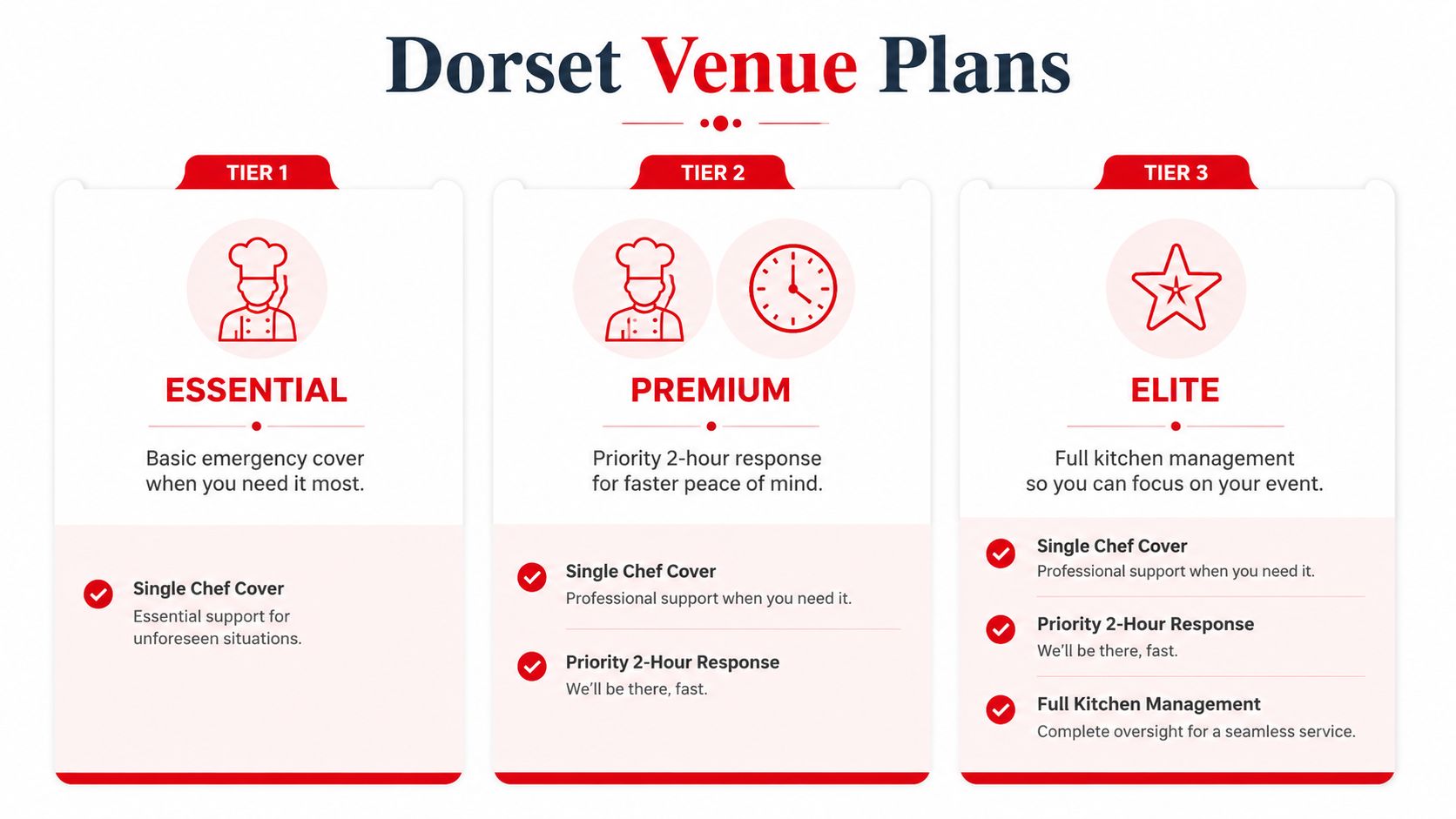
Every requirement is different, so there are no fixed packages. Contact our team for a quote based on the role, location and dates. Our experienced recruitment team is available 24/7 to help you find the right cover, subject to availability.
The cheapest labour option is often the most expensive operational decision if it creates failed service, wasted management time, or repeat rebooking.
From Booking to Service Onboarding Your Relief Chef for Success
The booking isn't the finish line. The handover is where the shift is won or lost.
A relief chef should arrive ready to work, but even a strong chef needs a clean landing. The best operators don't overcomplicate this. They give the essentials fast, point the chef at the main pressure points, and let them get into rhythm.

Good onboarding protects the whole brigade
The strongest placements happen when the role was matched properly at booking stage. Matching technical specs, such as NVQ Level 3+ equivalence for a CDP role, leads to an 88% success rate, compared with a 62% failure rate from poor alignment, according to Chefs & Events relief chef benchmarks.
That rings true in live operations. If you send in a chef who can effectively run the required section, the brigade relaxes quickly. If you send in someone who needs carrying, the permanent team gets dragged backwards.
What the first hour should look like
A practical first-hour handover usually includes:
- Site walk-in: Entry point, changing area, kitchen flow, storage, key equipment.
- Menu priorities: What's selling, what's awkward, what's been eighty-sixed, what needs watching.
- Section ownership: Exactly what they own and who they report to during service.
- Non-negotiables: Allergen process, plating standards, cleaning close-down, stock handling.
Keep it tight. Long speeches don't help when prep is live.
A realistic Dorset example
Take a coastal pub on a hot Saturday. Lunch runs over, evening bookings are already loaded, and a core chef is unavailable. A properly matched relief chef walks into a brief that covers menu, section, prep status, and expected pace. They don't need theatre. They need facts.
By the time first tickets land, the chef is in position, the pass is calmer, and the head chef isn't trying to do two jobs at once. That is what successful cover looks like. Not magic. Just a professional fit.
What managers should check before service
Chef-run staffing models tend to outperform generic recruiter models. The conversation is operational, not abstract.
Use this quick manager check:
- Can they describe the section clearly back to you
- Do they understand your top allergens and service sequence
- Do they know who calls tickets and signs off issues
- Have you shown them the pinch points, not just the prep list
A good relief chef doesn't need babysitting. They do need a proper brief.
When that happens, temporary support stops feeling temporary. It just feels like the kitchen is covered.
Your Questions Answered Your Kitchen Secured
Managers in Dorset usually ask the same final questions, and they're the right ones.
Can you use /relief-chefs-dorset for more than pubs and restaurants
Yes. Dorset demand isn't limited to traditional hospitality sites. Boutique hotels, private households, villas, and yacht operations all face the same core issue. They need skilled kitchen cover that can adapt quickly to the site, standards, and guest expectations.
What if the problem is permanent, not temporary
Then treat temporary cover and permanent chef recruitment as two separate jobs. Temporary chefs protect service now. Permanent recruitment solves the structural gap. Blending the two usually creates confusion and leaves the current rota exposed.
Does this only matter in summer
No. Summer is louder, but winter sickness, festive trade, attrition, and rota fatigue create the same exposure. Dorset venues feel it differently by location and concept, but every busy kitchen needs contingency.
Is a relief chef suitable for high-standard operations
Yes, if the brief is accurate and the matching is done properly. High-standard sites don't fail because they use temporary support. They fail when they accept untested support, poor fit, or no cover at all.
What should a GM do before making the call
Provide the actual shift details. Service times, role needed, kitchen style, who will brief on arrival, and what absolutely cannot go wrong. That turns an anxious phone call into an operational decision.
Kitchen stability is not luck. It's planning.
If your Dorset venue is still relying on job boards, favours, and last-minute agency roulette, you're accepting avoidable risk. The professional choice is to secure a dependable route for relief chefs, temporary chefs, permanent placements, and specialist cover before the next gap hits the rota.
If your kitchen can't afford another exposed shift, contact Relief Chefs UK and get proper cover in place. Whether you need short-notice relief chefs in Dorset, temporary chefs for peak trading, permanent chef recruitment, or specialist yacht and villa chef support, the priority is simple. Keep service stable, protect revenue, and stop gambling with your rota.
Call the team.
Office 01392 715474 · info@reliefchefs.co.uk