
What Is Staging in a Restaurant in the UK
4 September 2026

A stage in a restaurant is a short, unpaid kitchen trial used to assess a chef's skills and fit, but UK law only allows that arrangement when the person is being assessed rather than providing productive labour. The distinction matters, especially when a kitchen is short-staffed and a “trial” starts looking like an ordinary shift.
The familiar situation is a Saturday service approaching, a chef has called in sick, and a promising CV is sitting in the inbox. The temptation is obvious: bring the candidate in, put them on prep or a section, and see whether they can keep up. That may solve an immediate staffing problem, but it can also turn a recruitment exercise into unpaid work with legal, insurance and operational consequences.
For context, the UK restaurant market is substantial. The Office for National Statistics recorded 31,420 licensed restaurants in 2022, compared with 29,680 in 2021, an increase of 1,740 establishments, or about 5.9%, as reported in UK guidance on staging and employer responsibility. Restaurants across Devon, Bristol, Wales, Berkshire, Windsor, Reading, Slough, Dorset and other hospitality centres are competing for chefs while trying to protect service standards.
This is a practical briefing on what staging in a restaurant means in the UK, how it differs from a paid trial shift, and when an agency chef is the more sensible answer. The principle is straightforward: use staging to assess a future hire, not to disguise a labour gap.
What Staging in a Restaurant Actually Means
A sous chef asks a strong line cook to spend part of a day demonstrating pastry, larder and garnish work before the restaurant offers a permanent role. The candidate watches the briefing, prepares a defined dish, works under supervision and discusses the kitchen at the end. That is a stage.
A kitchen stage, also called a “stage”, is a short observation, demonstration or assessment period in which a chef shows relevant technique and experiences the way another brigade operates. The word comes from the French stagiaire, meaning trainee or intern. UK hospitality guidance describes it as a short, unpaid kitchen trial intended to help someone learn and demonstrate ability, rather than a formal job role.
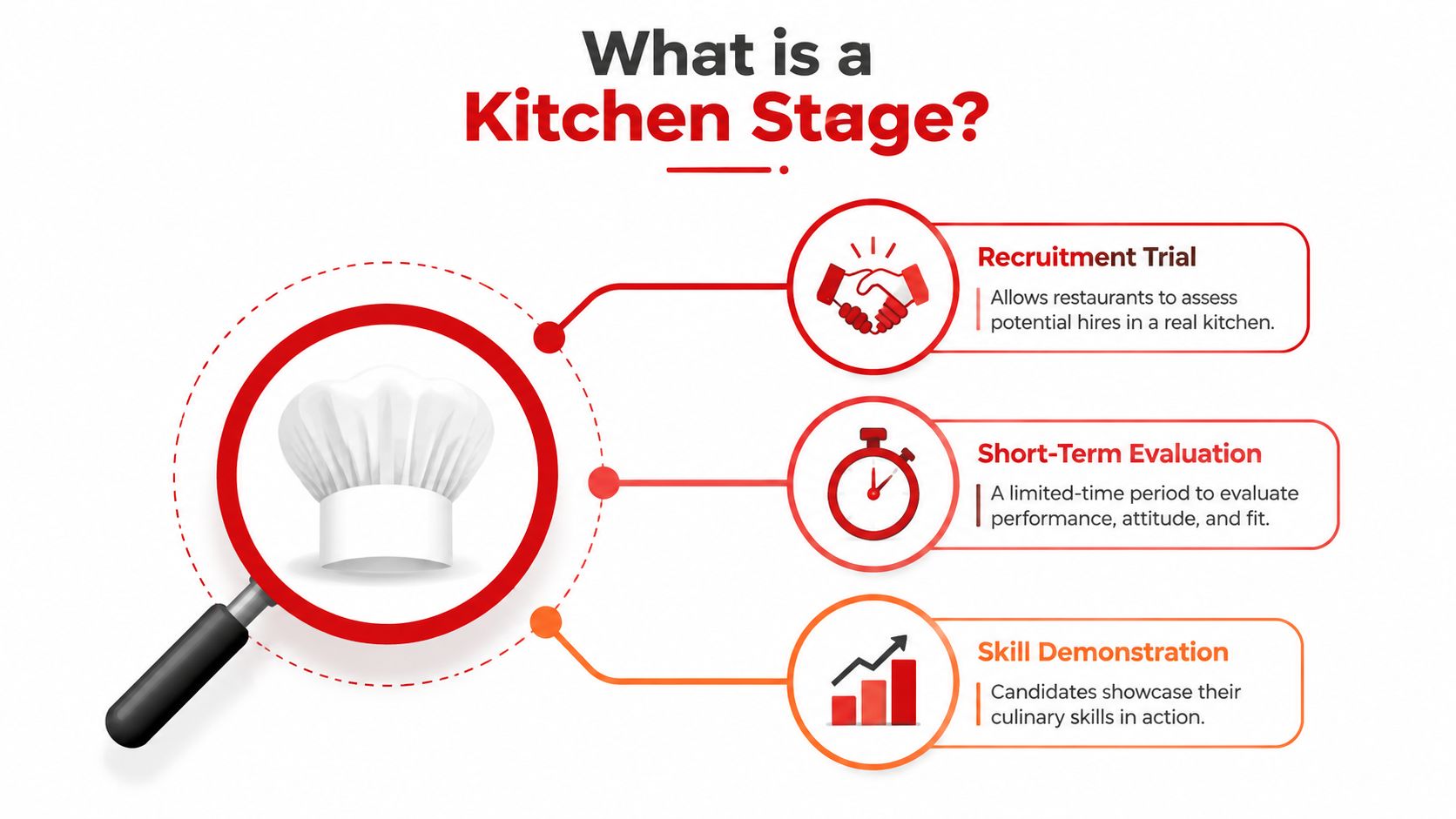
The legal caveat must sit at the centre of the arrangement. HMRC-focused guidance on UK trial shifts explains that an unpaid trial is only lawful when the person is being assessed rather than providing productive labour. It also recommends paying at least the National Minimum Wage for time worked and setting out the trial in writing beforehand.
What a sound stage includes
A credible stage has a defined purpose and a named supervisor. It might include:
- A tour of the kitchen, stores, pass and staff facilities.
- A menu and allergen briefing before any practical work.
- A knife-work or preparation demonstration.
- A signature dish prepared for assessment.
- Observation of service without taking over a paid employee's station.
- Feedback on technique, organisation, communication and standards.
The restaurant should learn whether the chef is suitable. It shouldn't receive a free replacement for an absent commis, CDP or sous chef.
Practical rule: If the kitchen depends on the person to keep service moving, treat the time as work and pay for it.
For chefs, staging can reveal equipment, pace, food standards, team culture and management style. For operators, it can test practical ability more effectively than a CV. But a person who is washing dishes, running a section, plating commercial orders or covering sickness is no longer merely observing.
Chefs considering a stage should agree the purpose and boundaries in advance. The guide to working for a temporary agency also helps candidates understand the alternative when they want paid kitchen experience rather than an unpaid assessment.
Staging vs Trial Shifts vs Internships
A chef arrives for an unpaid stage, then spends the evening running a section while a regular employee is off sick. The venue may call it assessment, but the kitchen has received productive labour. That distinction decides whether payment is required.
| Arrangement | Main purpose | Typical structure | Payment position | Best used for |
|---|---|---|---|---|
| Staging | Assess technique, fit or culinary interest | Short, supervised demonstration or observation | May be unpaid only where the person is genuinely being assessed and isn't providing productive labour | Permanent recruitment, specialist exposure or cultural fit |
| Paid trial shift | Test performance in real work | Candidate works alongside the brigade during prep or service | Pay at least the applicable National Minimum Wage for productive time, with suitable working arrangements | Assessing performance under actual service pressure |
| Internship | Provide structured learning over a longer placement | Defined objectives, supervision, programme and outcome | May be unpaid only where the relevant work-experience conditions genuinely apply | Education, recognised placements and planned development |
A paid trial shift is the correct route when the candidate prepares stock the kitchen needs, works a section, plates dishes for paying guests or covers a scheduled role. The label “stagaire” does not change the work performed or remove the obligation to pay for productive time. Set the shift up in writing, including duties, hours, pay and supervision.
Use a stage for a controlled assessment. Ask the chef to demonstrate a technique, prepare a planned dish or explain how they would organise a section. Keep the task supervised and separate from the kitchen's normal labour requirement. If service cannot run without the candidate, stop calling it a stage and pay for the shift.
An internship serves a different purpose. It requires learning objectives, supervision and a genuine educational basis. A placement linked to a recognised college course may fall within specific work-experience rules. Relabelling an unpaid job as an internship to avoid payment is poor practice and creates legal risk.
The decision is straightforward. Use staging to assess technique and fit. Use a paid trial shift to test safe performance during real work. Use an internship for planned education and development. For the relevant rules, review employment law for temporary staff.
If tonight's problem is a rota gap, choose neither an unpaid stage nor an internship. Book a properly contracted relief chef who can cover the work legally and safely.
Typical Stage Durations, Goals and Structures
A stage should answer one recruitment question within a defined period. It is an assessment tool, not a replacement for induction, probation, training or scheduled labour. If the kitchen needs the candidate to keep service running, set up a paid trial shift instead.
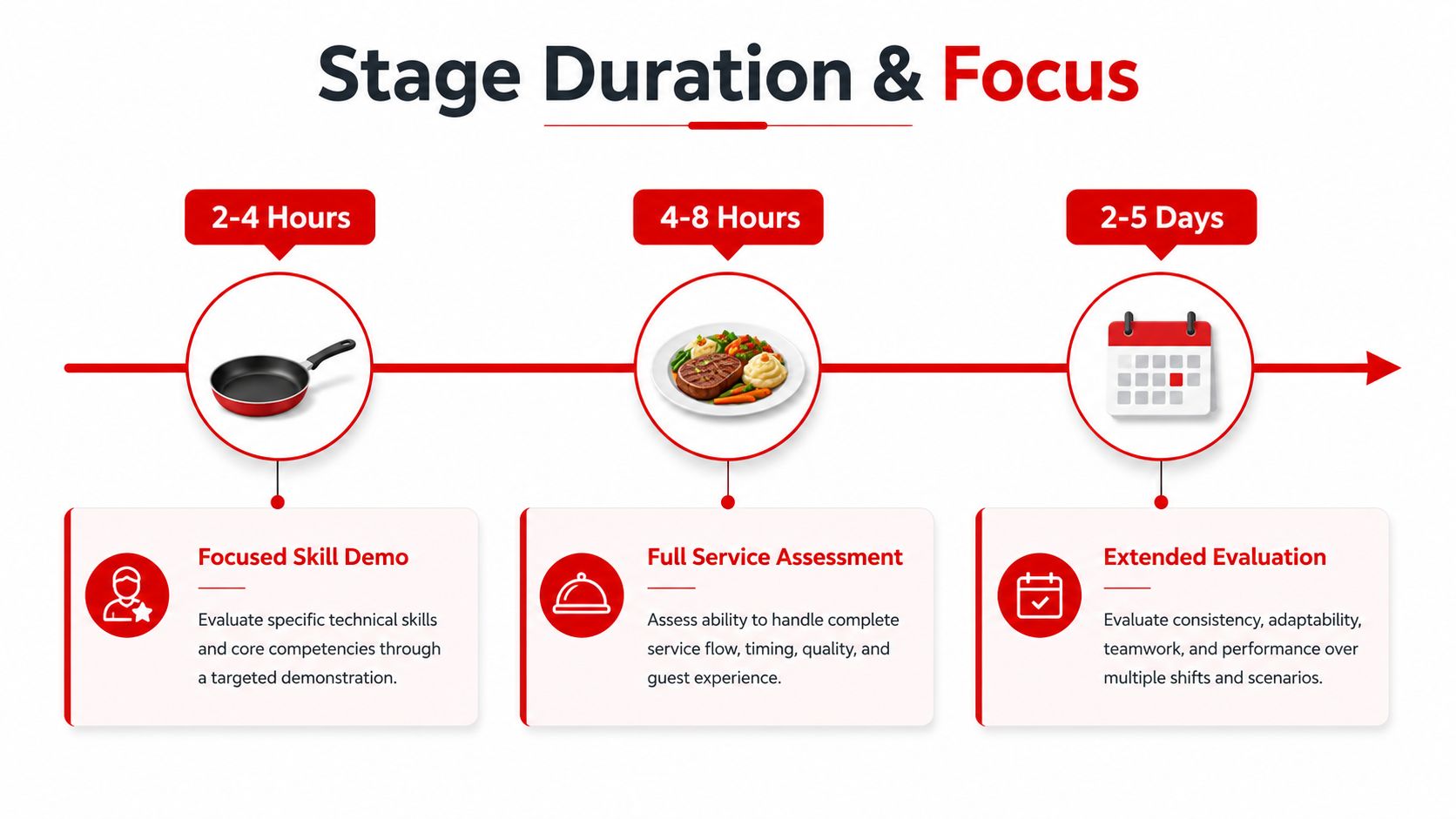
A focused skill demonstration may last two to four hours. A service assessment commonly runs four to eight hours. A more complex development stage may extend to one or two days, particularly in a boutique hotel or high-volume kitchen. These ranges appear in UK staging guidance for chefs and employers.
Match the assessment to the vacancy
An independent restaurant hiring a CDP might ask a candidate to prepare a signature dish, organise a section and explain their approach to waste, seasoning and timing. The head chef should observe the work rather than use the candidate to complete the normal prep list.
A boutique hotel may need evidence of pastry, banquet and fine-dining standards. Set a planned task, then ask structured questions about breakfast volume, functions and plated service. Do not turn the assessment into several unpaid shifts across every department.
A pub kitchen may focus on speed, ordering, stock control and menu discipline. Ask the candidate to demonstrate how they would organise a compact service with limited equipment and a tight menu. The operator must still separate assessment from productive cover.
Build a written running order
A useful stage plan contains:
- A confirmed start and finish time.
- The name of the supervising chef.
- The specific skills being assessed.
- Food-safety, allergen and site-rule briefings.
- Defined practical tasks, with ingredients and equipment explained.
- A feedback meeting and agreed next step.
A productive working stage should not continue for a week without pay. If the vacancy needs a longer evaluation, use paid work with clear terms. If the kitchen needs immediate cover, book a qualified relief chef instead of extending the assessment.
Chefs who need structured development can review training for chefs. End every stage with a clear decision: offer, paid follow-up assessment, or no further process.
Practical Checklists for Chefs and Venues
Good staging depends on preparation from both sides. A chef who arrives without the right kit wastes the first part of the day, while a venue that hasn't briefed its brigade creates an awkward and potentially unsafe visit.
Checklist for the arriving chef
Use this before leaving home:
- Prepare your knife kit and whites: Check that knives are sharp, labelled where appropriate, and safely stored. Bring clean chef whites, non-slip footwear and anything agreed in advance.
- Arrive 15 minutes early: Allow time to find the entrance, change and meet the supervisor without disrupting prep.
- Introduce yourself to the brigade: Speak to the head chef, sous chef, section leads and anyone working directly with you.
- Ask about the menu and allergens: Get the briefing before handling ingredients or plating food. Never guess about allergens.
- Keep a pocket notebook: Record methods, equipment, prep systems and questions rather than interrupting every task.
- Taste what you're offered: Family meal, sauces or components can tell you a great deal about seasoning and standards.
- Ask one focused question at a time: Listen to the answer, then apply it. A stage is an assessment of judgement as well as knife skills.
- Request a debrief: Ask what went well, what needs work and whether the restaurant will contact you about the role.
Checklist for the hosting venue
The operator should complete these actions before the chef arrives:
- Confirm dates, hours and meals in writing: State whether the visit is observation, practical assessment or paid work.
- Brief the head chef and brigade: Everyone must understand why the candidate is there and what they are not there to do.
- Set clear goals: Decide whether you're testing pastry, larder, grill, organisation, communication or leadership.
- Assign a mentor: One named person should supervise rather than leaving the candidate to drift between stations.
- Run a safety briefing: Cover knives, hot equipment, manual handling, fire procedures, allergens and emergency arrangements.
- Agree feedback points: Observe specific behaviours, not vague impressions about whether someone “fits”.
- Book a 15-minute review: Give the candidate a definite end point and explain the next step clearly.
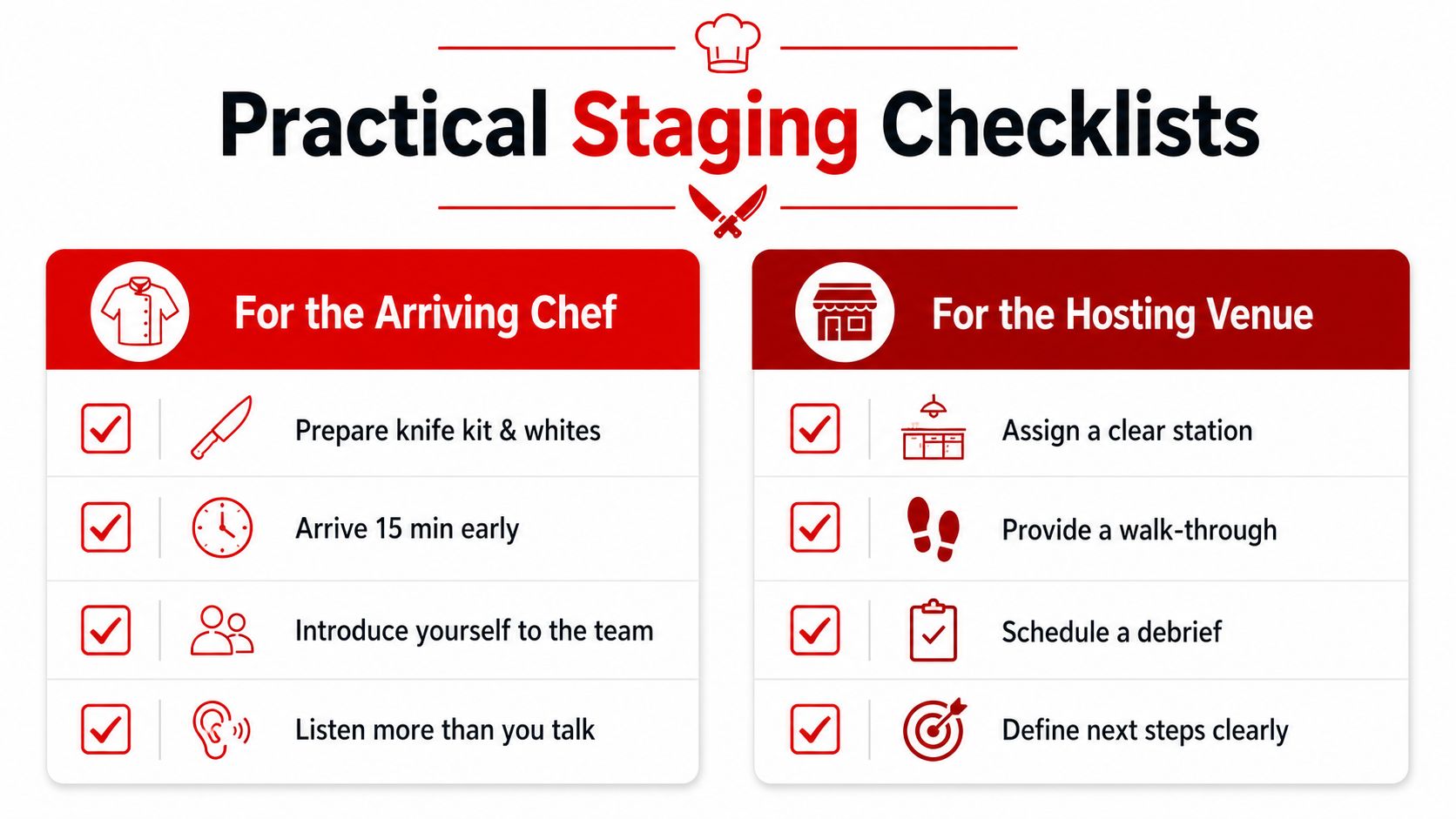
Print these lists for the pass or staff area. A written process protects the candidate, the venue and the quality of the hiring decision.
Legal, Pay and Insurance Rules UK Operators Must Know
The dangerous assumption is that staging is automatically free because the chef has agreed to it. Agreement doesn't turn productive labour into unpaid observation.
Under UK National Minimum Wage principles, a genuine assessment may sit outside pay rules when the person is being assessed rather than used as labour. The moment the chef performs a normal shift, covers an absence, runs a section or completes work the restaurant would otherwise pay someone to do, the operator should treat the time as paid work. UK trial-shift guidance based on HMRC rules recommends paying at least the National Minimum Wage for time worked and documenting the arrangement beforehand.
Compliance duties don't disappear
Before anyone enters a working kitchen, the operator should deal with:
- Right-to-work checks.
- Written confirmation of the arrangement, dates and hours.
- Employer's liability insurance and confirmation that the person is covered.
- A health and safety induction under the Health and Safety at Work Act 1974.
- Knife, fire, hot-surface and manual-handling instructions.
- Allergen controls and training relevant to Natasha's Law.
- Clear supervision and an incident-reporting process.
A person injured while handling a knife, lifting stock or working around hot oil creates an immediate safety and insurance question. The venue shouldn't assume its insurer will treat an unpaid stagiaire exactly like an employee or approved work-experience placement. Confirm the position with the insurer before the stage begins.
The legal trigger is what the person does
| Likely still a legitimate stage | Likely a paid trial shift |
|---|---|
| Observing a briefing and service flow | Preparing the normal mise en place list |
| Watching plating without taking over | Plating orders for paying guests |
| Completing a controlled demonstration | Running a section during service |
| Practising with training ingredients | Producing food the kitchen needs to sell |
| Taking notes and receiving feedback | Covering a sick chef or vacant rota line |
| Working under close instruction with no operational reliance | Working independently as part of the brigade |
An operator who gets this wrong may face backdated wages and HMRC enforcement. Health and safety failures can also trigger intervention, while poor documentation can complicate an insurance claim if the person is injured.
Red flag: If service would be slower, less safe or incomplete without the staged chef, stop calling it a stage and pay for the work.
The wider staffing climate makes discipline more important, not less. UKHospitality reported over 112,000 unfilled roles across the sector at the end of 2023, including shortages of 10% for head chefs and more than 20% for production chefs, in its account of staging and UK hospitality labour pressures. Shortages explain why operators feel pressure, but they don't remove the obligation to distinguish assessment from work.
When to Use Staging and When to Book a Relief Chef
Staging is a recruitment tool. It isn't an emergency staffing plan.
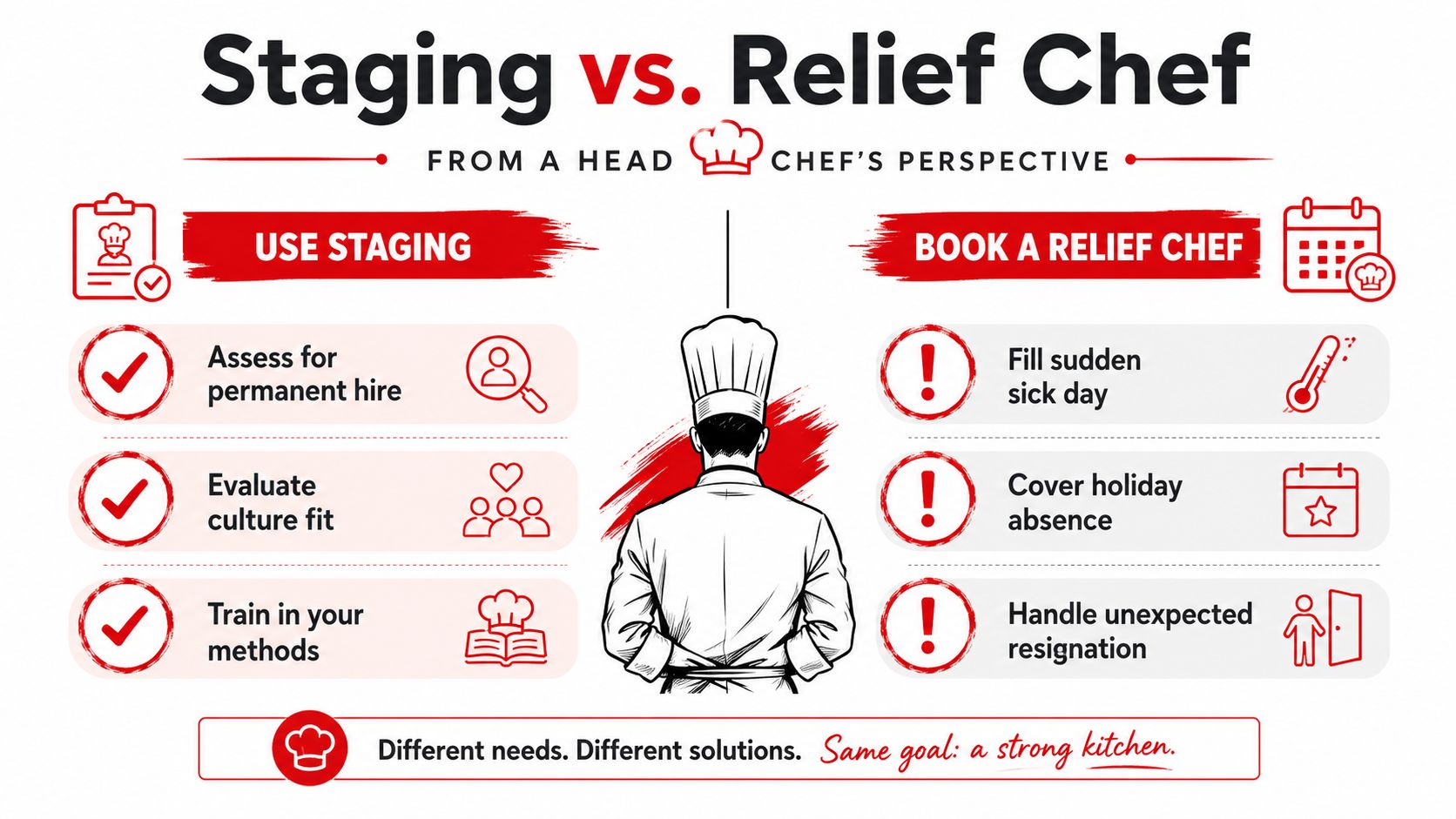
Use it when you have a real permanent vacancy, a candidate has passed an initial screening, and you need to observe technique, communication and culture fit. It also makes sense when assessing a senior sous chef or head chef, where leadership, organisation and standards matter as much as cooking ability.
Don't stage your way out of:
- A same-week sickness absence.
- A fully booked Saturday.
- A holiday gap.
- A chef who has resigned mid-week.
- A seasonal demand spike.
- A kitchen already operating without enough experienced supervision.
UKHospitality has described a shortfall of about 188,000 workers, with chef vacancies and front-of-house gaps particularly acute, as reported by the BBC on hospitality staffing shortages. That pressure is real in hotel kitchens in Windsor and Berkshire, restaurants around Bristol and Devon, and seasonal businesses in Dorset and Wales. It still doesn't make an unpaid candidate the right person to protect service.
Use this decision rule
Ask one question: Are you assessing someone for a future role, or do you need someone to work a shift now?
If the answer is future role, structure a stage or paid trial properly. If the answer is today's service, arrange a relief chef. A relief chef arrives as paid cover, with the appropriate checks, experience and readiness to contribute. That protects kitchen stability while your permanent recruitment process continues.
Staging looks cheap on paper, but it takes management time and may produce no immediate operational output. A relief chef costs per shift, yet keeps service moving and prevents a recruitment trial from becoming a compliance problem.
The temporary staffing market already supports flexible cover. The Office for National Statistics recorded 1.12 million people in temporary employment between January and March 2024, equal to 3.6% of everyone in work, and included fixed-term, agency, casual, seasonal and other arrangements in its classification, as summarised by Relief Chefs UK's temporary staffing resource.
Choose the arrangement that matches the problem. Stage for a considered hire. Book paid temporary cover for an operational gap.
Staging Questions UK Operators Ask Most
How short can a stage legally be?
There isn't a simple duration that automatically makes an unpaid stage lawful. A short visit can still be work if the candidate is producing food, covering a station or performing tasks that benefit the restaurant.
The safer test is purpose and activity. Keep an unpaid assessment observational or instructional, define the boundaries in writing, and supervise it closely. If the candidate contributes productive labour, pay at least the applicable National Minimum Wage for the time worked.
What happens if a staged chef is injured?
An injury can expose gaps in employer's liability insurance, risk assessment, supervision and training. A kitchen operator must not assume that an unpaid label removes responsibility for knives, hot equipment, manual handling, fire safety or allergen controls.
Before the visit, check insurance arrangements and complete the same safety induction you'd expect for anyone entering the working kitchen. If the person is working, a paid arrangement with clear terms is the responsible route.
Can an overseas candidate stage on a Standard Visitor visa?
Don't assume that a Standard Visitor visa permits a chef to work in your kitchen. Immigration permission depends on the visitor's circumstances and the activity involved, and a productive stage can look like work rather than observation.
Check the current UK government immigration rules and obtain specialist advice before arranging any visit by an overseas candidate. Complete right-to-work checks where required. If the candidate needs to perform kitchen duties, don't rely on the word “stage” to make the arrangement permissible.
Does staging help retention?
A well-run stage can improve the hiring decision because both sides see the kitchen's pace, standards and working culture before committing. That can reduce the risk of appointing someone who dislikes the menu, equipment, leadership style or service rhythm.
It won't fix poor management, inadequate pay, unstable rotas or chronic understaffing. UKHospitality also reported that the proportion of 16 to 24-year-olds working in hospitality fell by almost a third between 2019 and 2023, highlighting the sector's difficulty attracting younger workers in its UK staging and labour-market discussion. Use staging to improve fit, then retain people with fair conditions and competent leadership.
If you need a chef this week, don't run a multi-day stage and hope it fills the rota. Arrange paid temporary cover, then conduct your permanent recruitment assessment when the kitchen is stable.
Relief Chefs UK provides nationwide relief chefs, temporary chefs, permanent chef recruitment, yacht chefs, villa chefs and wider hospitality staffing support for pubs, restaurants, hotels and private operations. Visit Relief Chefs UK to request reliable cover for short-notice sickness, seasonal demand or an unexpected resignation, and speak to a team that understands kitchens because it's run by chefs.
Call the team.
Office 01392 715474 · info@reliefchefs.co.uk