
Your lunch rush is already bad enough without a chef calling in sick, a temporary replacement arriving at 9 a.m., and the allergen sheet sitting in the wrong folder. That is how food labelling regulations get breached in hospitality, not in some neat theoretical scenario, but on a Tuesday when the pass is full, the fridge is busy, and someone has changed the soup recipe without telling front of house. If you run a pub, hotel kitchen, café, deli, or private dining operation, labelling is not admin. It is part of keeping service legal, safe, and steady.
The hard truth is simple. A clean label system protects guests, supports kitchen handovers, and stops last-minute cover from turning into a compliance problem. That matters even more when you rely on relief chefs, temporary chefs, seasonal teams, or agency cover, because the moment your menu changes and your team changes, label accuracy gets fragile fast. If your operation needs stability as well as staffing, you need both a reliable chef rota and a labelling process that does not fall apart under pressure.
Why Compliance with Food Labelling Regulations Matters
A busy pub kitchen in Devon or Bristol can look organised right up until a chef rings in sick and the lunch prep shifts to a new pair of hands. The miso glaze is still on the pass, the sandwich labels are yesterday's version, and the allergen note for the warm tart has not been updated. That is the point where a service issue turns into a guest-safety issue, then into a legal one.
Food labelling regulations exist because guests need accurate information at the point they choose food. In the UK, that means the label or notice has to tell them what they are buying, what is in it, and where allergen risks sit. For hospitality operators, the operational problem is not the rule itself. It is the pace of change. Temporary cover, menu swaps, seasonal specials, and short-notice sickness all create the same danger, labels drift out of sync with the food being served.
Practical rule: if the recipe changed, the label changed, and the allergen call-out changed with it.
That sounds obvious, but kitchens fail on the handover. A head chef knows the dish. A relief chef follows the old prep sheet. Front of house repeats what was printed last week. Guests do not care why the information was wrong, and regulators will not either. The only safe answer is a label process that survives staff turnover and busy service.
Relief Chefs UK understands that reality because stable staffing and compliant labelling are linked. A kitchen with dependable cover is easier to standardise, easier to brief, and less likely to rely on memory alone. If your venue in Berkshire, Windsor, Reading, Slough, Dorset, Wales, or the South West is juggling short notice sickness or seasonal demand, you need cover that fits into a compliance system, not one that adds more confusion.
The point is not to make labels fancy. The point is to make them reliable enough that anyone walking into the kitchen can trust them.
Understanding the Legal Framework
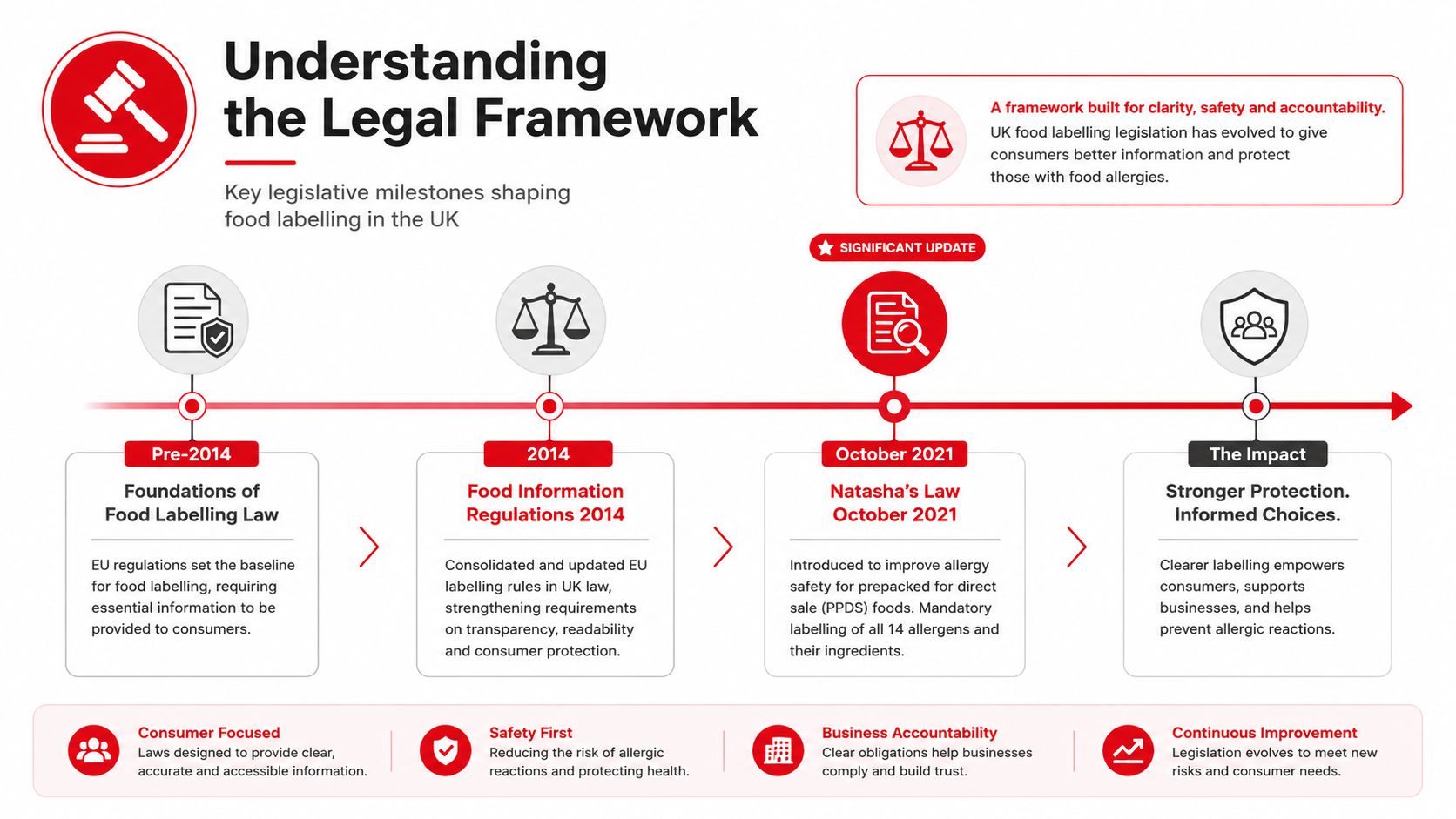
The UK framework starts with the Food Information Regulations 2014, then gets sharper with Natasha's Law, which took effect on 1 October 2021 across the UK, with equivalent rules in Northern Ireland, Scotland and Wales. Under those amendments, prepacked for direct sale (PPDS) food must carry the name of the food, a full ingredients list, and the 14 major allergens emphasised within that list. The Food Standards Agency explains that this was designed to close a long-standing allergen-information gap for foods made and packed on the same premises where they are sold, which is common in cafés, pubs, bakeries and hotel grab-and-go counters. Food Standards Agency guidance on Natasha's Law and PPDS labelling
What the rules actually cover
UK rules require mandatory particulars to be available at the point of choice. That includes the name of the food, ingredients including allergens, net quantity, date mark, FBO name and address, and, where relevant, QUID, country of origin or provenance, storage and use instructions, alcohol strength, and nutrition information. Government guidance also says key fields such as the name of the food and net quantity should appear in the same field of vision, and labels must be indelible so they are harder to remove or tamper with. UK food labelling guidance from GOV.UK
That matters in hospitality because many operations use several label types at once. A hotel breakfast fridge, a deli counter, a garden bar, and a banquet prep room may all be handling different formats of the same ingredients. If the label architecture is inconsistent, mistakes multiply. One site prints storage instructions in a footer, another buries allergen emphasis in tiny text, and a third skips the address line entirely.
Why hospitality feels the pressure hardest
The law is not only about packaged retail goods. It also affects the loose, buffet, and chef-prepared items that busy kitchens rely on to make margin. That is where temporary chefs and rotating menus create the biggest risk. A reliable full-time team can carry recipe knowledge in their heads. A short-term cover chef cannot, unless your systems are clean.
The legal standard is only useful if your kitchen can apply it at speed.
For venue managers, the answer is simple. Standardise every label format you use, keep every recipe linked to an updated ingredients list, and treat every menu substitution as a compliance event, not a verbal note. If you need help reducing risk across staffing and operations, health and safety compliance support should sit alongside your food labelling process, not outside it.
Prepacked Versus Non Prepacked Rules
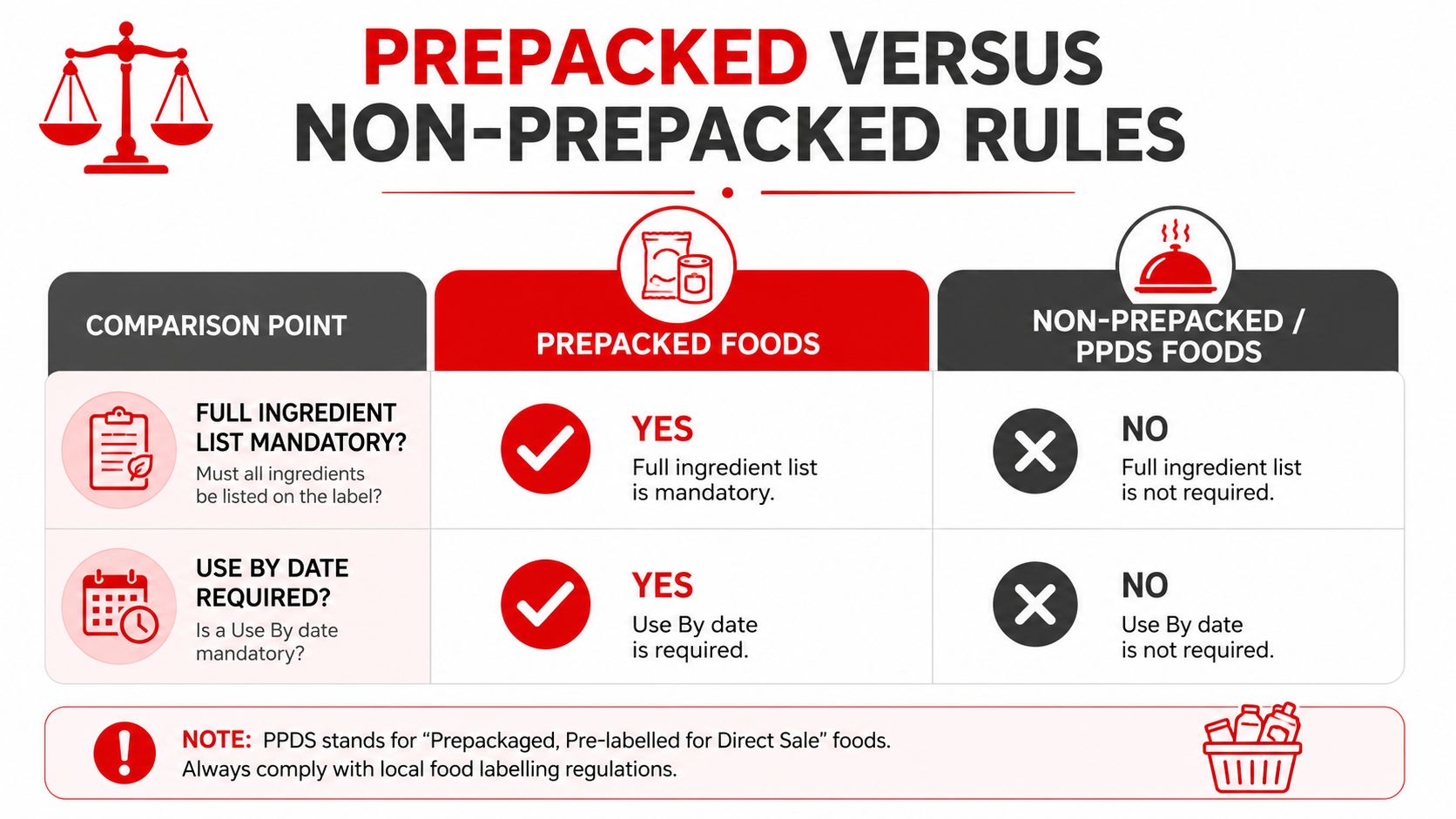
The confusion starts when teams use the word “labelled” as if it means the same thing everywhere. It doesn't. A sealed sandwich in the chiller, a tray of brownies on the counter, and a plated special on the menu all sit under different communication rules. If you blur them together, you will miss something.
Prepacked food needs full written detail
Prepacked items are the easiest to understand because the label has to do the heavy lifting. The name of the food, ingredient list, allergen emphasis, and other mandatory particulars need to be on the pack itself or directly linked to it. For hospitality teams, this usually covers bottled sauces, packaged desserts, and food sealed before sale in a way that prevents alteration.
Date marking matters here too. The Food Standards Agency makes the distinction clear, ‘use by’ is safety-critical, while ‘best before’ relates to quality rather than immediate safety. FSA guidance on labelling, allergens and date marks
Non-prepacked and PPDS food need point-of-choice communication
For non-prepacked foods, the 14 major allergens still have to be communicated in writing at the point of choice, through a label, notice, ticket, or menu, or through clear signposting to where that information sits. FSA guidance on packaging and labelling for business That is the point many hospitality venues miss. They assume a verbal explanation is enough. It isn't if the written information is missing or unclear.
PPDS food sits in a stricter category. Natasha's Law means the labels must be precise every time the item is packed for direct sale. For a café in Reading or a hotel breakfast operation in Berkshire, that might mean each grab-and-go sandwich needs its own updated label, even if the ingredient change seems minor.
The practical decision test
Use this simple check before service:
- Was it packed before the customer chose it? If yes, treat it as prepacked or PPDS and label accordingly.
- Can the guest see the ingredients information at the point they choose? If no, fix the signage or the menu.
- Did the recipe change today? If yes, the label file needs updating before the item goes out.
- Is the item using a date mark? If yes, train staff to distinguish safety from quality dates correctly.
That decision process is particularly useful when relief chefs come in and inherit an unfamiliar prep list. A dish that looked harmless on paper can become a risk if the label trail is not aligned to the actual recipe on the station. In Dorset, Windsor, or Devon, where seasonal demand often forces quick menu swaps, that discipline is what keeps service consistent.
Breaking Down Mandatory Label Elements
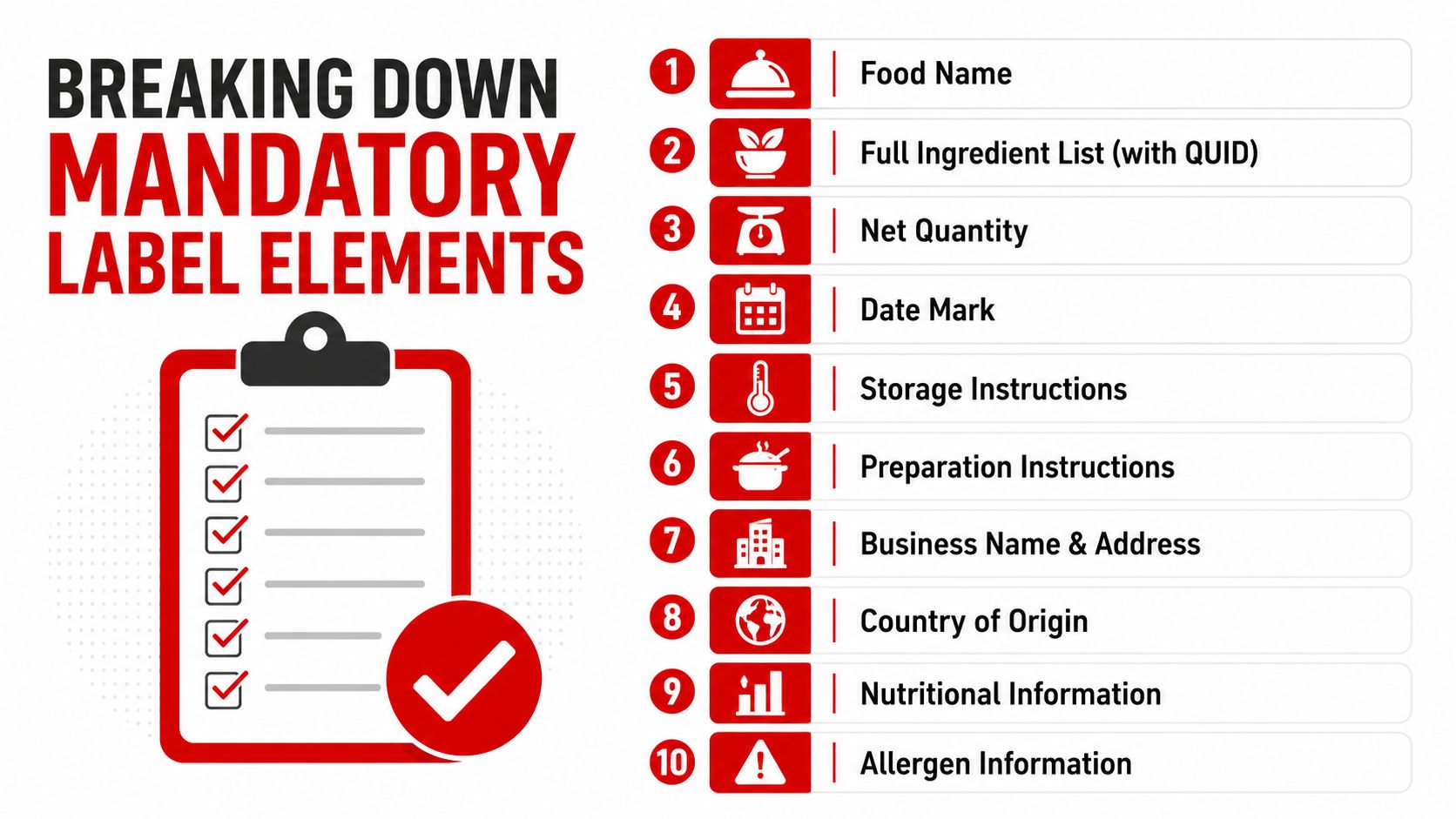
A compliant label is not a design project. It is a controlled piece of operational information. If one field is missing, the whole label is weaker. Government guidance requires the name of the food, ingredients including allergens, net quantity, date mark, FBO details, and, when relevant, QUID, origin, storage and use instructions, and nutrition information. GOV.UK food labelling guidance
Build every label from the same structure
Do not let each site invent its own version. Standardise the order, standardise the font hierarchy, and standardise where allergen emphasis appears. That gives temporary chefs and kitchen porters a familiar layout, even when they are covering in a hotel in Windsor one week and a pub in Bristol the next.
A workable label template should include:
- Food name. Use the exact dish name, not a vague description.
- Full ingredient list. Keep the sequence aligned to the recipe.
- Allergen emphasis. Highlight the relevant allergenic ingredients clearly.
- Net quantity. Especially important for packaged items.
- Date mark. Use the correct type for the product.
- Storage instructions. Be specific about chilled, frozen, or ambient handling.
- Business name and address. Keep it current.
- Country of origin. Add it when the rules require it.
- Nutrition information. Include it where applicable.
- QUID. State proportions when an ingredient is featured or emphasised.
Good label design reduces kitchen questions.
If staff keep asking what a product contains, the label is too vague or too hard to use.
Make labels operational, not decorative
A hotel grab-and-go sandwich needs a clear, compact label that can survive refrigeration, handling, and quick restocking. A bottled sauce in a pub store room needs a different treatment, but the same logic applies. If the recipe includes celery in the stock, sulphites in the glaze, or mustard in the dressing, that information needs to be visible and accurate, not hidden behind a stylised design.
The aim is consistency across sites. Temporary kitchen teams should not need to guess which field matters. They should be able to print, check, and place the label without improvising. That is how multi-site hospitality operators stop small mistakes from becoming repeated ones.
Adopting Allergen Labelling Best Practices
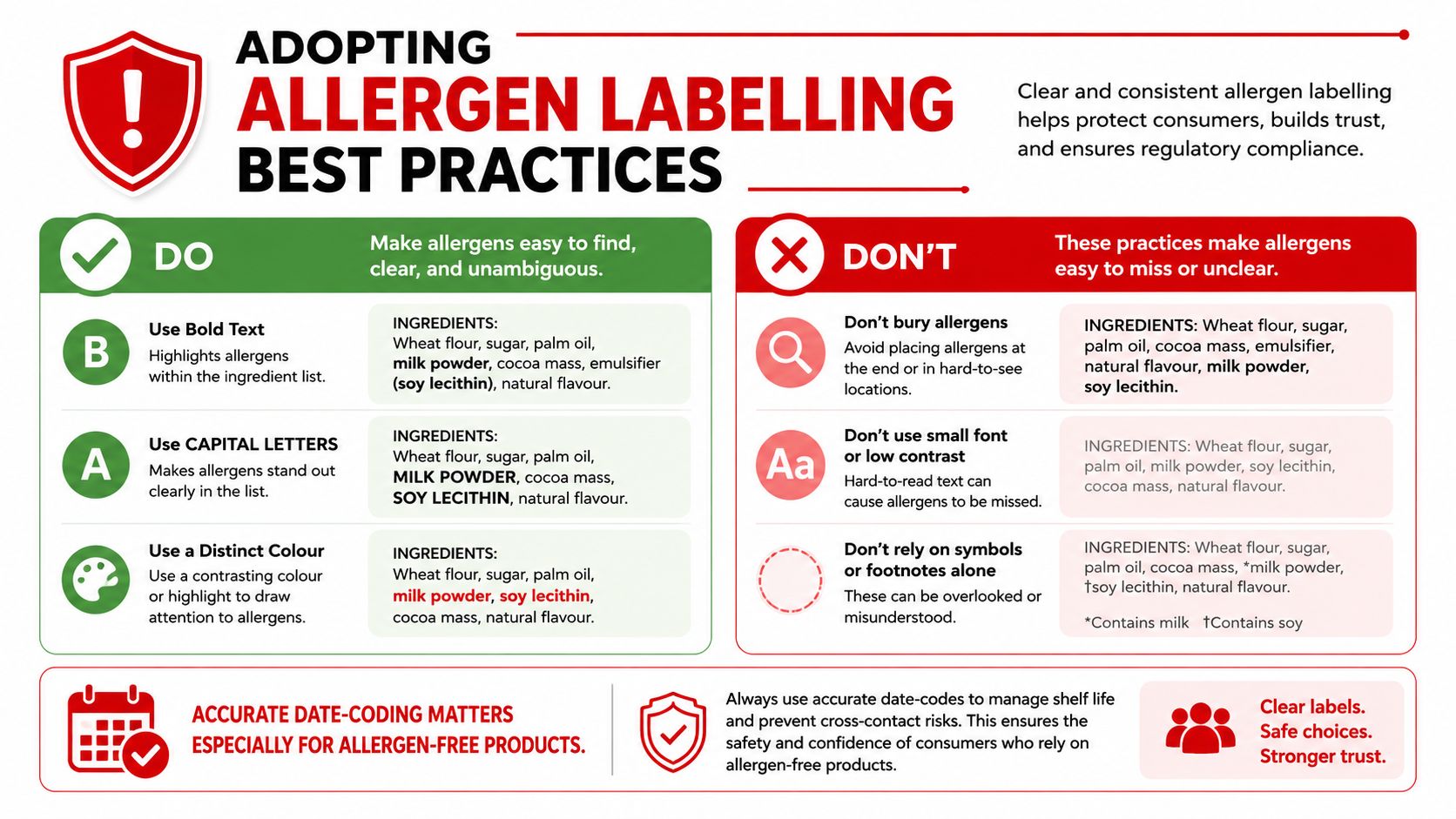
Allergen labelling fails when teams treat emphasis as optional styling. It isn't. For PPDS food, the 14 major allergens must be emphasised every time they appear in the ingredients list, and ‘use by’ dates are legally critical, because selling past them is a criminal offence. FSA guidance on allergen emphasis and use by dates
Use visible emphasis that kitchen staff can actually apply
Bold text is the cleanest option for most kitchens. Capitals can work if they're used consistently. Contrasting colour can help, but only if it remains readable after printing, chilling, or handling. The point is visibility, not decoration.
For loose food, buffet lines, and chef-prepared dishes, the written allergen information must still be available at the point of choice. If you are not providing it on the menu or label, then clear signposting has to show guests where to find it. FSA business guidance on packaging and labelling
Treat date coding as part of allergen control
Date coding is not separate from allergen safety. If a chilled item is past its safe limit, or a prep item is being rotated without proper checks, the risk rises fast. That is especially true in kitchens using relief chefs or temporary cover, where the person placing the item out may not know the prep history.
If your team uses a yacht chef, villa chef, or short-term relief chef, train them to work from the label system, not memory. Add a simple daily check for:
- Label match. The label matches the dish on the pass.
- Allergen emphasis. Every relevant allergen is highlighted.
- Date status. Nothing past its safe date is released.
- Service changes. Any substitution gets a fresh label before service.
- Signposting. Guests can quickly find information for loose items.
If you want a staff-facing process that reinforces the written system, use allergen awareness training alongside your kitchen induction, not as a one-off box tick.
Avoiding Common Compliance Pitfalls
The biggest mistakes are rarely dramatic. They are boring, repeated, and completely avoidable. Outdated templates stay on the system because the manager is busy. A chef changes a garnish and forgets to reissue the ingredients list. A temp cover chef assumes the previous day's labels are still correct. That is how the gap opens.
The five failures that keep coming back
1. Outdated templates. Old versions of labels are often sitting on laptops, in shared drives, or pinned near the printer. Kill the old files. Keep one master version and remove the rest.
2. Unclear allergen emphasis. If guests or staff have to squint to find the allergen, it is not emphasised properly. Use a standard format and never improvise.
3. Rotating menu confusion. Specials boards, seasonal dishes, and buffet items change quickly. That means the label file has to move at the same speed. Do not leave this to verbal handover.
4. Staff turnover gaps. Temporary staff do not know your recipes unless you tell them. The FSA-linked concern here is blunt, inconsistent recipe knowledge is a leading cause of labelling errors in hospitality, and high turnover makes that worse. FSA analysis of labelling risk and recipe knowledge
5. Inconsistent date-coding. A label that looks fine but carries the wrong date is a safety risk. One person's idea of “still fine” is not a control system.
Fix the process, not just the label
A lot of operators try to solve this by redesigning the label artwork. That does very little if the source information is wrong. The fundamental solution is tighter control of recipe updates, a named owner for label approval, and a kitchen rule that no changed dish leaves the pass without a refreshed label.
That matters even more during peak season, short-notice sickness, or agency cover. An experienced head chef can usually spot a bad process. A new starter or cover chef often won't. Your system has to do the checking for them.
If a dish changes, the label changes before service. Not after the first complaint.
For hotels, pubs, and multi-site groups in places like Dorset, Berkshire, and the South West, the operational goal is not perfection. It is repeatable accuracy, even when the staffing picture is messy.
Using a Step by Step Implementation Checklist
A proper compliance reset starts with the labels you already use. Do not assume your current system is close enough. Pull it apart, check each line, and rebuild it around how your kitchen works today, not how it worked last season.
Start with the audit
Begin by listing every item sold in each format, prepacked, PPDS, loose, buffet, or menu-served. Then compare the label or notice against the dish as it is made now. If a recipe changed, if a supplier changed, or if a temporary chef altered the method, mark it for immediate review.
Use this sequence:
- Audit every current label. Check the food name, ingredients, allergens, dates, and business details.
- Match labels to live recipes. Do not trust old printed sheets.
- Separate categories. Prepacked, PPDS, and non-prepacked items need different handling.
- Refresh templates. Remove clutter and standardise the layout.
- Train the team. Make sure chefs, supervisors, and front-of-house staff know where the information lives.
- Build date-coding discipline. Set a daily check for chilled and safety-critical items.
- Spot-check service. Verify that what is on the label matches what is on the pass.
Use templates that staff can actually follow
A good template should work for a head chef in a boutique hotel and for a relief chef covering a pub kitchen at short notice. It should be simple enough to complete quickly, but strict enough to stop guesswork. Keep separate sheets for allergens, recipe versions, and approved labels, so the kitchen is not searching through old messages to find the current version.
If you want a starting point for structure, keep your team working from a single allergen list template that ties the recipe, the label, and the service note together.
For venues that use seasonal cover, yacht chefs, or villa chefs, that discipline matters even more. A temporary chef can only protect your compliance if the information they receive is clear, current, and easy to apply under pressure. Build your systems around that reality and you will cut the number of avoidable errors.
Navigating Enforcement and Official Resources
Enforcement starts with the assumption that your information should already be right. Local authority officers and the Food Standards Agency will not accept “we were short staffed” as a control measure. If the label is wrong, missing, or misleading, the venue owns the failure.
That is why this issue carries reputation risk as well as legal risk. A compliance lapse in a café, hotel, or pub does not stay inside the building. Guests talk, staff lose confidence, and managers spend time dealing with something that should have been prevented by a basic process.
What regulators look at first
They look for the written evidence. Is the food name correct? Are the allergens visible? Are the date marks appropriate? Is the point-of-choice information available for loose and non-prepacked items? Is the business using a consistent, controlled system, or a collection of ad hoc notes and memory-based handovers?
The answer needs to be yes before service starts, not after a challenge from a guest. That is why good operators keep a current label file, a recipe log, and a simple sign-off process for changes. It gives you a paper trail and a working kitchen at the same time.
The official sources you should keep close
The most useful public references are the Food Standards Agency pages on PPDS, allergen emphasis, and business labelling guidance, plus the government's broader food labelling guidance. Those are the texts your managers, head chefs, and supervisors should be reading, not guesswork from old printouts or social media summaries. FSA PPDS and Natasha's Law guidance, FSA guidance on packaging and labelling for businesses, and GOV.UK food labelling guidance are the core references worth bookmarking.
The wider context matters too. By late 2023, 95 countries had mandatory nutrient declaration policies, 71 countries had nutrient claims policies, and 44 countries had front-of-pack labelling systems, including 16 mandatory schemes. That shows food labelling has become a regulated compliance function globally, not just a retail design issue. Frontiers in Public Health review on global labelling policy
Don't wait for an inspection to clean this up
If your venue uses temporary chefs, seasonal cover, or rotating menus, the safest move is to lock your labelling process before the next busy period. Tighten your templates, brief your staff, and make sure every change is checked before food goes out. If you need dependable kitchen cover while you sort it, contact Relief Chefs UK for a staffing solution that supports steady service, safer handovers, and stronger operational control across the UK.
A CTA for Relief Chefs UK.