
Hospitality Staff Shortage: A UK Operator Guide
3 November 2026
“Just recruit harder” isn't much help when your only experienced chef calls in sick before a full Saturday service. More adverts won't get breakfast cleared, prep finished and the pass covered before lunch.
The hospitality staff shortage needs a more practical response. Protect the services you can deliver safely, identify the exact skill that's missing and choose cover that fits the gap, rather than asking the same exhausted team to stretch again.
Why One Missing Chef Still Closes a Service
Say a boutique hotel has breakfast still running when the sous chef phones in sick. The head chef is preparing a Berkshire wedding breakfast, the chef de partie hasn't run the restaurant pass alone, and lunch bookings are already arriving.
The rota looked complete yesterday. Today, the GM has to choose between shortening lunch, moving someone off banqueting or refusing walk-ins. None of those choices creates another competent chef.
The missing skill is the problem
For an operator managing the hospitality staff shortage in 2026, the immediate problem isn't a record-vacancy headline. It's a rota failure. A kitchen can have enough names on the sheet and still lack someone who can close, manage allergens or control the pass.
That affects single sites and hotel groups alike. Moving a chef between properties might rescue dinner at one hotel while leaving breakfast exposed at another.
A chef borrowed from another kitchen isn't extra capacity if their original service then runs short.
Short-notice sickness, no-shows, seasonal surges and unreliable generalist agencies require different decisions. A missing breakfast chef needs a different replacement from a head chef vacancy, even if both leave the same blank space on the rota.
Decide before guests arrive
Build service continuity planning around the services and stations you cannot safely leave uncovered.
- Name the critical role: Identify who can run each service independently.
- Set the fallback: Agree which bookings or dishes you would restrict before standards become unsafe.
- Give someone authority: The duty manager needs a clear route to approve cover without chasing several people.
Relief Chefs UK is a chef-led nationwide agency established in 2013, with the kitchen understanding needed to discuss the gap in operational terms.
Hospitality Vacancy Numbers That Still Matter
A falling vacancy count reads like recovery. It can just as easily mean a sector that trimmed trading hours and stopped advertising posts it could no longer afford to fill. Both stories sit inside the same figures, so the numbers below deserve a careful read.
UK hospitality vacancies, post-pandemic peak to August 2025
| Period | Vacancy figure | Change | What it means on the rota |
|---|---|---|---|
| End of 2022 | 147,000, reported in UKHospitality's ONS comparison | Post-pandemic peak | Permanent recruitment pipelines couldn't keep up |
| End of 2023 | 112,000 in the same UKHospitality comparison | Down from 147,000, still 23,000 above the pre-pandemic 89,000 | Still above the pre-pandemic staffing gap |
| Nov 2023 to Jan 2024 | 4.5 vacancies per 100 employee jobs, in the ONS jobs and vacancies bulletin | Highest rate among listed sectors | Particularly intense recruitment pressure |
| Jan to Mar 2025 | 84,000, in the Morning Advertiser's reporting of ONS figures | Down from 107,000, a 21.5% fall in the same report | Fewer vacancies; whether kitchens got easier to staff is a separate question |
| Q1 2025 | 81,000 in the ONS vacancy series | A different published reading for the same quarter | Check whether hours and covers fell too |
| Three months to May 2025 | About 79,000, in the House of Lords Library's sector review | Down 19% from 98,000; payroll down 4.6% year on year to 2,100,827, all in the same review | Lower employment alongside unfilled posts |
| August 2025 | 78,000, in the Morning Advertiser's ONS-based employment report | Up from 74,000 in July; payroll down 4.1% year on year, from 2,174,759 to 2,085,155, in the same report | Leaner teams while vacancies ticked up |
Fewer vacancies can mean less trading
The broad direction is clear: vacancy totals eased from the peak. What a headline cannot show is whether operators filled the posts or gave up on them.
Those are different outcomes. A pub that recruits a sous chef and restores lunch has improved its staffing position. A pub that takes lunch off the diary and pulls the advert has cut its vacancy count without restoring capacity.
August is the cleaner warning. Payroll employment fell year on year while the vacancy count ticked up from July, which points to leaner teams carrying unfilled posts rather than a recovered market. The Lords review shows the same pairing: a falling vacancy total alongside shrinking payroll numbers.
The quarterly figures need careful handling. The table lists two readings for the same opening quarter of 2025, and different releases work from different estimates. Read the direction, and don't splice the figures into a supposedly precise trend.
Measure the service you can actually sell
A national total won't tell a rural hotel whether an experienced closer can reach the property tonight. It won't show whether a London restaurant can recruit someone who fits its menu, hours and budget.
Use the headline as context, then check the rota against the booking diary. The useful question is whether your team can deliver the bookings you're accepting without relying on repeated favours.
- Unfilled shifts: Record which stations stay uncovered, not just which adverts stay open.
- Overtime: Check who keeps extending shifts or surrendering days off.
- Lost sittings: Log shortened services, refused bookings and opening days cut because the kitchen couldn't cope.
If the national count falls while those measures worsen, the kitchen hasn't recovered. It has shrunk to the size it can staff.
What Drove the Hospitality Staff Shortage
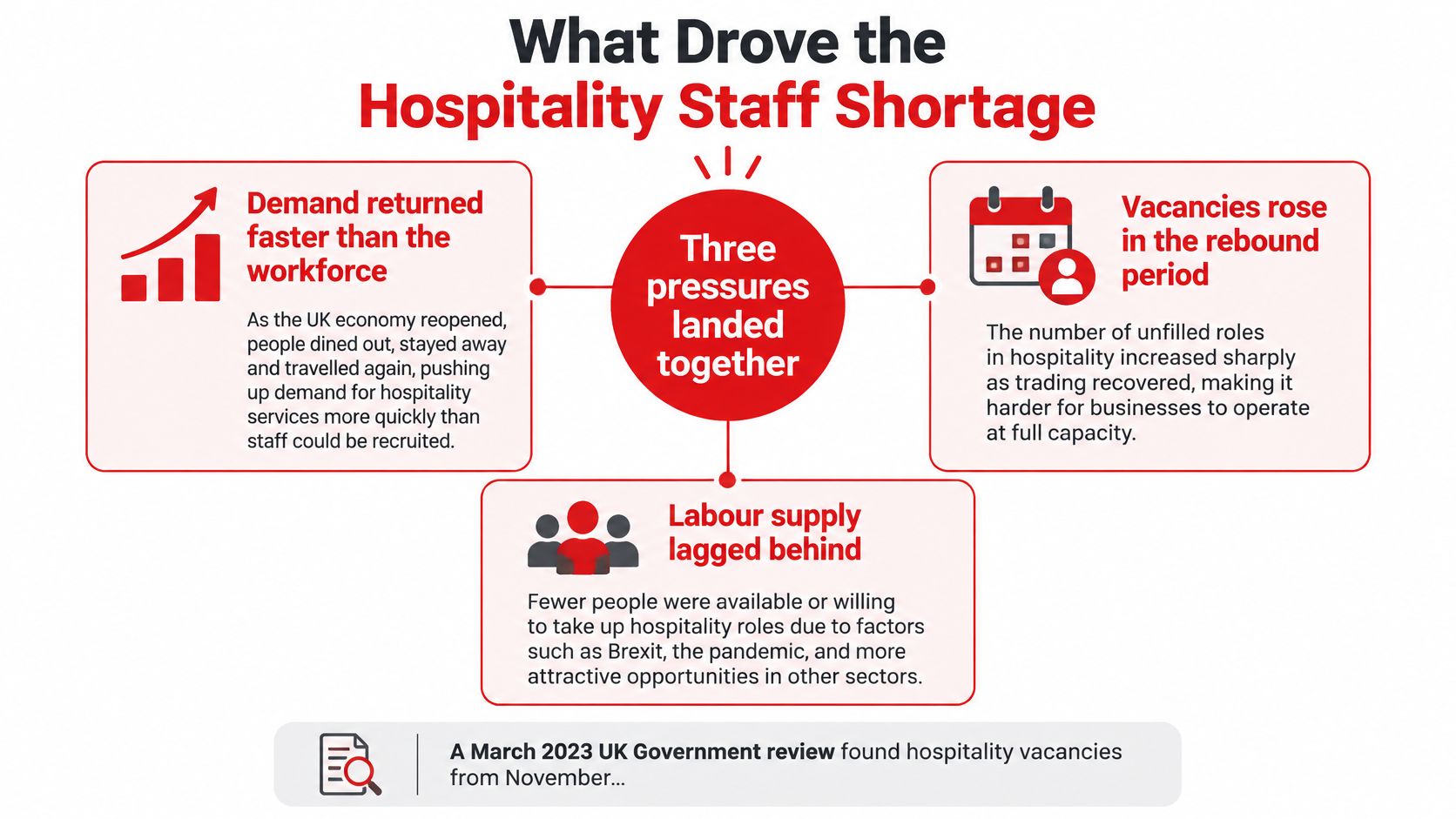
Demand returned faster than employers could rebuild their teams. A House of Commons Library review published in March 2023 found hospitality vacancies in November 2022 to January 2023 were 72% higher than in January to March 2020, compared with a 42% rise across the UK economy.
That review recorded record hospitality vacancies during 2022, with easing only beginning by early 2023. This was not the usual winter recruitment cycle.
The pressures overlapped rather than arriving neatly in turn.
Demand, workforce gaps and tighter margins
Employers also struggled to attract and retain the people needed to meet returning demand. A full booking diary doesn't mean a venue has rebuilt the kitchen behind it.
Employment costs then changed the recruitment calculation. A workforce dataset covering more than 35,000 employees, discussed by UKHospitality, reported labour costs rising 3% year on year to 35% of sector sales.
- Demand pressure: Guests return before the team is ready.
- Workforce pressure: Recruitment and retention leave gaps in experienced roles.
- Cost pressure: Managers delay replacing leavers to protect margin.
Say a country pub staffs for a quiet diary, then accepts a busy weekend without adjusting kitchen cover. The first sickness absence exposes the mismatch. Dropping Sunday evening may balance that week's wage bill, but it isn't evidence of a hiring recovery.
Chef Skills Gaps Versus Empty Headcount
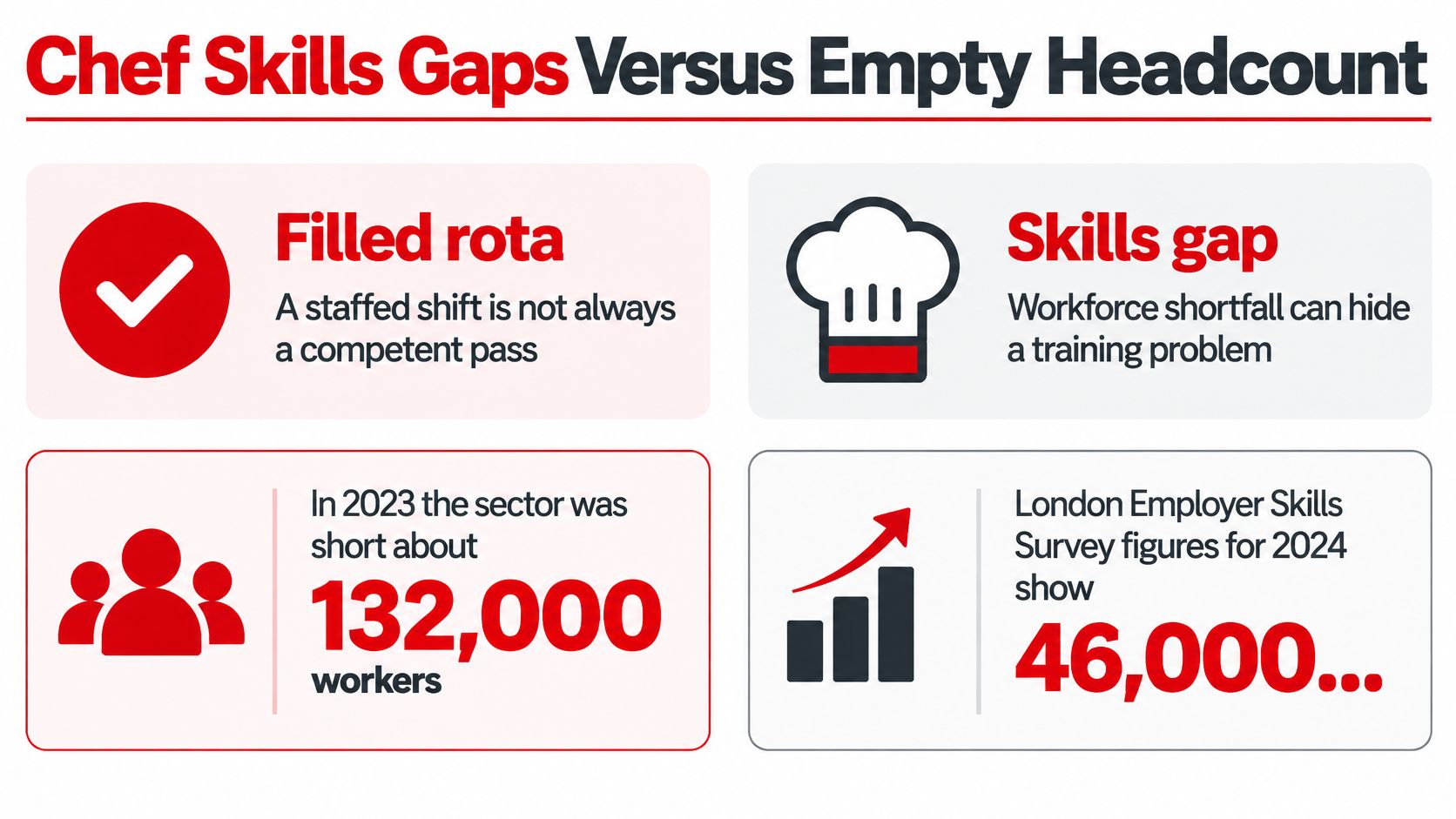
A filled rota isn't a competent pass. BDO's Hotel Britain report puts the sector's 2023 shortfall at approximately 132,000 workers and cites London-specific 2024 skills figures of 46,000 hard-to-fill vacancies, representing 24% of vacancies, alongside 310,000 employees, or 6% of the workforce, not fully proficient.
Those measures describe different problems. Recruiting another pair of hands doesn't necessarily restore allergen control, ticket times or independent production.
Specify what the chef must do
Start by identifying skill gaps, then separate independent cover from a supervised vacancy. A closing sous chef must make decisions immediately; a commis can develop under an experienced section leader.
Your booking brief should include:
- Service: Start time, expected covers, station and shift length.
- Capability: Seniority, menu style, production complexity and responsibility for the pass.
- Controls: Allergen procedure, handover arrangements and who authorises substitutions.
- Logistics: Exact location, access and live-in accommodation where available.
Stop the same gap reopening
A Berkshire country-house hotel and a Bristol wedding venue need different capabilities, not just different postcodes. Be equally specific about why permanent staff leave.
Check pay, workload, unstable rotas, supervision and progression. Temporary cover can create breathing room, but a chef de partie who cannot see a credible route upwards still has a reason to leave.
Staffing Models That Protect Service
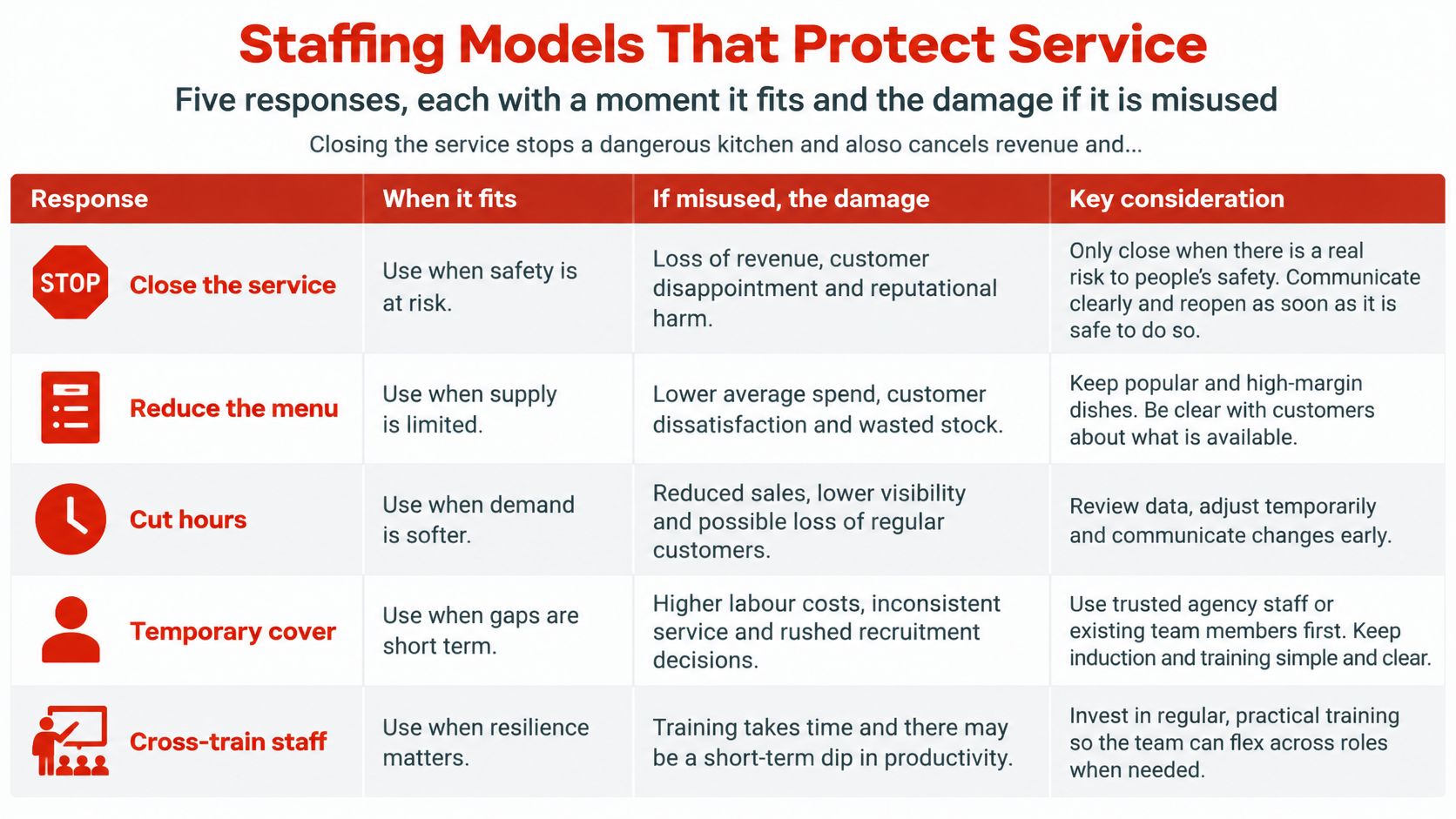
Match the response to the gap, not to the panic.
| Response | Use it when | Main risk | Effect on service |
|---|---|---|---|
| Close the service | No safe chef and no cover in time | Lost covers and damaged reviews | Guests turned away |
| Run the existing team longer | One quiet section and low covers | Fatigue, mistakes and walkouts | Standards slip by the pass |
| Book a relief or temporary chef | Sickness, a no-show or a known peak | Too late and local chefs are gone | Service holds while recruitment continues |
| Temp-to-perm trial | A head chef or sous role you expect to keep | A vague brief wastes the trial | You see the chef on your menu first |
| Simplify the menu only | Skill you cannot cover tonight | Becomes the permanent offer | Fewer dishes, labour cost barely moves |
Compare the cost with the service at risk
Closing is the correct decision when you cannot produce food safely. It also means cancelling revenue, contacting booked guests and fielding the next day's complaints, all before a single plate leaves the kitchen.
Running short can work when demand is low and the remaining chefs have the right skills. It fails when a head chef, sous chef and small section team are expected to cover breakfast, banqueting and dinner without recovery time. Overtime holds for a week. It rarely holds for a season, and the chef who absorbs it is often the next resignation.
Commercial test: Compare the cost of cover with the contribution from the sitting you can safely retain, not just with a permanent chef's hourly wage.
Menu reduction needs the same discipline. Remove dishes that release a pressured station or cut out complex finishing. Cutting easy dishes while keeping the labour-heavy ones won't touch the bottleneck, and a trimmed menu left in place too long can become the permanent offer.
Forecast before you need emergency cover
Restaurant's ONS-based employment analysis recorded accommodation and food-services payroll falling from 2,111,898 in April 2025 to 2,100,827 in May 2025. Leaner payrolls leave less slack when someone calls in sick, so forecast labour against covers and production complexity well ahead of known peaks, using the reservation and event data you already hold.
Read reservations, wedding function sheets, occupancy forecasts and annual leave together. A busy restaurant service and a plated wedding breakfast can demand separate skilled production even when the total covers look manageable on paper.
- Pre-book known pressure: Secure cover for confirmed events and planned leave.
- Keep an escalation route: Name who makes the emergency call and approves expenditure.
- Test agency reliability: Establish who checks references, right to work and station capability, and what happens if a placement falls through.
A good agency takes the vetting off your desk. Relief Chefs UK supplies relief and temporary chefs nationwide, subject to availability, but the operational conversation still has to establish whether that particular chef can deliver your menu from the first ticket.
A permanent appointment remains the long-term answer to a continuing vacancy. Flexible cover is the bridge, whether the fixed commitment is a restaurant sitting, a private dinner or a yacht departure.
Wider hospitality staffing matters where the blockage sits outside the kitchen. Missing event staff can delay plating and collection; a depleted bar team can disrupt the whole function. Don't book another chef to solve the wrong department's shortage.
Seasonal Cover in Devon Bristol and Wales
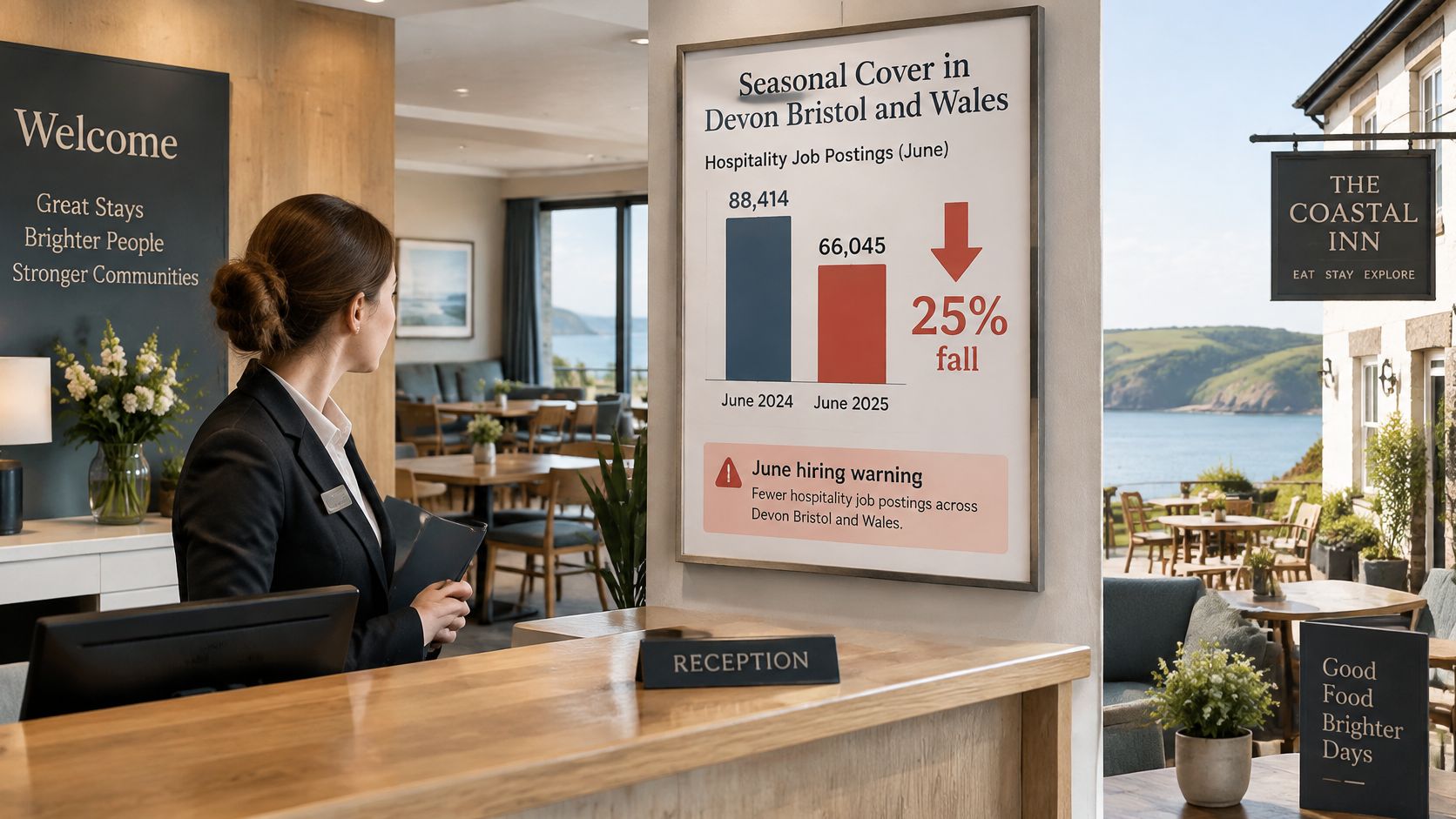
Summer demand isn't a recruitment plan. The Recruitment and Employment Confederation recorded 88,414 unique hospitality job postings in June 2024, compared with 66,045 in June 2025, a reduction of 22,369, or 25%.
That measures postings, not the number of chefs available for your dates. Full bedrooms don't guarantee applicants, and a thinner hiring market doesn't remove the need for skilled cover.
The booking diary and recruitment position need to be reviewed together.
Different locations, different pressure points
A Devon or Dorset coastal restaurant reaches a holiday week with its breakfast chef already on leave. The safe plan names who handles breakfast independently and who protects lunch prep. Moving the dinner chef earlier can leave the evening exposed.
A Bristol or Cardiff venue stacks weddings and conferences into the same weekend. Its staffing plan must separate event production, restaurant service and the pass. A chef who can manage a restaurant section isn't automatically the right person to lead banqueting.
A Berkshire country house or a hotel in Windsor, Reading or Slough loses its closer before a full book. The replacement needs the authority and competence to finish service, complete the handover and leave the kitchen ready for breakfast.
Set the minimum before the rush
For each peak, decide which services must run, which stations need independent chefs and whether accommodation is necessary. Rural Wales and coastal locations also require realistic travel arrangements, especially for early starts and late finishes.
Use seasonal demand forecasting to turn those decisions into dated requirements rather than a general request for summer help.
The same planning discipline applies to fixed hospitality commitments.
For private, yacht and villa work, match the chef to guest requirements, facilities and itinerary. A yacht chef's assignment isn't interchangeable with a chef de partie shift, even though both involve cooking.
- Single sites: Name the seniority and dates before advertising extra availability.
- Hotel groups: Coordinate known peaks centrally instead of letting properties compete for the same cover.
- Remote venues: Confirm accommodation, arrival arrangements and transport before the assignment is agreed.
Set the dates and seniority this week. Waiting until the morning of service removes options you could have kept.
Hospitality Staff Shortage Questions Answered
Is the hospitality staff shortage over?
Not because advertised vacancies have fallen. A business that has stopped recruiting after dropping a service hasn't necessarily solved its staffing problem. Check whether you can deliver your intended opening hours without overloading the team.
What should I do if my only chef is off sick tonight?
Agree the minimum safe service with the duty team and stop accepting bookings you cannot confidently fulfil. Contact Relief Chefs UK with the service time, covers, station and seniority, so the team can assess same-day availability. Don't promise guests a full service before cover is confirmed.
Should I book temporary cover or start a temp-to-perm trial?
Use temporary cover for a defined absence, no-show or peak. Consider a temp-to-perm trial for a continuing head chef or sous chef vacancy where you want to assess the chef on your own menu. Agree responsibilities and assessment criteria before the trial begins.
Can specialist cover include yacht, villa and private work?
Yes, but the brief must reflect the assignment rather than a restaurant job title. Include guest arrival dates, itinerary, dietary requirements, equipment and accommodation arrangements. Send those details early so the match accounts for the setting as well as cooking ability.
Call for Cover Before the Next Service
If a missing chef puts a revenue-generating service at risk, make the cover decision before prep falls behind. Waiting for the team to struggle through lunch leaves less time to protect dinner.
For a continuing head chef or sous chef vacancy, use a properly briefed trial rather than leaving juniors to absorb responsibilities they aren't ready to carry. For a known seasonal peak, reserve the required skill while you still have time to organise travel and accommodation.
Give the booking a clear owner
Relief Chefs UK is a trusted, chef-led nationwide recruitment agency established in 2013. We provide relief chefs, temporary chefs, permanent chef recruitment, yacht chefs, villa chefs and hospitality staffing support for businesses and private clients across the UK.
Our emergency chef cover assistance is available 24/7, subject to availability, for sickness, no-shows and sudden bookings. That gives you a route to request help outside office hours, not a reason to delay a known requirement.
The booking process has three steps:
- Tell us what you need. Give the location, dates, service times, station, seniority and expected covers.
- Take the matching call. Our team calls you to discuss the requirement and match you with a chef.
- Prepare for arrival. The chef arrives ready to work from day one; have the menu, allergen information, kitchen access and named contact ready.
Before arrival: Give the incoming chef a usable handover, not a pile of tickets and an explanation shouted across the pass.
Use the right contact route
Need a chef for service today? Call the emergency line on 07761 504333. The line is open 24/7, and the team can assess short-notice availability against your requirement.
For planned temporary cover, seasonal assignments or permanent recruitment, call 01392 715474 or email info@reliefchefs.co.uk. Include whether the role is live-in and whether the chef will work independently or alongside your existing head chef.
Make the enquiry specific enough to act on. “We need someone good” leaves the matching team guessing; “we need a sous chef to run dinner and close the kitchen” defines the responsibility.
If you're planning a Devon summer, a Bristol event weekend or a busy Berkshire hotel diary, send the confirmed dates rather than waiting for the final rota. The sooner the requirement is clear, the sooner travel, capability and availability can be considered together.
Relief Chefs UK offers temporary kitchen cover and permanent recruitment to help you protect service while building a stable team. Visit Relief Chefs UK and send your service time, covers, station and seniority now, so your kitchen isn't making the cover decision at the pass.
Call the team.
Office 01392 715474 · info@reliefchefs.co.uk